It came from outer space, of course.
Pharyngula
Evolution, development, and random biological ejaculations from a godless liberal

It came from outer space, of course.

Imagine you are a computer scientist and engineer, and you design a simulation that consists of a 15×15 square grid, with a ‘predator’ who follows some simple rules to seek out ‘prey’. You put most of your effort into designing the simulated ‘prey’ who uses visual detection, as well as some interesting uses of memory to simulate planning, to avoid the predator, and then you randomize the grid with various densities of black squares that block vision and white squares that allow line-of-sight to the predator. You work out some general principles for controlling the ‘prey’ simulation, for instance that less cluttered grids select for ‘prey’ that do more careful planning and have more complex rules for behavior.
I think that’s an interesting result, especially since they quantify everything. But is it enough to get a big splashy publication in Nature? To get noticed in the popular news media? Nah, probably not. It’s narrow niche research, but no one outside computer science is going to be impressed. So, how to spice it up?
I know! Claim that your simulation is significant evidence that explains the Cambrian explosion, the diversification of terrestrial vertebrates, and the evolution of human intelligence! That’s the ticket!
After explaining how their simulation works, the authors get down to explaining why their result is important. Apparently, it’s not because they’ve done anything interesting in computer science, so they need to borrow from biology to find a justification.
Parker has suggested that the origin of the Cambrian explosion lies in the atmosphere or oceans of the period gaining higher transparency to sunlight, triggering the evolution of the first image-forming eye and sparking a predator–prey evolutionary arms race that gave rise to the Cambrian’s profusion of animal forms. A second great change in transparency occurred with the emergence of fish on to land, which gave rise to a sensorium large enough to fit multiple futures. Our idealized model of spatial planning during predator–prey interactions suggests that there may be a link between the enlarged visual sensorium and habitat complexity of terrestrial animals and the evolution of neural circuits for dynamic planning.
They get even more hyperbolic when talking to reporters on CNN (see, it was a smart decision to add all that evolution stuff — it got the attention of the media).
The ways our ancestors adapted to live in patchy landscapes cluttered with obstacles “poured jet fuel” on the evolution of the brains of animals and early human ancestors, according to researchers at Northwestern University.
The combination of our enhanced eyesight and higher intelligence to survive in this complex land environment is “why we can go out for seafood, but seafood can’t go out for us,” said Malcolm MacIver, a professor of biomedical and mechanical engineering in Northwestern University’s McCormick School of Engineering.
Kind of a grand leap from a simulation on a checkerboard to an elaborate umbrella hypothesis that explains a complex and diverse evolutionary phenomenon as the the product of being able to see farther, isn’t it? I would have rejected this paper at the first sentence of the abstract, which tells me they’re not very knowledgeable about the biology they’re using as a prop.
It is uncontroversial that land animals have more elaborated cognitive abilities than their aquatic counterparts such as fish. Yet there is no apparent a-priori reason for this. A key cognitive faculty is planning. We show that in visually guided predator-prey interactions, planning provides a significant advantage, but only on land. During animal evolution, the water-to-land transition resulted in a massive increase in visual range. Simulations of behavior identify a specific type of terrestrial habitat, clustered open and closed areas (savanna-like), where the advantage of planning peaks. Our computational experiments demonstrate how this patchy terrestrial structure, in combination with enhanced visual range, can reveal and hide agents as a function of their movement and create a selective benefit for imagining, evaluating, and selecting among possible future scenarios—in short, for planning. The vertebrate invasion of land may have been an important step in their cognitive evolution.
It is “uncontroversial”? To whom? Which is “smarter”, a spider or an octopus? Why are you lumping the diversity of terrestrial animals into a neat tidy bin labeled “land animals” and making the assumption that they have more elaborate cognitive abilities than the wet creatures you’ve thrown into a bin labeled “aquatic animals”? If your hypothesis were sufficient to explain major evolutionary transitions, why is it that cetacean brains got larger as they adapted to an environment with reduced visual range? Why do you need a single a priori reason to explain the origin of complex phenomena with widely varying solutions? Why is it that the mantis shrimp, the animal with the most sophisticated visual sensorium, is neither particularly brainy nor terrestrial?
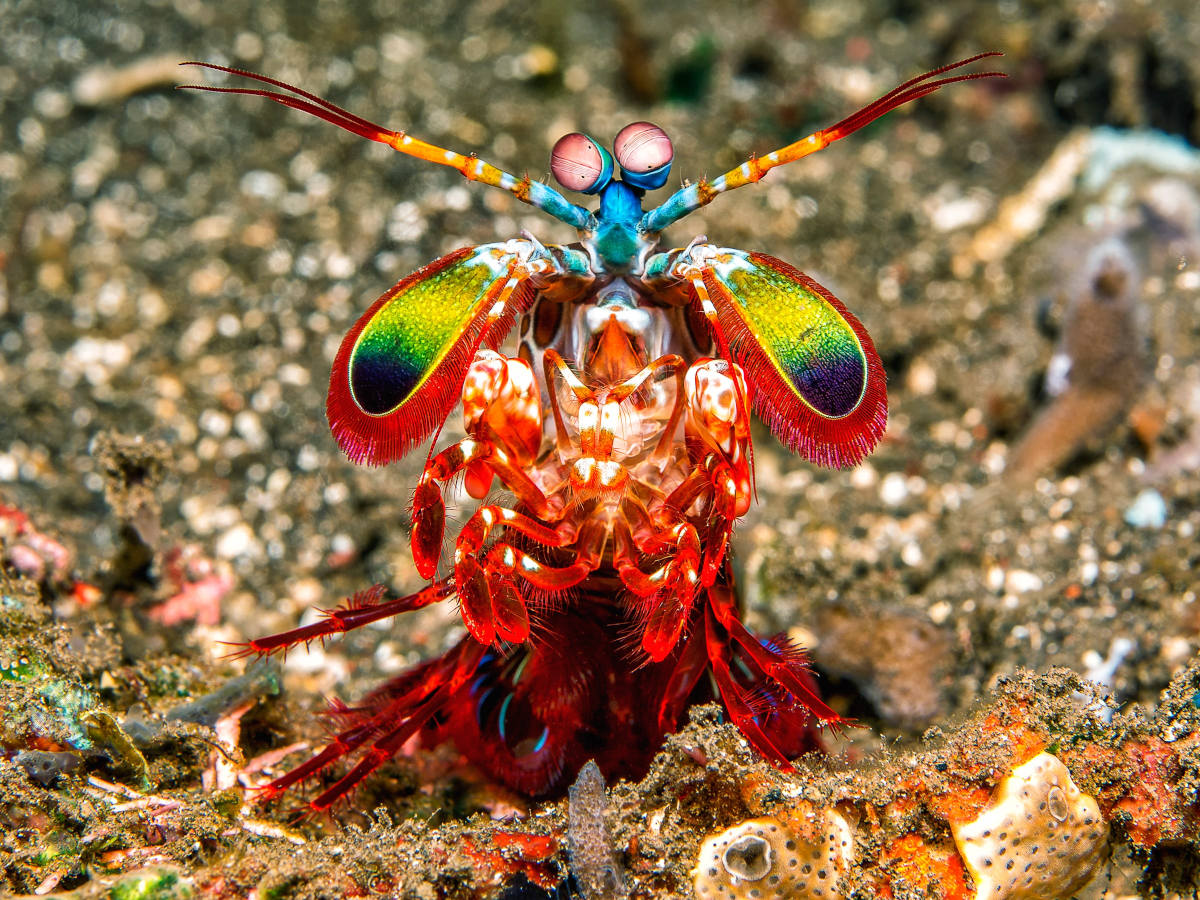
As you might guess from all of my questions, this is an immensely frustrating paper — not in its methods, or in the execution of the study, but in the overblown interpretations the authors have been made. It desperately need input from visual neuroscientists and evolutionary biologists, who might have put a damper on the nonsense they’ve shoveled into the work…but then it wouldn’t have made it to CNN, now would it? We could probably sell tickets to a battle of the umbrella hypotheses, Long Range Eyeballs vs. The Aquatic Ape. Epistemic humility just never sells.
(Oh, man, I keep coming back to exceptions they ignore. Aquatic and terrestrial environments are diverse — there are patchy aquatic environments and cluttered terrestrial ones. What about the issue of scale? The jumping spiders on my house live in a savannah-like environment, with wide open areas (the planks of my siding) of long-range visual opportunities, sprinkled with joins that are good hiding places. Why haven’t they invented calculus yet? If you tell me it’s because they’re tiny, then you’ve just admitted that the visual hypothesis is insufficient.)

And further, why does the media give them attention for it?
As the Guardian credulously claims, New calculations come up with estimate for worlds capable of communicating with others. That number is…36. What a load of bullshit. I think I’ve finally realized what the Drake Equation is good for: it’s an arbitrary formula that allows physicists to freely tweak the parameters and get a new number that they can publish. No, really, that’s all this paper is — they came up some new numbers to plug into the cascade of bullshit numbers in the Drake Equation, and got a new number. Surprise!
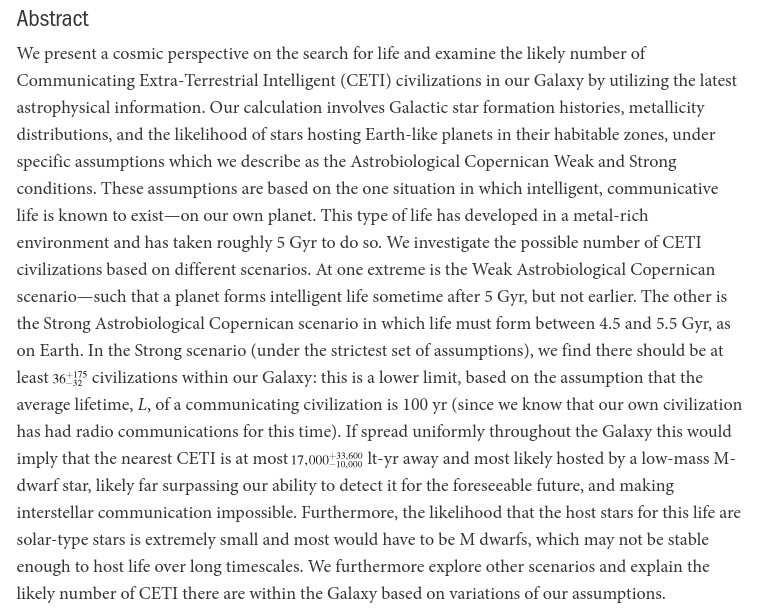
GIGO. It’s all GIGO.
The Guardian does get quotes revealing some of their assumptions.
Basically, we made the assumption that intelligent life would form on other [Earth-like] planets like it has on Earth, so within a few billion years life would automatically form as a natural part of evolution,said Conselice.
Wait, what? Automatically? Every Earth-like planet is going to form intelligent life within a few billion years, as a natural part of evolution
? That certainly is a simplifying assumption, I guess. It means their number is hugely inflated.
He’s not done, though!
[If intelligent life forms] in a scientific way, not just a random way or just a very unique way, then you would expect at least this many civilisations within our galaxy,he said.
Oh. If the evolution of intelligence is scientific, then it produces intelligence. If chance or unique conditions play a significant role, then it’s not scientific. I hope evolution is listening. Maybe it should take some physics courses?
He added that, while it is a speculative theory, he believes alien life would have similarities in appearance to life on Earth.
We wouldn’t be super shocked by seeing them,he said.
life on Earth
. Like it’s one thing that he can picture in his mind. What exactly does life on Earth look like?
Is this it?
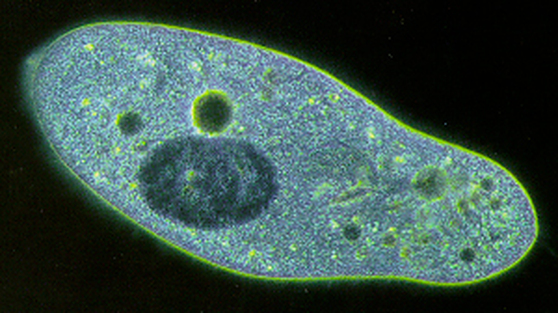
Or this?

Maybe it’s this, which Dr Physicist wouldn’t be at all shocked to see.

I have a few new rules:
I still have my old rule: when a physicist opines on biology, throw overripe tomatoes.
I do wonder if physicists are even capable of feeling embarrassment or shame. Somebody should do an experiment.

It’s true: there are mistakes in Genetics textbooks.

I know that I need a haircut, and I was losing my voice here, and that this Matt Powell character is an awful little pipsqueak who doesn’t deserve any attention, but I wanted to throw together a little video because I was bemused by the fact that he was using those claims about aliens by Wickramasinghe to condemn all of evolutionary since. When he started incredulously yelling that “THIS IS WHAT EVOLUTION TEACHES,” that squid piggy-backed on asteroids to populate the planet, I just had to point out that this is most definitely not what evolution teaches, and that it was plain bad science.
I think I’m far more pissed off at those phonies affiliated with panspermia, and their long-running infiltration of the science establishment, than I am with a not-very-bright loudmouthed kid babbling about Jesus.
And if I’m mad at those wackos, you can’t imagine how furious I get with those frauds promoting evolutionary psychology.

A reader informed me that I was mentioned in a British magazine, and sent me a scan of the relevant bit. It’s not so much my brief mention that interested me, as that it’s another example of the Panspermia Mafia in action. It’s an article about a recently elected Conservative MP, Jamie Wallis, who has a science degree…or does he?
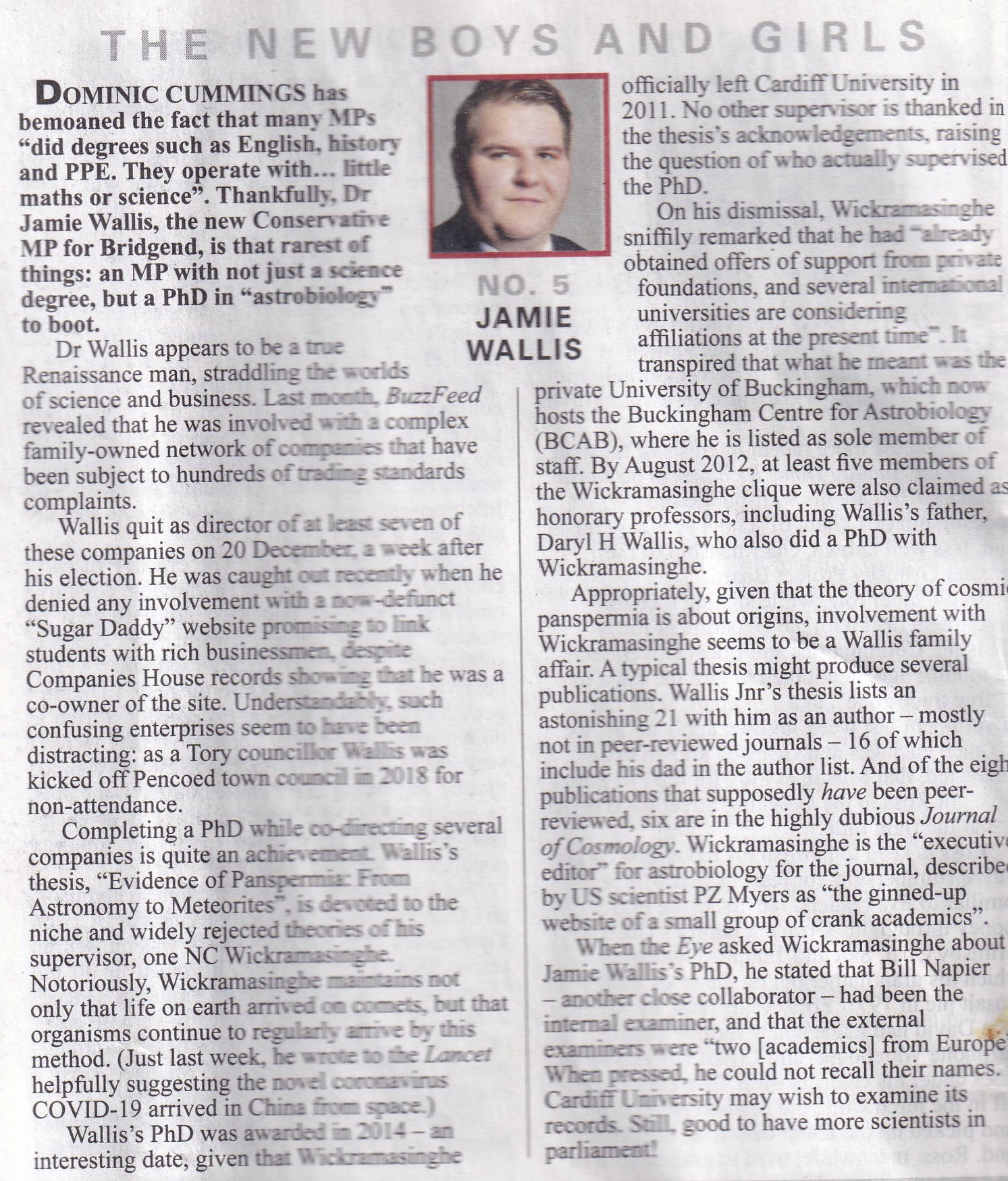
Dominic Cummings has bemoaned the fact that many MPs “did degrees such as English, history, and PPE. They operate with…little maths or science.” Thankfully, Dr Jamie Wallis, the new Conservative MP for Bridgend, is that rarest of things: an MP with not just a science degree, but a PhD in “astrobiology” to boot.
Where it gets interesting is that he obtained a PhD from, I presume, Cardiff University, which was NC Wickramasinghe’s former affiliation, although he has since ensconced himself at the Buckingham Centre for Astrobiology. There is reason to doubt that Wallis actually did the caliber of work we expect in a PhD thesis.
Completing a PhD while co-directing several companies is quite an achievement. Wallis’s thesis, “Evidence of Panspermia: From Astronomy to Meteorites”, is devoted to the niche and widely rejected theories of his supervisor, one NC Wickramasinghe. Notoriously, Wickramasinghe maintains not only that life on earth arrived on comets, but that organisms continue to regularly arrive by this method. (Just last week, he wrote to the Lancet helpfully suggesting the novel coronavirus COVID-19 arrived in China from space.)
Why does the Lancet, or any respectable journal, continue to publish crank letters from Wickramasinghe? But OK, I think it’s established that Wallis’s degree was somehow earned under the supervision of a well-known fringe kook, and that it’s questionable how much work he actually invested in the project, which sounds like some kind of review involving no independent research.
But why do I call this the Panspermia Mafia? They use their connections to promote a small family of fellow travelers.
Appropriately, given that the theory of cosmic panspermia is about origins, involvement with Wickramasinghe seems to be a Wallis family affair. A typical thesis might produce several publications. Wallis Jnr’s thesis lists an astonishing 21 with him as an author — mostly not in peer-reviewed journals — 16 of which include his dad in the author list. And of the eight publications that supposedly have been peer-reviewed, six are in the highly dubious Journal of Cosmology. Wickramasinghe is the “executive editor” for astrobiology for the journal, described by US scientist PZ Myers as the “ginned-up website of a small group of crank academics”.
Yeah, that’s about it — it’s so inbred that it relies on the one guy who has a name and connections but very little credibility, Wickramasinghe, to promote the members of his cabal in a roster of fake journals. This article didn’t examine them in detail, but I suspect that all 21 of the articles are rehashed, recycled, barely rewritten examples of frantic self-plagiarism. To say you got a degree with Wickramasinghe is the British equivalent of saying you’re a colleague of Kent Hovind.
Isn’t it nice that he provides a pipeline for Conservatives to claim they have the authority of science? Just in case you’re wondering, no, they don’t.

After I finished today’s grading, I whipped up a little video. Why? Because I could. And because Rhawn Gabriel Joseph is up to mischief again. He’s claiming to have found mushrooms on Venus and Mars!

Or from men, apparently.
Men can’t possibly commit sexual assault, because there’s no way they’d be able to find their way about in a woman’s nethers. They’ll just fumble about and end up poking her in a dimple in her knee, or something.

Or they’re just grossed out by the arrangement of parts.

I think we all want that guy to continue to be repulsed by all women. It’s best for everyone.

Ten years ago today, the Lancet issued a formal retraction of Andrew Wakefield’s notorious bogus paper claiming a link between MMR vaccinations and autism. The paper was wrong, it was shoddily done, and the work hasn’t been replicated.
Mr. Wakefield, you are the worst thing to happen to public health since the bubonic plague.
Maybe worse, since at least that wasn't intentional.
Happy Retraction Day! #VaccinesWork #VaccinesSaveLives #publichealth #medtwitter pic.twitter.com/0RrkSGtEy2
— Rachel Alter, MPH CPH (@RachelAlter007) February 2, 2020
Ever since, Wakefield has been living in shame, no one treats him as an authority anymore, and of course no one would claim that vaccines cause autism anymore.


You want to read a really good take-down of a bad science paper? Here you go. It’s a plea to Elsevier to retract a paper published in Personality and Individual Differences because…well, it’s racist garbage, frequently cited by racists who don’t understand the science but love the garbage interpretation. It really is a sign that we need better reviewers to catch this crap.
The paper is by Rushton, who polluted the scientific literature for decades, and Templer, published in 2012. It’s titled “Do pigmentation and the melanocortin system modulate aggression and sexuality in humans as they do in other animals?”, and you can tell what it’s trying to do: it’s trying to claim there is a genetic linkage between skin color and sexual behavior and violence, justifying it with an appeal to biology. It fails, because the authors don’t understand biology or genetics.
They’re advocating something called the pleiotropy hypothesis, which is the idea that every gene has multiple effects (this is true!), and that therefore every phenotype has effects that ripple across to every other phenotype (partially, probably mostly true), so that seeing one aspect of a phenotype means you can make valid predictions about other aspects of the phenotype (mostly not at all true). This allows them to abuse a study in other mammals to claim that human outcomes are identical. Here’s the key graf:
The basis of the pleiotropy hypothesis presented by Rushton and Templer hinges on a citation from Ducrest et al. (2008), which posits ‘pleiotropic effects of the melanocortins might account for the widespread covariance between melanin-based coloration and other phenotypic traits in vertebrates.’ However, Rushton and Templer misrepresent this work by extending it to humans, even though Ducrest et al. (2008) explicitly state, ‘these predictions hold only when variation in melanin-based coloration is mediated by variation in the level of the agonists at MC1R… [conversely] there should be no consistent association between melanin-based coloration and other phenotypic traits when variation in coloration is due to mutations at effectors of melanogenesis such as MC1R [as is the case in humans].’ Ducrest et al. continue, ‘variation in melanin-based coloration between human populations is primarily due to mutations at, for example, MC1R, TYR, MATP and SLC24A5 [29,30] and that human populations are therefore not expected to consistently exhibit the associations between melanin-based coloration and the physiological and behavioural traits reported in our study’ [emphasis mine]. Rushton and Templer ignore this critical passage, saying only ‘Ducrest et al. (2008) [caution that], because of genetic mutations, melanin-based coloration may not exhibit these traits consistently across human populations.’ This is misleading. The issue is not that genetic mutations will make melanin-based pleiotropy inconsistent across human populations, but that the genes responsible for skin pigmentation in humans are completely different to the genes Ducrest et al. describe.
To translate…developmental biologists and geneticists are familiar with the concept of an epistatic pathway, that is, of genes affecting the expression of other genes. So, for instance, Gene A might switch on Gene B which switches on Gene C, in an oversimplified pattern of regulation.

Nothing is ever that simple, we know. Gene A might also switch on Gene Delta and Gene Gamma — this is called pleiotropy, where one gene has multiple effects. And Gene Gamma might also activate Gene B, and Gene B might feed back on Gene A, and B might have pleiotropic effects on Gene Beta and Gene E and Gene C.
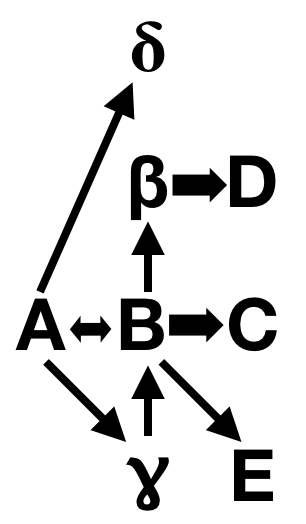
This stuff gets delightfully tangled, and is one of the reasons I love developmental biology. Everything is one big complex network of interactions.
What does this have to do with Rushton & Templer’s faulty interpretation? They looked at a study that identified mutations in a highly pleiotropic component of the pigmentation pathway — basically, they’re discussing Gene A in my cartoon — and equating that to a terminal gene in humans, equivalent to Gene C in my diagram. Human variations in skin color are mostly due to mutations in effector genes at the end of the pathway, like MC1R. It will have limited pleiotropic effects compared to genes higher up in the epistatic hierarchy, like the ones Ducrest et al. described. Worst of all, Ducrest et al. explicitly discussed how the kind of comparison Rushton & Templer would make is invalid! They had to willfully edit the conclusions to make their argument, which is more than a little dishonest.
It reminds me of another recent disclosure of a creationist paper that also misrepresented its results. This paper, published in the International Journal of Neuroscience, openly declared that it had evidence for creationism.
In the paper, Kuznetsov reportedly identified an mRNA from one vole species that blocked protein synthesis in a related vole species. That same mRNA, however, did not block translation in the original vole species or another species that was more distantly related. The finding, Kuznetsov wrote in his report, supported “the general creationist concept on the problems of the origin of boundless multitudes of different and harmonically functioning forms of life.”
I vaguely remember reading that paper and rolling my eyes at how weak and sloppy the data was — it was never taken seriously by anyone but creationists. I don’t recall the details, though, because it was published 30 years ago, and is only now being retracted, after decades of the author fabricating data and being so obvious about it that he was fired as editor of two journals in 2013. The guy had a reputation, shall we say. Yet he managed to maintain this academic facade for years.
Phillipe Rushton had similarly managed to keep up the pretense of being a serious academic for an awfully long time, right up until his death in 2012. He used his reputation to spray all kinds of fecal nonsense into the scientific literature, and that’s why you have to maintain a skeptical perspective even when reading prestigious journals.
