Why are private schools?

You know, the word “school” (and “college” and “university”) ought to have some kind of protected status, where you can’t call your institution one of them without meeting certain rigorous standards and qualifications. Get some other word for your propaganda outlet, and if you abuse the terms and mislead the people you are trying to lure into your scheme, there ought to be some kind of legal penalty. It’s not that you can’t rent a room and offer instruction to the gullible in whatever hogwash you’re peddling, but you can’t legally claim it’s a “school”.

Case in point: religious institutions that claim to be, for instance, a university, like Patriot “University”. Or private schools in general, which seem to be set ups for charging excessive tuitions and fees for information that’s better served by a true public school (goodbye, Harvard!) (OK, some private institutions have adopted good standards for education — this is a complex problem in taxonomy, I won’t pretend it’s easily solved.)

But then, there are other situations where the boundaries have clearly been crossed. Like the Centner Academy, “the brain school”. Maybe we can get them on false advertising, since there don’t seem to be any functional brains inside.

In April, a Miami private school made national headlines for barring teachers who got a coronavirus vaccine from interacting with students. Last week, the school made another startling declaration, but this time to the parents: If you vaccinate your child, they’ll have to stay home for 30 days after each shot.

The email from Centner Academy leadership, first reported by WSVN, repeated misleading and false claims that vaccinated people could pass on so-called harmful effects of the shot and have a “potential impact” on unvaccinated students and staff.

Yeah, that’s patently false. There are no viruses in the vaccine. There might be dead fragments, but nothing that can proliferate and infect.

David Centner, one of the school’s co-founders, repeated the debunked claims in a statement to The Washington Post, saying the policy is a “precautionary measure” based on “numerous anecdotal cases that have been in circulation.”

Listen to yourself, David. Do you know what “anecdote” means? You are making a policy decision based on stories and rumor — and you’re getting it all backwards! You’re blocking the people least likely to carry the disease from your “school”, and encouraging the unprotected students to attend!

The people who do attend this “school” are selected for wealth + gullibility, I guess.

Centner Academy is in Miami’s ritzy Design District, and tuition ranges from about $15,000 to nearly $30,000 per year. The school has become a haven for anti-vaccine parents because it does not require any immunizations for enrollment, citing a parent’s “freedom of choice” and falsely claiming there are “unknown risks associated with vaccinations” that could harm children.

Apparently, you go to this “school” to get a degree in ignorance and dishonesty.

A similar sentiment was shared in an email to parents last week regarding the coronavirus vaccine. School leadership referred to the shots as “experimental,” WSVN reported, and encouraged parents considering vaccinations for their child to wait several more months until the school year ends.

“We ask that you hold off until the summer when there will be time for the potential transmission or shedding onto others to decrease,” Centner Academy leaders wrote.

The school has a history of spreading inaccurate information about the vaccine and penalizing those who choose to get the shots. In April, Centner Academy employees were told they had to notify Leila and David Centner, the married co-founders of the school, if they received a vaccine. Vaccinated school employees were told they would not be allowed any contact with students “until more information is known” about the vaccines. School leaders also told those wanting the vaccine to wait until the summer to get the shots.

About a week later, a math and science teacher told students they should not hug their vaccinated parents for more than five seconds, the New York Times reported, referencing the same falsehoods the school communicated in its email about vaccine components “shedding” onto others. Some parents threatened to pull their children out of the school over the comments.

The Centners are a pair of rich kooks with egomania. Centner is a rich entrepreneur who sold code for monitoring toll booths — he has no background in education at all. They shouldn’t be allowed to pretend to be educators.

A grading epiphany!

As has become increasingly typical, I was up late last night grading exams, rather than reading a good book or watching a movie or going for a walk, like normal people do, and I was getting a little bit frustrated. This was an exam for an introductory biology course, all first year students, and it was fairly straightforward: about 40% multiple choice questions, the rest being short “essay” style questions that had to be answered with a coherent paragraph. I had questions like, “explain the difference between methodological and philosophical materialism” (yeah, there was some baby philosophy in this course) and “summarize the work of Peter and Rosemary Grant”, all stuff that we’d discussed in class, and if they’d missed class, it was there in the lecture notes I’d posted online, and which they should have studied.

You will be shocked and surprised to learn that some of them had not studied.

What annoyed me, though, and ate up a lot of my time, was when desperate students who had not studied tried to bullshit their way through an answer, throwing out vaguely recalled terms, hoping that some of them stick. The Grants, for instance, who actually did work on finch beaks and adaptation, were assigned to have worked on Galapagos tortoises or iguanas, and seemed to have compiled a taxonomic catalog of random, memorable animals on the islands. You don’t even want to know what kind of inventions they created to explain away the philosophy or history of science, or how the Cambrian was after the Cretaceous. It was ludicrous errors of fact and random word association games, and worst of all, I had to carefully read it all to see if there was a glimmering of an echo of a shadow of comprehension in there, and give them points for it. Ick.

I think I was muttering to myself something like “why don’t you just admit you didn’t know the answer” when I had my idea. In the very first lecture in this course I had talked to them about the value of asking good questions, and how it’s acceptable for a scientist to say “I don’t know” when they don’t have a good answer, and I thought, I should encourage them to admit when they don’t know the answer, especially since I have a pretty good bullshit detector. So I’ve invented a new policy I’ll announce to them.

If you don’t know the answer to an exam question, just write “I don’t know” and I’ll give you 25% of the points. It’s that easy! It’ll save me the agony of trying to interpret word salad, which generally earns 0 points anyway, and you’ll get a few points for honesty. Everyone wins!

Of course, 25% is not adequate to pass the course — 50% earns a “D” grade — so you can’t expect to slide through by answering “I don’t know” to everything, but if you hit one or two questions you’re drawing a blank on, it’ll spare you some anxiety and suffering, and me some exasperation, if you can just dismiss the question and move on. It’s also fitting with a major theme of the course, which is about how scientists do science and how we came to understand principles of evolution, genetics, and development.

I’ve only been teaching for a few decades before I thought of this simple solution to a chronic problem.

Why academia doesn’t lean right

Dang, this is a good video, succinct and to the point.

Why are there so few conservatives in academia? Because the the things conservatives want to argue about are no longer debatable. You can’t seriously operate as a biologist, for instance, and think the Earth is less than 10,000 years old…much less put together a class within the curriculum that tries to teach that nonsensical idea. I’m not as familiar with other disciplines, but are there economics professors who aren’t fringe cranks who teach trickle-down economics, Laffer curve and all that, when the evidence makes it patently clear that it just doesn’t work?

Don’t get me wrong, I know professors who are more conservative than I am — very few of us actually go so far as to suggest that the proletariat must rise up and seize the means of production — but we do tend to exclude the extremist positions. The problem is that modern conservatism consists entirely of extremist madness. Your typical professor is not some wild-eyed radical, but a cautious, moderate advocate for incremental improvement of society, and just that level of tepid support for betterment is antithetical to conservative thought.

Today’s agenda

I slept in until 8:30. I have now lingered over my coffee for a whole hour. Time to get to work!

  • Get my shoes on. (this is a major thermodynamic hurdle — I’m hoping the coffee provided enough activation energy to get the process started.)
  • Walk out the door to the lab. Usually by this point the reaction is mildly exothermic so it should go smoothly.
  • Say hello to the grass spiders living in the shrubbery outside my lab.
  • Feed all the spiders inside my lab.
  • Walk home.
  • Stretch. Crack my knuckles. Open up all the lab reports my students submitted to Canvas last night. Stare at them, mildly stupefied.
  • Start grading them, eventually. Do that all afternoon.
  • Return to awareness. Eat dinner. Wonder where the day went.

Tomorrow they turn in a homework assignment, and I’ll do exactly the same routine on Monday.

The bee don’t care about deadlines either, she’s just doing her thing.

There’s one thing my students haven’t quite figured out yet. I do set deadlines on all the assignments, because the software requires it, but…I don’t care. I just want them to do the work so they know how to do the work, and so I can see where maybe they’re going down the wrong path, but deadlines are an invention of The Man (or maybe Satan). Try to turn things in on time so they don’t pile up on you, but if it’s a few days late, I’m OK with that.

But these are all conscientious Midwestern kids, many of them first generation college students, so I get an amazing flood of email the day of, full of apologies and reasons why they didn’t meet the deadline, which I have to read, too. I get all these panicky messages sent just before midnight, “oh no I couldn’t solve this problem, I’m struggling with it, I can’t get it done on time” followed by a 3am follow-up, “I figured it out, I submitted it a little late, I hope that’s OK”.

I just want to say…Dudes. It’s fine. The software sets this specific 11:59pm deadline minute, but I’m sleeping then. I’m not hovering over the computer, ready to dock points from anyone who turns it in at 12:01am. Or even noon the next day. The only real deadline is when I go over the answers in class a few days later, because I want you to think them through yourself, rather than getting handed them. If you turn something in a little late, well, that’s a time-management issue you should work on, but I’m going to pretend it was turned in precisely on time and give you full credit, because I don’t care. All I care about is whether you learned the subject matter.

I guess I’d have to worry if every student procrastinated and I couldn’t get the bulk of the grading done at the time I set aside for it, but that hasn’t happened yet in 40 years, and the Midwestern work ethic means it’s not going to happen in the near future. Chill. Go for a walk. Enjoy the flowers and the spiders while you can. Biology isn’t a punishment drill, it’s supposed to be something that makes you happy.

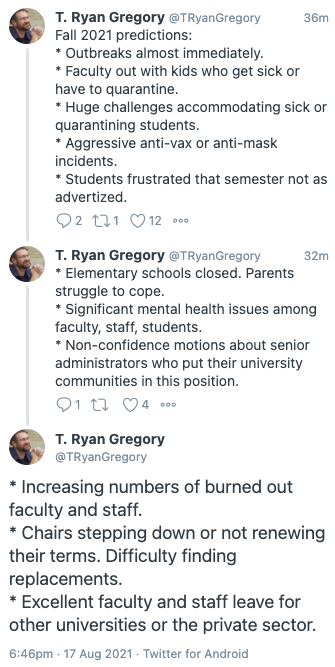
T. Ryan Gregory predicts the future!

This is my prediction, too. I have no confidence that we’ll make it through the semester without some radical revision in our plans.

I’ll testify to the burnout problem personally — the stress and uncertainty take their toll. Also, the declining confidence in university administrations is real.

Gregory, by the way, has announced that he’s on the market for a new position already, so if you’re at a university that isn’t saddled with an out-of-touch, blithering administration (are there such things) you might be able to snap him up.

Administrators are the enemy, you know

The president of Columbia University made it crystal clear. The administration is wrestling with the idea of in-person classes, which is telling in itself — the administration doesn’t give a good damn about the health and safety of faculty, staff, and students or they wouldn’t be debating how to shove their employees into milling crowds of unvaccinated students. But President Bollinger admitted something heinous in a memo to other administrators. First, though, he said this in public.

Faculty response to new models of teaching necessitated by the pandemic has been tremendous. We want to support faculty in every way we can…the University will not prescribe an approach for individual faculty members. Faculty will have leeway to teach in person, online, or some combination of the two, in consultation with their schools.

Great! That’s what I want to hear! Except…

…the instructional faculty for the Core is largely composed of non-tenure-track individuals, which means we should have greater leeway to expect in-person instruction, if that’s what we deem best.

Hey, you know that huge swarm of underpaid, untenured adjuncts we have teaching the core courses of the university? They’re expendable, they have to do what we say, we’ll just make them take all the risks! After all, we know what’s best for them.

I call on my fellow tenured faculty to show solidarity with the scholars and scientists who work side-by-side with us, with far more job insecurity and with the contempt of the administration. They are not serfs. They deserve equal respect…which, given that university administrators don’t have all that much respect for their tenured faculty, isn’t asking a lot.

Consider that your extra-sensory perception is not as accurate as you think it is

Just yesterday, I completed my universities training on sexual discrimination and harassment. One of things they did was have little skits illustrating the phenomena we have to watch out for. One of them was about an attractive young woman being followed around in her work by a helpful but over-eager male colleague, who touched her in the small of the back while leading her to a different room. It was so quaint. I agree that he was being overly familiar, but yeesh — there are plenty of stronger examples in real life. Perhaps the next time they could act out these little dramas from the life of University of Michigan computer science professor Walter Lasecki. He’s been investigated by the Office of Institutional Equity (OIE) andthe Association for Computing Machinery (ACM). Here are a few examples of his behavior:

In the final report released by OIE, a copy of which was obtained by The Daily, Jane alleged that Lasecki encouraged her to drink throughout the meal, at one point asking the waiter to make her a “double.” She also alleged that he briefly placed his hand on her thigh.

Later that night, Jane said Lasecki helped her return to her apartment. He then touched her sexually, she wrote in her OIE statement. The OIE report notes that Jane said she “did not give any nonverbal cues to indicate that she was interested nor uninterested in physical contact.”

A second non-University graduate student — who will be referred to as Rachel in this article — attended four conferences that Lasecki also attended between 2017 and 2019. She alleged that he touched her sexually at all four conferences. In her statement to OIE, which was obtained by The Daily, Rachel described the pervasiveness of Lasecki’s alleged harassment.

“When [Respondent] is around me when he is drinking, he is consistently physically affectionate with me,” Rachel wrote. “I can’t count the number of times he’s touched me in intimate and inappropriate ways. I’m anxious at events that he will come up to me and start touching me — it bothers me so much that I’ve started scanning the room at poster sessions, receptions, and parties to watch where he’s at.”

A third non-University graduate student wrote in her statement to OIE, also obtained by The Daily, that she experienced similar harassment at an industry conference in 2016. In this article, she will be referred to as Alex. Alex alleged that Lasecki groped her while she was talking to a group of people.

“His behavior was overly familiar, touching me at first in small ways as we were talking to other people,” Alex wrote. “At some point, he leaned closer to me and essentially reached his hand between my legs. I was uncomfortable the whole time, but I distinctly remember knowing he was faculty and well-regarded, and so thinking I should be flattered. At the point where he groped my crotch, though, I knew that was past a line.”

At least there’s no evidence that he touched their backs! Then he’d be out of work, for sure. He still seems to happily employed by the University of Michigan, though. The ACM found that he had violated its Policy Against Harassment, banned him from ACM events for at least five years (that’s all they could do, since he’s not employed by ACM). Strangely, Michigans Office of Institutional Equity concluded that he had not violated any university policies and let him off scot-free. That’s interesting, because I would think getting students drunk and fondling and groping them would be actionable behavior. But no! No sanctions against the gropey professor!

So how did he get off? It may be a case of the fox guarding the henhouse. Also, a lot of those foxes seemed to have taken residence in the henhous.

In January 2020, Provost Martin Philbert — who previously oversaw OIE — was placed on leave and later resigned after multiple allegations of sexual harassment against him were reported to the University. The allegations were later investigated and corroborated by law firm WilmerHale. Another WilmerHale investigation released earlier this month found hundreds of credible allegations of sexual abuse against former University doctor Robert Anderson over a 37-year period. The Anderson report concluded that the allegations represent a “devastating pattern” of abuse that was known to University officials.

Everyone noticed. A letter was sent to the university president saying they had no confidence in the university administration.

Lisecki is denying everything, although he does use a second excuse.

Lily wrote that Lasecki touched under her shirt later that night and that she repeatedly attempted to stop his advances. Despite these attempts, the harassment continued, she claims. She remembered how Lasecki tried to justify his behavior.

“Oh, sorry, from the way you were angling your body towards me during our meeting before, I figured you wanted me to,” she alleged that he replied.

Watch out, ladies, now “angling your body” at a particular angle is apparently considered consent. I don’t know what angle that is, unfortunately. Maybe women have been begging me for sex and I’ve just been oblivious. Alternatively, maybe Walter Lisecki’s mind-reading abilities don’t work.

What also comes to mind is Geoff Marcy, another academic whose career took a nosedive when he was found to have been inappropriately touching his students. He also had an interesting excuse:

“My engaging and empathic style could surely be misinterpreted, which is my fault for poor communication,” he said. “I would never intentionally hurt anyone nor cause distress.”

His empathy must have been on the fritz when all those women were saying “no” and trying to get away from Dr Handsey. Marcy lost his job and his career, and has now been expelled from the National Academy of Sciences.

Unlike Marcy, though, Lasecki has not been censured in any way, and is scheduled to be teaching undergrads in the fall. Now that is disturbing.