
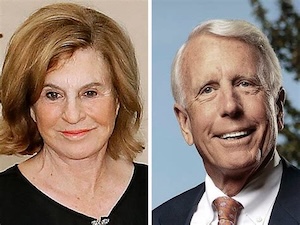
scummy Wisconsin billionaires
Fortunately, I’ve completely tuned out of television in this election season, or I’d be even more anxious right now. Minnesota is being flooded with conservative billionaire money. You know who benefits: Republicans.
The Republican nominee for governor, Lisa Demuth, has a super PAC funded mostly by a Wisconsin billionaire — Richard Uihlein, who has spent years bankrolling right-wing candidates and campaigns in other states and nationwide. In 2024, Uihlein and his wife were top Trump donors, spending $59 million to help deliver the White House back to Trump and to support other conservative candidates.
ANow they have turned their eyes to Minnesota. The Uihleins’ dark money super PAC heavily funded the Restore Sanity super PAC, which spent nearly $3 million to ensure Lisa Demuth won her primary — more than five times the amount Demuth herself raised, and about three times more than all of her Republican opponents raised combined.
In the counties where the ads paid for mostly by this single donor didn’t air (mostly outside the Twin Cities), Demuth often lost or underperformed. In the weeks leading up to the Republican primary, Demuth bragged about the work the super PAC was doing for her. She owes her campaign’s survival in large part to one man, and Minnesotans deserve to know what kind of return on investment he’s expecting.
Uihlein is not investing in Minnesota’s elections on a whim. In other states, he and his wife have used their personal wealth to fund extreme causes that they know would be rejected without their enormous outside spending. They have bankrolled efforts to restrict abortion. They have financed organizations committed to repealing the Affordable Care Act and to privatizing Social Security. They have funded efforts to undermine workers’ rights and labor unions and have fought reforms to lower prescription drug prices.
Why are billionaires intrinsically evil? How can anyone look at their agenda and fail to realize that they are not friends of humanity?
We can blame a good part of this villainy on the Supreme Court.
Going forward, the only long-term solution is to get big money out of our politics by overturning Citizens United and passing strong, nationwide campaign finance reform. Until then, Minnesotans can do their part by holding politicians accountable when they allow people like Uihlein to try and rig the system for themselves.
Whoever the next presidential candidate is, they better put a priority on purging the corruption from the Supreme Court.

Schlitz: How Milwaukee’s Famous Beer Became Infamous
The article is nebulous about which Uihlein was responsible.
Uihleins Shuttled In Workers From Mexico
@1
Let’s Make Snot Beer!
And now they want to do the same to Minnesota.
Just like prosecuting Trump after 2024, the Democrats would deem that “too political.”
“We just have to trust the process.”
Silica gel in beer?
Hmm..https://xkcd.com/2241/
Maybe they’re not – or, alternatively, the vast majority of humans are?
Here’s a short PBS segment on the seminal research (Piff et al) finding that the trappings of wealth privilege – randomly assigned and artificially induced – very quickly make us ruder, more dominating, louder, greedier, more unethical (e.g. willing to lie, and break rules and laws), less charitable, and far more likely to attribute our success to our own skills and smart decision-making, rather than to the enormous structural advantages conferred by a (literal) coin toss.
The researchers (and others) have gone on to expand their studies of inequality with national and international subjects, and more recently done some interesting work exploring what can be done about it.
No doubt, huge amounts of money help in political campaigns.
The USA has the best government (from the billionaire’s standpoint), that money can buy.
But it isn’t magic and doesn’t always win.
Sometimes the voters see through the ads and vote for their own well being.
In the last election for a judge on the Wisconsin Supreme court, Elon Musk spent $20 million including bribing the voters for his candidate.
They still lost.
“However, he lost by 10 percentage points to Democratic-backed candidate Susan Crawford.”
The equivalence, billionaires = evil oligarchies is becoming more and more well known.
That is going to diminish their money’s influence in elections or at least, so I hope.
Schlitz beer?
I remember it was everywhere and then suddenly it was gone
So that is what happened to it.
There is no such thing as a truly benevolent billionaire. Our organization got lots of huge office supply catalogs from Uihlein’s company. Everything was poor quality and very overpriced. These two are just two more rtwingnut aholes; part of the pestilence destroying what’s left of this country. Vote progressive or face more repugnantcant death squads roaming the streets.
Then there was the unfortunate downfall of Shotz beer which, oddly enough, appeared to be somehow related to a couple of employees putting gloves on bottles on the line.
I assume dinosaurs like Chuck Shumer still oppose adding judges to SCOTUS.
@7:
Well that’s the point. Definitely almost all billionaires and most likely all of them are fucking scumbags because that’s what having so much wealth and power does to humans. It also doesn’t help that the system is biased towards rewarding the most shameless, greedy, abusive, and exploitative individuals with massive wealth.
shermanj: I ran a small company and yeah, we’d get those U-line catalogs. I never actually ordered from them, they were offering me a lot more than I would ever need for my scale. The price was better than retail, but quality looked awful.
@12.. birgerjohansson : “I assume dinosaurs like Chuck Shumer still oppose adding judges to SCOTUS.”
There’s also a few Trumpist traitors on SCOTUS that need to be subtracted from that court and arguably even sentenced by other courts too..
This definitely makes me glad that, imperfect as they are, at least the UK has some laws to prevent elections being bought, especially by foreign interests. Laws which, it appears, Farage and his gang of reprobates are about to get smacked with. I love a bit of righteous schadenfreude.
Billionaires are evil because it requires one to be evil to accumulate multiple millions of dollars (I would have mentioned some authors as exceptions, but they’ve proved themselves as evil as the rest of them).
Being evil makes it easier to become very wealthy and powerful. There is a selection pressure at work.
Imagine a system where members of the lower judiciary can bring charges against members of the supreme court for making an unconstitutional ruling. It is then put to the vote by the entire nations judiciary and if successful those supremos are off the court and disbared, and the ruling is void.
@ ^ Dan Dare : Excellent idea! I like that suggestion.
Of course getting that to be the system is going to be a difficult but yeah. Wish that was the case.
It is a terrible idea; tenure via acclamation of peers.
See, if enough of the judiciary are partisan, they can enforce their will at will.
That is, if a political movement or ideology successfully achieves a majority, they can remove anyone they choose.
BTW, it would violate https://www.ohchr.org/en/instruments-mechanisms/instruments/basic-principles-independence-judiciary
—
Think about it: the sheer volume of magistrate, regional, and municipal lower-court judges vastly outnumbers the few apex justices. If a coordinated political movement achieves a ideological majority across those lower tiers, they possess the raw vote count to purge the Supreme Court at will.