
I have a hellish schedule today — a big committee meeting I have to chair, a student presentation, and then I have to scamper downtown and get a haircut (there goes all my strength) — and so naturally I needed to fortify myself with a hot cup of tea. I walked down the hall to fill up my electric kettle at the office tap, dum-dee-dum-dum, and when it filled, I looked down and…
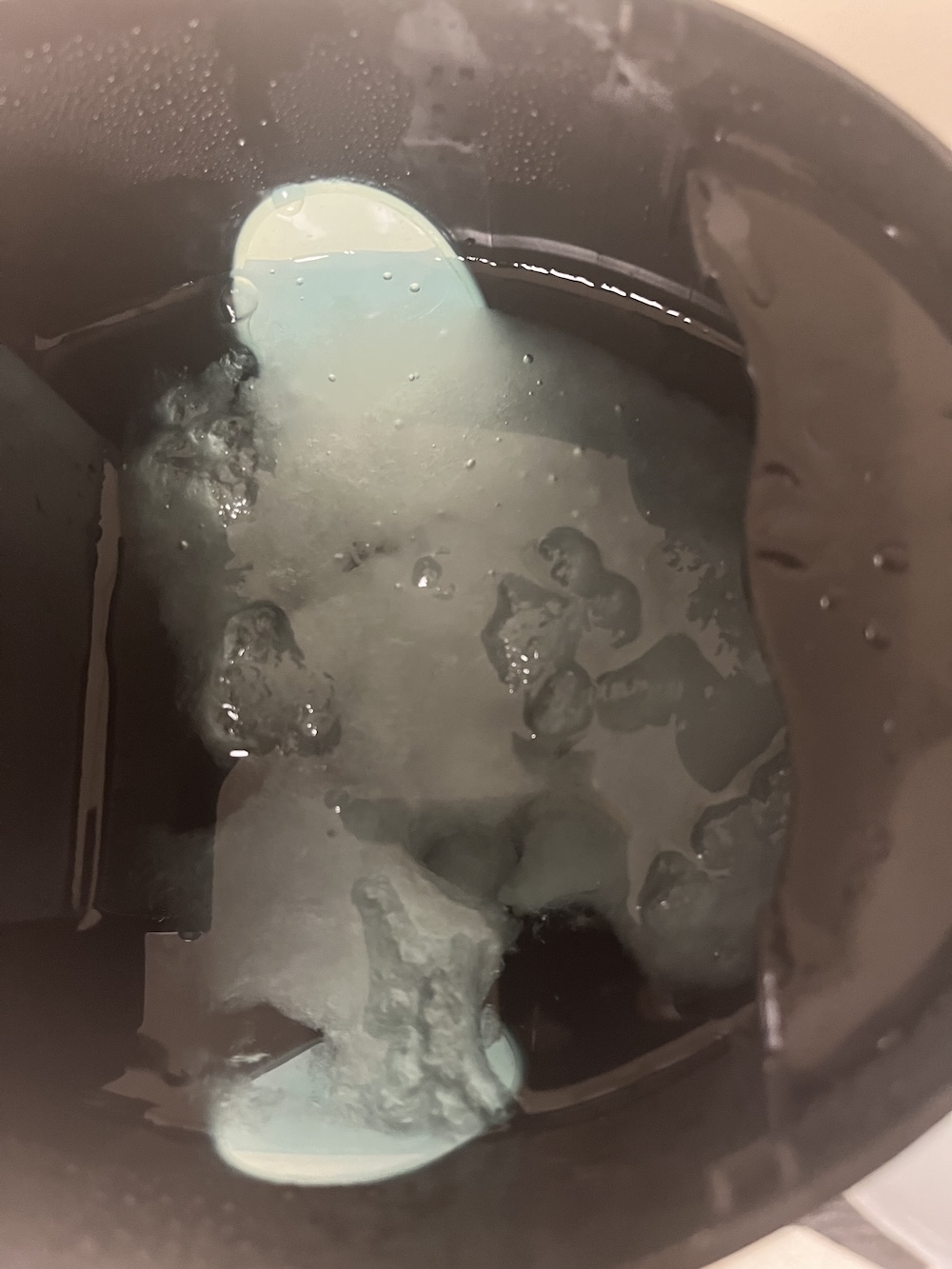
I’m looking down on the opening of my grayish-black kettle, and there in the middle, it’s THE BLOB! It looked like some awful pale gray clotted slime, and I thought for a moment about what kind of contaminant was accumulating in our plumbing.
But of course you’ve already figured out what it is.
It’s just ice — apparently the cooler was supercooling the water below its freezing point and it was instantly crystallizing when it hit the kettle. I was actually able to reach in and make a slushy snowball with it.
It’s too bad that what I then did was take it to my office and heat it to boiling.

You knucklehead! That’s the toilet!
“Fancy a cuppa? One lump or two?”
Your building has a system that cools tap water to below freezing? That’s absurd.
Says something for the cleanliness and smoothness of the tap and its pipe that the supercooled water survives until it reaches your kettle, I suppose.
Ok, who let the shoggoth make tea?
A few years ago I read Inventing Temperature by Hasok Chang, which is about the development of thermometry — a basic and humble piece of scientific measurement, but surprisingly hard to get right when you don’t yet know what you’re looking for. And one of the problems the early thermometrists had was that it’s actually not hard to achieve both supercooling and superheating under what are basically “kitchen” conditions (well, not in the same pot of water at the same time, obviously ;-). Until they figured that out, they didn’t have reliable fixed points to calibrate their experiments against.
Altogether in unison: It creeps, and leaps, and glides…
;-)
stevewatson, excellent point!
Reminds me of the difference between F and C.
Fahrenheit chose 0°F as the coldest temperature achievable using an ice-and-salt mixture as the bottom of the scale to try to preclude negative winter readings and used an arbitrary 180 degrees between water freezing (32°F) and boiling (212°F).
Celsius used pure water for a decimalised 100 degree interval between freezing (0°C) and boiling (100°C).
Kelvin kept the Celsius degree size but shifted the baseline to Absolute Zero (0 K), eliminating the scaling math.
(Which means 20C or 20F aren’t twice as hot respectively as 10C or 10F, but most people don’t grok that)
Actually, for some reason, Celsius set the freezing point to 100°C and boiling point to 0°C, but cooler heads prevailed. Initially, the °C stood for “degree centigrade”.