So far, Colorado has been a bust for spiders — too cold, and the house we’re staying in is way too new and clean. At least Iliana came through to show me her plush spider toy.
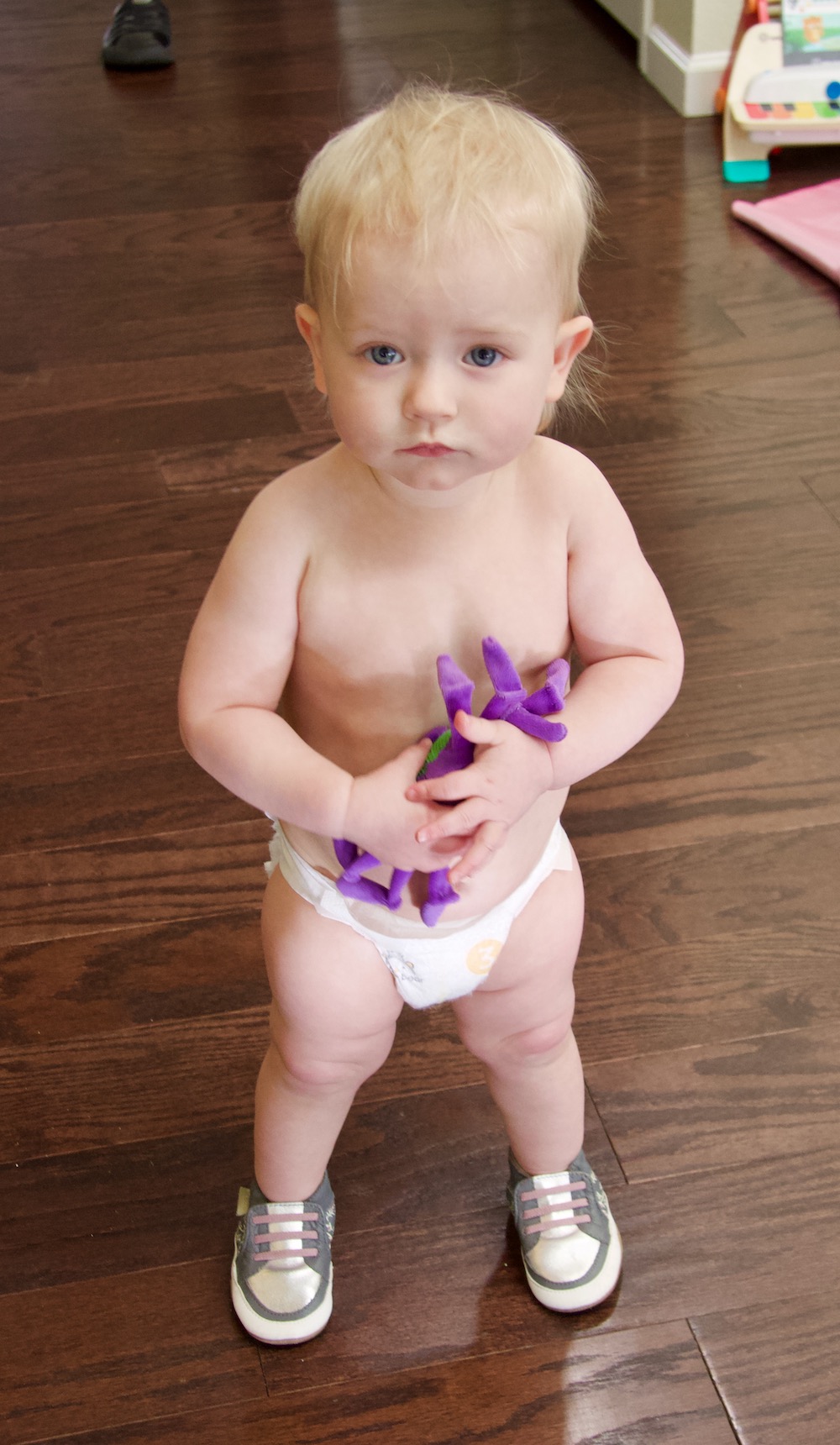

So far, Colorado has been a bust for spiders — too cold, and the house we’re staying in is way too new and clean. At least Iliana came through to show me her plush spider toy.

This is just ugly and unfashionable. I don’t quite get the point, unless it’s to mock women’s fashion shows, which just makes it petty and condescending.
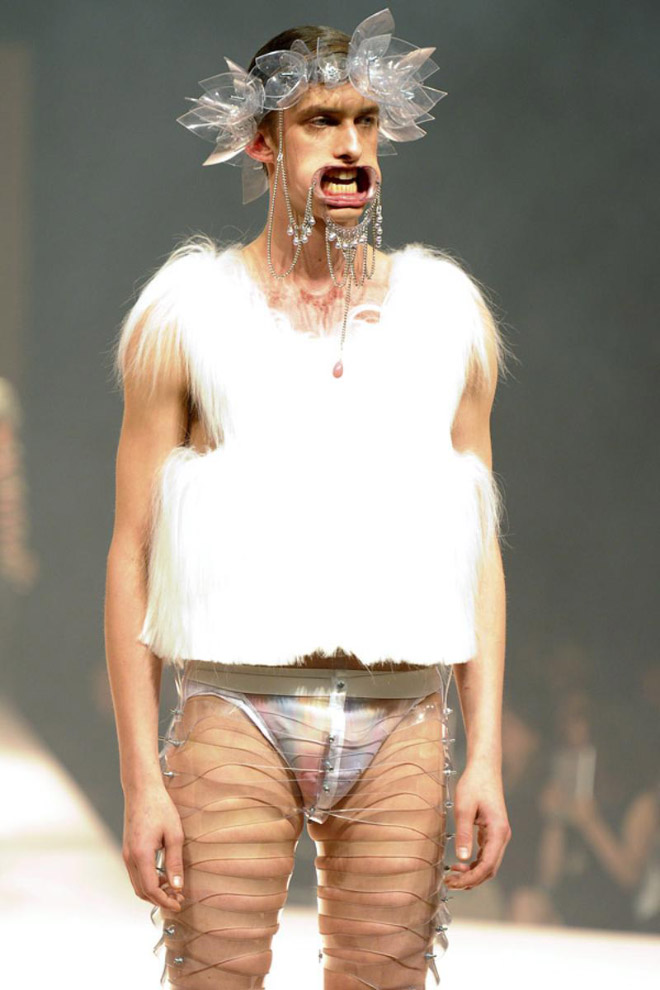
Why do people do this?

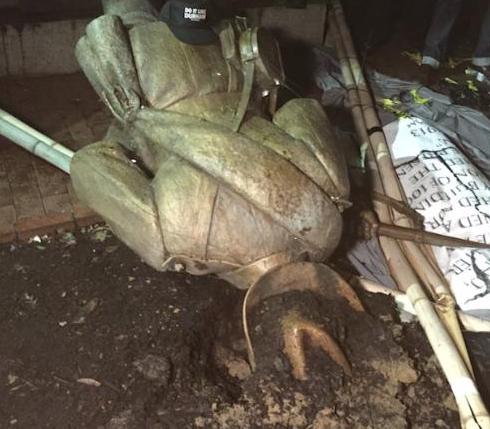
Recently, the University of North Carolina paid a Confederate group to take possession of a Confederate monument, a deal that stank like a garbage dump. They paid $2.6 million to the Sons of Confederate Veterans, a shady low-rent outfit of good ol’ boys who existed only to promote racism, which made it even stankier. Now the SCV has been further exposed — they’re a tax-exempt 501(c)(3) organization which is prohibited from meddling in politics, and guess what they’ve been doing? Meddling in politics, of course.
For years, the pro-Confederate group that the UNC System dealt $2.6 million has been violating federal tax laws, operating a political action committee in violation of its tax-exempt status and facilitating political donations through illegal means, according to numerous individual first-hand accounts, a slew of internal communications provided to The Daily Tar Heel and multiple expert legal opinions.
The North Carolina Division Sons of Confederate Veterans Inc. struck a pair of backdoor deals last November with UNC System Board of Governors members. A predetermined lawsuit and settlement gave the group Silent Sam and $2.5 million in UNC System money for the Confederate monument’s “preservation and benefit.” A week previous, the system paid $74,999 to the SCV for an agreement to limit its display of Confederate symbolism on UNC System property.
When I say low-rent, I mean it. SCV has $100 membership dues, and their process is rather irregular. The dues are paid to an individual who cashes the checks and doles out payments with little in the way of documentation.
“We tend to have the cigar box in the gun safe approach,” Starnes wrote. “So the checks are made out to the Captain, ie, Bill Starnes, so they can be cashed.”
They’ve got enough members that the organization’s income gets up into the range of tens of thousands of dollars, and UNC just plopped a couple of million dollars into Bill Starnes’ lap. This is nuts. It represents considerable fiduciary irresponsibility on the part of UNC — why are they paying all this money out to a fringe group with little financial oversight? — and suggests that there’s an even deeper layer of corruption in the UNC system that hasn’t been fully exposed yet.
I can’t even imagine my university dropping a few mil on some radical group to perform a dubious “service” for us. Heads would roll. Our students would rage at the wasteful use of their tuition dollars.


Gwyneth Paltrow would have you believe that her vagina smells like this:
With a funny, gorgeous, sexy, and beautifully unexpected scent, this candle is made with geranium, citrusy bergamot, and cedar absolutes juxtaposed with Damask rose and ambrette seed to put us in mind of fantasy, seduction, and a sophisticated warmth.
I’m not going to test her claim that her crotch smells like a geranium soaked in Earl Grey, but somehow I doubt that it does, and also it’s rather egotistical that she thinks it does. People aren’t flowers.
It’s probably the least harmful lie on her site, at least.


Isabel Fell has taken that feeble joke about identifying as an attack helicopter and weaponized it as a short story, “I Sexually Identify as an Attack Helicopter”. It’s good and slightly terrifying.
I sexually identify as an attack helicopter.
I lied. According to US Army Technical Manual 0, The Soldier as a System, “attack helicopter” is a gender identity, not a biological sex. My dog tags and Form 3349 say my body is an XX-karyotope somatic female.
But, really, I didn’t lie. My body is a component in my mission, subordinate to what I truly am. If I say I am an attack helicopter, then my body, my sex, is too. I’ll prove it to you.
When I joined the Army I consented to tactical-role gender reassignment. It was mandatory for the MOS I’d tested into. I was nervous. I’d never been anything but a woman before.
But I decided that I was done with womanhood, over what womanhood could do for me; I wanted to be something furiously new.
To the people who say a woman would’ve refused to do what I do, I say—
Isn’t that the point?
If transhumanism leads to increasing integration with machines, sure, why not have identity at all levels associated with the whole?

We took off for a day to Rocky Mountain National Park. It is aptly named.

It wasn’t the best day for sightseeing, though — misty, snowy, cold. We did see some savage wildlife.


I’m giving notice: I’m abandoning Facebook in two weeks, on the 25th of January. I usually put a link to anything I write here (including this post!) on Facebook, but I won’t be doing that anymore. I’ve maintained my Facebook account mainly to keep in touch with family and friends, but even that has been poisoned with saturating levels of targeted ads and stupid paid ads. Facebook is the Fox News of social media, leeching off my interest in social contact to sell soap and provide a platform for bots and trolls to thrive.
Then I read about how Facebook lies to drain money out of the people that use its services.
“In order to beat YouTube, Facebook faked incredible viewership numbers, so [CollegeHumor] pivoted to FB,” former CollegeHumor writer Adam Conover presciently tweeted last October. “So did Funny or Die, many others. The result: A once-thriving online comedy industry was decimated.”
Facebook agreed to pay $40 million last year to settle a lawsuit after advertisers sued the social media giant for inflating video metrics by up to 900 percent. But many former CollegeHumor staffers blamed the pivot to Facebook, which couldn’t deliver on its advertising promises, for the previously successful company’s collapse. Facebook did not immediately respond to a request for comment early Thursday.
“The slow (and then quick) death of CollegeHumor, Funny or Die, and your other favorite online comedy sites was not an accident,” Conover tweeted Wednesday. “It was the result of Facebook’s deliberate effort to kill the indie video industry, in part by massively falsifying viewer data.”
Or this, from 2018.
Comedian Luisa Omielan thinks so. “Facebook, to me, is becoming unusable as an artist or a creative,” she says. Three years ago, a video of Omielan’s standup went viral on the social platform, and has now racked up 41m views. “The algorithm wasn’t as intense as it is now,” she says. “When I first started standup, I created a page for comedy, and initially it was fine, I’d post about a gig and it would reach my audiences. Now, they [Facebook] limit any post of mine about anything comedy-related, so it might be seen by, like, 100 people when I’ve got over 200,000 people following my page.”
With a post’s reach being stifled, users are encouraged to “boost” their content, with Facebook charging the creator to show their post to more fans of their page. “That video that got 45m views? I don’t get any revenue from that,” says Omielan. “Yet Facebook gets revenue from me because I have to boost things to promote it within my own page.”
Nothing against Omielan personally, but Facebook is charging people to have their stuff shoved in my face? Not interested. The Holy Algorithm is just plain bad, too — I once looked up some microscopy gear that I couldn’t afford out of curiosity, and for months I was constantly dunned with ads for stuff there was no way I’d ever buy, that I was aware of after I’d already looked it up, and had dismissed long ago. Also, don’t look up PVC elbow joints or the Internet will decide you’re a plumber. None of that helps me at all, but it does allow Facebook to turn to microscopy companies or plumbing supply houses and promise oodles of eyeballs if only they’d pony up some cash. It’s a scam, and we’re all contributing to it. So I’m out.
The change is not because I’m a grumpy misanthrope who hates interacting with people online, but because Facebook is such a crappy medium for doing that. If you want to keep in touch, there are still plenty of ways to do that:
I’m @pzmyers on Mastodon.
I’m pzmyers on MeWe.
I’m pzmyers on Instagram.
I’m @pzmyers on Twitter.
I’m pzmyers#2563 on Discord.
(I sense a pattern here.)
We’re also beginning to set up a Discord server for Freethoughtblogs as a whole.
And of course, Freethoughtblogs is not going away.

At least now everyone outside of Beltrami County will have heard of the place. I’m sure the chamber of commerce is gratified.

Steve Sack

My daughter is working towards a Ph.D. in computational linguistics (I think…when she talks about her research I only understand every third word) at the University of Colorado Boulder. I’m just hanging out with my granddaughter this week, and I cringed at the chewing out Orac delivers to the institution — there is a unit of UC called UC Health that is publishing the most outrageous quackery, most recently an article touting the benefits of acupuncture in winter, written by a quack with a Masters degree in Oriental Medicine from the Southwest Acupuncture College. That’s gotta be a joke degree, right? If someone applied to my department with that on their CV, we’d have a good laugh and round-file it on the spot.
Anyway, now I feel like marching down to the university administration and giving them a good talking-to. How dare they dilute and devalue my daughter’s hard work with this nonsense?

We can be better, and the Society for Integrative and Comparative Biology shows how it’s done. Their journal published an article describing the steps they were taking to make SICB more inclusive and representative, and show the state of affairs in their membership.
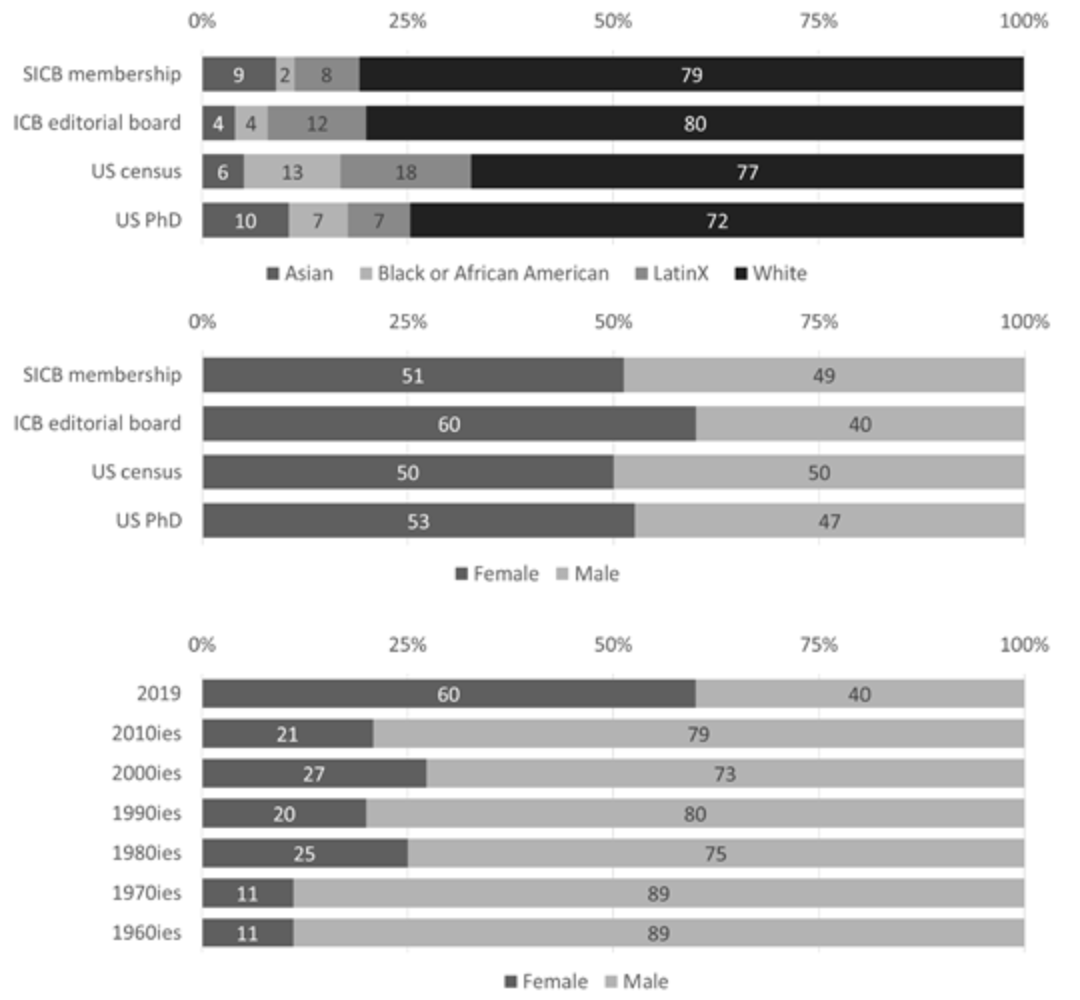
The ethnic (top panel) and gender (middle panel) composition of SICB membership and the ICB editorial board (data from 2019) compared with the US and NSF census (data from 2015 US census and 2017 NSF survey). Bottom panel: Gender composition of the ICB editorial board since the journal’s foundation (median per decade).
The top graph is the ethnic distribution, and while the percentage of people of color in the society is somewhat lower than it is in the population of Ph.D.s, and significantly lower than the overall population, the key thing is that the population in leadership roles, that is the editorial board of their journal, is proportional to the population in the general membership. That sets the direction they’ll be taking.
The second graph is the gender distribution, and it’s roughly a healthy 50:50; maybe women are a little over-represented on the editorial board, but that’s also a smaller population with more variation. It’s worth noting, too, that over half the population of Ph.D.s in the country are women, so you’d better start paying more attention. Before the usual neandertals start whining about how women are in more ‘soft’ disciplines, note that over half the population of SICB, a highly technical field, are women. I should also point out that it doesn’t matter what discipline you’re talking about, all those non-STEM fields also require rigor and discipline and hard work.
The real eye-opener is that third graph, which shows the history of SICB. Sixty years ago, it was a very ‘masculine’ organization, with only about 10% of the SICB editorial board women; it rose to about one quarter women in the 80s, surging abruptly to 60% this year. That is a big deal. Changing the gate-keepers opens up new opportunities.
Researchers from non-prestigious institutions or minority groups face hurdles in publishing and in obtaining funding; for example, female scientists publish relatively less and get fewer citations than their male counterparts due to bias, such as gender differences in self-citation. Just as female and non-white authors remain underrepresented in the USA, so do authors from low-income and Global-South countries. In many scientific areas male, majority ethnic, and US scientists remain over-represented as gatekeepers (peer reviewers, editors) and lead authors. Although editorial boards have become more inclusive, most journals in the life sciences are still led by editors from US institutions and by men: in 2018, of the top 100 journals in life sciences as ranked in a 2009 study, 78 had a male editor in chief and 68 had an editor in chief affiliated with a US-based institution. Of the 22 female editors in chief, 17 were affiliated with US-based institutions. In contrast, women made up more than half of all PhDs granted in the USA in 2017 (Fig. 1), and the USA granted fewer than a quarter of doctoral degrees worldwide in 2018.
I’ve been to SICB a few times (not as much as I’d like, but their January annual meeting time doesn’t fit my schedule well), and there’s always been a lot of interesting work presented there. The directions they’re taking only make me want to go more often.
