Breaking news: pipelines leak!

Bet you didn’t know that, didja? There has been a totally unexpected, surprising oil spill in North Dakota.

The Keystone pipeline has spilled hundreds of thousands of gallons of crude oil into North Dakota this week, The New York Times reports.

The pipeline has leaked roughly 383,000 gallons of crude oil, impacting an estimated half-acre of wetland, according to state environmental regulators.

This one is poisoning a “mere” uninhabited wetland. Then people wonder why others protest when Big Oil builds pipelines over their drinking water supplies…

Shouldn’t we expect social media to practice a little information hygiene?

It’s been in the news that Facebook openly allows political ads to lie, which is appalling. But did you know that while they’ve made some efforts to police specific forms of quackery, there is a thriving market for others?

Even as Facebook has cracked down on anti-vaxxers and peddlers of snake oil cure-alls, a particularly grotesque form of fake cancer treatment has flourished in private groups on Facebook. Black salve, a caustic black paste that eats through flesh, is enthusiastically recommended in dedicated groups as a cure for skin and breast cancer — and for other types of cancer when ingested in pill form. There’s even a group dedicated to applying the paste to pets.

A Facebook spokesperson told BuzzFeed News that these groups don’t violate its community guidelines. This summer, it launched an initiative to address “exaggerated or sensational health claims” and will downrank that content in the News Feed, similar to how it handles clickbait. But it’s not clear how it defines what a “sensational” health claim is. Citing user privacy, Facebook would not say whether or not it had downranked the black salve groups in the News Feed.

Black salve is truly awful stuff — it’s a corrosive goop that burns away whatever part of your body it touches, and its proponents proudly post grisly photos of holes punched through their bodies or chunks of flesh that have fallen off. They take pride in their self-abuse, and claim it cures just about everything. It’s certainly potent and has demonstrable affects, just like Republicanism, but also likewise is simply universally destructive.

It’s also the case that other social media, like MeWe, are also afflicted with this black salve poison. Shouldn’t they all take action to prevent their platforms from being a place that does harm by spreading bad information?

People love to be told what tribe they belong to, I guess

I submitted a DNA sample to 23andMe, and now they send me periodic updates on what they’ve figured out lately from my genes. For instance, they’ve informed me about traits I might have.

This is strange. I know what I take away from it, but I wonder what the general populations learns from this kind of list. Here are the two important messages I learn from this kind of revelation:

  • Notice all the “likely”s and “less likely”s? That will never change, because if there’s one thing we can be confident of, it’s that every trait is the product of multiple genes interacting in complex ways. It says I’m not likely to have a cleft chin, but I know for a fact that under my beard there is a cleft chin, and that I’ve passed that on to my children and inherited it from my father. It doesn’t mean 23andMe did something wrong, it means that they’re missing information about all the factors that contribute to chin shape, and are estimating from knowledge of a few genes. They’re drawing on correlations in the large database that they have, but can’t infer mechanisms or the full range of interactions that occur during jaw development.
  • What’s really depressing, though, is how trivial all these traits are. Does anyone really care that I’m less likely to get dandruff? Wouldn’t I get better information about that by checking my shoulders than by analyzing my DNA? Part of the reason for the triviality is that they also have a “health report” that they charge extra for which summarizes more substantial predilections, which I haven’t paid for. It would have exactly the same kind of probabilistic statements. It might, for instance, say I’m genetically predisposed to heart disease, but I could probably guess that from the fact that my father died young of heart disease, and would be better off going to my doctor to have my cholesterol and blood pressure checked (as I do regularly, and no worries — I’m in good shape for a man of my age).

So what I take away from this is a lesson in uncertainty and doubt; is that the information they’re trying to share with the general public? Because that’s not what I get from their “traits tutorial”, which starts off “Our Traits Reports are a fun way to explore how your DNA makes you unique.” Where’s the fun? Where’s the uniqueness? Am I special in my resistance to bunions, or am I supposed to be entertained with the news that I probably have blue or green eyes? (Not blue, by the way, more green, kind of hazel; I usually say they’re the color of rich algal swamp mud).

My general impression is that this is “fun” in the way taking Myers-Briggs tests and horoscope readings are fun; it’s mostly bogus, phrased in a way to seem positive, and we can poke through them for affirmations of stuff we were pretty sure of, already.

I signed up mainly for the ancestry component, but even there, it’s vague.

My god, I’m a white guy! Who’d have guessed?

Meanwhile, this is just nonsense.

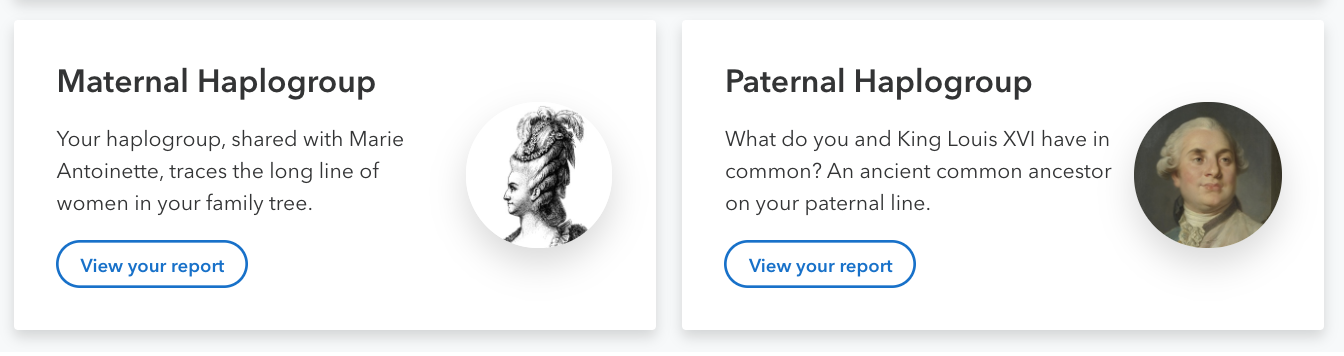
Yes, I’m a member of haplogroups that include European royalty, which is true of almost all the white people from Northern Europe. You might as well announce that I have pale skin, just like the kings and queens of old Europe! Whoop-te-doo! I am fun and unique.

I am not opposed to the idea of 23andMe, and think they’ve gathered a lot of potentially useful information. I just feel that the way its presented to the public is biased to reinforce false ideas of genetic determinism to induce people to participate, and that worries me.