Pharyngula
Evolution, development, and random biological ejaculations from a godless liberal


The odious Eric Bolling tried to “school” Jon Stewart on the horrible exploitation of the American taxpayer by criminal looters, AKA poor people. He gets delightfully shredded.
(Below the fold because somehow Comedy Central clips always get turned into autoplay obnoxiousness here.)

One more story of academic inside baseball — I’ve been following John Wilkins, a brilliant philosopher of science who just can’t get a job, and I’ve been sensing waves of resentment at the rotten state of academia. I will be the first to tell you that I’ve been exceptionally lucky and privileged to get a job at a university that does a lot of things right, and one reason I can criticize freely is that UMM actually handles academic positions well.
Elsewhere…not so great.
It is becoming increasingly difficult to get any kind of academic job at all, other than the miserable, harrowing, exploitive position sometimes called “adjunct”, or sometimes “lecturer” — temporary positions in which the instructor is hired on a per course basis. Bad jobs are driving out the good as university administrations cut corners, and somehow, it’s always the faculty who suffer the first painful snips.
This is the time of year when high school students come around to visit various universities and make decisions about where they want to go next year. Are you one of them? Or perhaps you’re a parent of a prospective student? You’ve got some power. Universities may be courting you, because they want your tuition dollars, or they see you have some skills that would bring honor to the school. Use your clout. Ask questions.
Here are some questions I wish more prospective students were knowledgeable enough to ask.
Ask, “Who teaches your introductory or service classes?” You may be thinking ahead to those lovely upper-level courses with the big names teaching them and the shiny lab equipment, but before you get there you’ll be expected to take courses outside your major — service courses in disciplines like math and English — that have big enrollments. At some universities, those will be taught by an ever-rotating set of temporary faculty called adjuncts. They are often treated like dirt, poorly paid, and given overloads. Often they’re so poorly paid they have to take adjunct positions at multiple colleges to make ends meet.
Those course are important. You’ll take a lot of them. You want them to be well-taught. And that’s precisely where many schools cut corners on the quality of the education.
Ask, “How many of the faculty in your department are temporary faculty?” There are a great many colleges, some of them quite prestigious, where the swarm of adjuncts outnumbers the tenure-track faculty. Tenured faculty are in a privileged position where they get more money and lighter teaching loads, while the adjuncts are being victimized. Do not go to those colleges. Tell them why.
Now adjuncts are often very good teachers — they have to be deeply committed to the profession to put up with the crap they have to take — but they are often spread thin and given frustratingly difficult workloads. My wife was an adjunct for a while, and she was commuting all over eastern Pennsylvania and New Jersey to cover her scattered positions, on top of all the coursework. I think she was a marvelous professor, but the burdens compromised her ability to deliver to the students to the best of her ability.
Ask, “Can I talk to some of the other instructors?” I know the runaround. You’ll go to the university, they’ll have a lovely canned presentation of all the benefits, and you might get to sit in on a course or meet for half an hour with Professor So-and-So, who will show off their lab and talk about the great things about being in their profession. Ask to talk to any of the people who teach that first year course in your major; if you’re lucky, Professor So-and-So will say, “That’s me!” and you’re off to a good start. If you’re not so lucky, you’ll be led to a cramped office divided into cubicles with a group of temporary faculty crammed into it.
They’ll probably still say nice things about being at the university. Partly because they do love their job, but also partly because they’re in terror of losing it.
It would be very nice if more students and their parents paid attention to the growing inequity within academic ranks, and if the tuition-paying people would regard that as important, and that the voting citizens would recognize that their state legislators are all conspiring to strangle higher education. It would be especially nice if students refused to support universities that were happily screwing over their teachers.
But I’m a realist. I know what university PR departments do and emphasize and tell prospective students is important: will your education get you a job after graduation, and how is the football team doing? Those are great smokescreens to hide the decay behind the scenes.
I’ve had a few prospective students ask the really important questions: will I learn many great and interesting things in my years at this institution, will it make me a better and wiser person, is this school investing in improving the educational experience? Those are the students I really want to keep.
By the way, I can tell you to ask those questions because I know UMM will pass them with ease: almost all of our introductory and service courses are taught by tenure-track faculty, we have almost no temporary faculty (occasionally some, to cover faculty on sabbatical leave, for instance), and I can walk you right down the hall and introduce you to each of the professors who teach every one of our courses, and they’ll be right there in those same offices when you come back in the Fall.
(This has been an advertisement for the University of Minnesota Morris. An advertisement I enthusiastically endorse.)

I’ve been in quite a few job searches, on both sides of the table. I think I know what makes for a good job candidate, and I respect one who makes reasonable requests for accommodation. So I was rather shocked by this story in Inside Higher Ed about a candidate who lost a job for negotiating.
She was offered a position, and she wrote back requesting a few things that would help make her decision.
1) An increase of my starting salary to $65,000, which is more in line with what assistant professors in philosophy have been getting in the last few years.
2) An official semester of maternity leave.
3) A pre-tenure sabbatical at some point during the bottom half of my tenure clock.
4) No more than three new class preps per year for the first three years.
5) A start date of academic year 2015 so I can complete my postdoc.
The college’s reply? They withdrew the job offer!
It was determined that on the whole these provisions indicate an interest in teaching at a research university and not at a college, like ours, that is both teaching and student centered. Thus, the institution has decided to withdraw its offer of employment to you.
That’s absurd. The article has several other sources criticizing the negotiator (also calling Nazareth College “totally uncouth”), but I thought every one of those requests was reasonable, and I could easily imagine how we, at my “teaching and student centered” institution would respond. At the top of our priorities would be doing what we can to turn the candidate into a happy colleague.
Salary decisions are largely out of our department’s hands — that’s determined higher up. We go to bat for our candidates trying to get the best salary we can, so we’d probably go back to the administration and get them to concede as much as possible. We almost certainly wouldn’t get $65K for an assistant professor of philosophy, which is very high for a small liberal arts school, but we’d come back with a counter offer.
Maternity leave is a really good thing. Balancing work and life is important, and yes, we’d yell at the administration to get that for them. Also, if the candidate were a man, I’d think it also a good sign.
A pre-tenure leave is also an excellent idea. We already have policies in place to encourage new faculty to take a semester leave before coming up for tenure. We may be a teaching university, but hell no, we’re not going to tell faculty to abandon all scholarship.
The most draining, exhausting thing in starting a new position is developing new courses. Every time I’ve done it, it’s a killer: every night is a late night spent reading and taking notes and putting lectures and labs together — and everyone in my department is well aware of the challenges.
But small faculty at a small university means you have to wear a lot of hats, and new faculty are often hired with a laundry list of courses we need taught. We have tricks we do to lighten the load, though: pairing new faculty with experienced ones in particular courses, balancing introductory courses with advanced ones, juggling other faculty’s schedule so they take on a course that was initially assigned to the new person’s list, so they can get a breather by repeating a course. We always have a set of courses on our roster that need to be covered; I’d fire back with a two year plan with specific courses and ask if that was reasonable.
Ouch. This is probably the most problematic one. When we send out a job announcement, it has a specific start date clearly stated — we mean that. If we say “Fall 2014”, it’s because we need a person teaching a course that is essential for our students at that time — you can’t tell students that they don’t get to graduate this year because a scheduled course required for their major isn’t offered this year.
But really, I read that list and saw absolutely nothing that implied this person wasn’t being serious about being committed to a teaching university. There were requests that I’d imagine we’d have a hard time meeting, but nothing that wasn’t a reasonable concern for a person that was serious about their academic career.
The rejection by Nazareth College tells me one thing: that their philosophy department isn’t as committed to their faculty’s fulfillment as they should be, and that she is better off not going to work there.
Well, it does tell me one other thing: the job market for academics is so desperate that some universities assume they can be total assholes to their candidate pool.

I have to empathize with Rebecca Watson here — sometimes it’s enough to piss the jerks off.

Well, this isn’t going to happen. He rejects my insistence on equal profit sharing — you know, there would be TWO of us in this debate — blows right past my demand that the topic be strongly and narrowly focused, and babbles away with his usual demented hamster routine…which is a foreshadowing of what any debate with him would be like. Not interested. I wasn’t that interested to begin with, but I might have been willing if I thought I could get him to focus.
He does say he’s found a creationist to throw away money on Ray Comfort DVDs for the entire student body at Morris, so that’s a win. Coasters for everyone!
3-13-14 Response to self proclaimed atheist PZ Myers.
On 3-9-14 I sent out a blog (posted on 2peter3.com) titled “Open Letter to self proclaimed “atheist” PZ Myers of U of Minnesota- Morris. My blog had 18 numbered paragraphs.
A day or two later (I don’t have that data) he responded on his blog but I don’t have his web address either. It may be freethoughts.com/pharyngula but I’m not sure. Sorry about that. He at least referred to my paragraph numbers so below is my answer to his “A few comments from me”:
I’ll use my original paragraph numbers for ease of reference. Sorry I can’t cut and paste and insert here to make it easier to follow.
First- I was totally unaware that quote marks ” ” would scare you or anyone! I’ve never heard them called “scare quotes” in my 61 years! Is this new? I always use them for emphasis or irony. It is NOT “Rational” to believe in evolution.
1&3- I think a simple search of the web or a survey of your students would show that you do indeed push your views on others. Why do you post comments at all? I cannot “subscribe” to any blogs here but I’ll have someone do it for me. Thanks for the info.
4. PZ, you don’t “pay attention” to LOTS of details! Like the IMPOSSIBILITY of your religion being true. Dogs produce dogs. Always, no exceptions. You have a gift for not seeing the “details” that prove every aspect of the evolutionism religion wrong. I suspect this is because you like the idea of freedom from God and His Word and His authority over your life.
Notice you did NOT say, “I’m sorry I published false information about you Kent.”
5&6. I have not started any of the legal fights. They brought all this to me and I’m just defending myself as anyone should. You are “not concerned with the details” of real science that demonstrate the evolution religion to be stupid either.
7. You are either lying (again) or unable to understand simple English here. I have NEVER been convicted of fraud. There was no fraud in my case. You (and the folks at “Rational” Wiki) seem to like that word for some reason but it does not apply. Words have meanings PZ. You (and the rationalwiki folks) seem to play fast and loose with words. Like the word “science” for example. You freely include a lot of religion in with your science. I think “fraud” may apply to a person who claims to teach “biology” yet routinely mixes his religious beliefs in class about all life forms having a common ancestor or humans being related to bananas and humans being a fish (as you stated in the “Evolution vs. God” DVD). Maybe “charlatan” is a better word for these false teachers. Maybe the courts will explain to the folks at “Rational” Wiki that words have meanings and it is not good to falsely accuse someone of the crime of fraud (unless you have proof).
The government was wrong in my case as is shown in many of the filings posted on 2peter3.com. The reason we even have appellate courts and a Supreme Court is precisely because the lower courts can get it wrong. Being convicted by one person does not prove guilt. 6 million Jews were convicted and executed in Germany in WW II. Does that prove they were guilty of some crime? Watch the news. Often cases are overturned on new evidence. Sometimes many years after the conviction. Simple history 101 will show many examples. I know you are rejoicing that the lower court ruled against me just as Jesus’s enemies rejoiced when he was convicted and sentenced. Well, it’s NOT over. If I DO get the case overturned and it is admitted by a higher court that the lower court erred and I did NOT commit a crime will you also admit it or will you then think the higher court erred?
I have learned a LOT of things from all this! Read my previous blogs over the last 7 years to glean some if you like.
“Lake of remorse?” Should I be sorry I took my own money out of my own bank to pay my own bills? Read the Complaint of Misconduct against the AUSA in my case filed in the Denver court and tell me which of the 3 charges I should be remorseful for please.
8. One of your own fellow travelers corrected you on this one. “Evidences” is fine. BTW- I notice you used “scare quotes” here. Twice! It worked! I’m scared! :)
9&10. Be specific. You give a nebulous accusation about Ray Comfort lying and quote mining yet give no specifics. Anyone can watch the DVD and see you make a fool of yourself. No need for quote mining. You are your own worst enemy. A wise man once said, “It is better to remain silent and be thought a fool than to open your mouth and remove all doubt.” BTW-someone beat me to the 1900 students. They will all be getting the DVD soon and see the truth for themselves. This might be a good time for a long sabbatical for you. :) You may not want to show your face around the university for a while once they all see that one.
BTW- Send me the specific spots where Ray lied or quote mined please.
11-14. My offer stands as is. I have been more than generous in the terms. You are welcome to sell copies of the DVD but I am not going to hire someone to keep track of the ones I sell just so you can get a %. I didn’t ask for a % of the ones you sell or your “profits.” If you are so smart and feel so confident you will win the debate then why can’t you rest assured that people world wide will run to you to buy a copy? If you indeed decide to sell it I will add your web site as a source where people can get it. There are MANY who claim to be “atheists” and “agnostics” who would LOVE to see you (or anyone) beat me in a debate on creation vs. evolutionism. Watch ANY of the 20 debate dvds on you tube to see how they did. :)
As stated in my 3-11 post—I’ll pay my expenses to come to your turf, pay to video it, pay you as stated and give you a master copy to sell copies from for the rest of your life. I will not sell them for you. If this “counter offer” was the loophole you added so you could worm out of doing the debate at all and save face then go ahead and back out. “Rational” (hope I didn’t scare you with the quotes-didn’t mean to. I just do it for emphasis as most people do) folks will understand the real reason why you refused.
15. Once we clearly define the slippery term “evolution” into its 6 natural divisions as I have done scores of times (see DVD #4 for example) it is obvious to anyone with one eye and half a brain that the first 5 divisions/ levels/ meanings of the word as taught in your university are 100% religious! You have to BELIEVE they can happen by FAITH in the face of zero/zip/nada scientific evidence or you have to BELIEVE that they happened “long ago and far away” where no one can observe them. NO ON has ever seen matter create itself from nothing. Before you can have ANY “evolution” you must have something to evolve. It’s common sense 101. The text books at the university where you teach do indeed proclaim the big bang and matter coming from nothing. I’ll copy them when I come and show you and the students. If it is SCIENCE that matter can come from nothing-let’s do it again in a lab. I want to see it this time.
The next 4 meanings of evolution: chemical, stellar, organic and macro are just as religious and have NEVER been OBSERVED. Variations within the same kind of plant or animal happen all the time like your stickle back fish example. As Ray pointed out-they are still fish!
I know there is no chance that you will admit it or even understand it but any “evolution” above the level of minor changes within kinds only takes place in the fertile imagination of those who faithfully believe it does. Even the little boy could see- The king hath no clothes! You need to sue the “tailors” who sold you that dumb religious evolution suit you so proudly wear in public. Aren’t you embarrassed to believe you came from a rock? BTW-congrats on having an asteroid named after you. Is that an ancestor too?
What “evidence” do you teach in your class that would show scientifically that humans are related to bananas as you said on the DVD? If it can be shown there are some sections of the complex DNA code of humans and bananas that seem to be similar that would not prove a common ancestor. A freshman law student could see through that! It is just as much evidence for a common DESIGNER! Do you mention THAT to your students? The lug nuts from a Vet will fit on other Chevy products. Does that prove they both evolved from a skate board?
16. Read your answer #17 and see who is acting like they are 12 years old. BTW- in the military officers can be disciplined for “language unbecoming an officer.” Doesn’t your university have any standards of conduct or language for the teachers who represent the school? You need a committee to oversee stuff like this and discipline those who use 4th grade insults. Maybe a bar of soap?
Words have meanings as Rational Wiki may soon find out. As one ol’ country boy said, “Huntin ain’t no fun when the rabbit has a gun.” Maybe they thought they should kick a man when he was down in prison and unable to defend himself?
17. I don’t know if anyone will ever “win you over” but exposing your lies may help prevent you from ruining the students who sit in your class. I’ve debated 100 self proclaimed evolutionists and can’t claim to have won any of them over. I do it to expose lies, present truth and help students NOT be brainwashed or taking in by the slick sales pitch guys like you have. We have gotten thousands of testimony letters from students who saw the debates and saw the truth.
18. Your income is at least partially based on a tax funded institution-U of M. I feel certain you could not make a living in the real world without any government help, grants etc. That’s part of the reason why you suggested what you did in #11-14. I produce a product people want and I don’t get funding from the government to do it. The evolution you teach, even if it were true, is 100% useless in the corporate world. Nobody will pay for it. It has no commercial value. A doctor needs to know real science to do surgery not the junk science presented in evolution classes.
Again (sigh) I have never been convicted of being a “con artist” but I’m sure it makes you feel better to act 12 (see #16) and call names rather than deal with real science and the issues.
Contact Marianne to schedule a debate with the terms I already offered if you are brave enough. :)
Kent Hovind

Vaccinate your kids.
Tara Smith is an expert in infectious diseases, and she also has a new baby (congratulations!) fussing up her house, so she knows what she’s talking about…and she explains why she vaccinated her kids. Just do it. It’s the only smart choice.

I was looking over the Discovery Institute’s Evolution News and Views site, prior to forgetting about it. I mentioned that I am forced to revamp my email handling and was going to be blocking a lot of noise from my work address, and as I was reviewing what domains I needed to allow through, I noticed that boy-howdy, I get a lot of crappy spam from the Discovery Institute (all of which is now getting blocked). So I actually bothered to go through one of their links and see what they’re babbling about now.
General impression: the Discovery Institute is really obsessed with Cosmos: A Spacetime Odyssey. They’re flailing about angrily about how it’s just bad and awful and a serious threat. Good work, Neil deGrasse Tyson, you’re obviously doing something right!
The other thing that has them worked up, though, surprised me a little bit: they’re kind of peeved that scientists keep pointing to this evidence that humans and chimpanzees are close relatives, and they throw around a lot of sciencey words trying to cast doubt on the idea that we’re related. They don’t come out and openly deny it, exactly — but it’s still the stupid old yokel’s denial that they didn’t come from no monkey, stated a little more ornately to make it sound less stupid. They failed; it still sounds stupid. But have no fear, they’ve put their Top Man and Chief Scienceologist, Casey Luskin, on the job.
Oh, wait. That makes it even stupider.
It should be pointed out first that ID does not have an “official” position on common descent. Guided common descent would be compatible with intelligent design. However, many ID theorists do question the evidence offered for universal shared ancestry.
Scratch an ID theorist
, and what do you find? Just another dumb evolution denier. Common descent, and in particular the close relationship between humans and other apes, is not in question at all, but the Discovery Institute can’t even muster an official position on it. Other basic science questions the Discovery Institute will not say a word about: the age of the earth, whether the human race was reduced to an 8 person bottleneck by a big flood 4,000 years ago, Jesus: magic man or genetic engineer?, and just how ignorant is Casey Luskin, anyway?
The way Luskin questions the shared ancestry of humans and chimpanzees is to simply dump, with virtually no explanation, lists of legitimate scientific papers that show various common genetic properties. Codon frequency can affect transcription rates, so synonymous changes in nucleotides of a sequence may have phenotypic effects; yes, this is true. Position effects can also affect phenotype; this is also true — translocations, movement of a chunk of DNA from one location to a different one, can modify gene expression. Pseudogenes aren’t always free from selectional constraints, and sometimes also modulate the expression of other genes — yeppers. These are also all basic facts that we’ve known for decades, that have been worked out by scientists, not creationists, and that have absolutely no relevance to the question of whether chimpanzees and humans are closely related. They say that there are many complicated ways in which variation can arise in a lineage, that it’s difficult to reduce the degree of difference between two species to a single number, but everyone who does any bioinformatics at all already knows that.
For instance, here are two sequences. How different are they from one another? Can you give me a simple number that summarizes the variation?
1-2-3-4-5-6-7-8-9-10-A-B-C-D-E-F-G-H-I-J
1-2-3-4-A-B-C-D-E-F-G-H-5-6-7-8-9-10-I-J
Biologists are already intimately familiar with the difficulty of describing the variation in sequence between species. If it were just a matter of a string of DNA accumulating point mutations, it would be relatively easy, and we could simply measure how many positions had acquired a novel nucleotide, but mutations can be all kinds of other things, like translocations or inversions or deletions or duplications. So Casey Luskin high-handedly informing us that measuring variation is more difficult than just enumerating a linear series of nucleotide changes is absolutely nothing new, and telling us that pairwise comparisons are complex, therefore we should doubt the relationship between two primates, is utterly bogus and logically fallacious.
The question should be, “if we compare the differences between chimpanzee and human genomes, messy and complicated as they are, are they less different from one another than, say, the human and gorilla genomes? Or the human and mouse genomes? Or the human and fly genomes?” Just comparing any two species can only tell you that they have differences and similarities; you need to do multiple comparisons between different species and an outgroup to get a feel for the relative magnitude of differences.
Luskin’s only approach, carried to an excruciating degree, is to simply say there sure are a lot of differences between humans and chimpanzees (six million years of divergence will do that), therefore it is reasonable to question their relatedness. Yeah, and my brother is a few inches taller than I am and has red hair, therefore we can’t possibly be related.
Casey Luskin isn’t the only IDiot on staff at IDiot Central. They also have Ann Gauger. She does exactly the same thing, citing a Science article that discusses the difficulties of quantifying the differences between genomes. It also points out that the subtle differences can be immensely significant, which Gauger makes much of.
Here are some large-scale differences that get overlooked in the drive to assert our similarity. Our physiology differs from that of chimps. We do not get the same diseases, our brain development is different, even our reproductive processes are different. Our musculoskeletal systems are different, permitting us to run, to throw, to hold our heads erect. We have many more muscles in our hands and tongues that permit refined tool making and speech.
Golly, yes. We’re different from chimpanzees. We do things they don’t, and they do things we don’t. My brother has red hair, and mine is brown. None of this is controversial, or in any way challenges the idea of relatedness or degree of relatedness. To do that, you have to compare multiple lineages and quantify all these variations — we go beyond simple nucleotide counts, for instance, to ask how many duplications? How many regulatory changes? How many deletions? And when we measure those, doing more than just asking how many bases are different between two different genes, we also get measures of relatedness. And they line up!
Gauger notably fails to refer to the figure in the article she cites.
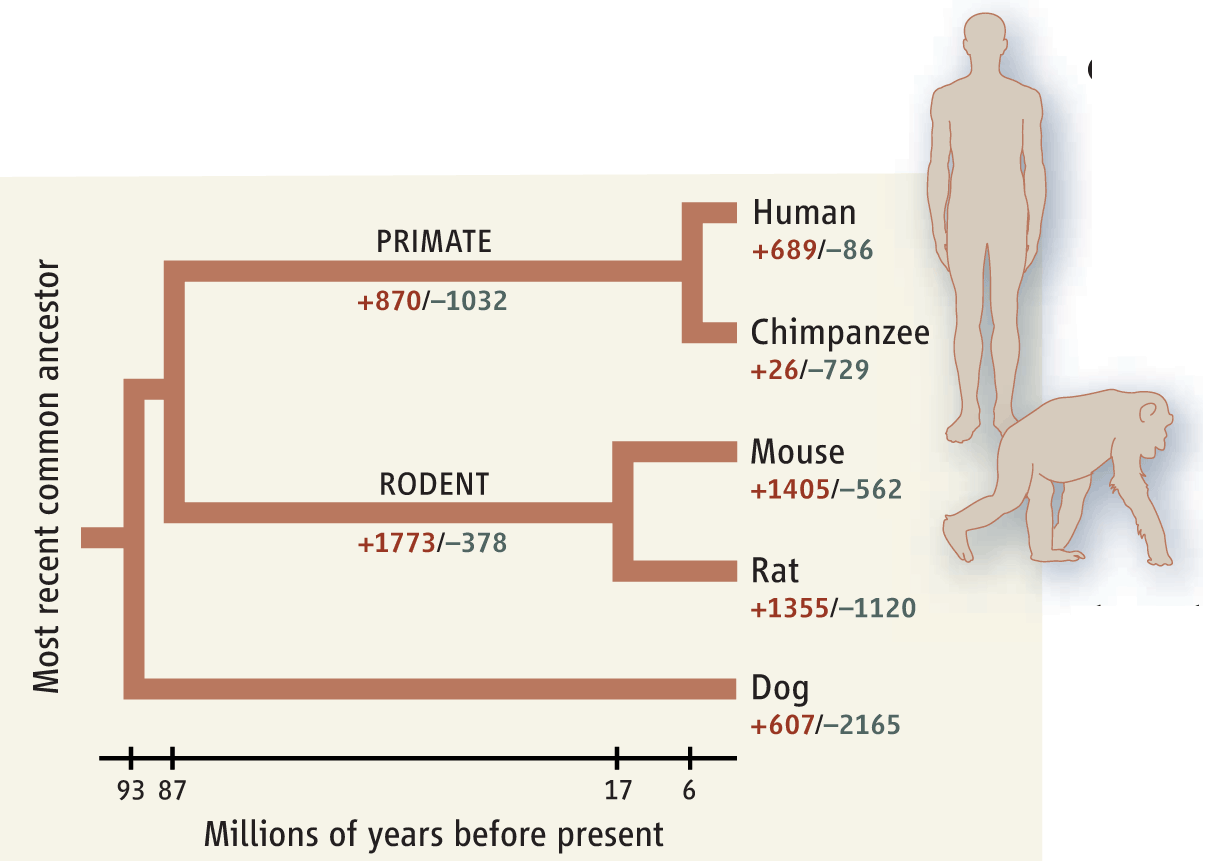
Throughout evolution, the gain (+) in the number of copies of some genes and the loss (–) of others have contributed to human- chimp differences.
Why, Ann, why? Because it actually demolishes your whole argument by demonstrating degrees of similarity between different species using a different index, the number of gene duplications and deletions? If you want to question chimp/human propinquity, you don’t get to simply ignore the data we use to justify that.
But of course, Gauger wants to argue that the unique attributes of humans are somehow especially special and deserve special consideration — that they completely set us apart from other animals.
Going beyond the physical, we have language and culture. We are capable of sonnets and symphonies. We engage in scientific study and paint portraits. No chimp or dolphin or elephant does these things. Humans are a quantum leap beyond even the highest of animals. Some evolutionary biologists acknowledge this, though they differ in their explanations for how it happened.
You know, I would agree that we carry out certain things to a greater degree than other animals — we do have more elaborate language, more intricate technologies, much more complex art. But other animals exhibit curiosity, playfulness, exploration, communication, and we can look at a chimpanzee, for instance, and see attributes that we’ve amplified and expanded. The roots of our humanity are patent in other species, and we are not qualitatively unique. Furthermore, other species have abilities we don’t. Can you sing under water and have your music transmitted over hundreds of miles of ocean? Can you wash your car with your nose? Aren’t you a little bit embarrassed by the puniness of your teeth?
But Gauger is oblivious to the astounding beauty of other organisms — it’s all about us.
In truth, though, we are a unique, valuable, and surprising species with the power to influence our own futures by the choices we make. If we imagine ourselves to be nothing more than animals, then we will descend to the level of animalism. It is by exercising our intellects, and our capacity for generosity, foresight, and innovation, all faculties that animals lack, that we can face the challenges of modern life.
Generosity? Has Ann Gauger never had a dog?
As for innovation, yeah, I agree. Humans do have some novelties. Here’s a paper about the de novo origin of human protein-coding genes, that compared those chimpanzee and human genomes looking for just the unique genes in the human lineage (this is only one measure of difference, of course; they are not looking at location or sequence comparisons, just what genes are brand spankin’ new and not shared at all with chimps). They found a few.
Many new genes, generated by diverse mechanisms including gene duplication, chimeric origin, retrotransposition, and de novo origin, are specifically expressed or function in the testes. Henrik Kaessmann hypothesized that the testis is a catalyst and crucible for the birth of new genes in animals. First, the testes is the most rapidly evolving organ due in part to its roles in sperm competition, sexual conflict, and reproductive isolation. Second, Henrik Kaessmann speculated that the chromatin state in spermatocytes and spermatids should facilitate the initial transcription of newly arisen genes. The reason for this is that there is widespread demethylation of CpG enriched promoter sequences and the presence of modified histones in spermatocytes and spermatids, causing an elevation of the levels of components of the transcriptional machinery, permitting promiscuous transcription of nonfunctional sequences, including de novo originated genes.
Behold my ball sack, noble repository of all that is precious and special and extraordinary and exceptional in mankind. How come the creationists never have time to praise the mighty testicle, and are always going on and on about sonnets and symphonies and such?
I am quite comfortable with my status as an animal. I have a lot of respect for other organisms, and I can also recognize traits that are particularly human. Why this puts creationists on edge is a mystery: I just blame it on their ignorance.

The combination of an attempted hack, jacking up my email security, and breaking my usual email reader have lead to a worse-than-usual mess in my email in-box, and I’m implementing a few changes that won’t affect most of you who write to me, but just in case, I’m spreading the word.
You want to email me? You can still use pzmyers@gmail.com. That is the only valid address for most of you.
Some of you occasionally write to my umn.edu address. That one is getting thoroughly locked up: if you send email there, it will automagically be fed into a nuclear furnace and vaporized, unless you are writing to me from another umn.edu address or from a small set of authorized domains (and I won’t tell you what they are). Pretend that email address doesn’t even exist anymore. This has become necessary as essential work and student email has been getting buried under the noise.
I’m actually enjoying the purity and simplicity of that account right now — it’s so clean and manageable!

Former second place winner of the US presidency Paul Ryan reveals his understanding of poverty. It’s those black people.
House Budget Chairman Paul Ryan (R-WI) previewed his upcoming legislative proposals for reforming America’s poverty programs during an appearance on Bill Bennett’s Morning in America Wednesday, hinting that he would focus on creating work requirements for men “in our inner cities” and dealing with the “real culture problem” in these communities. “We have got this tailspin of culture, in our inner cities in particular, of men not working and just generations of men not even thinking about working or learning the value and the culture of work, and so there is a real culture problem here that has to be dealt with,” he said.
Ryan also cited Charles Murray, a conservative social scientist who believes African-Americans are, as a population, less intelligent than whites due to genetic differences and that poverty remains a national problem because “a lot of poor people are born lazy.”
Don’t anybody tell him that he’s already got the white racist vote totally locked up, he doesn’t have to keep pandering to them.

