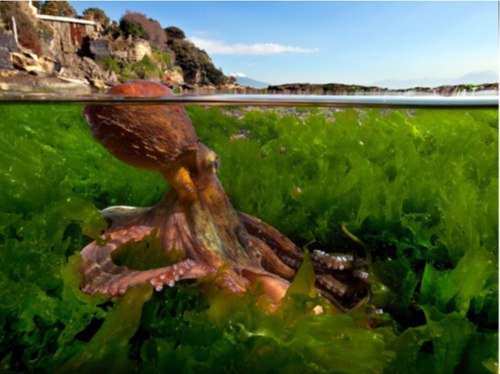
(via NatGeo)
(Also on FtB)

I am an academic researcher in Immunology and Infectious Disease; I have a general passion for science and scientific thought, and value science education tremendously.
Until the beginning of 2003, I was a believer. The belief was not taught, but came naturally to me as a consequence of the environment I grew up in. I was born to and raised by parents who practise the Hindu religion. As a matter of fact, to my parents, the Hindu religion (I avoid the term ‘Hinduism’) was not at all about the kind of teeth-gnashing, attention-clamoring, intemperate, uncivil hooliganism that has become the face of Hindu-ism in modern India. To them, it was a philosophy; a unifying theme of ‘One god – many manifestations’ – that easily included the god-heads of other religions of the world; a kind, understanding, all-embracing way of life, that taught temperance, the value of life and love, and worship through discharge of duties to the fellow human being. It was such a basic and deep understanding that they never stood much on ceremonies and rituals. Growing up in this environment, I never really felt any clash between my spirituality and my science, because I felt that the two belonged to two completely different non-intersecting planes.
It was in the past eight years or so that I acutely became aware of a disconnect. I am not ashamed to admit that this possibly resulted from three major life events: (a) getting married to a wonderful woman who is a non-believer, (b) both of us moving to the US, and (c) being introduced to PZ Myers’ Pharyngula by my wife – the last two events being of seminal importance. In the US, I was far away from the overly-pervasive faith- and belief-laden environment of home – which helped. My eyes were opened to the contemporary world. The Pharyngula posts, relentless discussions, my introduction to the erudite, reasoned writings of Dawkins and Hitchens – all contributed equally to shape the way I see the world now, by making me aware, pushing me to question my beliefs, burning away my brain-fog of wishy-washy spirituality, and administering a healthy dose of rationality and skepticism. In fact, it wouldn’t perhaps be inappropriate to consider myself a “Born Again” Atheist, given how utterly radically I was transformed.
What an awakening it was! Not aware of anything more than undercurrents of Hindu and Islamic fundamentalism at home, I saw and learnt to recognize the horrible face and full import of religious fundamentalism and all the cesspits of human detritus that accompany it, such as hatred, bigotry, misogyny, homophobia and so forth. I found it grossly offensive to my sense of what is right. I saw people killing and being killed in the name of religion; I found a growing sentiment of ‘my religion is the best; the rest are all hogwash’. I watched with horror religious observances taking such precedence in people’s lives that they oftentimes forgot, or started ignoring, the basic, fundamental qualities that make us human, including logic and reason. I was shocked and amazed to find the so-called religious leaders tout faith as the panacea to all problems, when clearly blind, unreasoning faith was inciting more hatred and mindless violence in many parts of the world. All very different from the concept of faith I had grown up with. It shook the foundations of my beliefs, and I started deconstructing religion with reason. Soon it all came away unraveled.
I thought, “This cannot be right! If there is a God who cares, this is not the kind of madness that should be pervading mankind!” More and more I looked around, I couldn’t find any evidence for the existence of any god, only the very human quality of post hoc rationalizations leading to flawed arguments for the assumed presence of a deity. Nothing beyond figments of very human and very limited imagination, it occurred to me. I also realized that religion had nothing to do with a higher power or divinity. Instead, it was fraught with the basest human inequities, craze for power, greed, lust, subjugation through fear and guilt. The rest was all myths built by humans around this core to give it a lasting aura of respectability and prestige. And this was not unique to any particular religion; all of them, Hinduism, Judeo-Christianity, Islam, even lesser-known religions of the world, were full of hypocrisy and glaring inconsistencies. I came to understand that morality and ethics, in order to be viable guidelines for a way of life, did not really need the crutches of religion and observances; on their own, they could survive as eminently sound, logical and reasonable practices to build a life around.
It did not take me long thereafter, to renounce any contact with religion. What helped steel my resolve was a sense of betrayal by my parents, my country, my upbringing, my shielded existence until this point. Nothing in my prior 30 years of life had prepared me for this reality; nothing had truly opened my eyes and inculcated any questioning attitude. Nothing ever goaded me to see the now-obvious disconnect between my science education and the quavering tendrils of my erstwhile faith. I felt ashamed, small and inadequate.
My denouncing make-believe gods and coming out as an atheist must have pained my parents, although they were gracious enough to leave me to my thoughts, rather than try to impose theirs on mine. But even today, my mother keeps trying to reignite that spark of faith in me. But never again. More and more I look at the world today, atrocities fomented (and sanctioned) by the religions and committed by the religious zealots come to the fore. To find nothing wrong with religion is living in a state of active denial, a practice many of the so-called ‘religious moderates’ indulge in – and that includes my parents. They feel that people who incite violence and hatred in the name of religion are not the truly religious; the truly religious would focus on the messages of peace, non-violence, brotherhood, love and duty, central to most religions. Note that these lofty ideals are occasionally embraced by the religions when it suits their purpose. And to think that those ideals represent the whole idea of religious practices is, at best, delusional thinking, and represents the No True Scotsmen fallacy.
I am often asked by friends and family why I choose to denounce religion so stridently (Yes, I am a Gnu Atheist!), why I can’t simply ignore the perversions of religion, and let everyone choose what they want to believe in – even if I don’t believe in religion or any god. I found out long ago that I cannot change anybody else, except myself. As a working scientist, I deal with empirical evidence. There is no evidence for existence of a god, any god, but there is plenty of evidence that the responsibility for much of the plight of human beings in today’s world devolves directly on religious belief and blind adherence to dogma. That is the core problem. Religion cannot submit itself to logical enquiry; it demands blind acceptance, ‘faith’ and unthinking acquiescence to utterly ridiculous, often outdated, and superstitious belief systems and traditions.
The nature of religious belief is so insidious, that it needs to pervade, to spread like a cancer away from its source. An astonishing majority of the population of believers is deeply busy in trying to disseminate their odious doctrine to others, and none-too-gently, too! It is more often ‘My religion is better than yours, so convert or die’ kind of treatment, or it is done on the sly – ‘Want medical care? Come to Jesus’ kind of way. Religious indoctrination has progressed to such ludicrous levels that the ‘faithful’ often pull out the ‘religious belief’ card at every possible instance to explain their intransigence and imperviousness to common sense. They are trying – very actively – to spread their brand of stupidity to education, healthcare, politics, and other walks of life. If this is not actively countered, it will end up destroying our basic humanity.
Kausik Datta
United States

The great ferocious talent of Christopher Hitchens is gone — he died last night of complications from esophageal cancer. We knew him well; that is, he was one of those people who opened himself up so thoroughly, who expressed himself so excellently, who had a personality so strong, that millions of us can hold him in our mind’s eye. I can see him now — there’s a glass in his hand, his eyes are calm and steady, and he’s speaking in measured tones and with flawless English sentences with passion and reason perfectly intertwined. Even if I didn’t agree with him, I’d be standing awed and respectful before his clarity and elegance.
But I do not say farewell to Hitch. I do not say “rest in peace”. I definitely do not say that he has gone to a better place. I actually find myself already bracing myself for the next sign of deep disrespect that is destined to appear soon: the hackneyed political cartoon that draws him standing at the pearly gates.
Hitch is dead. We are a diminished people for the loss. There can be and should be no consolation, no soft words that encourage an illusion of heavenly rescue, no balm of lies. We should feel as we do with every death, that a part of us has been ripped from our hearts, and suffer pain and grief — and we are reminded that this is the fate we all face, that someday we too will die, and that we are all “living dyingly”, as Hitch put it so well.
As atheists, I think none of us can find solace in the cliches or numbness in the delusion of an afterlife. Instead, embrace the fierce strong emotions of anger and sorrow, feel the pain, rage against the darkness, fight back against our mortal enemy Death, and live exuberantly while we can. Confront mortality clear-eyed and pugnacious, uncompromising and aggressive.
It’s what Hitch would have wanted of us.
It’s how Hitch lived.

All it took was one post, and I was enraptured by the sweetness and light.
I’ll start promoting Newt tomorrow. It’s a small first step.

Hawa Akther Jui wanted to go to college and get a degree. Her husband, Rafiqul Islam, disapproved. So he tied her up, gagged her, and chopped off all of the fingers on her right hand.
I won’t just blame Islam, though. All the patriarchal religions are disgusting.
The one scrap of salvation in this story lies in the human response: Hawa Akther Jui is learning to write with her left hand.

A few weeks ago, PLoS One published a paper on the observation of preserved chitin in 34 million year old cuttlebones. Now the Institute for Creation Research has twisted the science to support their belief that the earth is less than ten thousand years old. It was all so predictable. It’s a game they play, the same game they played with the soft tissue preserved in T. rex bones. Here’s how it works.
Compare the two approaches, science vs. creationism. The creationists basically insert one falsehood, generate a ludicrous conflict, and choose the dumbest of the two alternatives.
|
The Scientific Approach ↓ ↓ find traces of organic material in ancient fossils ↓ Cool! We have evidence of ancient biochemistry! ↓ Science! |
The Creationist Approach ↓ declare it impossible for organic material to be ancient ↓ steal other people’s discovery of organic material in ancient fossils ↓ Cool! Declare that organic material must not be ancient, because of step 1, which we invented ↓ Throw out geology, chemistry, and physics because they say the material is old ↓
|
You see, the scientists are aware of the fact that organic materials degrade over time, but recognize that we don’t always know the rate of decay under all possible conditions. When we find stuff that hasn’t rotted away or been fully replaced by minerals, we’re happy because we’ve got new information about ancient organisms, and we may also be able to figure out what mechanisms promoted the preservation of the material.
The creationists start with dogma — in this case, a false statement. They declare
Chitin is a biological material found in the cuttlebones, or internal shells, of cuttlefish. It has a maximum shelf life of thousands of years…
and
Because of observed bacterial and biochemical degradation rates, researchers shouldn’t expect to find any original chitin (or any other biomolecule) in a sample that is dozens of millions of years old–and it therefore should be utterly absent from samples deposited hundreds of millions of years ago. Thus, the chitin found in these fossils refutes their millions-of-years evolutionary interpretation, just as other fossil biomolecules already have done.
But wait. How do they know that? The paper they are citing says nothing of the kind; to the contrary, it argues that while rare, other examples of preserved chitin have been described.
Detection of chitin in fossils is not frequent. There are reports of fossil chitin in pogonophora, and in insect wings from amber. Chitin has also been reported from beetles preserved in an Oligocene lacustrine deposit of Enspel, Germany and chitin-protein signatures have been found in cuticles of Pennsylvanian scorpions and Silurian eurypterids.
So the paper is actually saying that the “maximum shelf life” of chitin is several tens of millions of years. And then they go on to describe…chitin found in Oligocene cuttlefish, several tens of millions of years old. The creationists are busily setting up an imaginary conflict in the evidence, a conflict that does not exist and is fully addressed in the paper.
The creationists do try to back up their claims, inappropriately. They cite a couple of papers on crustacean taphonomy where dead lobsters were sealed up in anoxic, water- and mud-filled jars; they decayed. Then they announce that there’s only one way for these cuttlebones to be preserved, and that was by complete mineralization, and the cuttlebones in the PLoS One paper were not mineralized.
…mineralization–where tissues are replaced by minerals–is required for tissue impressions to last millions of years. And the PLoS ONE researchers verified that their cuttlebone chitin was not mineralized.
Funny, that. You can read the paper yourself. I counted 14 uses of the words “mineralized” and “demineralized”. They state over and over that they had to specifically demineralize the specimens in hydrochloric acid to expose the imbedded chitin. And of course the chitin itself hadn’t been mineralized, or it wouldn’t be chitin anymore! Did the creationists lie, or did they just not understand the paper?
The scientists also do not claim that the chitin has not been degraded over time. They actually document some specific, general properties of decay in the specimens.
β-chitin is characterized by parallel chains of chitin molecules held together with inter-chain hydrogen bonding. The OH stretching absorbance, at about 3445 cmâ1 in extant chitin, is diminished in the fossil and shifted to lower wavenumbers, showing that the specimen is losing OH by an as yet undetermined mechanism. The N-H asymmetric stretching vibration is shifted to slightly lower wavenumbers, showing that it is no longer hydrogen bonding exactly as in extant specimens. Changes in the region 2800-3600 cmâ1 indicate that biomolecules have been degraded via disruption of interchain hydrogen bonds.
So, yes, the creationists seem to have rather misrepresented what the paper said. Here’s another blatant example of lying about the contents of the paper.
The question they did not answer, however, is why the original organic chitin had not completely fallen apart, which it would have if the fossils with it were 34 million years old…
Actually, they did. A substantial chunk of the discussion was specifically about that question, a consideration of the factors that contributed to the preservation. It was a combination of an anoxic environment, the presence of molecules that interfered with the enzymes that break down chitin, and the structure of cuttlebone, which interleaves layers containing chitin with layers containing pre-mineralized aragonite.
In vivo inorganic-organic structure of the cuttlebone, in combination with physical and geochemical conditions within the depositional environment and favorable taphonomic factors likely contributed to preservation of organics in M. mississippiensis. Available clays within the Yazoo Clay in conjunction with suboxic depositional environment may have facilitated preservation of original organics by forming a physical and geochemical barrier to degradation. One key to the preservation of organic tissues, in particular chitin and chitosan, is cessation of bacterial degradation within environments of deposition. Bacterial breakdown of polymeric molecules is accomplished through activities of both free extracellular enzymes (those in the water column) and ektoenzymes (those on the surface of the microbial cell) such as chitinases. Chitinases function either by cleaving glycosidic bonds that bind repeating N-acetyl-D-glucosamine units within chitin molecules or by cleaving terminal N-acetyl-D-glucosamine groups. These enzymes adsorb to the surface of clay particles, which inactivates them. Strong ions in solution like iron may act in the same manner. Once bound to functional groups within these polymeric molecules, Fe2+ ions prevent specific bond configuration on the active-site cleft of specific bacterial chitinases and prevents hydrolysis, thus contributing to preservation.
Organic layers within cuttlebones are protected by mineralized layers, similar to collagen in bones, and this mineral-organic interaction may also have played a role in their preservation. Specimens of M. mississipiensis show preserved original aragonite as well as apparent original organics. These organics appear to be endogenous and not a function of exogenous fungal or microbial activity. Fungi contain the γ form of chitin not the β allomorph found in our samples. Also, SEM analyses shows there is no evidence of tunneling, microbes, or wide-spread recrystallization of the aragonite. Therefore the chitin-like molecules detected in fossil sample are most likely endogenous. Similar to collagen in bone, perhaps, organics could not be attacked by enzymes or other molecules until some inorganic matrix had been removed.
Like I always say, never ever trust a creationists’ interpretation of a science paper: they don’t understand it, and they are always filtering it through a distorting lens of biblical nonsense. They make such egregious errors of understanding that you’re always left wondering whether they are actually that stupid, or that sleazily dishonest. Or both.
But imagine if the creationists hadn’t screwed up royally in reading the paper, if they had actually found an instance of scientists being genuinely baffled by a discovery that should not be. What if there was actually good reason to believe that chitin could not last more than ten thousand years?
Then the only sensible interpretation of this observation of 34 million year old chitin would be that the prior estimation of the shelf-life of chitin was wrong, and that it could actually last tens of millions of years. What the creationists want to do is claim that that minor hypothetical is actually correct, and that instead the entirety of nuclear physics, geology, radiochemistry, and modern cosmology is wrong. On the one hand, uncertain details about the decay of one organic molecule; in the other, entire vast fields of science, already verified, and with complex modern technologies built on their operation…and which hand would the creationists reject? The trivial one, of course.
I’m leaning towards “stupid” as the explanation for their bad arguments.
Oh, after I started this dissection, I discovered someone had already beaten me to it: here’s another analysis of the creationist misinterpretations.
(Also on FtB)

A few weeks ago, PLoS One published a paper on the observation of preserved chitin in 34 million year old cuttlebones. Now the Institute for Creation Research has twisted the science to support their belief that the earth is less than ten thousand years old. It was all so predictable. It’s a game they play, the same game they played with the soft tissue preserved in T. rex bones. Here’s how it works.
Compare the two approaches, science vs. creationism. The creationists basically insert one falsehood, generate a ludicrous conflict, and choose the dumbest of the two alternatives.
|
The Scientific Approach ↓ ↓ find traces of organic material in ancient fossils ↓ Cool! We have evidence of ancient biochemistry! ↓ Science! |
The Creationist Approach ↓ declare it impossible for organic material to be ancient ↓ steal other people’s discovery of organic material in ancient fossils ↓ Cool! Declare that organic material must not be ancient, because of step 1, which we invented ↓ Throw out geology, chemistry, and physics because they say the material is old ↓
|
You see, the scientists are aware of the fact that organic materials degrade over time, but recognize that we don’t always know the rate of decay under all possible conditions. When we find stuff that hasn’t rotted away or been fully replaced by minerals, we’re happy because we’ve got new information about ancient organisms, and we may also be able to figure out what mechanisms promoted the preservation of the material.
The creationists start with dogma — in this case, a false statement. They declare
Chitin is a biological material found in the cuttlebones, or internal shells, of cuttlefish. It has a maximum shelf life of thousands of years…
and
Because of observed bacterial and biochemical degradation rates, researchers shouldn’t expect to find any original chitin (or any other biomolecule) in a sample that is dozens of millions of years old—and it therefore should be utterly absent from samples deposited hundreds of millions of years ago. Thus, the chitin found in these fossils refutes their millions-of-years evolutionary interpretation, just as other fossil biomolecules already have done.
But wait. How do they know that? The paper they are citing says nothing of the kind; to the contrary, it argues that while rare, other examples of preserved chitin have been described.
Detection of chitin in fossils is not frequent. There are reports of fossil chitin in pogonophora, and in insect wings from amber. Chitin has also been reported from beetles preserved in an Oligocene lacustrine deposit of Enspel, Germany and chitin-protein signatures have been found in cuticles of Pennsylvanian scorpions and Silurian eurypterids.
So the paper is actually saying that the “maximum shelf life” of chitin is several tens of millions of years. And then they go on to describe…chitin found in Oligocene cuttlefish, several tens of millions of years old. The creationists are busily setting up an imaginary conflict in the evidence, a conflict that does not exist and is fully addressed in the paper.
The creationists do try to back up their claims, inappropriately. They cite a couple of papers on crustacean taphonomy where dead lobsters were sealed up in anoxic, water- and mud-filled jars; they decayed. Then they announce that there’s only one way for these cuttlebones to be preserved, and that was by complete mineralization, and the cuttlebones in the PLoS One paper were not mineralized.
…mineralization—where tissues are replaced by minerals—is required for tissue impressions to last millions of years. And the PLoS ONE researchers verified that their cuttlebone chitin was not mineralized.
Funny, that. You can read the paper yourself. I counted 14 uses of the words “mineralized” and “demineralized”. They state over and over that they had to specifically demineralize the specimens in hydrochloric acid to expose the imbedded chitin. And of course the chitin itself hadn’t been mineralized, or it wouldn’t be chitin anymore! Did the creationists lie, or did they just not understand the paper?
The scientists also do not claim that the chitin has not been degraded over time. They actually document some specific, general properties of decay in the specimens.
β-chitin is characterized by parallel chains of chitin molecules held together with inter-chain hydrogen bonding. The OH stretching absorbance, at about 3445 cm−1 in extant chitin, is diminished in the fossil and shifted to lower wavenumbers, showing that the specimen is losing OH by an as yet undetermined mechanism. The N-H asymmetric stretching vibration is shifted to slightly lower wavenumbers, showing that it is no longer hydrogen bonding exactly as in extant specimens. Changes in the region 2800–3600 cm−1 indicate that biomolecules have been degraded via disruption of interchain hydrogen bonds.
So, yes, the creationists seem to have rather misrepresented what the paper said. Here’s another blatant example of lying about the contents of the paper.
The question they did not answer, however, is why the original organic chitin had not completely fallen apart, which it would have if the fossils with it were 34 million years old…
Actually, they did. A substantial chunk of the discussion was specifically about that question, a consideration of the factors that contributed to the preservation. It was a combination of an anoxic environment, the presence of molecules that interfered with the enzymes that break down chitin, and the structure of cuttlebone, which interleaves layers containing chitin with layers containing pre-mineralized aragonite.
In vivo inorganic-organic structure of the cuttlebone, in combination with physical and geochemical conditions within the depositional environment and favorable taphonomic factors likely contributed to preservation of organics in M. mississippiensis. Available clays within the Yazoo Clay in conjunction with suboxic depositional environment may have facilitated preservation of original organics by forming a physical and geochemical barrier to degradation. One key to the preservation of organic tissues, in particular chitin and chitosan, is cessation of bacterial degradation within environments of deposition. Bacterial breakdown of polymeric molecules is accomplished through activities of both free extracellular enzymes (those in the water column) and ektoenzymes (those on the surface of the microbial cell) such as chitinases. Chitinases function either by cleaving glycosidic bonds that bind repeating N-acetyl-D-glucosamine units within chitin molecules or by cleaving terminal N-acetyl-D-glucosamine groups. These enzymes adsorb to the surface of clay particles, which inactivates them. Strong ions in solution like iron may act in the same manner. Once bound to functional groups within these polymeric molecules, Fe2+ ions prevent specific bond configuration on the active-site cleft of specific bacterial chitinases and prevents hydrolysis, thus contributing to preservation.
Organic layers within cuttlebones are protected by mineralized layers, similar to collagen in bones, and this mineral-organic interaction may also have played a role in their preservation. Specimens of M. mississipiensis show preserved original aragonite as well as apparent original organics. These organics appear to be endogenous and not a function of exogenous fungal or microbial activity. Fungi contain the γ form of chitin not the β allomorph found in our samples. Also, SEM analyses shows there is no evidence of tunneling, microbes, or wide-spread recrystallization of the aragonite. Therefore the chitin-like molecules detected in fossil sample are most likely endogenous. Similar to collagen in bone, perhaps, organics could not be attacked by enzymes or other molecules until some inorganic matrix had been removed.
Like I always say, never ever trust a creationists’ interpretation of a science paper: they don’t understand it, and they are always filtering it through a distorting lens of biblical nonsense. They make such egregious errors of understanding that you’re always left wondering whether they are actually that stupid, or that sleazily dishonest. Or both.
But imagine if the creationists hadn’t screwed up royally in reading the paper, if they had actually found an instance of scientists being genuinely baffled by a discovery that should not be. What if there was actually good reason to believe that chitin could not last more than ten thousand years?
Then the only sensible interpretation of this observation of 34 million year old chitin would be that the prior estimation of the shelf-life of chitin was wrong, and that it could actually last tens of millions of years. What the creationists want to do is claim that that minor hypothetical is actually correct, and that instead the entirety of nuclear physics, geology, radiochemistry, and modern cosmology is wrong. On the one hand, uncertain details about the decay of one organic molecule; in the other, entire vast fields of science, already verified, and with complex modern technologies built on their operation…and which hand would the creationists reject? The trivial one, of course.
I’m leaning towards “stupid” as the explanation for their bad arguments.
Oh, after I started this dissection, I discovered someone had already beaten me to it: here’s another analysis of the creationist misinterpretations.
(Also on Sb)