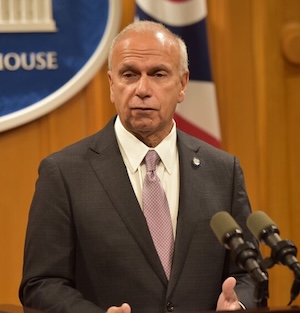
This is the notorious professionalized liberal making machine
The Secretary of the US Department of Transportation is an airhead lawyer and former reality-TV “star” with no qualifications in transportation, Sean Duffy, but hey, you knew because he has a high appointment in the Trump administration that he was unqualified and incompetent. At least it’s better than his previous sinecure as the acting administrator of NASA! The last I heard about Duffy he was advising us to take advantage of the long delays at airports by doing calisthenics in the terminals. That’s just the kind of guy he is.
What I didn’t know is that he roped in a bunch of corporate sponsors who wanted to curry favor with the Trump administration, like Boeing, Toyota, Shell, United Airlines, Comcast, Royal Caribbean, Enterprise Rent-A-Car and Lyft to fund his summer vacation. He, his wife, and his 9 kids got into a gigantic RV with a following camera crew to drive all around the US for 6 weeks or so. Boeing and Toyota each coughed up a million dollars to pay for the extended joy ride.
I haven’t had a vacation in years. Maybe I’d be able to if just one of those corporations gave me a million dollars. Unfortunately, I’m not a corrupt opportunist like Duffy, and don’t have any influence on our government.
So anyway, one of the purported justifications for this trip was to visit colleges, for his kids who were of age to enter college. They visited Harvard. His daughter Paloma wants to go to school there. Duffy has opinions.
Sean Duffy tells his daughter she cannot go to Harvard because they have "professionalized figuring out how they can take good young girls and corrupt their minds" pic.twitter.com/opCB02jPEv
— FactPost (@factpostnews) August 19, 2026
After declaring that they were a highly conservative family and that they had raised their kids in a strictly Catholic environment, he announces that she cannot go to Harvard because he didn’t believe that Harvard offers a well-rounded education.
His wife, Rachel Campos-Duffy, declares We spent a lot of time nurturing and providing formation for our kids, giving them an environment where they are steeped in faith and values, so the idea of dropping her off at a place where they would undermine that or undo all those things makes me worried.
Because he is a profoundly stupid man, Sean chimes in And again I don’t want them to get one viewpoint, I want them to get a lot of different viewpoints, but I don’t want them fed only one viewpoint that is contrary to the way my kids were raised,
completely oblivious to the fact that he has just contradicted his wife and himself in one sentence. Because he is truly, deeply, stupid and unthinking. He then claims that Harvard has professionalized figuring out how they can take good young girls and corrupt their minds
.
Uh, I’m not the greatest fan of Harvard (I think they are over-rated and too rich for their own good, and that we have numerous great institutions of higher education all over the country), but Harvard is not particularly liberal, and they are not a machine with the goal of churning out liberal students. The liberalism is a side-effect of getting a lot of different viewpoints
. Harvard has a lot of prestige, a lot of money, and has a privileged status in the world; if any of my kids had had the opportunity to go there, I would have encouraged them, although it probably would have bankrupted us. Duffy wouldn’t have that problem. He’s just an ignorant goober attached to an administration that hates education.
I am wondering about poor Paloma. What shithole school would Sean and Rachel like to ship their daughter off to? I hope it’s not Liberty University, but that’s probably not Catholic enough for them. Sean is a graduate of Saint Mary’s University of Minnesota, a private Catholic college which I wouldn’t describe as a shithole, but it probably doesn’t have the status the Duffys would want. Notre Dame? Bad news there, they expose their students to a healthy diverse student body, and she’d probably end up learning about feminism and equality and reason, all those things the Duffy family opposes.
I’d recommend that she attend the University of Minnesota Morris, if Harvard is off the table. We don’t have a professionalized liberalizing process here, we just let students be who they want to be, and help them get the education they need. Paloma might just fit in perfectly here.