
A while back, two physicists, Paul Davies and Charles Lineweaver, announced their explanation for cancer with a novel theory, which is theirs, that cancers are atavisms recapitulating in a Haeckelian reverse double backflip their premetazoan ancestry. They seemed very proud of their idea.
I was aghast, as you might guess. They even claimed that human embryos go through a fish/amphibian stage with gills, webbed feet, and tails in a pattern of Haeckelian development. They do not understand evolution, development, or cancer, facts that were apparent even in the absence of their admission that they had no prior knowledge, and it was freaking embarrassing to see two smart guys with a measure of legitimate prestige in their own specialties charging off into another discipline with such crackpot notions.
Now they’ve done it again, repeating the same claims all over again. And worse, they’ve now published it in the journal Physical Biology, under the title “Cancer tumors as Metazoa 1.0: tapping genes of ancient ancestors”.
The genes of cellular cooperation that evolved with multicellularity about a billion years ago are the same genes that malfunction to cause cancer. We hypothesize that cancer is an atavistic condition that occurs when genetic or epigenetic malfunction unlocks an ancient ‘toolkit’ of pre-existing adaptations, re-establishing the dominance of an earlier layer of genes that controlled loose-knit colonies of only partially differentiated cells, similar to tumors. The existence of such a toolkit implies that the progress of the neoplasm in the host organism differs distinctively from normal Darwinian evolution. Comparative genomics and the phylogeny of basal metazoans, opisthokonta and basal multicellular eukaryotes should help identify the relevant genes and yield the order in which they evolved. This order will be a rough guide to the reverse order in which cancer develops, as mutations disrupt the genes of cellular cooperation. Our proposal is consistent with current understanding of cancer and explains the paradoxical rapidity with which cancer acquires a suite of mutually-supportive complex abilities. Finally we make several predictions and suggest ways to test this model.
Oh. My. Gob. So…much…wrongness.
I read the paper. I cringed. This blogger read the summaries. He cringed. I think anyone who is the least bit informed about biology will feel the same way…but this crap will continue to get published in legitimate journals because…because…hey, physicist! They must know something we don’t! (Well, they do know things we don’t, but we know things they don’t, and knowledge of cosmology doesn’t translate into knowledge of molecular biology. Or vice versa.)
The conceits of the paper are 1) a lack of knowledge about cellular evolution that allows them to posit evidence-free scenarios; 2) peculiar notions about molecular biology that allow them to imagine whole invisible networks of primeval genes lurking as atavisms beneath the polished exteriors of urbane and civilized modern cells; and 3) bizarre misconceptions about cancer causing mutations that they can’t back up with a single specific example.
So let’s start with the first objection, the weird evolutionary history enshrined in the title. They postulate a step in evolution just above the colonial stage, with groups of cells having marginal specializations — which is reasonable, up to a point.
The transition from unicellular to complex multicellular organisms took place over an extended period starting at least 1 billion years ago (Hedges and Kumar 2009). Importantly, ‘advanced’ metazoan life of the form we now know, i.e. organisms with cell specialization and organ differentiation, was preceded by colonies of eukaryotic cells in which cellular cooperation was fairly rudimentary, consisting of networks of adhering cells exchanging information chemically, and forming self-organized assemblages with only a moderate division of labor. These proto-metazoans were effectively small, loosely-knit ecosystems that fell short of the complex organization and regulation we associate with most modern metazoans. In short, proto-metazoans, which we dub Metazoans 1.0, were tumor-like neoplasms.
Aaargh. That last sentence. It’s like announcing a theory of human evolution which has as a premise that chimpanzees are mentally retarded people — it manages to insult and mischaracterize both chimps and people with mental handicaps. No, early metazoans were healthy, functional, successful organisms. Neoplasms are abnormal masses of tissue produced by excessive reproduction of cells with broken regulatory machinery. You don’t get to declare the relevance of your analogy by simply declaring both sides equivalent; there is no reasonable, evidence-based rationale for declaring early metazoans to be a bunch of tumors.
Davies and Lineweaver don’t provide any evidence for their evolutionary history, either. It’s really a simplistic just-so story in which they claim metazoan precursors were just like cancers so that they can claim that cancer uncovers a lurking atavism which proves that metazoan precursors were just like cancers. It’s so circular I got dizzy.
Which leads us to their problem #2: ‘atavisms’. They’ve got this vision of wedging poor old Darwin into supporting a hierarchy. Like Haeckel’s version of the story, we’re built of accumulated layers of new traits, where old ones are buried and fossilized beneath new genes, and all it takes is a little erosion to expose well-preserved relics. It’s all terminal addition, with a little nod to some modification of earlier stages of our evolution.
It is, however, in the nature of Darwinian evolution that life builds opportunistically on what has gone before. The genetic apparatus of the new Metazoa 2.0 was overlain on the old genetic apparatus of Metazoa 1.0. The genes of Metazoa 1.0 were tinkered with where possible, and suppressed where necessary. But many are still there, constituting a robust toolkit for the survival, maintenance and propagation of non- differentiated or weakly-differentiated cells—‘tumors’—and when things go wrong (often in senescence of the organism) with the nuanced overlay that characterizes Metazoa 2.0, the system may revert to the ancient, more robust way of building multicellular assemblages—Metazoa 1.0.
Aaargh. No. Genes that are suppressed decay and are lost, not lurking. Genes that remain and are tinkered with by mutations acquire new functions, lose old ones, and are assembled into new, coevolving networks. If they’re still there, they’re still part of the current regulatory pathways; they’re not in a separate ‘layer’, they’re not waiting, unmodified, to blithely re-enact ancestral states. No, really, you can’t take one of your cells, switch off a few genes, and set it free in the ocean to swim off and follow its primitive lifestyle. Cancers are not dreaming of protistan independence.
Again, they’re playing the same trick: postulating a condition that would make their model work, because it would make the model work, not because they actually have evidence that this is how gene networks function.
Along the way, they try to argue with standard models of cancer formation which assume, for instance that cell proliferation is a product of broken regulatory brakes, not activation of a sleeper program to reinvoke an ancestral state. Davies and Lineweaver point out that cancer cells actually have patterns of integration and communication that promote survival — how could that be if they were merely rogue cells rampaging madly through the body? I wanted to scream at them, “because they are slightly modified metazoan cells still, you blinkered crackpots!” Cancer cells can execute growth-promoting activities like secreting signals that encourage a blood supply to infiltrate the tumor because they are intrinsically multicellular, not because they are reverting to a cunning barbarism.
They also object to a model they call “internal Darwinism”: that cancer cells have the suite of traits that they do not because of some internal coherent plan, but because they experience random mutations, many of which kill the cancer cells, but we only see the successful combinations of traits that produce proliferative, invasive tumors. And they claim to have evidence against that model. They don’t.
Our explanation of cancer as an atavism that short- circuits the Metazoa 2.0 regulatory system and unleashes the suppressed Metazoa 1.0 system receives support from the amazing pleiotropy of some enzymes, and, as has been realized recently, some micro-RNAs (miRNAs). Thus the enzyme COX-2 and the miRNA known as miR-31 have been found to control not just one, but a collection of tumorigenic factors. Such remarkable efficiency and economy would be deeply puzzling if it arose from a few decades of internal Darwinism, but makes perfect sense if it had been honed by evolution over an extended period of time to form an optimized package that constitutes a type of on–off switch for a set of previously adaptive traits.
But…but…pleiotropy is an essentially universal property of regulatory genes! We expect this kind of widely interacting behavior. And why would you consider expression of an interaction between two components of a regulatory system to be a property of “previously adaptive traits” rather than a property of currently functional and adaptive traits? This kind of argument resolves nothing in their model.
Let’s now consider that third problem I mentioned, that they don’t seem to be able to discuss how known cancer mutations work, and don’t give any specific examples of atavistic gene circuitry exposed by a modified oncogene. I’ll be specific; let’s use Rb as an example.
Rb is a known oncogene, that is, a gene that when modified or broken can cause one step in the path towards cancer. It’s normal role in healthy cells is as a regulator of the cell cycle.
Dividing cells follow a cycle. Most cells are in G1 (Gap 1), doing what cells do, and then under control of clock-like changes in specific genes, they can enter the S (synthesis) phase, when their DNA is replicated, followed by a G2 phase (gap 2), and than an actively dividing mitotic or M phase. Each of these phases has a checkpoint where a battery of proteins survey the state of the cell and either permit the process to proceed, or block it if there are problems. In extreme cases, the checkpoint proteins can determine that the cell is so irreparably damaged that the only option is suicide, and the cell will self destruct.
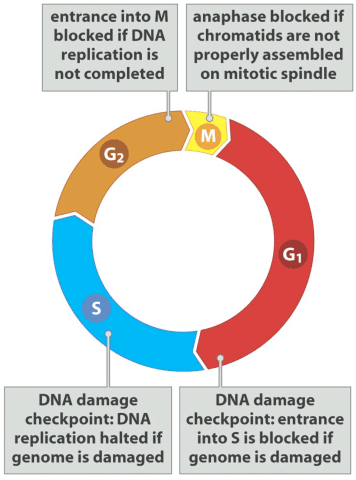
This is a process that cancer needs to disrupt if it is to continue; cancer cells typically have damaged DNA or aberrant signals flying everywhere that ought to be triggering all kinds of alarms in the checkpoint system, and either stopping cell division immediately, or activating repair mechanisms that fix the damage, or just killing the corrupted cell immediately.
One of the most critical points in this cycle is called the R or Restriction point. Prior to this point, the cell is sensitive to external signals that can induce cell division; after this point, the cell no longer pays attention to those signals, because it is on a rigidly programmed track towards completing cell division. This is that last fateful moment of decision before the cell commits to dividing.
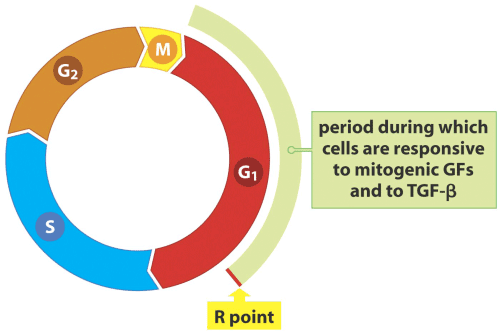
Standing at this point is an essential guardian of the cell cycle, pRb. This protein is an inhibitor of cell division, acting as a tumor suppressor gene. It’s the guard at the gate, and it must be satisfied that all is well in the cell before it will allow division to continue. It’s default mode is to stop cell division, but it recieves signals from a wide array of pathways that can tell it to stand down and let the process continue. Trust me, control of this gene is complicated because it is so essential to well-regulated cell division: look at it here, standing sentry just above the yellow R point, with all these other pathways talking to it:
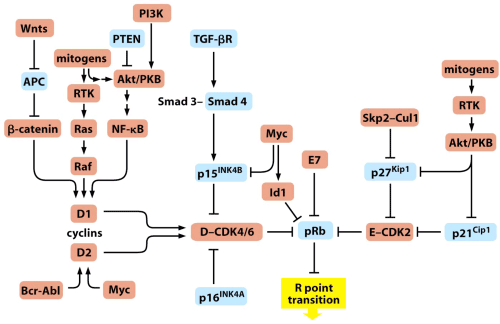
I think you can see how this gene can contribute to cancer when it’s defective. Shoot the guard, open the gate wide, and allow cell divisions to proceed unchecked.
What I don’t see, and what doesn’t fit the Davies/Lineweaver model, is where the emergent atavisms are. The components of the cell cycle that are disinhibited by loss of this protein are not hidden away and are not unused, primitive versions of cell cycle regulators; they are simply the contemporary regulators with an essential limiting factor removed.
This is not to say that the evolutionary history of the gene is unimportant. There have been several phylogenetic studies of Rb; it’s present in most eukaryotes (and some homologous sequences have been identified in the Archaea!), single-celled as well as multicellular, but it does show increasing complexity in its function in multicellular organisms. It is simply not the case, however, that you can find “layers” of Rb function that allow you to peel away modern functions to expose an antique Rb that makes it revert to an ancient pattern of behavior.
Let’s let Davies and Lineweaver get even further from science. Why should we like their model? Because it’s more optimistic than those poopyhead biologists’ ideas!
Given cancer’s formidable complexity and diversity, how might one make progress toward controlling it? If the atavism hypothesis is correct, there are new reasons for optimism. The postulated toolkit of Metazoa 2.0, although admittedly complex, is nevertheless a fixed and finite feature of multicellular life. The number of tools in the kit is not infinite. What one cancer learns cannot be passed on to the next generation of cancers in other patients. Cancer is not going anywhere evolutionarily; it just starts up all over again in the next patient. Although cancer may seem like a perpetually moving target, a given cancer has a strictly limited set of atavistic possibilities open to it. Thus, cancer is a limited and ultimately predictable adversary. This understanding of cancer as a limited atavism should engender optimism among oncologists. The anticipated precision of personalized drug therapies will not be infinite. This view contrasts sharply with the open-ended possibilities for cancer implied by the ‘internal Darwinism’ model.
Scientists shouldn’t be looking for optimism, they should be searching for the truth, which is sometimes going to be grim. So what if the ‘internal Darwinism’ model implies an intimidating number of possibilities? It is what it is. Every cancer is different, every cancer is complicated, and waving your hands and pretending that there is an ancestrally-derived unity of mechanisms under every single cancer doesn’t make it so. Davies and Lineweaver are going to have to do better than parading decades-old evolutionary misconceptions at me to persuade me of their case.
Cao L, Peng B, Yao L, Zhang X, Sun K, Yang X, Yu L (2010) The ancient function of RB-E2F pathway: insights from its evolutionary history. Biol Direct 5:55.
Davies PCW, Lineweaver CH (2012) Cancer tumors as Metazoa 1.0: tapping genes of ancient ancestors. Phys. Biol. 8 015001-015008.
Takemura M (2005) Evolutionary history of the retinoblastoma gene from archaea to eukarya. Biosystems 82(3):266-72.

Hmmm. I wonder what field they specialize in – Newtonian physics? Can’t they see the connections between physics and biology and see what nonsense they’re spouting?
I.e. tumors are porifera, essentially. It’s not nice to insult Sponge Bob.
I have a novel theory in which inertial mass is closely related to gravitational mass. I hypothesize a now-extinct “ur-mass” which is the common ancestor of inertial mass and gravitational mass. This accounts for the similarity of inertial mass and gravitational mass.
One day we may find fossil remnants of ur-mass, but I doubt it; The fossil record is remarkably poor at preserving intrinsic properties.
I don’t know Lineweaver, but Paul Davies has a long track record of this kind of ridiculous crap. He published a piece in New Scientist a few years ago making the argument that rare events must be directed by some force because the chance of them occurring was less than some bizarre computational maximum for the universe he pulled out of his derriere.
This isn’t true.
Cancers are evolutionary results.
They can and often do evolve resistance to the treatments; chemo, radiation, targeteds, and biologicals. This is frequently treatment limiting.
None of which they or their hosts ever saw until biologists invented them.
I have a novel* theory™ that black holes are sentient.
*Actually I read it in a short story.
Chigau! That’s more evidence than Davies has for his theory!
PUUUUBBLLIIIIIIISHH!
I think Davies is a former Templeton fellow/payee.
as a physicist, i am aghast that they have gone so far out of their field of expertise and published crap.
on that note:
P.Z.: what are your thoughts on biological explanations to unite quantum mechanics and relativity? you should publish!1!1!!1!!!
p.s. i would like to submit this song by William Shatner as evidence that skill in one field doesn’t necessarily transfer to skill in other fields.
Proof that socialized education is a plot by the anti-christian atheist legions to make baby jesus cry! If you know better (from educations!) you can’t make up bullshit stories!
But, they might work as atavistic genes if their quantum properties align with the universal oncological paradigm! Because, QUANTUM!
Bravo! It’s always a distinct pleasure to see Prof Myers flexing his magnificent metazoan brain-muscles. I had just read Davies’ article on Dawkins’ website last night, and in my biological ignorance I thought it was fairly impressive…
Aaargh, indeed. Thank-you for taking the time to better educate me!
P.S.
“but it recieves signals from a wide array…”
FYI. I spotted this small typo, Prof Myers. Otherwise, your article appeared to be spotless.
Maybe they should get together with the “balloon animal theory of evolution” guy, or we could aim them at one another for a kook fight. Include Chopra for quantum balloon animals cancer! I bet hilarity would ensue.
Zinc Avenger #3:
“One day we may find fossil remnants of ur-mass, but I doubt it…”
I believe ur-forces may still be detectable, at least in-principle, because the resulting acceleration of modern inertial and gravitational masses has been theorized to be slightly different. We’ll have to wait for the development of accelerometers capable of precision on the order of 0.0000000000000000000000000000000000000000000000000000000000000000000000000000000000000000000000000000000000000000000000000000000000000000000000000000000000000000000000000000000000000000000000000000000000000000000000000000000000000000000000000000000000000000000000000000000000000000000000000000000000000000000000000000000000000000000000000000000000000000000000001.
But these guys are physicists. As Lord Rutherford noted: “All science is either physics or stamp collecting.” It’s pure hubris that a mere stamp collecting biologist should correct some physicists.
Oh dear lord. I have papers in Physical Biology and now I feel soiled.
And it had to be Paul fucking Davies again, didn’t it? Arizona State gave him some ludicrous sinecure ( http://cosmos.asu.edu/ ) as a get-out-of-evidence free card.
I had a chance to talk with him at lunch one time – this was after he’d invited a speaker in who was claiming that Deinococcus radiodurans had evolved to survive interplanetary transport in meteorites. Yes, that’s as dumb as it sounds.
He was very keen on nuking Mars so as to look for underground life in the crater. We tried to object on all the obvious grounds, but he said we were being “sentimental”.
He’s become a crank. Don’t buy his books, don’t pay any attention to his ideas. He’s gone too far off the rails.
Time to tout a classic paper:
The Hallmarks of Cancer.
The updated 2011 version is also linked to in there somewhere.
In the words of Sheldon Cooper: “I’m a physicist, I have a working knowledge of everything in the universe.”
Oh. Dear.
I was under the impression that Physicists had to win a Nobel Prize before they became experts in biology and medicine.
Apparently I was wrong. Mea Culpa.
In a fairer world, they would be required to read and refute all the crank letters to physics departments from people who claim to have disproven general relativity. Furthermore, they would have to do so using only chemistry and the fossil record.
So, PZed poopyhead, when can we look forward to your new paper on Dark Matter, String Theory, and Supersymmetry? I’m sure it has something to do with biological symmetry.
I wonder if the physicists in question would get the point if the favor were returned….?
Is Peter Uhnemann the editor of Physical Biology? Seems like his kind of journal.
I didn’t realise Shatner was a physicist.
It looks to me as though his acting transferred perfectly into singing.
When Davies received the Templeton Award in ’95 it was described as being for “a living individual who has shown extraordinary originality in helping to advance the world’s understanding of God and/or spirituality.” Davies just loves to sit back and speculate about how you can insert God into reality by using scientific concepts. It’s theology-style thinking and he’s gotten a lot of praise for it. Big Questions. “Affirming life’s spiritual dimension.” Wow.
He probably thinks he can sit back and speculate about other Big Questions and get just as much credit and praise. He’s going to figure out cancer. Right.
I’m willing to bet that somewhere in this mess there is something, somewhere, which helps to affirm life’s spiritual dimension.” That has always worked so well for him, he’s bound to want to use it.
I quote the wisdom of Randall Monroe. And am reminded of what happened when Roger Penrose tried to do cosmology.
Oh dear. This is par for the physicists-over-reaching-themselves course for Davies.
I’m sorry to see Charlie Lineweaver joining him. He occasionally makes an appearance on the science program Catalyst and he’s pretty good at presenting physics/cosmology stuff for a general viewer.
Another one bites the dust. Now when I see him I’ll have cause to pause about taking his information straight. As long as he sticks to a narrow path, I’ll regard him as reliable. But any inter-disciplinary diversions will be immediately suspect.
My calculations show conclusively that rare events are so unlikely, that if the universe lasted 100 billion years there would only be eight.
In a possibly vain attempt to defend the honor of physicists, I decided to read PZ’s excerpts of Davis and Lineweaver’s work and post my conclusions before reading PZ’s responses:
(just posting the first bits of each excerpt instead of reprinting the whole thing)
This just seems to me bizarre. There has been a tremendous amount of change in organisms since the first animals appeared. I might possibly accept that some aspects from such ancient organisms might influence some of the behaviors of some modern cancers, but to think that this could be a primary way of understanding the major aspects of cancers just seems weird.
My limited understanding of cancers is that in order for tumors to grow significantly, they have to manage to take advantage of the body’s signaling mechanisms to accelerate the production of blood vessels to supply the growing tumors with nutrients, for example. Accelerating the growth of blood vessels hardly seems to me to be something that can possibly be attributed to a state previous to much cellular differentiation. Pretending that cancers are just a group of atavistic undifferentiated cells seems to me to be a non-starter.
I don’t see how this would work, or what it even means.
Claiming that cancer’s toolkit would be limited to this “Metazoan 1.0” toolkit seems to me to be hopelessly naive. Cancers absolutely evolve over their lifetimes. My understanding is that there is often a tremendous rearrangement of the genome that happens when a cancer takes hold, with lots and lots of mutations occurring. Why would there not be new functionality created from all these mutations? Why would “Metazoan 2.0” genes not be suborned for the purpose of making the cancerous tumor grow faster?
Anyway, now on to read PZ’s responses. Hope I didn’t do too badly…
Forgot to mention that I am a physicist. Hence my attempt in post #28, in case it wasn’t obvious.
“Release the Hounds”,
of Woo,
again.
The comments in the Guardian article range from amusing to scary.
Ever since he supped at the feet of Templeton, Davies has been bouncing around like a demented pinball, commenting on everything/anything.
Does he have a deep seated fear of irrelevance?
michaelbusch
I think you got that backwards, Penrose was, and his prior work still is, very respected in cosmology.
In yet another example of a cosmologist going off the rails, it’s his recent work in neurology that is crankery.
Perhaps Physical Biology was looking to boost their Crank Factor (CF).
One of them was spot on, though. ;-)
having attempted and failed to model myc and bcr-abl in zebrafish I appreciate this
@erikthebassist:
Good catch, and my mistake.
But Penrose’s recent cosmology has been pretty bad too. The “circles in the CMB” stuff was impressively nonsensical.
I.e. tumors are porifera, essentially.
Some of them are referred to as “polyps”. Wouldn’t that make them cnidaria?
Sort of tangentially related to this subject, is it true that some species of animals contain cells that look like unmodified choanoflagellates?
It could be worse, they could be theologians instead of physicists
michaelbusch,
Agreed, which is why I said “was” and “prior work”
:^)
I am awaiting PZ’s monologue on how cellular mitosis causes binary star collapse. Hey, may as well return the favor. Who knows, your paper might even make more sense than theirs!
I always wonder how all that garbage can pass peer review.
roland,
For every peer who submits a terrible paper, there is an equal and opposite peer who will accept it.
All the interesting information was just barely enough to make my head stop hurting from reading the horrible, horrible, short excerpts. And then I tried to read the Guardian article. The tripe was possibly worse in popular journalism prose, and I couldn’t hack it.
F, don’t forget this is a Templeton prize-winner.
In the Guardian, it’s “our theory”, in the journal, it’s “we hypothesize”.
(But I suspect that he knows it’s but a speculative conjecture, and that he’s pandering to notoriety)
*headdesk* Who the hell was the reviewer of this article?! I know no one has time to check everything line-by-line, but the BSness of this paper’s arguments is obvious with even my mathematician-with-tiny-bit-of-microbiology training…
paul (#37):
Sponges have “collar cells”, or “choanocytes”, which resemble choanoflagellates.
I study biophysics and it seems that a lot of (fortunately not published) pseudoscience ends up as pseudobiophysics. Probably in order to avoid the criticism of biologists and physicists by saying that neither are qualified to criticize. For example animal magnetism, energy fields, 2nd law of thermodynamics and evolution, etc. Davies stuff isn’t really a case of that since it doesn’t seem to involve physics, but I still think it’s interesting.
Obligatory Saturday Morning Breakfast Cereal comic on the lifecycle of physicists:
http://www.smbc-comics.com/?id=2556
Why is it almost always the physicists who spew bullshit about topics outside of their field?
Here’s another good comment: “This piece is awash with inappropriate metaphor. I do wish scientists would present facts as facts and not as imagery. Here, we have IT metaphors – “pre-programmed”, “subroutine”. There’s the fanciful attribution of intention to things that could not have it – “outwit”, “exploit”, “make a bid”. Also, the back-to front interpretation of evolutionary changes as purposeful…”
I am torn apart here.
On the one hand, I sympathize with the idea of cancer cells being species of cells reverted to an unorganized state when they are unable to obey their tissue specific program any longer. On the other hand, I can not grasp what Haeckel or a general recapitulation of phylogenetic ancestry should have anything to do with it.
Cancers are vastly diverse and share only few common features. One of them is the “uncontrolled” growth, which is what allows to make the connection to lower eukaryotes. I can see that cancerogenous cell patterns might resemble the behavior of lower eukaryotes, quintessentially they are nothing else than a loss of function in the general context of the tissue/organism mediated cell cycle.
Once a colleague proposed to me that cancer is a the stage of a “new level” in evolution and my immediate response was that it is more likely to be an ancestral programmed pattern than a new one. I think I was right in that question. But cancer is neither a novel step in evolution nor a recapitulation of of ancestral programs, it is a loss of contemporary function of an eukaryotic cell. Hit me up on the details for the why’s if you are interested or, much better, read a book on oncology.
As a physicist myself I can only postulate that the ones that go nuts and start ‘researching’ and publishing outside their field without even the most basic bringing themselves up to date and getting familiar with the basic concepts have been contemplating quantum mechanics too long.
And if it’s publishing this sort of screed, is Physical Biology actually a reputable journal?
So there is an xkcd and an smbc for everything.
Well, there are better journals available but it is at least not a fake journal publishing without review as far as I understand. Defiantly not one of the journals I would read on a regular basis (I am home in molecular biophysics) but a good site to dump papers that have something to do with biology and physics and that are not new or weak (or not interesting to the general public)
PZ, I think you didn’t study their references closely enough. They point to Altered States as one of their sources.
You know, I bet we can cure cancer with deprivation tanks.
William Shatner has a skill in one field?
What field?
Alcoholism?
@56:
vacation bookings.
I’m glad they did, because otherwise I wouldn’t have been able to read this post. Thanks!
Shatner is still the number one at Captain Kirk impressions.
Free Protistan!
Shattner did well reading Sarah Palin Beat Poetry.
Jumpin’ Jesus on a pogo stick, this sort of thing irritates me. While I’ve actually been a proponent of multidisciplinary approaches to cancer research that include disciplines not normally associated with it (for instance, I’ve seen some cool physics research that looked at changes in surface tension in cancer cells compared to normal cells), this sort of thing is the risk that comes with including disciplines whose members don’t know the very basics of cancer, the sorts of things that were fleshed out decades ago. This whole idea that cancer somehow recapitulates an ancient evolutionary gene expression program isn’t even a new idea, yet these guys seem to think they’ve discovered something we ignorant cancer researchers never thought of before.
Rrrrrr. It’s enough to make me want to blog this from a cancer researcher’s perspective—after Thanksgiving, of course, by which time other outrages might well have arisen that irritate me more and/or the food and libations of Thanksgiving might have mellowed me to the point where I don’t care about Davies and Lineweaver’s nonsense enough to bother. We’ll see. :-)
Wait a second. This paper is nearly two years old. No wonder it sounded familiar. Never mind. I probably won’t bother with it…
Think I will publish my theory on cosmic sink holes (aka black holes). If we can figure out where all the water like substance is running, I think we can prevent them.
Heh, makes about as much sense as what these clowns are suggesting.. lol
No no no, clearly black holes are a math problem. Someone divided by zero! All we need to do is figure out a way to modify the equation – maybe multiply something by i or something.
I can’t believe that no one thought of it yet.
These two have clearly got their theory from an episode of Star Trek: The Next Generation! Episode 171, Genesis, wherein a virus causes the crew to ‘de-evolve’ into organisms in their evolutionary history.
It may have been among the very worst episodes of The Next Generation, but it’s damned compelling evidence for this theory!
what year is it where you exist, Orac?
oops.
My bad. My apologies.
PZ mis-cited.
Orac’s correct:
link
It’s premise was dumb but they even managed to make it dumber by getting it glaringly wrong by having people devolve into species they certainty were not the descendents of. Shared common ancestry with but not were in the ancestry.
Damn, but it was such a bad episode. And yet, clearly represents the genesis of this theory. It jives so well, being so science-y and not at all scientific.
Are you sure that this one isn’t worse?
http://en.wikipedia.org/wiki/Threshold_%28Star_Trek:_Voyager%29
@Chigau
Same shit different day. Genesis was the worst of TNG. Threshold of Voyager. Dear Doctor of Enterprise and probably Trek in general.
And ALL of them had to do with evolution.
For those who want a neat trick, if the Trek deals with Sex, Gender or Evolotion it is probably going to be grotesquely awful.
Ing #74
Yup
http://en.wikipedia.org/wiki/Turnabout_Intruder
The wikipedia description cannot convey the horror of watching William Shatner trying to portray a man trapped in a woman’s body.
Ing, that’s not a trick, unless the trick is to produce extreme embarrassment.
My girlfriend did a master’s thesis on Trek: TOS, and found it very good for its time on gender.
FTR, she hates star trek, she just finds it historically interesting. And I wouldn’t be surprised if later series failed horribly.
As others have pointed out. This is far from the first time a physicist has gone out of field. My personal favorite are Heimburg and Jackson http://www.ncbi.nlm.nih.gov/pmc/articles/PMC1175000/, who apparently discounted the idea that action potentials are due to ion channels and proposed they were due to waves of pressure traveling down the axons.
In double checking this, I see articles suggesting they have further publications on this work.
Apparently, even the lead writer called it a “royal, steaming stinker.”
What got me, watching it years ago, was the part about being ‘allergic to water’ towards the beginning of the transformation, but ending up an ‘amphibian being on a swamp planet’. Did they even read the damn script after they wrote it? Ugh.
Not sure I would call it a favorite, but, and I don’t remember the guys name, there was the one that took the worst psychic on TV, according to a lot of magicians, that Edwards guy…, and tried to test the “theory” that psychics where actually reading information from their victims,via the transmission of coherent data, from common, well known, and entirely incidental, flashes of light, which our cells give off during normal function. I kind of always wondered.. did he then go on to intensely study EVP (Electronic Voice Phenomena), or is he still trying to figure out how psychics are “mysteriously reading things from other people’s brains”? :head->desk:
Dear Pharyngulites,
Paul Davies taught Physical Science and Cancer at Arizona State University last semester. He and his wife proctored, lots of guest speakers and basic quizzes from our textbook.
Our textbook was Principles in Cancer Biology by Lewis Kleinsmith. Read outside of class, weekly quizzes. Most of class was listening to speakers and discussion.
I had to register to tell you…now I have to go study cancer biology and make sure I didn’t learn anything too kooky!
Weirdly, Lineweaver published a paper with Tamara DAVIS (not Paul DAVIES) some years back that did a lovely job of clearing up some conceptual issues in cosmology; it’s entitled
““Expanding Confusion: common misconceptions of cosmological horizons and the superluminal expansion of the Universe”
and it’s available at http://arxiv.org/abs/astro-ph/0310808 if anyone wants to take a look.