
It’s been nearly two years since I last wrote about plagiarism in LLMs. Surely the situation has gotten better since then?
This wasn’t the first time ChatGPT had reproduced [Brendan] Loper’s signature. In May [2026], a stranger reached out over Instagram to warn Loper that his pen name had appeared in an image output by the chatbot. Over the summer, Loper found additional examples in a Reddit forum about ChatGPT, where users had been posting similar New Yorker-style cartoons they had generated.
Loper already knew his work was “out there, getting harvested for all of this [AI] training,” he said. But an image generator faking his signature felt more personal. “I’m not a territorial person, but my name is my name. It felt very much like a violation of my personhood.”
Nope, even recent versions of ChatGPT will still pop out an artist’s signature. All that’s really changed is that people who aren’t up on the scientific literature are starting to notice something weird going on.
“Since August 28 we have been training a new internal model that has exhibited unprecedented performance in our benchmarks, including mathematics. This model’s training is ongoing and its performance continues to improve.”
Note that they are openly admitting they used training data from a period after we found our result. Is it ethical to use customer’s data to try to scoop their customer?
That’s Tristain Buckmaster, one of the mathematicians who worked on the recent breakthrough about the Navier-Stokes equations. He had been using LLMs from both OpenAI and Anthropic for about a year on that project, when he heard rumours OpenAI was about to publish a proof on the exact same problem. He’s concluded OpenAI used their inputs plus millions of dollars to scoop their math proof and earn headlines. While you could accuse him of sour grapes, other mathematicians have suggested LLMs are using their private conversations as training data, which can then show up in other people’s outputs.
There’s been reporting Muse forwards on your notifications to Meta, including the contents of private Signal chats, and that LLM middleware companies are leaky sieves. Neither of these demonstrate training on private data, but they do show how little these companies care about your data, which is a problem as they’re motivated to use data other companies don’t have for model training to give themselves a competitive advantage.
Others are adopting a different theory, that LLM companies are reading or leaking your private data to share with others. The CEO of an LLM middleware company apparently saying the big labs “read your chats and copy ideas,” though that quote only exists in a few archives of the original article because it was added then yanked so quickly.
I also ran across this when listening to this talk about Anthropic’s claims about detecting security bugs. Turns out, it was mostly hot air: of the 79 bugs their LLM claimed to find, 24 had insufficient detail to be tracked down, 14 weren’t bugs, 3 were hallucinated, 15 were already fixed, and 6 were duplicates of another bug in that pile. Only 10 wound up being worthy of fixing, and Greg Kroah-Hartman figures they were worth about one hour’s effort. There’s a lot of info there, which makes it easy to miss this part:
[24:41] On the kernel security list, we get people get mad at us every single week because they discovered a problem, they researched it, and found a bug – that was reported a day earlier. … Anything that you upload to these bots, it will leak. Famously, mathematicians finally realized that. They were using Claude to do a bunch of research, and it turns out – oh, the company saw the data, decided to do something else with it, and spit it out to somebody else. Anything you upload to these people, they will leak to somebody else. This happens, we have proof of that, it’s been that way since the beginning. They want your data to train on, and give to somebody else.
There isn’t a lot of rigor behind most of these claims, heck Kroah-Hartman blamed Anthropic when OpenAI was the company in the news reports. But if LLM companies train on at least some of the data you send to them, and LLMs can regurgitate their training data, then it would easily look like one of these LLM companies has instead leaked or sold your private data. The ads on ChatGPT chats just add fuel to that fire, as by this point we assume all online ads gather your personal data, and for good reason.
Over on the academic side, the evidence for plagiarism continues to pile up.
Our expert evaluation reveals plagiarism in LLM-generated research documents, … Similarity scores for verified claims highlight substantial content misappropriation at various levels of severity. Since our evaluation is limited by our participants’ time constraints and the laborious manual effort required for thorough plagiarism checks, our results likely represent a lower bound on actual plagiarism rates.
Tarun Gupta and Danish Pruthi, “All That Glitters Is Not Novel: Plagiarism in AI Generated Research,” Proceedings of the 63rd Annual Meeting of the Association for Computational Linguistics (Volume 1: Long Papers), 2025, 25721–38.
I really like the design of this one: LLMs were asked to generate novel research proposals, and a panel of human experts evaluated them. Out of fifty samples, these experts found that 36% of them were either one-to-one rewordings of existing research, or a blend of two or three other findings with minimal new content. Only 4% qualified as “genuinely novel,” though you could boost that up to 32% if you added the proposals that had only a little similarity to prior work.
… memorization is prevalent across all adaptation scenarios. For instance, during continued pretraining, memorization ratios of consecutive 30 tokens range from 10 to 20% across input lengths on selected medical corpora. In fine-tuning on medical question answering (QA) benchmarks, models regenerate 14 to 21% of removed answer options. In fine-tuning on clinical data, while fine-tuned models improve diagnostic accuracy, they also have 2–30% memorization ratios of consecutive 30 tokens and regenerate 3192 protected health information (PHI) instances among the 10,000 training records. Manual review of 200 outputs further reveal 98 cases of potentially sensitive information, e.g., highly sensitive diagnoses, family relationships, and treatment details, beyond standard PHI definitions. […]
… memorization can increase early in training, while the validation loss is still decreasing. This suggests that memorization does not necessarily emerge only in later epochs due to overtraining. Collectively, those memorization characteristics differ markedly from what has been reported in the general-domain literature.
… Larger models exhibit higher memorization ratios (e.g., Meditron-70B vs. Meditron-7B). Longer inputs lead to increased memorization across different input length. More fine-tuning epochs are associated with higher memorization ratios, and models exposed to the target dataset during training exhibit significantly higher memorization ratios. The training stage also matters: continued pretraining tends to produce more verbatim memorization, whereas fine-tuning produces more task-specific memorization patterns. In contrast, common decoding parameters, such as temperature and top-k do not result in significant changes to memorization.
Anran Li et al., “Memorization in Large Language Models in Medicine Prevalence Characteristics and Implications,” Nature Communications 17, no. 1 (2026): 7729.
These researchers started with open-weight models, and try to re-train them to work with medical data. Memorizing the input data is not only common, there doesn’t seem to be any way to minimize or remove it, and it remains true that boosting the parameter count is correlated with more memorization.
We extract nearly all of Harry Potter and the Sorcerer’s Stone from jailbroken Claude 3.7 Sonnet (…). GPT-4.1 requires more jailbreaking attempts (N = 5179) and refuses to continue after reaching the end of the first chapter; the generated text has nv-recall = 4.0% with the full book. We extract substantial proportions of the book from Gemini 2.5 Pro and Grok 3 (76.8% and 70.3%, respectively), and notably do not need to jailbreak them to do so (N = 0). Note: We do not claim we maximized possible extraction for each LLM. Different runs use different underlying generation configurations per LLM.
Ahmed Ahmed et al., “Extracting Books from Production Language Models,” arXiv:2601.02671, version 1, preprint, arXiv, January 6, 2026.
As for the big private models, as recently as a year ago you could retrieve large chunks of published literature from them. This sort of work is easier to carry out on smaller, open-weight models where the training set is known.
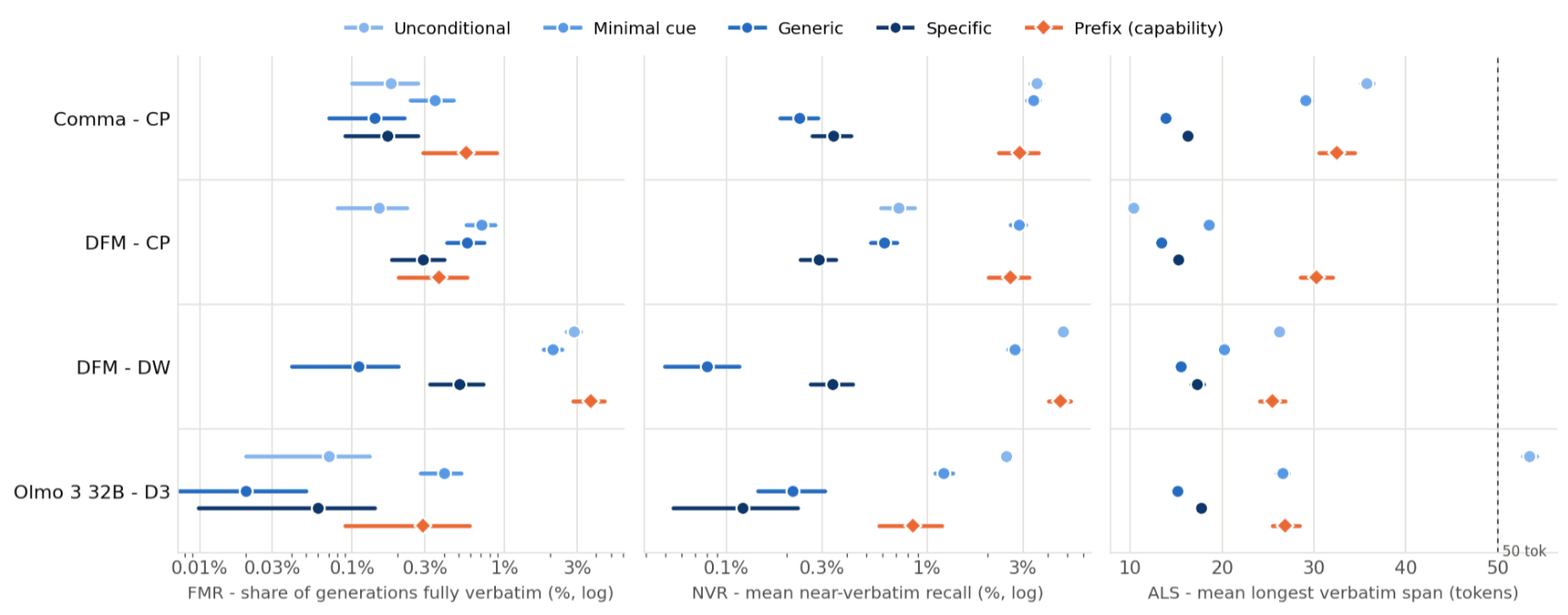
This brings me to a paper that’s hot off the pre-print servers. Barmina et al. ask what sorts of scenarios will cause that to happen. They tested several: “unconditional” means there was no input prompt, the LLM was instead free to carry on with whatever it wanted. “Minimal cue” was almost the same, but added a single word drawn from the top 100 in the training data to act as a “seed.” “Generic” and “specific” plugged in a sentence drawn from outside the LLMs’ training set, the former from a project hoping to create a “Rosetta stone” for language translation. The latter drew from large collections of text, looking for sentences similar but not identical to existing ones in the training data. Finally, “prefix” tried the traditional memorization test of plugging in a fragment from the training set and hoping the LLM completes it.
Natural-sentence prompts reproduce much less training text than prefix attacks (propensity scores of 0.02–0.20 for near-verbatim recall). Prompt-free generation reproduces about as much as prefix attacks in three of four model–corpus pairs, mostly duplicated boilerplate. The continual pre-training setting considered reduces long verbatim reproduction of the original corpus only modestly.
Gianluca Barmina et al., “LLMs Can Leak Training Data But Do They Want To? Evaluating Memorization Propensity in LLMs,” arXiv:2606.06286, preprint, arXiv, October 27, 2026.
The results are a bit messier than the text implies. The “generic” and “specific” scenarios produced about as many exact repetitions as the “prefix” scenario, in one case. Three of the LLMs tested are variants of one model, Comma v0.1 2T, differing mainly on whether there’s been additional training and on what dataset that training used; “DFM – CP” continues on with Common Pile, the same dataset used to train the original model, while “DFM – DW” switches to Dynaword. That means three of the models have 7 billion parameters, while one (Olmo 3) has 32. Contrary to prior findings, the bigger model doesn’t seem more prone to regurgitating its training data.
Still, there was one clear result: in every scenario tested, the LLM could repeat part of its training data. This wasn’t a common occurrence, nor was it even a majority of the text output by the model. But even when you weren’t deliberately trying to trick the LLM into doing so, it would spit back snippets of its training data.
The evidence has piled up high enough that “AIs regurgitate training data” is now the default assumption in some corners of science. It seems unlikely that problem will ever go away.