Humans are already a little bit porny

The internet has a lot of pornography, because human beings are fascinated by sex. How much, though? If you try to google the stats, unfortunately, mostly what you get is horrified anti-porn crusaders who are prone to inflating the numbers and calling it an epidemic, or a plague, or a perverted nightmare of hellish hedonism. But here’s one estimate that seems sober and reasonable:

● In 2010, out of the million most popular (most trafficked) websites in the world, 42,337 were sex-related sites. That’s about 4% of sites.

● From July 2009 to July 2010, about 13% of Web searches were for erotic content.

That sounds right: common, easily found when you look for it (and many people are looking for it!), but not exactly flooding your browser at the instant you turn it on. I know about the big name porn sites, like PornHub, and I’ve even seen them a few times, but that kind of content is also easily avoided…well, except for when some asshole gets the clever idea to email me piles of gay porn, but that’s what the delete key is for, and gmail filters.

I didn’t even know there were Twitter accounts that distribute pornography freely, until now. Now I know. Because Ted Cruz’s twitter account favorited a tweet by @SexuallPosts, and that’s all the internet is babbling about this morning.

OK, I know that the hypocrisy is delicious, but I just wish that we could get half as much mocking, laughing, smirking finger-pointing over Cruz’s sanctimonious public prudery that we get over his closet prurience. This is a man who tried to ban sex toys, who wants to control what people are allowed to do in the privacy of their bedrooms, and wants to oppress LGBT people. We ridicule when he’s caught watching a porn clip, which I’d guess nearly everyone reading this has done at some point in their life, and we call down a greater firestorm of scorn over that than we do his attempts at anti-human, anti-woman legislation, which I hope most of us deplore.

The difference is that you can get elected on a platform of denying abortion, hating gays, and suppressing sexuality, while the ‘revelation’ that you have seen moving pictures of naked people having sex, and maybe even liked it, can kill your political career. That seems backwards to me.

Moose and squirrel better than Boris and Natasha at undermining patriotism

Suddenly, I am reminded of Rocky the Flying Squirrel and Bullwinkle the Moose, from Frostbite Falls, Minnesota. It’s become history.

Mr. Chairman, I am against all foreign aid, especially to places like Hawaii and Alaska,” says Senator Fussmussen from the floor of a cartoon Senate in 1962. In the visitors’ gallery, Russian agents Boris Badenov and Natasha Fatale are deciding whether to use their secret “Goof Gas” gun to turn the Congress stupid, as they did to all the rocket scientists and professors in the last episode of “Bullwinkle.”

Another senator wants to raise taxes on everyone under the age of 67. He, of course, is 68. Yet a third stands up to demand, “We’ve got to get the government out of government!” The Pottsylvanian spies decide their weapon is unnecessary: Congress is already ignorant, corrupt and feckless.

Hahahahaha. Oh, Washington.

That joke was a wheeze half a century ago, a cornball classic that demonstrates the essential charm of the “Adventures of Rocky and Bullwinkle and Friends,” the cartoon show that originally aired between 1959 and 1964 about a moose and a squirrel navigating Cold War politics.

I’ve seen every episode of the show, although it’s so long ago I’ve almost forgotten every episode of the show. The reason is ritual.

In the 1960s, I was going to Sunday School almost every week. I didn’t mind, because I had friends there, I liked the teachers, and the “teaching” was trivially easy. I remember felt boards, crafts, and memorizing Bible verses, which I usually did on the walk over to the church. But mostly what I remember was Sunday mornings at my grandmother’s house, where Grandma would make French toast and we’d watch cartoons.

Sunday morning in 1963 did not provide a great variety of cartoons. We only received four channels, you know, and the TV was a black & white set, and the convention was that cartoons were for Saturday morning, so the stations only served up left-overs and oddballs. There was Davey and Goliath, a stop-motion series about a boy and his talking dog. It was moralistic pablum with a Christian message, which was probably why it was stuffed into Sunday. I hated it. There was Beany and Cecil, about a boy and his sea serpent. I liked that one, but it aired only sporadically, and it seemed they only showed about 3 episodes in random rotation. Sunday morning was really the dregs of programming, and I don’t think the stations cared what dumb thing they stuffed in there.

And then there was Rocky and Bullwinkle. You had to have been there. The animation was crude, the art work childish, and you could tell it was made on a shoestring — so it relied on the words. It improved my vocabulary far more than the Bible did. It was subversive; the show casually mocked all the stuff Davey and Goliath treated as sacred. It was constantly breaking the fourth wall, never shy about telling the boys and girls that this was just a cartoon, and a badly drawn one at that.

That was my Sunday lesson. From church I learned how boring sanctity could be. From Rocky and Bullwinkle, I learned irreverence. From Grandma I learned to appreciate well-made French toast, with a little nutmeg and cinnamon and real butter and maple syrup. These were important lessons!

For you youngsters who’ve never seen Rocky and Bullwinkle, the Goof Gas episode is on YouTube (with an awful intro tacked on). Watch and be appalled, but enjoy the cunning undermining of Cold War American values.

Also remember an age when “We’ve got to get the government out of government!” was considered ridiculous over-the-top satire of our politics, rather than the actual raison d’etre of an entire political party.

Racism is a popular recipe for YouTube success

Once again, shallow YouTube Personality PewDiePie has blurted out a racist slur in a video. Hey, it was just a heated gaming moment, says notoriously dimwitted Breitbart apologist Ian Miles Cheong. He has 57 million subscribers. He made $1.4 million a month for squealing in gaming videos. He is the very definition of the superficial, lightweight, know-nothing and contribute-nothing pinnacle of internet vapidity. And he’s very good at it.

So he puked out hate in a heated gaming moment. That apparently excuses everything. I guess my gaming moments have never been sufficiently heated to prompt me to shout out bigotry against other people…or maybe I don’t feel that degree of bias. I think I might say the usual swears — damn, shit, fuck — in those heated moments, but I’m not sure why you’d suddenly spit against a whole people. Filthy Norwegians! Gosh, I lost my game, I suddenly hate Saxons. Whoops, blame that one on the Luxembourgians.

But despite being appalled at this talentless ass, you have to recognize that there’s not much to be done. How many of his subscribers will drop his account because he’s prone to racist outbursts? None. I predict he’ll gain some. Contrarians, alt-righters, channers, Nazis, members of the KKK will sign up just to show solidarity. YouTube will do nothing, because that’s their core constituency.

Stupid triumphs.

Still, he hasn’t been entirely silent: His most recent video, which argues that this year’s hurricane season is nothing out of the ordinary and shouldn’t be politicized, was posted earlier Sunday. It already has more than two million views.

Here come the climate change deniers, the anti-science brigade, the Republicans, all ready to sign up and swell his legion of assholes.

One must have a goal

Here’s a good one: a step-by-step recipe to becoming a fossil. Yes! I think I can do this!

Step 1 is to die. I will probably be able to do this without too much problem, but I think I’d rather wait a little while.

Step 2 is neglect. Your corpse shouldn’t be dismantled, shredded, consumed, etc. I think I can do that one, too!

So far, this is looking easy.

Step 3 is burial, also achievable. First catch, though: soil chemistry matters. This is not usually on the list of options at the mortuary. Burial under volcanic ash is mentioned as specifically a bonus, also not usually a service provided by the undertaker.

Step 4 is…fossilization? Wait a minute, all that other, easy stuff is just a prelude? Dang. And then this step looks like it’s strongly chance dependent.

Oh, well. At least the procedure doesn’t look like I’ll have to do any work, which is good, since I’ll be dead through most of it.

I had no idea dresses were encoded in our DNA

Well, your DNA, ladies. Not mine. I have manly DNA that makes me incapable of wearing a skirt.

This fellow, Nigel Rowe, yanked his kid out of school and is planning to sue the school for discrimination…because they allowed another little boy to attend classes wearing a dress. They are just outraged! This is unnatural! It confuses their child, because mommy and daddy say boys can’t wear dresses, but there he is, acting as if it is perfectly reasonable to flaunt how wrong mommy and daddy are!

His reasons are fatuous.

There’s a distinct difference between male and female, not just in what you wear but also within our DNA, the way that we are as boys and the way that we are as girls.

We feel that there’s a political agenda that’s driving and pushing this. Remember we’re talking children that are six years of age.

A six-year-old is not really able to, does not have the mental capacity to work out those kinds of things. It’s such a young age and we’re concerned about that.

We can distinguish biological sex in a number of ways: you can look at the chromosomes, for Barr bodies, for hormones, at anatomy. These are usually, but not always, concordant. But as we look at phenomena like behavior, personality, sexual orientation, it’s not uncommon to find the situation to be far more complicated and for mismatches to arise. And when we look to cultural signifiers, like what clothes you wear or how you style your hair or even how one behaves in public, there is no DNA bias at all — those differences are entirely imposed by culture. To bring up DNA here is try and falsely imply a scientific justification for bigotry. It’s a lie to insist that molecules define your identity.

It’s also obnoxious to disrespect the autonomy and intelligence of six year olds. I remember my kids at six — and they weren’t stupid, unthinking little drones. But then, they weren’t fundamentalist Christians, either.

Yeah, he’s also lying when he claims his objections are driven by scientific evidence. They’re religious nuts.

As Christians, we believe that all people are loved by God. But the school’s behaviour has created a clash between our family’s rights and the imposition of this new ideology.

Allow me to remind you: the school is not imposing anything on their child. The school is allowing someone else’s child to reasonably express their identity, and the Rowes are accusing them of having a political agenda, as if being an intolerant Bible-walloping dorkbag is no agenda at all.

Something rotten in Rochester

The cognitive and brain science department at the University of Rochester had a good reputation, but one rotten apple, a computational linguist named T. Florian Jaeger seems to be spoiling the whole barrel.

Seven current and former professors, including Kidd and Aslin, as well as another former graduate student, have submitted identical EEOC complaints claiming that Jaeger, the University of Rochester, and several administrators violated laws that ban discrimination in the workplace and in federally funded education, and stating their intent to sue if the EEOC does not take up their case. The charges, laid out in a detailed 111-page document, allege that over a span of 10 years Jaeger contributed to a “hostile environment” for some graduate students, postdocs, and professors in the department, causing at least 11 women to actively avoid him and lose out on educational opportunities.

Charges were made and investigated, and the university ended up dismissing them and supporting Jaeger. I want to say that a procedure was followed and we should abide by the decision of the reviewers, except something is funny here. The results of the investigation weren’t exactly an acquittal.

The investigation into Jaeger’s behavior took about three months. In her final report, UR investigator Catherine Nearpass concluded that Jaeger had had a sexual relationship with at least one graduate student in the department, as well as a prospective Ph.D. student; that parts of his behavior were inappropriate; and that he “liked to push boundaries with students,” the EEOC complaint alleges. Still, the university ultimately found that Jaeger had not violated the university’s policy against discrimination and harassment, and that there was not enough evidence to conclude he sexually harassed Kidd or any other student in his lab. An appeal was unsuccessful.

Whoa. They confirmed that he was having inappropriate relationships with students, but did not find the complaints of 11 women credible? Something is seriously wrong with that investigation.

Also disturbing: these accusations were made before Jaeger was tenured, and he was tenured anyway. You’ve got a junior faculty member who can’t even keep it in his pants for the few years needed to earn tenure, and this wasn’t throwing red flags everywhere? Heck, this is a bonfire on the beach, flares and rockets being fired upwards, and it was just overlooked in the review?

It seems that the chair of the department, Greg DeAngelis, took Jaeger’s side, and is now retaliating against the faculty he accused of “smearing” Jaeger. The star of the department, Richard Aslin, has resigned in protest, and other faculty are trying to find jobs elsewhere.

Now here’s a statement from someone who knew Jaeger.

I went to graduate school with Florian Jaeger. He was a couple years ahead of me. I am not shocked that he’s been called out for sexualized behavior. I am shocked that he’s been called out for non-consensual behavior. It is totally okay to be a sexual being. It is utterly deplorable to be a sexual bully. His actions are not only morally reprehensible, but they are damaging to our entire academic community, and harmful to academic progress. Because I might have once called him a friend, it’s all the more disappointing and frankly frustrating that he has behaved in this way. (And yes, I am intentionally using active language here because we know that the default in discussions of sexual harassment is to use passive voice to protect the aggressor.)

Florian and I had lunch not too long ago, where he gave me some genuinely good advice about, ironically now, how to foster collegiality as a graduate supervisor. I’m not writing this blog post to demonize him, although he should clearly be held accountable for his actions. The point is not to shake our heads at one person, and then totally give up on that person, and just chalk it up to an isolated incident, and move on with our lives as if it has nothing to do with us. The point is that we are all complicit. This is a systemic problem, and has been for a long time. I believe the only way we’re going to change it is if we academics take responsibility for ourselves, and have hard discussions with one another, and try as much as possible to listen humbly and fully and not get defensive. Especially those of us with relatively more power. Especially men.

This is a system that doesn’t consider an abuse of power to be a reason to not give more power to the abuser, so this is exactly correct.

The terrible Molyneux gets another drubbing

We have a review of Molyneux’s ridiculous book, The Argument, right here on Pharyngula, by Joshua Stein. If you enjoyed that, you may also like this other review of Molyneux by Alexander Douglas. It’s pseudo-philosophy for the alt-right.

But didn’t I say this was a book designed to flatter the egos of its readers? Well, it is. But this requires the readers, who are taken as complete troglodytes, to be shown in turn to be vastly intellectually superior to somebody else, namely those silly, emo, irrational liberals who don’t understand The Argument.

Thus Molyneux is led to make daring leaps from his slap-headed logical platitudes to ridiculous critiques of liberal views. Since, again, he’s writing entirely for an audience of white men who think they’re geniuses obscured behind the cataracted judgment of the world, he doesn’t have to work hard here. Having taken several excruciating pages to explain precisely how if Fa is true for all a then there is not an a for which ~Fa, he then infers that campus rape culture is a liberal myth. The Einsteins of the alt-right will of course see the link by intuition, but as a courtesy Molyneux includes an argument for those of us less blessed:

If I have some sexual fetish role-play fantasy about being raped, and I then ask my partner to simulate such an attack, I cannot reasonably charge my partner with rape.

Of course not. Consent couldn’t possibly ever be withdrawn. That would go against logic. Here is the proof: A if and only if A. How the hell is that relevant, you ask? Well, now you’re getting emotional. And emotional reactions (from women) are by definition coercive and go against the peaceful free-speech standards of The Argument:

A woman who pouts and withdraws emotionally if you don’t do what she wants is not using The Argument, because she punishes you for noncompliance, rather than making a reasonable case for her preferences.

One of the fundamental ideas of science is that you don’t work to prove a hypothesis — you test it to see if you can break it. It’s one of the reasons that creationism is objectionable, it’s because they don’t do science. They start with their conclusion and then finagle the evidence to make it fit.

Molyneux is a fine example of how not to do philosophy. He also has a set of priors, and what he’s doing is finagling logic to support them.

I’m kind of feeling that that is even more offensive than making up evidence.

The SJWs are taking over Science Fiction!

I’m not particularly fond of circular logic, but it sure gets used a lot. Here’s an example: there are more men working in tech than women, therefore men are better at coding than women. It’s easy to find people who accept that reasoning without a qualm.

But those same people balk at another example: more women than men are getting published in science fiction now, therefore women are better writers than men. They go to extraordinary lengths to rationalize away the current difference. Why, the SJWs must be actively discriminating against men! I can prove it using math, because men are also naturally better at math than women!

I have found the most remarkable example of this “proof”. This fellow has gone through back issues of various magazines and tallied up the number of male and female authors published — and also the number of “not real sex” authors, which sort of tells you right there what kind of regressive asswipe we’re dealing with. He comes to the conclusion that there’s a huge discrepancy in the numbers of F&SF stories getting published by men and women, and that it’s the product of a conspiracy by SJWs to actively harm men. Really!

It’s been obvious for a long time in publishing that men need not apply, you’re not welcome. But now in the 2% where men were actually allowed to compete, it’s been completely taken over by social justice warriors who don’t care in the least about equality, but want to actively harm men both as professionals and readers.

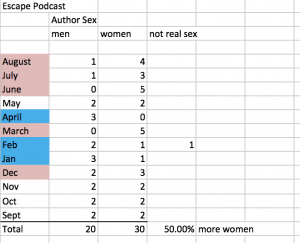
In order to demonstrate this, he engages in some amazing cherry picking and distortion of the statistics. He plugs numbers into a spreadsheet and then does some weird analysis. For example, here’s the month-by-month counts for a podcast, the Escape Pod. The thing is, there are huge numbers of podcasts out there — why is he selecting this one? Is he going to exhaustively summarize the state of the podcast genre (no, of course not, because that would be a huge undertaking), or is he selecting this one because it will support his claim? You know it’s the latter. I looked it up, and here’s one of the criteria for entries in the podcast:

We are especially interested in seeing more submissions from people of backgrounds that have been historically underrepresented or excluded from traditional SF publishing, including, but not limited to, women, people of color, LGBTQ or non-binary gender people, persons with disabilities, members of religious minorities, and people from outside the United States.

If you identify as part of these or other underrepresented groups, we welcome and encourage you to indicate so when you send us your story. We acknowledge the reality of unconscious bias and will make our best efforts to account for it during the editorial review process. Our goal is to publish fiction that reflects the diversity of the human experience.

So yes, they intentionally are casting a wide net, and are trying to bring in diverse writers. They aren’t discriminating against men at all.

So let’s see the numbers.

So a podcast that is actively encouraging diverse submissions still includes 20 stories from men, vs. 30 stories from women. That’s not bad at all. But wait: what’s that number? He’s saying that there are 50% more stories by women than men? That’s odd. How does he get that?

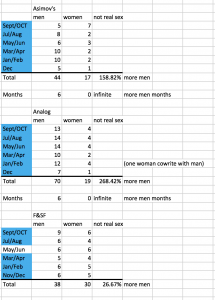
Looking at several of his examples, it becomes obvious: he’s taking the difference in the number of stories by men and women, and then dividing, not by the total number of stories, but by the number of of stories by men. It’s a way to amplify and exaggerate the differences — it allows him later to claim that some magazines publish 247% more women! 306% more women! Aaaiee! It’s a bullshit statistic, though.

And then there’s this interesting table: these are the long-standing big names in SF publishing: Asimov’s, Analog, and F&SF. There are more men getting published in the established magazines than women! You would think this would be a troubling statistic for his thesis.

So magazines that encourage diversity in their authorship get fewer submissions from men, which is totally unsurprising. What is odd is that a couple of magazines buck the trend. Why? Our intrepid investigator has an explanation.

The oldest of the old guard of magazines still seem to be a safe place to submit if you’re a man. Now the numbers look very skewed in men’s favors and a feminist might cry foul here saying that these magazines actually discriminate against women. This is where they’re wrong. A source that will remain nameless told me that the editor of Asimov’s, Sheila Williams, prints male to female stories in the ratio of submissions she receives. Even though the monthlies look a little suspect, if these periodicals still work in an old way of proportionate representation of submissions, this is probably an accurate picture of what Science Fiction authors make ups are overall, and what one should expect were that more the case.

Uh, wait. This is actually a bit bothersome. I expect the role of the editor is to select the best quality stories for publication, without regard for the identity of the author. This guy is actually saying that this is not true for Asimov’s — that they have a quota system. If 60% of the submissions for that month are from men, they decide that, regardless of quality, 60% of the published stories for that month have to come from that pile? So all the guys have to do is throw lots and lots of trash at the magazine, and they’ll effectively squeeze out stories from women authors?

Excuse me, but I don’t really believe that. If true, though, that works both ways, and all the women have to do to break the male hegemony at Asimov’s is to submit, submit, submit stories. Fish the crappy stuff out of the wastebasket and send it in anyway — it probably won’t get published, but it will enable more of your sister writers to get in.

Which is why I don’t believe this story.

But then take a look at his conclusion.

If you’re a man, even with the skewed results of the legacy three magazines of Asimov’s, Analog and F&SF, that are vocal about the fact that they’re proportionate in representation of submissions, you’re hosed. An analysis of all the markets that accept these submissions on a monthly basis (I left out Lightspeed Magazine which has dead even results), the total discrimination against men is big. The totals of all stories published in this market survey over a year are:

Men: 426

Women: 487

Which means women have a 14.3% advantage just in sheer numbers of stories published. If the industry holds with ratios of 4:1 submissions, and say the accepted represents about 1% of all submissions, it means there’s about 91,300 submissions in the industry. Rough estimates puts men at 73,040 submissions and women at 18,260 submissions.

First look at that bit I highlighted: he threw out a data point because Lightspeed Magazine happened to have equal representation of men and women authors — that is, he discarded data that didn’t fit his hypothesis. You don’t get to do that! He doesn’t even seem to be aware that this is a great big flaming no-no in data analysis. Of course, given how he chose to inflate numbers throughout, it’s not surprising that he’s clueless here.

Second, he’s claiming that discrimination against men is big, yet all he’s got to show for it is a difference of 426 to 487? What’s the statistical significance of that? Wait, scratch that: his methodology means that at best he’s confirming a bias he favored with his process, which isn’t particularly interesting. He intentionally selected magazines that are trying to acquire a diverse audience, so of course he sees some underrepresentation of men. It doesn’t say there’s a conspiracy, or that men are being harmed.

Third, to amplify his claim of discrimination, he brings in this other statistic: men submit more stories than women with a ratio of 4:1, so there’s even more invisible bias! To back up that claim, he mentions a submissions tracker and market database called The Grinder. I poked around in there, but didn’t see a way to pull up stats on women’s vs. men’s submissions — maybe someone could explain how you do that. But the thing is that in his one specific example of Asimov’s, Analog, and F&SF, he claims that the proportion published is representative of the proportion submitted, and it’s nowhere near 4:1. I also rather suspect that those magazines that encourage submissions by underrepresented groups also tend to get relatively fewer stories from your traditional white male engineering types, so the 4:1 doesn’t hold.

But given that 90% of everything is crap, I don’t find submission rates to be particularly compelling, so that line of argument is also crap.

But here’s my bottom line: of course there is bias! It’s everywhere! Some places will favor women, others will favor men. Go to your supermarket and look at the magazine racks: there are magazines “for men”, and magazines “for women”, and they tend to propagate some ugly stereotypes. In a field like science fiction that tends to encourage innovation and change, and that like all literary fields goes through waves of new emphases, there will be times when people are trying to shake up the old staid tropes, and that means that the previous beneficiaries of convention will fall out of favor, and will find it harder to publish. People are looking for new twists and interesting ideas in their fiction, and of course if you want to write stories exactly like the ones you read 30 years ago, you’re going to be discriminated against.

Or you’ll find a niche publishing market.

Really, I don’t choose my preferred reading material by the color of the author’s skin, or what genitals are slung under their pants. I read Nnedi Okorafor, or Scott Lynch, or Ann Leckie, or NK Jemisin, or China Mieville, because they challenge me with new ideas and good writing. Sometimes to get new ideas you have to encourage new perspectives, which tends to disrupt the Old Guard.

But here’s another factor that influences what authors I favor. The good ones (even the white male authors!) will read those new authors, too, and praise what they like and grow and change themselves to value those novel approaches, and their writing will get better.

The bad ones will read stories by authors different from themselves and resent it, and run away from the challenge, blaming others for their lack of adaptability and talent.

But don’t worry, White Men! You’re just as capable of writing great stories as people who are not White Men, as long as you don’t get tangled up in your persecution complex.

Buddhist atrocities

Aung San Suu Kyi won the Nobel Peace Prize for “for her non-violent struggle for democracy and human rights”.

The Burmese Peace Prize Laureate Aung San Suu Kyi is the daughter of the legendary liberation movement leader Aung San. Following studies abroad, she returned home in 1988. From then on, she led the opposition to the military junta that had ruled Burma since 1962. She was one of the founders of the National League for Democracy (NLD), and was elected secretary general of the party. Inspired by Mahatma Gandhi, she opposed all use of violence and called on the military leaders to hand over power to a civilian government. The aim was to establish a democratic society in which the country’s ethnic groups could cooperate in harmony.

In the election in 1990, the NLD won a clear victory, but the generals prevented the legislative assembly from convening. Instead they continued to arrest members of the opposition and refused to release Suu Kyi from house arrest.

The Peace Prize had a significant impact in mobilizing world opinion in favor of Aung San Suu Kyi’s cause. However, she remained under house arrest for almost 15 of the 21 years from her arrest in July 1989 until her release on 13 November 2010, whereupon she was able to resume her political career and put her mark on the rapid democratization of Myanmar.

She is currently the de facto leader of Myanmar (although trying to puzzle out the tangle of factions running that country is not trivial), and representative of the Buddhist majority. A Buddhist majority which is currently active in perpetrating genocide. A Muslim minority, the Rohingya, have been living in Myanmar, and right now they’re being rounded up by the military and murdered.

“They’re killing children,” Matthew Smith, the chief executive of a human rights group called Fortify Rights, told me after interviewing refugees on the Bangladesh border. “In the least, we’re talking about crimes against humanity.”

“My two nephews, their heads were cut off,” one Rohingya survivor told Smith. “One was 6 years old and the other was 9.”

Other accounts describe soldiers throwing infants into a river to drown, and decapitating a grandmother. Hannah Beech, my Times colleague who has provided outstanding coverage from the border, put it this way: “I’ve covered refugee crises before, and this was by far the worst thing that I’ve ever seen.”

Even Buddhists. We tend to think of Buddhism as the nice peaceful religion (we conveniently ignore their history and the oppressive nature of Tibet), but this just goes to show that people with power can be horrible no matter what philosophy they pretend to have.

“We applauded Aung San Suu Kyi when she received her Nobel Prize because she symbolized courage in the face of tyranny,” noted Ken Roth, executive director of Human Rights Watch. “Now that she’s in power, she symbolizes cowardly complicity in the deadly tyranny being visited on the Rohingya.”