They aren’t colorful enough, either.
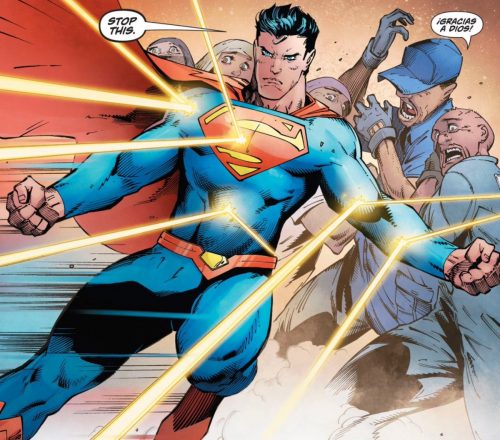
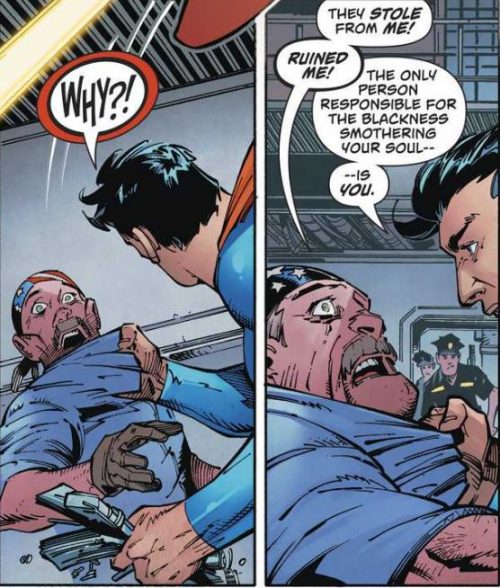
During the eclipse, the Donald was yelled at to not look directly into the sun, and what does he do?

You’d think, as a billionaire, he could afford the very best protective eyewear, and as the President, surrounded by security and advisors, he’d be informed that a squint is not going to help. What a dumbass.
Could someone please tell him that he can’t fly, and leaping off the top of the Trump Tower would be a very bad idea? Please?
I met with my first group of new student advisees this morning. I think we’ll keep them.
Also, totally irrelevant: we’re supposed to have begun the partial eclipse here in Morris, but unfortunately the sky is a uniform sheet of light gray cloudiness — I can’t even see the sun anywhere. Maybe the moon ate it.
But then, everything sounds lovelier in French. I’m told the refrain translates as “angel dust got into you, you’d make a wonderful mom, but just not right now”.

It’s the “full list of antifa members” on 8chan. I had no idea my application had been accepted! (Actually, I had no idea where to send the application, and hadn’t even written one, so apparently antifa has the power to read minds). It’s a very long list, though, so it’s no particular distinction.
I do find their little Hitler-loving dwarf mascot amusing, though. I also appreciate being on a list of people who detest fascists who revel in Nazi sloganeering. I wouldn’t want to not be on such a list.
It takes a while to assemble a comprehensive rebuttal to pseudoscientific claims — everyone who has dealt seriously with creationists knows that, absurd and ignorant as their arguments are, it takes hard work and diligence to assemble a coherent, evidence-based criticism, something I wish a lot of people who think debating creationists is easy would realize. It’s the same story with that James Damore memo. It’s easy to see that it’s garbage, but much harder to assemble the details of a rebuttal.
Fortunately, the well-research criticisms are steadily emerging now. For instance, Caryl Rivers and Rosalind C. Barnett can declare that “We can say flatly that there is no evidence that women’s biology makes them incapable of performing at the highest levels in any STEM fields”, and back it up with citations.
Many reputable scientific authorities have weighed in on this question, including a major paper in the journal Science debunking the idea that the brains of males and females are so different that they should be educated in single-sex classrooms. The paper was written by eight prominent neuroscientists, headed by professor Diane Halpern of Claremont McKenna College, past president of the American Psychological Association. They argue that “There is no well-designed research showing that single-sex education improves students’ academic performance, but there is evidence that sex segregation increases gender stereotyping and legitimizes institutional sexism.”
They add, “Neuroscientists have found few sex differences in children’s brains beyond the larger volume of boys’ brains and the earlier completion of girls’ brain growth, neither of which is known to relate to learning.”
Several major books have debunked the idea of important brain differences between the sexes. Lise Eliot, associate professor in the Department of Neuroscience at the Chicago Medical School, did an exhaustive review of the scientific literature on human brains from birth to adolescence. She concluded, in her book “Pink Brain, Blue Brain,” that there is “surprisingly little solid evidence of sex differences in children’s brains.”
Rebecca Jordan-Young, a sociomedical scientist and professor at Barnard College, also rejects the notion that there are pink and blue brains, and that the differing organization of female and male brains is the key to behavior. In her book “Brain Storm: The Flaws in the Science of Sex Differences,” she says that this narrative misunderstands the complexities of biology and the dynamic nature of brain development.
And happily, the widely held belief that boys are naturally better than girls at math and science is unraveling among serious scientists. Evidence is mounting that girls are every bit as competent as boys in these areas. Psychology professor Janet Hyde of the University of Wisconsin–Madison has strong U.S. data showing no meaningful differences in math performance among more than seven million boys and girls in grades 2 through 12.
I also like this article by Erin Giglio, a Ph.D. student in evolutionary biology, who discusses the complexity of sexual development and evolution, something avoided by the reductionist generalizations of privileged dabblers like Damore (‘there are only two genders!’ is their rallying cry). But she also makes a significant criticism of the whole evolutionary psychology approach.
Curiously, however, these disciplines do not include evolutionary psychologists: I have never met an evolutionary psychology student taking any course, presenting at any evolutionary biology seminar, or interacting in any way with the evolutionary biology students in my own department, and I have never seen a behavior-focused Ecology, Evolution and Behavior student from my own department mention spending time learning from evolutionary psychologists. This is particularly odd because my university, which is the University of Texas at Austin, happens to host an extremely prominent evolutionary psychologist in the form of Dr. David Buss…and also several prominent and well respected behavioral ecologists in my department, most of whom are specifically prominent in the field of sexual selection and courtship behavior itself. This is also a topic that evolutionary psychologists have a well documented and particularly strong interest in, and this includes Dr. Buss. So why the lack of collaboration?
The answer boils down to the fact that evolutionary biologists and behavioral ecologists — which is, again, the term usually used to describe people studying the evolution of animal behavior in a naturalistic context — are typically some of the most vocal critics of evolutionary psychology. Indeed, several prominent behavioral ecologists have written popular science books that criticize evolutionary psychology openly.
Why might this be the case?
One huge issue is the question of adaptationist hypotheses. Evolutionary biology had a large intradisciplinary discussion back in the late 1970s and early 1980s about adaptationist thinking, largely kicked off by Stephen J. Gould and Richard Lewontin’s classic paper The Spandrels of San Marcos. The central argument of this paper is that evolutionary biologists should not assume that the null expectation for any observable biological trait is that the trait is in some way an adaptation for survival. Indeed, some traits arise as accidents of pleiotropy — genes with multiple effects — and some merely develop over time by chance. Gould and Lewontin argued that in order to describe a trait as a known evolutionary adaptation, evolutionary biologists first needed to identify some evidence that the trait was both adaptive to survival and also that it had sufficient heritability for selection to be capable of acting on it.
While this paper was controversial at the time it was published, it has largely become accepted among evolutionary biologists that it is generally correct. In fact, I have most often seen evolutionary biologists use the term ‘adaptationist thinking’ amongst themselves as a slur, implying that another scientist’s research paradigm is insufficiently critically rigorous; it’s a term right up there with ‘telling Just-So stories’ within the field. It doesn’t mean that you can’t hypothesize that a trait evolved because of positive selection — it just means that adaptationist hypotheses must be tested against a null, neutral hypothesis.
By contrast, evolutionary psychologists openly argue that adaptationist assumptions are essential to the field and are simply good science, and that starting with adaptationist hypotheses just makes sense. This is further confounded by the methodology generally chosen in the field of evolutionary psychology (see below), which is typically limited to surveys confirming that the behavior in question does in fact exist — something even acknowledged by defenders of the field’s capabilities of falsification. Occasionally fMRI studies are also used.
Yeah, I’ve seen this behavior myself — Evo psych people react to the name Gould like you’ve just summoned Satan. While guilty of some hyperbolic overreach, Gould’s views have largely been accepted: you can’t simply say a trait exists, and therefore it has an adaptive purpose. That completely undermines the Evo Psych ‘research program’.
If you’re one of those people who read Damore’s memo and thought it sounded reasonable, brace yourself. You’re like the buffoon who read about Flood geology and thought that sounded like a good alternative hypothesis, who is about to get crushed by the deluge of real scholars of geology and paleontology and biology who will be pointing out how stupid the argument is. The people who actually understand the fields Damore was abusing are rising up now.
Don’t panic too much, though. Just as the creationists keep churning out excuses and exercises in motivated reasoning to defend their nonsense, you’ll still have ranks of evolutionary psychologists shoveling crap to keep you happy.
There doesn’t seem to be any question that Andrew Escobedo, a professor of English at Ohio University, sexually assaulted several of his students, and then threatened them if they exposed him. The case looks like a done deal.
…the school’s civil rights office issued a graphic 78-page report that not only substantiated their claims but also those of two other women alleging sexual harassment by Escobedo dating back to 2003. Escobedo denied the accusations, but his bosses, from the dean and provost to the president, agreed he should be fired.
It also looks to me like Escobedo has basically confessed.
After the investigation finished, Escobedo wrote a letter to colleagues — outing the names of witnesses and alleged victims — in which he said they had multiple opportunities to move away from him, yet they didn’t. Adams and Hempstead told investigators they feared that if they more forcefully rejected Escobedo, he could retaliate when giving them their final grades.
That letter…yikes. While vehemently protesting that he didn’t do it, and the witnesses couldn’t have seen him do it, and that it was the students’ fault for not running away from his grabby hands, and he was really drunk anyway, he also proposes that appropriate punishments would be a year of unpaid leave (in the business, we call those “sabbaticals”) and a permanent ban on working with grad students. He’s bargaining about the degree of guilt! Ick.
But he’s not out yet. He has been suspended from teaching duties, but he’s still getting paid.
The administration may want Escobedo gone, and the school’s own report may have painted Escobedo as a predator who “has engaged in a pattern of exploiting females who are subordinate” to him, but because of tenure, university policies entitle him to an administrative process that has kept him on staff for months. The Athens News reports that Escobedo’s salary last year was $87,000. At any time, Escobedo could resign without facing formal punishment, something the graduate students want to prevent.
Now Adams and Hempstead are questioning whether tenure, a system they both believe in as it safeguards intellectual freedom, has actually hamstrung how universities like theirs deal with sexual harassment cases.
Wait a minute — this looks like a case where the system is working. Escobedo was reported in March of 2016, and he was removed from his teaching responsibilities fairly quickly. That 78 page report was completed in December of that year, so a thorough turnaround in 9 months is simply amazing to anyone who knows how slowly academic bureaucracies grind. The breakdown of the schedule of the investigation shows that while it was lengthy, it was also prolonged by protocol.
Ohio University said it strives to finish investigations within 60 days, but it can be tough booking witnesses for interviews. That’s why the probe of Escobedo’s behavior took nearly nine months. The president then took almost three months to weigh in on how to punish Escobedo. Escobedo then had 30 days to request a hearing before the faculty senate to challenge the firing recommendation, and another 60 days to prepare his defense. Escobedo’s hearing is scheduled for Sept. 1 — nearly 18 months after Adams and Hempstead formally complained about him.
That is not unreasonable. You don’t want tenure decisions to be lightly rescinded, since that would defeat the whole point of tenure.
Now, in light of all the evidence against him, if Escobedo is not fired after his hearing, then there are grounds to complain. Keep in mind that his colleagues are also eager for a certain resolution of this problem because they are currently paying for a faculty line that is doing nothing, so his teaching load has been distributed among others, which is not an acceptable solution. Everyone in a department has to work to keep students progressing smoothly.
The one flaw in the system, though, is that “At any time, Escobedo could resign without facing formal punishment”, and move on to apply for new positions elsewhere, without a big black flag on his record. The internet does provide an informal check (imagine future hiring committees googling “Andrew Escobedo Ohio University”) which probably means his academic career is dead, but still…being able to just put “Resigned” on his CV and invent a bullshit excuse that won’t be checked gives him an out. It also means that when prospective employers check on his work history, Ohio University can pretend the sordid mess did not occur and say something bland.
Having tenure does not mean that you no longer have to worry about the repercussions of your actions.
Oh. Escobedo has already resigned. OK, English hiring committees, keep an eye open for CVs with his name on them. You don’t want to hire him.
We’re having an eclipse tomorrow.
A white moose has been spotted in Sweden.

And the corpse flowers are blooming.
I swear, the first week of classes aren’t usually filled with this many dark omens.
![]()
I’m registered for Skepticon 10. Are you? If not, go here. 10-12 November in glorious Springfield, Missouri.

How could Valerian fail? Luc Besson, $200 million budget, the stills and clips I saw beforehand were visually spectacular. And then I watched it last night. I would have fallen asleep if the flashing colors hadn’t made my eyes hurt. Besson made a movie with fantastic visuals, but he forgot to include little details like a sensible plot and relatable characters and some motivation for wanting the characters to succeed; it’s like being given the job of making a cake, not bothering with substance, and building an elaborate confection out of nothing but marzipan and lots and lots of food coloring.
It starts out interestingly enough, with a series of scenes starting with a contemporary ship docking with a space station, and visitors and residents shaking hands. Then, over time, the station gets bigger, more ships come, more handshakes, and eventually aliens show up, and we see a succession of weird aliens. Well, not so weird. My first disappointment is that all of the aliens are still all two-eyed bipeds with hands that can be shaken — for all the enthusiasm for Besson’s imagination, it has flopped down and died in the first 10 minutes. One of the tedious things about the visual effects in this movie is that he’s just ramped up the garishness that we saw in The Fifth Element — there are many scenes that are just incoherent, full of loud flashing colors and random design elements. It’s a lot like a Michael Bay movie without the violence.
The second disappointment is simple innumeracy. The space station has grown so much it has to be moved out of Earth orbit…to the Magellanic clouds? That’s quite a move, all the way out of our galaxy. But then later we learn that it was moved 700 million miles, which is just a small fraction of a light year. Scale and scope are completely confusing in this movie.
Then we cut to a distant alien planet called Mül, although in my head it was actually the Planet of the Androgynous Supermodels on a Beach Shoot. We’re introduced to the McGuffin of the movie, a magical rat thing (it looks a bit like Skrat, from the Ice Age cartoons, with warts) that, when fed these blue marbles, poops out buckets full of duplicate blue marbles that are tremendous power sources with ten times the energy needed to power an interstellar starship, but which the supermodels use to wash their face with in the morning. Suddenly, the planet is destroyed. Supermodels look weepy and horrified.
Fast cut to our Heroes, Valerian and Laureline. Valerian is a cocky frat boy. Laureline is aloof. They’re in love, I guess. We need to be told that, because you sure aren’t going to see it in their chemistry. The whole movie is then about these two young people scurrying about to reunite the Supermodels with Magical Rat Thing and a Blue Marble, although they don’t have a clue what they’re doing themselves. Neither do we. There’s some irrelevant nonsense about a growing danger to the space station and bad robots and misunderstandings and nefarious conspiracies that don’t really matter, and then it ends with some treacle about the power of love.
That’s it. That’s the whole movie. Two hundred million dollars worth of marzipan and food coloring. Skip it. Watch the psychedelic wormhole sequence from 2001: A Space Odyssey again, it’s about as flashy and will leave you no less confused.
Which makes me think…maybe Valerian would have been more entertaining if I’d been high on ‘shrooms while watching it.