Two science-fiction writers got into a fight, and it didn’t matter

That’s the story here, two science-fiction authors disagreed with each other about colonizing the galaxy, and you can stop reading now, because it’s all fuss and bother about a fantasy. Except, I would argue, that the disagreements and advocacy of their respective positions have consequences, and I agree far more with one than the other.

Kim Stanley Robinson wrote a novel called Aurora about a failed effort to colonize Tau Ceti with a generation ship. It’s pessimistic: complex engineering projects fail if you try to keep them running for centuries, the biology of small populations fail predictably if you have limited genetic diversity and limited environmental information, human societies are messy and fragile and tend to fall apart over time, and biology is complex and unpredictable and your destination is either going to be dead (which isn’t good) or teeming with independently evolved organisms (which is worse). He wrote the novel in response to a weird-ass initiative from NASA called The Hundred Year Starship.

In 2011, NASA and DARPA (the Pentagon agency that gave birth to the internet) lent their names to a project called The Hundred-Year Starship. Its aim was to coalesce the space community behind a goal of launching an interstellar mission by your time: 2112. For generation ship dreamers, it was like Christmas had come.

And then along came Kim Stanley Robinson to stomp over all our dreams and tell us that Santa Claus didn’t exist.

Robinson is best known in our time as the author of the Mars trilogy (Red Mars, Green Mars, Blue Mars, all written in the 1990s, the latter two set in your century). He’s what they call a hard sci-fi guy — he talks to the experts in the field, reads the latest research, does his level best to get the science exactly right. For example, all of his novels set in the 22nd century feature a flooded, post-climate change Earth. (Again, we’re really sorry about that.)

Watching a Hundred-Year Starship conference incensed Robinson. “It was a combination of a scam and a religious meeting,” he says, “presented with such an authoritative sheen, such pseudo-science.” So he went to NASA Ames, discovered a lot of internal consternation about the agency’s involvement with the project, talked actual planetary science with actual planetary scientists, and published Aurora in 2015.

I sympathize. It is a scam. There is a range of such ridiculous projects that are cheerfully supported by people who should be much more responsible. It ranges from the starry-eyed optimism of people like Seth Shostak, who want to pump money into SETI with exactly the same mindset as people who buy lottery tickets every week, to malignant rich assholes like Elon Musk who think the Earth is doomed to become an ecological hell-hole, so they are eager to get off this planet to one that is already dead. He sees trouble coming, and his response is to invest in the most expensive, futile tomb he can imagine. And unfortunately, that imagination is fed by overly optimistic science-fiction writers.

I like science fiction, myself. I also think it can be valuable in inspiring people to think about the future. But I would like people to be inspired about ways to solve real problems — we have lots of them crashing over us right now — rather than imaginary bullshit, like how we’re going to get to and colonize a planet we haven’t even seen. There is a place for that, but it’s called escapist fantasy, and there’s nothing wrong with it, unless you lose track of reality and muddle it up with real-world issues.

I will remind you that what inspired Robinson’s novel was NASA and DARPA supporting the idea of building a generation ship to carry humans to another star system 10 or more light years away, to be built and launched in the next century. Elon Musk isn’t going to build a viable colony on Mars, yet we’ve already got people day-dreaming about voyages that could last centuries, launched to destinations unknown, as if that has a chance in hell of happening. At the rate we’re going, the starship collapse Kim Stanley Robinson imagines in his novel is more likely to occur on a grander scale right here on Starship Earth, and we aren’t going to rocket away from it, no matter how many physicists and fantasy authors close their eyes and wish real hard.

That pessimism about space colonies annoys Gregory Benford, who wrote a negative review of the novel. It’s not a rebuttal of the ideas that Robinson advance, but really is just a review of where he thinks the story fails.

In 2012, Robinson declared in a Scientific American interview that “It’s a joke and a waste of time to think about starships or inhabiting the galaxy. It’s a systemic lie that science fiction tells the world that the galaxy is within our reach.” Aurora spells this out through unlikely plot devices. Robinson loads the dice quite obviously against interstellar exploration. A brooding pessimism dominates the novel.

Yeah, the review consists almost entirely of picking at plot holes in the book — which may be entirely valid flaws in the novel. He thinks, for instance, that Robinson “stacked the deck” by making the planet the starship arrives at implacably hostile to human habitation, which is the most likely outcome. The universe is not designed for us, so the majority of destinations are going to be uninhabitable! I think Robinson stacked the deck by making the imaginary starship actually succeed in arriving with a live crew at a distant star, which is already incredibly unlikely, and then being able to turn around and fly back to Earth. Unlike real life, I guess we can fix a plot hole in a book by just rewriting the planet so it’s a paradise.

Then I notice why Benford is disagreeing with Robinson — he’s the editor of an anthology of stories based on that silly conference!

Now I have a dilemma. I’d kind of half like to read that book, but only because it would probably make me really angry at the “scam and a religious meeting” and pseudo-science aspects of it all. Do I really need that kind of negativity in my life? Maybe. It does keep the bile flowing.

Loving an animal for itself is a good human trait

I agree so much with John Oliver here, with one qualifier.

Octopuses are awesome, but they have a flaw: they don’t live in the Midwest. In fact, the entire centers of every continent are an octopus-free zone, which means I can either spend my life pining for an unrequited love, or I could open my eyes and realize that instead, the continents are crawling with an equally weird and even more diverse population of mysterious creatures who don’t get no love. Not that they care, but part of the appeal of octopuses and spiders is that they don’t give a good god damn about people — they’re independent and free and living their best life without you.

Reminder: YouTube Q&A today, at 11am Central

Open season on PZ Myers today! Stop by leave questions in the video chat or my previous announcement or here, and I’ll try to answer them within the constraints of keeping the conversation to about an hour. I’m also giving priority to my Patreon donors, who can leave questions there or even pop up on Zoom to say hello. In case everyone is shy, I’ve got a few things lined up to prime the pump, as well.

I’ll try not to natter on about spiders. The stuff I’ve prepared consciously avoids spiders, so you’re probably safe.

Hey, that’s Bill Nye!

Did you know that before he hit it big with a kids’ science show, he was in a small comedy group local to the Seattle region? Here he is, playing a cop in Ballard. If you don’t know, Ballard is a suburb north of Seattle that is infested with people of Scandinavian ancestry.

I think science communicators can greatly benefit from a background in theater or similar performing (which I totally lack, I know, you’ve noticed). So don’t be shy about engaging with any audience on any topic!

Spoiler: there are no spiders in Black Widow

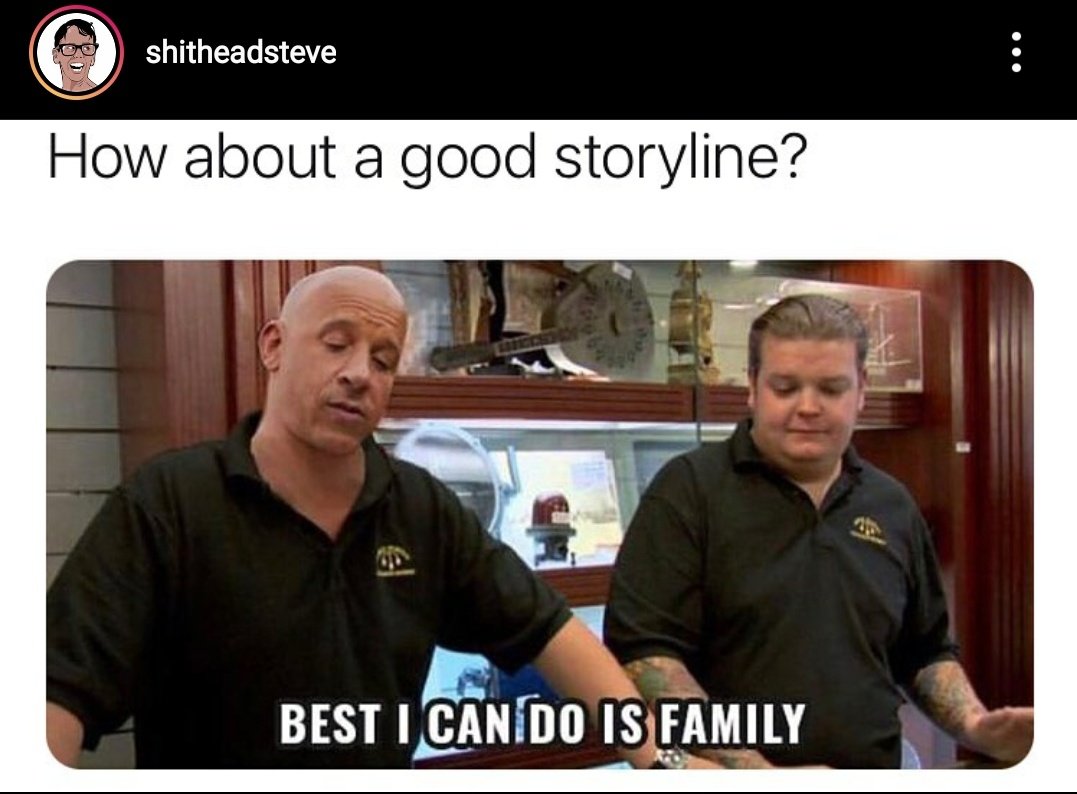
Last week, I watched this incredibly stupid, badly acted, big budget piece of crap called F9. It’s currently a bit of a joke on the internet, with memes featuring Vin Diesel saying “family” all the time. It’s appropriate — the movie was noise, and occasionally Diesel would occasionally piously say “Family” as if it was sufficient justification for driving cars in outer space. Hated it.

So this week, I saw Black Widow, which, strangely enough, actually is about family. The story starts with a “fake” family of Russian spies hiding in the United States — the father, Alexei, the mother, Melina (the smart one, a scientist), and two daughters, Natasha and Yelena, adopted as part of their cover — while Melina steals American (that is, Hydra) mind control secrets. The family is torn apart at the beginning of the movie when their cover is blown, and they all have to frantically flee to Cuba, where they are separated. Alexei gets thrown into a Russian prison for life, Melina is buried away in a secret lab run by the chief villain, Dreykov, and the two girls are taken away to something called the Red Room, a secret and brutal training room for ninja super-assassins who are all mind-controlled by Dreykov. Natasha later breaks free and defects to the US, joining the Avengers and appearing in a number of big budget superhero movies, the American dream.

That’s the setup. That’s the foundation for the whole plot. From that point on, it’s more James Bond than classic superhero movie: Dreykov has planted his mind-controlled female assassins all over the world, controlling them from his base, the Red Room, and Natasha, the Black Widow, must smash his nefarious plans and free all of his mind-slaves. Along the way, she’s going to find the scattered, disaffected members of her family, and together they will learn to live, laugh, and love as a true family, while blowing the shit out of everything.

I joke, but the movie works best if you view it as a family drama between the four principle actors (who actually can act! And do a good job with the story) surrounded by explosions and fights and an improbable giant flying super-villain fortress. All the interesting moving parts of the plot are wary conflict between two sisters, Natasha and Yelena, the uncovering of the hidden deep affection their spy-scientist mom had for them, and how they rescue their bumbling, blustering dad, who turns out to be Russia’s version of Captain America. That all works. I enjoyed watching those four interact.

I guess the super-spy/super-hero parts of the plot also worked. At least, there were many spectacular action set-pieces, and there was a spectacularly violent conclusion, and there were many fast-paced fight scenes with lithe beautiful women kicking butt. If that had been all there was, though, I would have left the theater feeling “meh”, instead of carrying away a residue of affection for Natasha, Yelena, Melina, and Alexei. That’s what made the film.

Okay, criticisms:

  • Waaaay too many moving parts. The plot is complicated, and it flits all over the world, from Ohio to Hungary to Morocco to a mysterious location above Siberia. It’s de rigueur for a James Bond movie, but here it just felt like they had so much money they could treat the principal cast to filming in exotic locations.
  • As is also common in these kinds of movies, the world-threatening villain is unimpressive. He only exists for the two hours of this one movie, so why invest in developing him? He’s bad, he has a super-weapon, that’s all you need to know.

  • The accents. Yuck. At the beginning, the family speak clear, unaccented American English. In Russia, they all talk to each other with heavy Russian accents. Stop it. It’s especially annoying because they’re setting up Yelena to be the new Black Widow in future films, and you know she’ll be talking without the accent in the next movie.

  • The one significant male lead, Alexei, is comic relief. He’s fat and barely fits into his supersuit, he keeps saying the wrong things, he’s a bit vain and talks too much, he’s Homer Simpson in a fancy red costume. The actor, David Harbour, brings a little more depth to him, but I suspect his character will go nowhere in future films. He’s also a bit of a crude Russian stereotype.

  • There is an unspoken premise throughout. Why women? Why nothing but women? Say something about it! The villain has a world-spanning network of female assassins under his control, he puts cadres of women assassins through a vicious training regimen that, they say at one point, only one women in 20 survives. Give a reason (“women can blend in better,” “women are more agile than men”, anything, no matter how bogus), or I’m just going to assume some weird awful exploitive psycho-sexual sadism that the story lacks the courage to confront.

  • The big problem: in spite of the promising title, there is not one spider shown in the entire movie. Not one. Not a single leg waving in the corner of the screen, not one non-speaking walk-on role, no little cameo anywhere. They apparently forgot what the movie is really about, Latrodectus.

Breathtakingly evil

Whoa, whoa, whoa. This is one of the most awful essays I’ve ever read: it’s by Declan Leary in The American Conservative, and the dreadfulness does not stop. All you have to do is look at the title to know there is going to be a very special argument following.

“They’re good, actually.” The article is a defense of death of Indian children.

The first argument is a typical Catholic story, about a French missionary, Jean de Brébeuf, trying to get the Wyandot peoples to convert to Catholicism. This is treated as a good thing, rooting out the “ancient pagan religion”. His efforts don’t seem to have been appreciated, because he was eventually tortured and killed. The purpose of this anecdote seems to be along the lines of “Well, they did it first,” which I hope most of us have outgrown.

His second argument is that we have always known that many children died in the residential schools, as if that diminishes the problem. Yeah, the First Nations people have been mourning for over a century, we just weren’t listening, so their grief doesn’t count.

Next, he tells us that childhood mortality in that era was high; those kids would probably have died anyway. I guess the stress of being ripped from your family did not contribute to their sickness and death. And when kids die, you put them in the ground, so finding old graves is nothing surprising.

Then, see, even if those kids died in the residential schools, it wasn’t the fault of the Catholic church anyhow.

If anyone is at fault here—and the residential school system, for all the good of its evangelizing purpose, was hardly without flaws—it is, without a doubt, the secular authority. Had the Canadian government, which in word endorsed the Christian mission of the residential schools, upheld that word in deed by providing the funding which Church authorities repeatedly said was necessary for adequate operation, living conditions could have been improved and a great many premature deaths avoided.

No one is letting the Canadian government off the hook, they were definitely promoting the kidnaping of children. But this is a bit like saying that Nazi concentration camp guards were not responsible, the blame lies with those civilians who drove the trains to the camps.

This isn’t the worst yet, though. Hang on to your butts, everyone, because here comes the nightmare justification of a mad theocrat. It was all OK because at least the dead children got Christian burials, and all the death and suffering was worthwhile because it helped destroy a pagan culture, and converted them to Christ.

Whatever good was present at the Ossossané ossuary—where those who had not yet encountered the fullness of Truth honored their dead as best they knew how—is increased a thousandfold in the cemeteries of the residential schools, where baptized Christians were given Christian burials. Whatever natural good was present in the piety and community of the pagan past is an infinitesimal fraction of the grace rendered unto those pagans’ descendants who have been received into the Church of Christ. Whatever sacrifices were exacted in pursuit of that grace—the suffocation of a noble pagan culture; an increase in disease and bodily death due to government negligence; even the sundering of natural families—is worth it.

Dear sweet merciful Cthulhu. Burn a church today. Burn all the churches.

They’ve always known

Ignorance is such a common excuse.

We didn’t know carbon dioxide could affect our climate. We didn’t know pipelines would leak. We didn’t know slaves were people. We didn’t know women could have the same aspirations as men. We didn’t know colonialism was exploitive. We didn’t know those people would be unhappy if we stole their children.

We knew all along. We just didn’t want to do anything about it.

Don’t believe those “if we had only known” people. There were other people who were telling them the truth, and they just chose to ignore them, usually because the lies were more profitable.

It is not the time to slack off

I’ve been waiting for a coherent, responsible university policy decision to address the ongoing pandemic (did you know it’s not over?), but generally all we get is minimal effort to muddle along with the status quo. In particular, we’re not demanding that students be vaccinated in order to return to school in the fall, which seems to me to be a really easy requirement to ask for.

Well, some of our faculty are just as disappointed as I am.

In an e-mail to the University of Minnesota community sent on June 14, President Joan Gabel announced that the U will not require students, faculty and staff to be vaccinated against COVID-19 prior to the start of the fall semester. As members of the U community, we are disappointed by this decision.

The U is the flagship educational institution in the state. It boasts the largest medical school, with a faculty of world-class clinicians, educators and researchers; it also serves as a scientific and economic engine to the state. As such, the U should be expected to be a leader in the fight against COVID-19 by supporting science-based policies that create the safest and least-disruptive environment possible.

The U is also a community, comprising thousands of people from across the state, country and world, of all different ages and in all states of health. Its commitment to the community should be the same: to follow the science to create the safest environment possible, especially for its most vulnerable members.

This refusal to insist on the best mechanism we have for dealing with this disease is absurd. When we enroll kids in elementary school, there are requirements for vaccination; they maintain records for that sort of thing, and they’ll send kids home if they don’t meet the requirements. Yet we don’t bother at the college level? Instead, the administration tells us to make accommodations to cope with the effects of the pandemic. So all last year, I happily did what I could. It meant greatly increasing my workload, halving lab size so we could at least give them a taste of lab work, and at the same time, coping with the disruption of students having to go into quarantine or going home for funerals. This was miserable for all concerned. Shouldn’t we do everything we can to end this ugly experience?

You know numbers are currently going up, and new viral variants are killing more people, right?

Unvaccinated people made up all of Maryland’s reported coronavirus deaths last month, as well as the vast majority of new cases and hospitalizations, the state reported Tuesday — data that public health officials say demonstrates the effectiveness of vaccines.

The numbers come as experts try to persuade the vaccine-hesitant to get shots and protect themselves against a virus that has killed more than 22,000 people in the region and nearly 4 million worldwide.

We keep taking every improvement in the situation as an excuse to abandon every policy decision that led to that improvement. Can we please just stick with something until we’ve beat it?

If I had my druthers, here’s what I’d do.

  • Require vaccination for public participation. Everyone should carry proof of vaccination and be ready to show it, or be thrown out.
  • Masks are still required when indoors with other people, like in a classroom.
  • We continue remote instruction, and labs are reduced in size to allow for social distancing.
  • And this is important: we keep in mind that vaccination does not make you totally immune. It improves resistance, but there’s still a chance of infection, especially in the context of new variants that are allowed to proliferate because we’re so slack about maintaining common sense harm reduction.

It’s still time to be aware and cautious!

Hussman, Hussman, Hussman

I do wonder if Walter Hussman was aware of what his $25 million donation to UNC would do to his reputation. He’s standing out as a central villain in the denial of Nikole Hannah-Jones’ tenure.

But as news stories revealed the extent of pressure from conservatives, including Arkansas media magnate and UNC mega-donor Walter Hussman, Hannah-Jones said returning to her alma mater to teach seemed less logical.

“Once the news broke and I started to see the extent of the political interference, particularly the reporting on Walter Hussman, it became really clear to me that I just could not work at a school named after Walter Hussman,” Hannah-Jones said. “To be a person who has stood for what I stand for and have any integrity whatsoever, I just couldn’t see how I could do that.”

The journalism school was renamed for Hussman after receiving a $25 million donation from him in 2019. The school also committed to etching what Hussman calls his “core values” into stone on the building. No one, including the school’s dean Susan King, said they foresaw that Hussman would assume the gift granted him far more than naming rights.

When King told Hussman she was pursuing Hannah-Jones for the school’s new Knight Chair in Race and Investigative Journalism, he objected. When King stood firm, Hussman peppered Chancellor Kevin Guskiewicz and Vice Chancellor David Routh, who oversees charitable giving at the school, with emails detailing his opposition. They included complaints about “The 1619 Project,” the award-winning, long-form journalism project originally published in The New York Times and conceived of by Hannah-Jones — she won a Pulitzer in commentary for her opening essay — that’s been the target of criticism from many conservatives. Hussman also personally objected to her views on reparations to Black Americans for slavery. Hussman shared his emails critical of Hannah-Jones’s work with at least one member of the UNC-Chapel Hill Board of Trustees. The board subsequently decided not to consider her tenure application.

So here’s this rich old fart who smugly assumes that he could buy the curriculum and faculty of a university, and that his one-time major donation made him a permanent consultant in hiring decisions. If anyone wants to donate millions of dollars to my university, we will be grateful and deeply appreciate it, but not if you think it gives you the right to meddle.

It actually makes me think we need to tax the rich more to remove their temptation to think they’ve got the right to own everything.