
(via The Lurker’s Guide to Stomatopods.)

On Monday at 10pm EST, AronRa will be debating Ray Comfort on internet radio. I’m planning to tune in, even though I suspect Ray will just babble out his usual, familiar schtick and never engage any of the arguments.

I mentioned that Satoshi Kanazawa has a new column on Big Think. Now I’ve got two flavors of responses for you!
Flavor #1 is spicy! Adam Lee, who is also on Big Think, is indignant that standards have dropped so low.
I can only speculate as to the lapse in editorial judgment that must have occurred for Big Think to extend this racist, sexist, genocide-advocating pseudoscientific bigot a platform. Were they unaware of his views? Were they aware, but went ahead anyway because controversy is good for traffic? (Racism can’t be good for traffic, can it?)
I don’t want to be accused of giving any extra publicity to Kanazawa, so I won’t be writing to criticize him again. However, I want to make it clear in the most emphatic terms that I think him utterly vile and contemptible. And rest assured, I intend to follow up with Big Think’s upper echelons to find out who made this decision and why, and I’ll update when I know more.
Apparently, he did talk to the upper echelon at Big Think, because a nameless editorial source posted a response, which is Flavor #2.
Flavor #2 is oleaginous, lumpy, and full of sugar — it’s a kind of lard-flavored ice cream, with bullshit chunks (Hmm, what would Ben & Jerry’s call that? “Fecal Globsplosion”?). The editors support Kanazawa with many adjectives.
Having tracked his thinking for years, including having him appear for an interview on Big Think, we cannot help but admire Satoshi’s convictions to freedom of thought, even if sometimes we too have cringed at his missteps . At its best, it yields wondrous new perspectives on confounding aspects of modern life, such as the challenge of dating in big cities. At its worst, it yields the intellectual equivalent of shock-jock antics which serve as a call-to-arms for the legions of self-righteous self-promoters eager to decontextualize and oversimplify matters into stark injustices they condemn into oblivion across the cable news airwaves.
Our support for his approach to thinking, and intellectual purview, should not be confused with an endorsement of his conclusions and prescriptions, to the extent that he actually argues on behalf of any specific outcome or conclusion in any given instance. The best and fairest criticisms of his work are truly academic in nature and involve just how far his cross-cutting postulates (one might call them intellectual mash-ups) can extend on the backs of the (current) consensus theories that underpin them and the empirical data he marshals alongside them (often circumstantially).
Whoa. Read the whole thing. It reeks of desperate justifications, but it’s entertaining to watch this person twist themselves into knots trying to simultaneously praise Kanazawa while also trying to make sure they don’t get splashed with the slime from his certain eruptions.

I’m glad we can illustrate it with one simple cartoon.


I wouldn’t have called myself an atheist during my childhood, but I certainly was un-churched and if someone had asked me about my opinion of god I would have shrugged my shoulders and said “I don’t know. Maybe”. But my friends believed in him and he seemed important to them, so I decided to test his existence by asking for him to show me a tornado because I had always wanted to see one. I mean, he was supposedly all powerful and such, so that shouldn’t be such a difficult task, right? I lived in Colorado where tornados were fairly common and I found that even under what should have been easy circumstances to produce a tornado (inclement weather), god could not do it when I asked. I mean, god, god, you couldn’t even give me a god damn tornado when it was like all windy and lightning-ing and thundering everywhere? Pathetic. And so I decided there was probably nothing out there.

A wildlife photographer gets a lucky break and captures an aerial photo of a flock of flamingos that’ has spontaneously assembled into a rough wading-bird shape. Cool enough, a nice example of pareidolia in wildlife form, and then the photographer has to go and ruin it:
“The reaction to this photo has been remarkable. Some people have actually said that the image is divine intervention and proof that there is a God.”
That’s a pretty remarkable reaction right there, first crediting the Ultimate Patriarch for a happy accident and then distancing yourself from it, FoxNews style, with the “some people say.”
I don’t stampede my herd of pronghorn through your cathedral, guy. Please keep your God out of my Wonders of Nature.

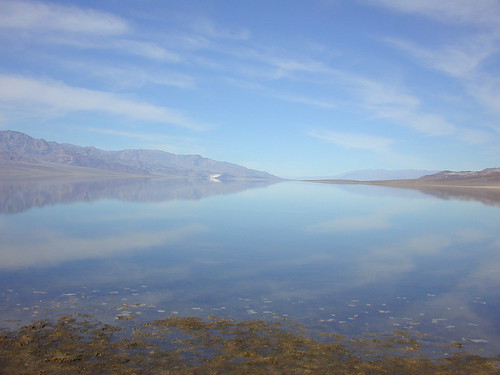
Death Valley on a much cooler day in January 2005, with Pleistocene Lake Manly reemergent at Badwater.
I say more about this over at KCET, but I’ve found it kind of surprising that today’s barrage of coverage of the World Meteorological Organization’s official dethroning of the 1936 El Azizia, Libya temperature record didn’t mention this fascinating work that came out a few months back.
The short version of today’s news: a global group of meteorologists, including Libyan scientist, Khalid El Fadli, climate director of the Libyan National Meteorological Center, went over the old records that secured El Azizia’s spot in fifth-grade geography texts as the site of the world’s highest recorded temperature. That much-memorized datum, an air temperature peak of 136°F (or 58°C for those of you in civilized countries) 90 years ago today on September 13, 1922, turns out to have been an artifact of difficult-to-read equipment combined a newbie weather technician working at an Italian Army post. The peak actual temperature that day was likely 7°C cooler, putting it well within the range of normal hellishly hot for the neighborhood I just moved out of. That puts Death Valley’s July 10, 1913 reading of 134°F/56.7°C back in the first place spot it ought to have enjoyed for the last 90 years.
El Fadli, by the way, had to go underground for a bit during the revolution. His colleagues lauded him today for taking risks to get this study done, and we wouldn’t have had this info without his taking significant personal risks as Qaddafi’s regime went through its death throes.
The thing is that those official records have a bit of built-in sampling error: namely, they derive from the places where we’ve managed to maintain weather stations for long enough to keep records. The WMO has more than 11,000 weather stations worldwide, but “worldwide” is a big place, and that works out to an average of one weather station for every 13,000 square kilometers of land surface. Admittedly, much of the really underrepresented land surface is in Antarctica, where it’s unlikely any high air temperature records will be set anytime soon. But that’s still a lot of potentially hot land not being monitored, in the deserts of Asia, Africa, and even the Sonoran Desert in North America.
The research that made the press a few months back involved measuring Land Skin Temperature (LST), which I’d embarrassingly typoed as “Land Sin Temperature” at KCET until just now, via infrared satellite monitoring of the Earth’s surface by way of the Moderate Resolution Imaging Spectroradiometers on two NASA satellites. The researchers, led by Steve Running of the University of Montana, found a number of places well away from the nearest WMO-approved weather station that had astonishingly high surface temperatures. The record? A dark and gravelly spot in Iran’s Lut Desert, where on one particularly warm day in 2005 the LST reached 159.3°F/70.7°C. The place on Earth with the second-hottest LST was an unspecified spot in the bush in Queensland, which will no doubt delight the Strines in the crowd. That temperature: 156.7°F/69.3°C. The Turpan Basin in Xinjiang, China took third place at 152.2°F /66.8°C.
Of course air temperature and LST are different animals. The WMO requires that air temperature measurement be taken 1.2-2 meters off the ground in the shade, which means comparing air temps and LST is kind of comparing apples with the sun-baked soil at the base of the apple tree. Think walking barefoot on the beach on a nice day with air temperatures in the 80s. Differences of 50°F between air temperature and LST aren’t unheard of. And until we plant a WMO-approved weather station out on the Lut Desert, we probably won’t have a good idea how those temperatures compare with Death Valley’s.
But we do know one thing: when Running’s team listed the places on Earth with the hottest Land Skin Temperatures, Death Valley didn’t make the list. So the hottest place on Earth, according to the news today, probably isn’t. It’s just the hottest one for which we have a recorded air temperature. Which doesn’t make as snappy a headline. But that’s okay: the California Desert still has that 767 straight days without rain at Bagdad, about 40 miles north of where I’me sitting right now. It’s at most in second place after the Atacama Desert, which has some places where rain’s never been recorded, ever. But we’re’ good at being in second place around here.

Come to a book reading! the Minnesota Atheists are sponsoring a reading at the Southdale Libary at 2pm from our anthology, Atheist Voices of Minnesota: an Anthology of Personal Stories
It will be fabulous. And it will be the most exciting thing happening in Minnesota all day long! You must come!


This is the lounge. You can discuss anything you want, but you will do it kindly. Careful! Don’t squeeze the platypuses!
Status: Heavily Moderated; Previous thread

You really should read Jonathan Eisen’s response to a quantitative biology conference invitation that listed 25 male speakers and organizers, and one lonely woman. See? All kinds of geeks turn out to be unthinkingly sexist.
I wondered how this could happen, and then I saw that the first two organizers are named Ditto and Hasty. Well, of course then.

