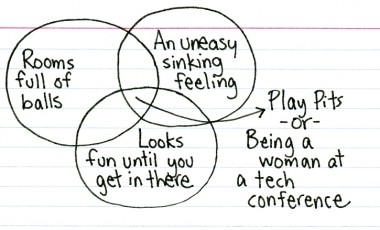
Ow, cringing

Yikes, this is an awkward story. A teaching assistant mailed her students personal, nude photos of herself instead of homework answers. If it was a genuine mistake, and I assume it was, I feel for her — she’s going to get some unfortunate student feedback.

But to everyone giggling over it, I would say, grow up. Adults are sexual beings. They will have sex lives; they aren’t going to sacrifice that so students can pretend they’re all alabaster statues. This was an unfortunate error, but it doesn’t mean she’s something unusual: educated people, like your professors, tend to have rather adventurous and interesting sex experiences. They just don’t usually expose them.

But most of my cringing is reserved for the commenters at the link who are making much of the fact that the woman was of Asian descent, and are throwing around jokes built on offensive stereotypes. There is no shame in a person having sex. There ought to be quite a bit of shame in being a bigot.

Do better. Please just do better.

It’s been a rough couple of weeks in the community of science bloggers, with the abrupt downfall of Bora Zivkovic, a very well liked (I consider him a friend) and influential leader. If you haven’t been following it, here’s a summary and timeline of recent events. The simple version of the whole story is that one of the major pioneers of science blogging and one of the people most instrumental in forging a community online has been found to have abused his privileges to sexually harass women members.

I’ve been processing how I feel about it all. As I say, Bora is a long-term friend; I remember when he joined us at Scienceblogs, and I also remember meeting him for the first time — he was a genuinely enthusiastic proponent of bringing people together and building a new platform for science communication. So this is a real tragedy that he has managed to undermine his own talents.

At the same time, though, here’s what I feel now: discouragement and despair and cynicism. We’ve been through this before in the skeptic/atheist communities. It was beginning to be my expectation that any grand attempt at building new organizations and improving communication was eventually going to collapse into the sewer of patriarchal sexual politics — that this pattern of sexual inequity was hardwired into the culture as a whole, and anything rising up out of it was going to be infected with the taint and eventually succumb to it. Same ol’, same ol’, I thought — the hard slog is never going to end.

But I was surprised: the science community’s response has been strong and appropriate. There’s no excusing his behavior, and rising up and demanding better is exactly what needed to be done, painful as it was. And they did it. There’s hope? Really? The struggle might actually lead to progress?

There has been a lot of writing on this topic in the last few weeks, but I thought Scicurious captured it particularly well.

Bora is not the man I thought he was. And the science communication community was not the place I thought it was.

The whole week has been full of downs. But toward the end. I started to see #ripples of hope. Not just the hashtag (though that alone is brilliant), but from other bloggers, saying, we can, in the future, be better. We want to be better. We WILL be better. People taking decisive action.

And I have been incredibly impressed with many of my colleagues. Yes, people fought, and jumped to conclusions, and etc. But there have been no death threats or rape threats, and compared to some communities I’ve seen…well I’m impressed. I always thought I wrote with and worked with some amazingly good people. Now, I KNOW it.

I contrast that with the atheist community. We also have some amazingly good people — as I travel around, I run into them all the time, at all levels of organization, and all doing good work — but we also have a substantial number of amazingly awful people…and as it turns out, it doesn’t take many sexist jerks clawing at the structure of your organization to distract and disrupt and impede progress. We have enough atheist asshats to provide shelter and support to exploiters — and too many of us are willing to overlook the content of our leaders’ characters, as long as they are willing to say the right words about the sacred atheist cause.

I’ve been astounded at how many people demand that we plaster over an atheist’s human flaws simply because, well, he’s The Man. We’ve been building up a body of revered saints, rather than recognizing that every one of us is human and needs to be held accountable. Face reality: if Bora had chosen to be a leader of the atheist community, rather than the online science community, right now there would be a huge battle going on, with loud voices shouting that “He only talked to these women; aren’t they strong enough to resist?” And the women who spoke out would be flooded with death threats and rape threats, and would be endlessly lampooned on our little hate nests scattered about the internet. Youtube would be full of videos expressing outrage that a Good Man should have been chastised by the Shrill Harpies of Feminism.

We’ve all seen it. Every atheist woman who dares to challenge the privileged status quo and ask for a little respect gets the treatment: just ask Rebecca Watson, or Jen McCreight, or Ophelia Benson. So I feel mixed: there is the despair at the failure of atheism to motivate real change, and hope that the science online community will set a model for everyone to follow.

But I also fear that atheism’s problems are rooted too deeply. This community is full of people who are already convinced that they are better than everyone else. But to be a good person, you have to always want to be better than yourself right now.

Still?

The myth will never end. The Three Stooges…errm, I mean, the three main egos of AVoiceForMen met in a video chat to crow over their fame, and among the topics that came up was that universal obsession of MRAs everywhere, Rebecca Watson. Dave Futrelle transcribed the relevant bits so we don’t have to watch it, but it’s a remarkable demonstration of their opacity to evidence. Here’s John “the Other” Hembling, describing the most notorious elevator ride ever.

Watson then went online and did a video admonishing the male members of the atheist community, of which she was a part, “guys don’t do that,” and characterized this conversation in the elevator as if it was some sort of great, terrible, frightening threat, and crafted her victimhood out of that, and essentially used that story to launch a professional speaking career on the atheist circuit.

Really? They’re still repeating this nonsense, despite the ready availability of the video that shows they’re all wrong? She didn’t even imply that the guy was frightening, she didn’t present herself as a victim, and she was already a popular speaker on the lecture circuit — why do these guys think she was in Ireland anyway?

Apparently it’s not just religion that schools people in self-delusion.

Who do you trust to tell you lies?

Here’s a simple experiment: separate two people. Give one person, the sender information about two packets of money, a small sum and a larger sum. Let them then tell the other person, the receiver, about the two packets, and give them the choice of which one they can have. Will the sender lie or not, in order to trick the receiver into picking the smaller packet?

The result in college students in Canada is that roughly 50% of the subjects lie. Before we go on, be sure to put this in context: this result is only valid in one particular culture. Related economic tests have found that there are many other cultures that value giving over receiving, and that would skew the interpretation of this one, so we’re not looking at broader human properties, but solely at the properties of products of one narrow culture. OK? OK.

The interesting result is a finer breakdown of the individuals who were more likely to lie. Mostly, no consistent associations were found, except that membership in any of these three groups were more likely to predict lying: a) Business majors, b) children of divorce, and c) people who say religion is important in their lives. I’m sorry, business majors, but (a) doesn’t surprise me at all. (b) I would not expect; I wondered if financial insecurity played a role, but they report no correlation with socioeconomic status or student debt. Hmmm.

Again, (c) does not surprise me in the slightest. I’ve known too many Christians. Sorry, believers, you’re not all bad, but man have you got a lot of hypocrites in your ranks. I would actually expect that because parasites are more likely to choose to blend in with the dominant group.

I would suggest a variation on the experiment, though. Pair the senders; I’d guess that those students professing a strong religious belief would show a strong reversal, being far less likely to lie, if a co-believer were there to witness. On the other hand, I’d bet that two business majors acting as senders would high-five each other with a successful lie. Put a couple of Libertarians in there, though, and they’d grab both packets and sneak out of the room.

Yeah, I have a hierarchy of well-earned cynicism.

Evolution of a feminist

I highly recommend Aron Ra’s video and commentary on his growth towards feminism.

I have to disagree with his conclusion, though (it’s OK — I think it’s a strength that we do not passively accept our Brave Leaders’ view). He points out that we atheists are a small minority in a sea of superstitious believers, and that we shouldn’t be fighting among ourselves. And, unfortunately, he characterizes this as a struggle over trivialities that are dividing the movement.

They are not trivialities. These are issues that we must resolve now, because they will shape how our movement evolves from this point on. I’d rather affiliate with progressive theists (although I’d be carping at them constantly about their goofball faith) than with atheists who want to rationalize women into subservience. We’re in a fight for the soul of atheism — and I want atheism to be something worth fighting for.

(Note: if you want to pile on Aron Ra for that last short section of his talk, and you want to do it without watching everything that precedes it, don’t. I’ve highlighted one bit that I disagree with; the rest is good stuff. Watch it all and read his blog post before you chime in on the conversation, OK?)

An invitation from Ancient Aliens

I received a polite invitation from the makers of the History Channel show, Ancient Aliens. Here’s what they asked:

Dear Dr. Myers,

I’m working with Name Redacted on the show Ancient Aliens. We have a crew coming to Minnesota this week, most likely Wednesday, and we would like to find out if you would be available for an interview. We’d also like to speak with you on the phone briefly about some of the topics we’d be discussing (development of the brain, embryonic development, evolutionary development of reptiles and mammals) and make sure that they are topics you’d fell comfortable talking about. Is there a convenient time when we could speak with you on the phone?

Kind Regards,

Name Redacted
Associate Producer
Prometheus Studios

I considered it. I’m always happy to engage with people with wacky ideas — heck, if I was willing to talk to Ray Comfort, you know I’m open to conversation — but I’d only seen a few snippets of this program and heard about it by reputation. So this evening, before I replied, I tuned in to the History Channel website to get an idea of what I’d be getting into.

I was aghast. It was the same nonsense I’d seen presented at the Paradigm Symposium this past weekend, in a very glossy and professionally done format. I congratulate Prometheus Studios on their skill in turning out superficially slick and attractive programs. The content, though…the content. It was just a series of ludicrous assertions of the most absurd claims of gods and aliens and extraterrestrial conspiracies and outright nonsense. Not once did I see any skepticism expressed. Mainstream academics were treated as dogmatic ignoramuses who couldn’t see the power of totally unsubstantiated hypotheses about aliens.

I could foresee how any material I might give them would be treated. So this is what I wrote back.

I actually know quite a bit about those topics, evo devo and neuroscience are my specialties. However, having viewed a few of your programs, I doubt very much that my skeptical view — that the processes of the development of the brain are entirely natural, that they do not support any claims of extraterrestrial intervention, or that humans lack any exceptional capabilities that require a design hypothesis to explain them — would actually survive the editing process to make it on air. In fact, I notice a remarkably complete absence of any critical evaluation of the rather bizarre “theories” that tend to get promoted in your programming, so I don’t even see how my expertise could contribute.

After due consideration, I’d have to say that no, I’d rather not contribute to the program, and that there’s no point to wasting your time or mine.

Thank you for the invitation. I’d wish you well in your work, but seriously — your show is credulous, ridiculous, and offensively ignorant of any reasonable understanding of science. If you’re ever involved in programming that actually contributes to human understanding, rather than undermining it, please feel free to contact me then.

Willing as I am to have a conversation with people with wild & weird ideas, it was just too obvious that my side of the conversation wouldn’t be useful to them…and couldn’t possibly appear on their program.

Also, all of the people on their show enthusiastically promoting aliens were clearly total wackaloons, and I’d be embarrassed to be associated with them.

The most depressing thing I’ve read today

Ten years ago, Ivan Macfadyen sailed across the Pacific Ocean. He repeated the voyage recently, and was shocked at the changes: the sea was empty of fish, and thick with garbage. He describes the painful experience, and also sees the trawlers stripping the reefs naked.

The speedboat came alongside and the Melanesian men aboard offered gifts of fruit and jars of jam and preserves.

"And they gave us five big sugar-bags full of fish," he said.

"They were good, big fish, of all kinds. Some were fresh, but others had obviously been in the sun for a while.

"We told them there was no way we could possibly use all those fish. There were just two of us, with no real place to store or keep them. They just shrugged and told us to tip them overboard. That’s what they would have done with them anyway, they said.

"They told us that his was just a small fraction of one day’s by-catch. That they were only interested in tuna and to them, everything else was rubbish. It was all killed, all dumped. They just trawled that reef day and night and stripped it of every living thing."

Macfadyen felt sick to his heart. That was one fishing boat among countless more working unseen beyond the horizon, many of them doing exactly the same thing.

No wonder the sea was dead. No wonder his baited lines caught nothing. There was nothing to catch.

Waste and destruction. Does humanity deserve to continue?