Oh, really? You mean that accusation was serious?

Guess who just got a vaguely threatening Freedom of Information Act request demand? Me!

You may recall that bizarre letter slipped under my door by John Geiger, editor of the right wing campus rag, the North Star. In it, he blithely accused me of stealing a print run of his newspaper because the distribution locations smelled like chloroform and other sciency things, and because I’d written a post expressing my contempt for the disgusting racism he exhibited.

I thought it was a joke. But no, he has enlisted something called The Alliance Defending Freedom For Faith For Justice to come after me. They sent a letter. Here’s the relevant part:

Pursuant to Minnesota’s open records law, MINN. STAT. §§ 13.01 to 13.99, we request access to and a COPY of the following documents and data:

1. Video surveillance of all cameras near the following locations on the University of Minnesota Morris campus from 12:00 a.m. on November 22 to 11:59 p.m. on November 23, 2013:

a. In the tunnel between the Science building and the Student Center; and

b. In the Humanities Fine Arts building; and

2. Written communications, including electronic, sent or received by UM- Morris Professor Paul Z. Myers that refer to the “NorthStar,” “North Star,” or John Geiger; and

3. Written communications, including electronic, sent or received by UM- Morris Chancellor Jacqueline Johnson that refer to the “NorthStar,” “North Star,” or John Geiger.

Do we even have video surveillance cameras there? I have no idea. Anyway, I was happy to oblige, did an email search for those terms, and came up with all of…about a dozen items. Most were references to the North Star STEM alliance; one was a message to the whole campus from our chancellor deploring the allegations of fascism and racism published by the North Star, and that was actually the only correspondence at all that mentioned Geiger. Other than Geiger’s own letter, of course.

There won’t be any evidence of a conspiracy, or that I stole their dreadful papers, because there wasn’t and I didn’t…but one thing we know, wingnuts love to make noise about dreadful sneaky conspiracies against them and the American Way.

Besides, I have an alibi. I was in Benghazi, extorting money from Bill Clinton’s mistresses to invest in the Whitewater project, and also gathering fake temperature readings for Al Gore to fool everyone into believing climate change is real.

Ceterum censeo Creationism esse delendam

Aww, the poor Discovery Institute. They are so oppressed and censored that they are now asking for nominations for Censor of the Year. Because, as you know, criticizing creationism and expecting science teachers to have basic competence in their fields is tantamount to silencing alternative views.

They do admit that the majority — the vast, overwhelming, Jebus-crushing majority — of scientists accept evolutionary theory, but they put a paranoid twist on it.

Yes, a majority of scientists who will speak openly will you tell you, if questioned, that they accept the Darwinian account and reject the scientific alternative of intelligent design. But the statistical fact of such a majority is the result, in no small measure, of rule by fear. For every story of a scientist or teacher silenced that we have covered here, many, many others could be told — but the censored scholars and instructors are careful about keeping safe from further threats and reprisals, which means keeping quiet.

First, we aren’t “Darwinians” any more. Evolution is much bigger than Darwin imagined. Could these goobers someday learn that? I recognize Darwinian processes in evolution, but I also appreciate others.

But more importantly…”rule by fear”? Nonsense. The training of biologists and biology educators involves learning a great deal about the evidence and studying the research that lead to the conclusion that life evolved. The only thing we might be afraid of is looking ridiculous and uninformed if we were to promote the ridiculous and uninformed ideas of Intelligent Design creationist clowns.

But do help them out. Nominate those science educators who have done a great job of informing the public about the absurdity of creationism — because that’s the Discovery Institute’s working definition of “censorship.”

Henry Gee is gently, delicately, softly chastised

Nature has posted a rebuke to one of their employees for outing a pseudonymous blogger.

We would not normally comment on a point of view expressed by an employee in a personal capacity and in their personal time. However, as Nature was mentioned in a recent personal Twitter post by a Nature editor, it is necessary for us to clarify our views and policies. Firstly, we are pleased that the editor in this case has apologised to Dr Isis for the language used and for the fact that her identity was revealed. We also wish to make clear that both the language and behaviour are contrary to Nature’s principles and codes of editorial practice, and indeed contrary to the practices of all our editors. We encourage civility and respect on social media by our employees, and hope for similar standards from those we interact with. Blindness to the status of research authors is enshrined in our editorial selection policies and practices, as is the respect for, and protection of, anonymity. We take our responsibilities to our authors and reviewers seriously and we protect the identities of anonymous reviewers, manuscript authors or authors of magazine articles. Our policies on anonymity are detailed on our author and reviewer services pages: http://www.nature.com/authors/index.html. We continue to listen to reactions and are carefully considering the issues. The history and circumstances are complex, so we will not be commenting further on the specifics at this time.

The only comment directed at the offending employee begins with “we are pleased”. Wait, did I say “chastised” and “rebuked”? My error. I meant to say “lovingly stroked.”

This is how Nature‘s reputation gets dethroned, you know.

Chemists can, sometimes, do pretty work

One of the advantages of working at a small university that puts a variety of disciplines cheek-by-jowl in a single building is that I get exposed to all sorts of different stuff. It sometimes has its downsides — I’m on an interdisciplinary search committee, so next week is consumed with seminars in statistics and computer science, all very mathy, that will sorely strain my brain — but I get to learn stuff all the time, which makes me happy.

So this semester I’m always trundling stuff up and down between the second and third floors for my genetics lab, and the third floor is where all the chemistry labs are taught, so I run into these cool posters that I have to stop and stare at every time I go by. They’re cartograms of the periodic table of the elements from webelements.com, and yes, you can buy them for yourself ($10.14, cheap). Unfortunately, the thumbnails available on their site are fairly low quality and don’t do justice to them — they’re very pretty posters.

elementabundance

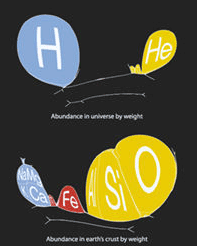
So here’s some perspective for you, two periodic tables where each element is proportionally scaled by abundance (the product of the big bang!), the top one of abundance in the universe, and the bottom one showing abundance in earth’s crust (products of nucleosynthesis in exploding stars).

That’s what the universe is all about: thinly distributed hydrogen and helium in a vast space, with traces of heavier elements occasionally forming in energetic accidents.

Also, any time I see a periodic table anymore — which is all the time — I am reminded of that awful debate with Jerry Bergman in which he claimed that Darwinists were trying to criminalize the periodic table because it revealed that all the elements were irreducibly complex. That’s how out of touch with reality those guys are.

Boom

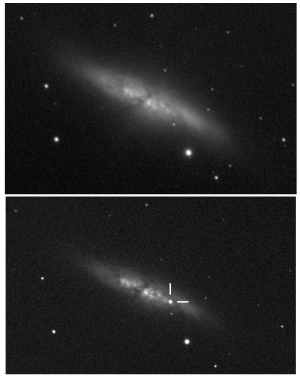
Last night, or 11.4 million years ago, a star exploded in galaxy M82. These photos are about a month apart.

supernova

I’m looking at that and thinking, “I bet it was warm there.”

It’s expected to get brighter over the next few weeks, to the point where it might be possible to see it with your home telescope or even a pair of binoculars. Over eleven million light years away, and the supernova is going to be faintly visible from my yard.

Revise my earlier sentiment: I bet it was really warm there.

Bill Nye is to creationists as the Catholic Church is to Galileo

At least, that’s what right-wing überlöön (so metal, he deserves a 3-umlaut title) Glenn Beck. Watch his meandering monologue* in which he accuses science and science education of being on the wrong side of history, and literally accuses Nye of persecuting creationists.

*In Beck’s case, that’s redundant.

Abortion: Safe, legal, and as frequent as you want one

Elyse talks about abortion, and there she goes, undermining the conventional narrative.

And when we talk about abortion, we talk about the hand wringing. The indecisiveness. The longing to keep the baby. The understanding that the woman already knows a part of her will always regret her decision. There’s pacing around the house. There’s sleepless nights trying to make a decision. There’s waffling. And there’s tons of crying. So much crying. When we talk about abortion, we imagine every woman feeling nothing but profound sadness over the decision she is trying to make. Choosing between herself and her child.

But fuck that narrative. It’s bullshit. It robs women of their right to be viewed as fully actualized human beings. We are not people who are a lot like men but with a psychological and biological mandate to become mothers one day, struggling to figure out if that day is today, worried that if we don’t seize this opportunity, right here and right now, we will never become what we were always meant to be: moms. We are people. Just like men are people. And just like men, some of us want to be parents. Some of us do not.

And we need to stop talking about pregnancy like it’s some kind of fucking alternative to ecstasy. Women who are carrying pregnancies they planned don’t always bond with their babies-to-be. To paint the picture of the unwanted, unplanned pregnancy as one that causes grief because of instant maternal instinct that begins around two minutes after pissing on a stick is harmful to women. It’s harmful to families. It teaches us that mothers like me are less than. We don’t love enough. We’re broken. It’s hard enough to try to nurture and support a person who moved into your abdomen and that you don’t necessarily like. It’s harder when you think not loving them makes you a sociopath.

It takes a creationist to pack so much wrong in so little space

Apparently, Martin Cothran believes that there is no life elsewhere in the universe, and that this unimaginably vast emptiness is evidence that a god created us. I don’t understand the logic, but then I don’t understand most of his weird leaps in this post on how life on other planets is like believing in the Flying Spaghetti Monster.

First, there is the naive scientific oversimplification.

We are told by many New Atheist scientists in particular (who like to mark their territory) that a belief can only be scientific if it is falsifiable. This is their demarcation criterion of choice and they use it to ruthlessly guard the borders of science. This is one of the reasons, they say, we must reject Intelligent Design. This idea comes generally from Karl Popper, a philosopher, who said that a theory cannot be considered scientific merely because it admits of possible verification, but only if it admits of possible falsification.

Oh, go away, Karl Popper. He seems to be the only philosopher of science the creationists have heard of. Falsification is one criterion; it’s part of a general effort to solve the demarcation problem, a problem I don’t think can be solved because the boundary between science and non-science is a grey murky haze. Personally, I think observation and evidence are more central to science than falsification.

How can a creationist even talk about applying falsification to science, though? They believe in so many things that have been falsified.

They don’t even get our jokes.

It is this general idea that is behind Richard Dawkin’s "Flying Spaghetti Monster." The Flying Spaghetti Monster exists just outside the range of the most powerful telescopes and the more powerful the telescopes, the further away the monster gets so that we are never able to actually detect him. There is therefore, no way in which belief in him may be disproven.

The Flying Spaghetti Monster is Dawkin’s send-up of the belief in a theistic God, belief in Whom has the same status as his imaginary monster: there is no evidence that can possibly count against his existence. God can never be disproven.

Dawkins didn’t invent it. Bobby Henderson did.

The flying spaghetti monster is a collection of absurdities intended to mock religious goofballs like Martin Cothran, so I guess it’s unsurprising that he doesn’t get it. It was clearly made up out of whole cloth, so it lacks any supporting evidence — just like religion. It makes ridiculous claims, like that pirates prevent global warming, with no mechanistic relationship and that are clearly false — just like religion. It makes untestable promises of an afterlife — just like religion. You can’t distinguish pastafarianism from Christianity on any criterion, not just the Popperian one, so Cothran’s single-minded focus on falsification is inappropriate.

But come on, let’s get to the claims about life in outer space.

Okay, now take the belief that life exists somewhere else in the universe. This is a common belief among atheist scientists. In fact, Dawkin’s himself conjectured that life on earth may have come from other planets. But how can that belief possibly be falsified?

There is a possibility that, if true, it can be proven true simply by finding it somewhere in our outside our own solar system. But if it is false, how could we ever know that it was false? If it was false and the universe were infinite, as many scientists believe, then would could never know it to be false even theoretically. And if it was false but the universe was finite, there is no practical way we could ever know it to be false even though it is theoretically possible–although there is some question whether it is even theoretically possible for humans to investigate a universe as massive as we know ours to be.

Once again, Cothran fails to grasp the argument or understand the science.

Here’s the key point: the hypothesis that life exists on other worlds is not about astronomy. It’s about life. It’s a religious premise that the purpose of the universe is all about us, and you’ll find that the most fervent opponents of the idea of life beyond earth are religious people who dislike anything that detracts from their geocentric view of the universe. That’s unscientific. To be fair, you’ll also find many science-fictiony types who populate the universe with aliens because they can’t write a drama that doesn’t involve interactions between sentient beings. That’s understandable, but also unscientific.

But no one came up with a scientific hypothesis of extraplanetary life because they looked outward and saw signs. The primary evidence for that derives from the study of biology. Life is just chemistry. There is no clear sharp boundary between what is alive and what is a chemical reaction. Chemistry is a ubiquitous property of the universe; it’s really just a subset of physics. So if you want to say no life exists elsewhere, you have to argue that there is something unique about Earth to only allow that chemistry to occur here.

The creationists are actually on the right track when they try to claim that life is a historical product of a design intervention; that would be a kind of event that could be restricted to a tiny subset of worlds. Unfortunately, their work to date has consisted of shouting assertions (COMPLEXITY ONLY ARISES FROM DESIGN!) that have been falsified (oops, hoist by your own petard, Cothran), or that rely on vague and poorly stated premises (what the heck is specified complexity?) or require distorting and lying about the actual evidence.

Biology has not found anything unique, supernatural, or exclusively dependent on exceptional properties present only on this one planet. Absent a restriction, the null hypothesis is that other worlds with similar physical properties are also likely to contain self-propagating, energy utilizing chemical processes. If creationists want to claim otherwise, that Earth is unique, they are obligated to provide the specific and unique property of life that confines its origin to one planet.

They have to make the falsifiable claim, not us.

This doesn’t count. It’s just stupid.

Even in this latter case of a finite universe theism would be less problematic since a theist could simply say "Well, we will find out after we die." And since everyone will certainly die, at least he has that to go on.

So there you have it. Belief in extra-terrestrial life. The Flying Spaghetti Monster. Theoretically indistinguishable. And taking this into consideration, how is believing in God any more or less scientific that believing there is life on other planets?

Again, the expectation of extraterrestrial life is based on studying life on earth and knowing its properties. No one has studied any gods, including the flying spaghetti monster, in any scientific way. That makes the claims trivially distinguishable.

So theism is a more scientific idea because it’s falsifiable, and it’s criterion for falsification requires testing it by dying? By ceasing to exist?

That violates another criterion for science. How will you publish?