Kitty. Victim of the late-Cenozoic extinction at the Page Museum in Los Angeles.
I usually like Scientific American’s short science explainer videos, but this one — Instant Egghead – Are We Facing the Sixth Mass Extinction?” — bothers me for a few reasons.
Fred Guterl starts off by saying that we don’t know yet whether our current extinction event qualifies as a “mass extinction.” It’s a bit of a semantic question, as the threshold for what constitutes a mass extinction is debated, and some rankings put different events in the top five. But let’s just take Guterl’s statement as meaning “we don’t know whether this current extinction is as big as the really big ones we’ve had in the past.” It’s an excellent point. It’s become received wisdom among a certain crowd that we’re facing Big Dieoff 6.0, and reminders that this isn’t necessarily any worse an event than, say, the extinctions at the end of the Eocene are always good. Not that the end-Eocene extinctions were a kitten romp.
The video goes off rather quickly, though, starting with the quick “citation” of a UNEP estimate of up to 200 species extinctions per day, which seems to have been taken urban legend style from an estimate Norman Myers made in the 1970s. Myers gave the range as 50-200, and he was saying 50 in 2006. We’ve seen a lot of estimates by different biologists. In 1993 E.O. Wilson offered an estimate of 30,000 species per year going extinct, about 85 a day. It depends on what models you use, and those models are the topic of debate.
Still, that’s more an editing quibble than anything. Few maintain that species aren’t going extinct faster than is “usual” for the Cenozoic.
There are a couple other WTF moments in the video, chief among them the statement that the end-Permian extinction was caused by Siberian lava flows igniting large coal deposits, creating a atmospheric CO2 spike “on the order of what we’re seeing today.” There’s certainly lots of evidence to support the idea, but it’s not a slam dunk, and other mechanisms remain possible.
There’s also an interesting mention of passenger pigeons that goes nowhere. In the context of species extinction rate models Guterl mentions that there was a population of billions of passenger pigeons in North America for who knows how many millions of years, and yet only two fossils of the species are known. And then he drops it, not explaining the fact’s relevance. I mean, I got there, and you probably did too — it implies that for each species we know went extinct back in the day, there were likely many we don’t know of whose fossils we have not yet found. What that implies in terms of past extinction rates I’m not sure: it’scertain that species we don’t know of went extinct and aren’t counted in the totals, but it would seem equally plausible that species we don’t know about survived the extinctions of the past, or that species we do know about that we now count as victims of mass extinctions actually survived those extinctions but left no trace for a few millon years afterward. Perhaps someone here with a better understanding of paleontology can help me out with this. In any event, it would have been nice to have Guterl finish his thought there.
My biggest problem with the video, though, is in Guterl’s suggestion that our changing the atmosphere’s composition — referring to the end-Permian extinction, as well as the “Great Oxygenation” of the Paleoproterozoic — is what’s got scientists worried about mass extinction these days, given that we happen to be adding CO2 to the atmosphere faster than the Siberian Traps did 252 million years ago. And scientists are indeed worried about the effects of climate change on biodiversity.
But scientists working on studying and preserving biodiversity — which after all is the positive way of saying “not having a mass extinction’ — are worried about a whole lot more than climate change. We could completely solve the atmospheric CO2 overburden on Tuesday and still be faced with an extinction crisis as we plow up grasslands, cut down forests, bottom-trawl the oceans, and build new sprawling cities on land that once supported wildlife.
The IUCN identifies habitat loss as the main threat to 85% of the species it lists as “Threatened” or “Endangered” on its Red List. The Red List includes 391 terrestrial plant species of all threat levels described as potentially threatened by climate change or severe weather, compared to 5,582 that may be threatened by human disruption of their habitat. The equivalent numbers for terrestrial animal species are 1,991 potentially threatened by climate change and 13,388 by habitat disruption.
There are errors inherent in the IUCN data that stem mainly from lack of resources to assess species, but the implication is clear. Climate change is thought to pose a serious threat to many species. Human-caused habitat disruption is likely a more serious threat.
One of the problems I have with the mainstream environmental movement these days is that “environmental protection” has been conflated with “climate change mitigation.” You can search environmental publications in vain for a long time for mentions of other issues. When I started editing environmentalist publications in 1992 — the year of the first Earth Summit, in Rio — public attention was about evenly divided between the importance of preserving biodiversity and the threat of climate change. You can see evidence of this in the newly revamped Google Ngram viewer, by comparing mentions of the relevant phrases in books archived by Google as a function of time:
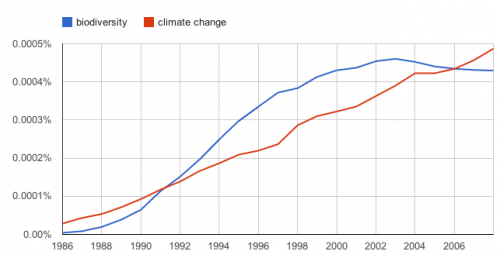
Expressed as a percentage of text in all books in the database, “biodiversity” peaks relative to “climate change” in 1997, then actually starts to decline in 2003. “Climate change” gains the lead the year the Al Gore’s movie came out. Google’s data runs until 2008. My personal anecdata would suggest that the lead “climate change” started developing in 2006 probably grew dramatically after 2009, with biodiversity likely to catch up a little bit sometime next year due to renewed attention to the issue on the UN front.
The point is that environment has become synonymous with climate in many minds. Thinking of biodiversity as of secondary importance (at best) to climate change has resulted in proposals to stem climate change that would actually harm biodiversity. They include everything from seeding oceans with iron to cutting down rainforests for biofuel soy plantations to siting utility-scale solar plants on intact and biodiverse desert habitat when there are former alfalfa farms in the neighborhood.
By mentioning only climate change in a video that purports to address whether we’re facing a mass extinction, Scientific American helps promote this emphasis on climate change — which is obviously a huge threat — to the exclusion of the greater causes of current extinctions. Yes, it’s a video lasting less than three minutes, but one could easily mention agricultural conversion and overfishing and forest clearcutting in a short video. They aren’t complicated concepts.
By all means, SciAm should rail against climate change. SciAm should persuade people to look at their carbon footprints, to demand changes in the way we run our industrial society, and to challenge the idiots in charge who’d deny any climate problem exists. But this was supposed to be a video on the current extinction event, and you somehow failed to mention the larger causes of that extinction. That does a disservice to SciAm’s viewers — and to the science.