
(via Larry Linton)

We sometimes focus too hard on the struggle with the regressive jerks who squawk and scream on the internet, but I have to tell you — they are completely irrelevant to major policy initiatives in academia (note: this does not mean academics can’t be assholes, too, it just means policies try to be more enlightened). Every time I have to deal with the people managing the major granting institutions, it’s simply taken for granted that we will be doing our best to encourage equal opportunities for everyone. The blind stupidity we seem to encounter when dealing with leaders of major skeptical organizations just doesn’t happen — that behavior would get them fired.
Latest example: the NSF is expanding maternity leave opportunities. Why? It’s obvious: because sexist policies derived from the conventions of the 1950s drive good people out of science.
Instituted in 2012, NSF’s Career-Life Balance (CLB) Initiative is an ambitious, ten-year initiative that will build on the best of family-friendly practices among individual NSF programs to expand them to activities NSF-wide. This agency-level approach will help attract, retain, and advance graduate students, postdoctoral students, and early-career researchers in STEM fields. This effort is designed to help reduce the rate at which women depart from the STEM workforce. Further information on the CLB initiative may be found on the Foundation’s website.
…
The purpose of this DCL is to announce a new opportunity for GRFP institutions to submit supplemental funding requests to sustain the research of active NSF Graduate Research Fellows who have been granted an NSF-approved medical deferral for dependent-care (family leave) situations (see Guide for fellowship status options). This gender neutral supplemental funding opportunity is in addition to the limited paid leave option for Fellows on Tenure with an NSF-approved medical deferral. GRFP institutions are invited to submit supplemental funding requests to provide additional personnel (e.g., research technicians or equivalent) to sustain the research of NSF Graduate Research Fellows on approved medical deferral due to dependent care (family leave) situations. The supplemental funding request may include funding for up to 3 months of salary support for the additional personnel, for a maximum of $12,000 in salary compensation. The fringe benefits and associated indirect costs may be in addition to the salary payment and therefore, the total supplemental funding request per Fellow may exceed $12,000. The supplemental request also must include a letter from the Fellow’s faculty advisor supporting the CLB/GRFP Supplemental Funding Request.
Beneath the bureaucratese, it’s pretty simple: gender-neutral family leave opportunities are now available at all ranks of the scientific enterprise, from graduate students on up. And they don’t ask questions.
There should be no privacy related information provided in this request, i.e., the rationale for leave should not be disclosed to NSF.

Vox Day/Theodore Beale really is hilariously easy to trigger into paroxysms of foolishness. He now refers to me as a professional "biologist" in those lovely scare quotes, because he thinks his understanding of “genetic science” is better than mine. He explains what he meant by his remarks that he, a white man, and NK Jemisin, a black woman, are not equal.
You see, Africans are pure homo sapiens sapiens. Non-Africans are not. NK Jemisin, being of African extraction, is almost surely more purely homo sapiens sapiens than I am. Or, for that matter, than PZ Myers is.
"Previous research has revealed that Neanderthal DNA can be found in the genomes of everyone who isn’t of African extraction. But, as Pääbo said, "The Denisovans had contributed DNA only to people in Papua New Guinea, Fiji, Australia, and other places in Melanesia." In other words, modern humans entering Asia interbred with Denisovans. But the Denisovan DNA didn’t wind up circulating to other areas of the world the way Neanderthal DNA did."
So, everyone who isn’t African possesses DNA from other homo species, including Homo neanderthalensis and what is either Homo denisova or Homo sapiens denisova. This is why I often mock those who believe in both evolution by natural selection and human equality, because humanity is not only NOT all the same under our skin, we are not, according to current genetic science, even all entirely the same subspecies. If we apply their idiot logic, then I was actually claiming that I am not fully equal to Jemisin rather than the other way around.
Pure what? What is a “pure” human? Every single person on this planet belongs to the same identical species, Homo sapiens, so his distinctions by differences in alleles is irrelevant. I must also mention that his habit of capitalizing the binomial name is a bit irritating. We teach a class in science writing here that hammers on a lot of the scientific conventions, and we literally tell our students that one of the first signs you’re dealing with someone who doesn’t know basic biology is that they get the punctuation wrong.
The existence of individual variants, even regional patterns, is an expected aspect of the genetic complement of a population. A species is not ever assumed to be genetically homogeneous, so it’s ridiculous to point to one member with a particular admixture of genes within a group and say they’re more a member of the group than someone else with a slightly different genetic complement.
It’s pure typological thinking. Theodore Beale has a crude version of 19th century biology (to be generous) rattling around in his head, and he thinks it makes sense.
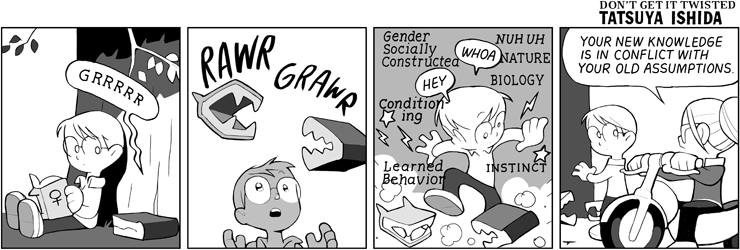
Oh, look, Sinfest has a comic just for Theodore.

I’m shocked. Just totally surprised. And it was unanimous — the Supreme Court determined that human genes cannot be patented. This is excellent news.
Why is it a good decision? Because medical DNA analysis was turning into a patchwork of competing landgrabs. Sequencing technology is coming along so nicely that more and more diagnostic tools are available, that can analyze big chunks of the genome for, for instance, known dangerous mutations. But at the same time, many stretches of DNA were ‘owned’, or patented by various companies. A company called Myriad had the patents on the genes BRCA1 and BRCA2 which, when defective, are associated with a higher frequency of breast cancer. Another company which might have a tool for analyzing a piece of chromosome 17, where BRCA1 was located, would have to intentionally mask their analysis, hiding the sequence of the BRCA1 gene, or they’d have to pay royalties to Myriad.
This is an increasingly ridiculous situation. Imagine if 50 competing meteorological forecasting companies each had rights to the weather above a different state, and a weather service in Louisiana had to pay the weather service in Florida for the right to examine clouds and wind and pressure to the east, and you couldn’t have a national or worldwide weather analysis without paying a thousand petty weather barons. That’s where we’ve been in genetics, with an increasingly balkanized genome and a welter of companies expecting payment if you looked at the DNA sequence in an individual patient.
Francis Collins, director of the National Institutes of Health, who has long argued for limiting private control of DNA data, said today that he was pleased with the ruling. “Our position all along has been that patenting DNA in its natural state does not provide any benefit to the public. There have been concerns that you might have a $1000 genome sequence, but a $500,000 royalty fee to use it. We can breathe a big sigh of relief that this will no longer threaten to inhibit the progress of DNA research.”
So, smart move, Supremes. For once they made a decision that didn’t simply back corporate interests.
One complication, though. They made this decision based on the logic that the genetic sequence wasn’t an invention of the company — it was just what they found there — making that unpatentable. But they also made a decision that cDNA was patentable, which is a little weird.
cDNA isn’t exactly an invention by the company. Here’s what it is: the genomic sequence of a messy human gene is a cluttered mess. There are regions called exons which code for the proteins of the gene product, but they’re broken up by intervening sequences called introns. What the cell will do is copy the whole messy DNA sequence into RNA, and then enzymes come along and snip out the introns and splice together the exons into one continuous sequence. It’s like finding an interesting magazine article in which every other paragraph is interrupted by an ad, so you cut it up, throw away the ads, and tape the story together into one complete, uninterrupted flow of text. It’s a tedious exercise, but your cells do it all the time.
So this processed RNA is simply the coding part of the sequence, with all the useless bits cut out. Most of our genes are more intron than exon, so this is a fairly significant task; the BRCA1 gene, for instance is made of 24 exons, so those 24 chunks are splice together to make the final RNA molecule.
Your cells do not naturally produce cDNA, so the judges are sort of right to recognize it as an artificial process. To make cDNA, that spliced-together RNA is processed by a reverse transcriptase in the lab, making a complementary sequence of DNA. It gives you a new chunk of DNA without all the introns cluttering it up, which you can then insert into a bacterium, for instance, and put it to work making the full RNA/protein for you.
I guess it’s a reasonable compromise to say cDNAs are patentable. There is some specificity to it: you might be selecting a particular splicing variant (there are 38 different kinds of RNA produced from different patterns of cutting and splicing BRCA1 RNA, for instance) with a specific mutation, producing a particular molecular construct that is useful for diagnostics or for experiments. In that case, you have used the sequence to build a useful probe or tool — it seems fair to say your tool is a patentable creation, especially since the underlying genetic sequence is not patented, so someone else could come along and build their own tool from scratch.
There’s still one troubling thing about the decision, and it was Scalia who pointed it out.
Although the court’s opinion was unanimous, Justice Antonin Scalia added a divergent view. While he agreed with the decision, he could not personally stand behind the “fine details of molecular technology” cited by his colleagues, he wrote, because “I am unable to affirm those details on my own knowledge or even my own belief.”
So the judges came to an acceptable decision in this case, but truth be told, none of them are trained in molecular biology and genetics, so they weren’t actually competent to make that decision. This is a problem that’s only going to grow worse and worse as biology becomes more powerful and more esoteric. It’s also a little worrying that Scalia thinks mere belief might have been a useful barometer in making a decision — but the case was so far beyond the bounds of what he understands that I suspect he and the other judges based their decision entirely on the recommendations of the lawyers presenting briefs for their scientist clients.

In Australia New Zealand:
It started when seven-year-old Alijah got a small cut on the bottom of his foot in December 2012.
"Of course we didn’t think it was too serious, it was just a little cut but a couple of days later he started getting symptoms like a stroke on the side of his face," Mr Williams says.
"A couple of days later during the night he started to get cramps across his face. His face would contort and he was in a lot of pain."
After 24 hours in Auckland’s Starship Children’s hospital, the doctors diagnosed Alijah with tetanus, and he was taken to intensive care.
His parents didn’t get him a tetanus shot because they were afraid of vaccines.
In California:
Whooping cough, also known as pertussis, has claimed the 10th victim in California, in what health officials are calling the worst outbreak in 60 years.
Since the beginning of the year, 5,978 confirmed, probable and suspected cases of the disease have been reported in California.
All of the deaths occurred in infants under the age of 3 months, says Michael Sicilia, a spokesman for the California Department of Public Health. Nine were younger than 8 weeks old, which means they were too young to have been vaccinated against this highly contagious bacterial disease.
"This is a preventable disease," says Sicilia, because there is a vaccine for whooping cough to protect those coming in contact with infants, and thereby protect the infants.
However, some parents are choosing to not vaccinate their children. In other cases, previously vaccinated children and adults may have lost their immunity because the vaccine has worn off.
Ignorance kills, and we’ve got people promoting ignorance.
People like Robert F. Kennedy Jr.
Robert F. Kennedy Jr. likes to talk. When he calls you to discuss vaccines, he talks a lot, uninterruptably. He called Keith Kloor after Kloor wrote a story for Discover about RFK Jr.’s keynote address to a convention of people who think vaccines cause autism. You can read about their conversation at Kloor’s blog. Phil Plait wrote a story about RFK Jr. for Slate last week, pointing out that the idea that vaccines cause autism is a crackpot theory that has been thoroughly debunked, that it is dangerous, and that RFK Jr. is one of its most effective proponents.
Kennedy claims that thimerosal, a preservative used in some vaccines, causes autism. No, it doesn’t. This has been tested out the wazoo, and there’s no connection between autism and thimerosal, or autism and vaccines, for that matter. In order to back up his claim, Kennedy is reduced to completely misrepresenting the scientific evidence.
For a guy whose family has such a distinguished record of public service, Kennedy says some pretty awful things about government employees: “The lies that you are hearing and printing from the CDC are things that should be investigated.” He spoke to one scientist (he named her but I won’t spread the defamation) who, he said, “was actually very honest. She said it’s not safe. She said we know it destroys their brains.”
I asked the scientist about their conversation. She said there is in fact no evidence that thimerosal destroys children’s brains, and that she never said that it did.
There’s a pattern here.
When RFK Jr. challenged the university scientist about a study of the biological activity of thimerosal in vitro, which “everybody accepts because journalists hadn’t read it,” the scientist said, “ ‘Oh, yeah, you’re right about that.’ He backpedaled.” That’s because “now he was dealing with somebody who wasn’t afraid to read science.”
I talked to the scientist, who would prefer I not use his name because he gets death threats from unhinged anti-vaxxers. He said, “Kennedy completely misrepresented everything I said.”
I don’t know why Kennedy is bothering to misquote scientists and trying to get scientific authority to back him up, though, because he doesn’t believe in scientists anyway. He’s got a gigantic conspiracy theory in which all these scientific organizations are lying.
Robert F. Kennedy Jr.’s elaborate conspiracy theory is just as delusional and dangerous. Rather than accepting the findings of the Institute of Medicine, the National Institute of Mental Health, or the American Academy of Pediatrics, Kennedy says the scientists are lying. He says vaccine-makers are intentionally poisoning kids and giving them autism. Only he and his fellow activists know the truth because journalists, although they may report aggressively on the National Security Agency, Defense Department, and Central Intelligence Agency, are cowed by the Centers for Disease Control and Prevention.
Apparently hereditary political lineages are a really bad idea. The UK has Prince Charles, and the US has Robert F. Kennedy Jr.

These are awesome. I want a swarm for a pet.

Upwards of 3 feet long and in some cases-as thick as a garden hose and have the texture of jello. There’s mucus. These things are crazy.
Key words: EAT EVERYTHING. ALIVE or DEAD. These have been fed almost everything-and they eat what’s given them: fecal pellets, starfish, dead seal meat, fish, sponges, sea anemones, worms amphipods, penguin meat, sardine meat (with tomato sauce!) and on and on….
(via The Echinoblog.)

This language stuff is messy and complex. I was looking at this series of maps illustrating American pronunciation differences, and was starting to see a pattern in my own language — basically, if you look at the general rule for Washington state and Minnesota (which are often the same), that’s how I talk. With one exception:
I grew up spending many summers wading in the Green River collecting those crustaceans (and eating them), and we always called them crawdads, without question. “Crayfish” was a formal name, “crawfish” was unheard of. It’s green on this map.
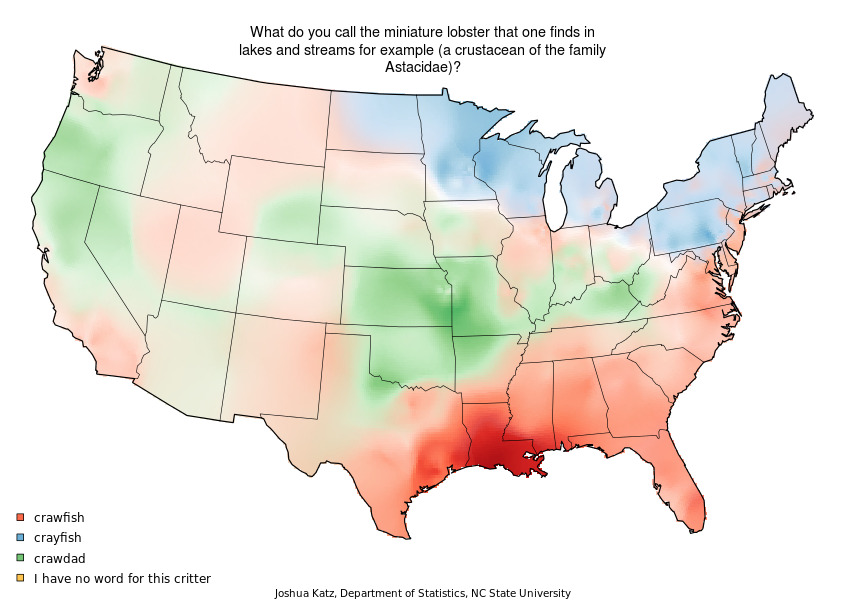
Then I realized…it was my father the fisherman who taught us about crawdads, and his family was apparently Appalachian Scots-Irish way, way back, who ended up in Iowa during the Civil War era, and eventually wandered into lives picking fruit and vegetables in the Spokane-Yakima axis…and those areas are all greenish on the map. Cool. There are these vestiges of my family history lurking right there on my tongue.
One weird thing about the article on this, though. It says,
Regional accents are a major part of what makes American English so interesting as a dialect.
American English doesn’t vary all that much — I can easily understand everyone all across the country. English in the United Kingdom, though — that’s where you get the strong regional accents.
(via Skepchick.)

Another day, another stupid creationist argument. This time, it’s some pastor whining that biologists don’t understand how animals survive the winter. We don’t?
These insects are not the only ones that hibernate – there are several others butterflies, insects, and even frog that make antifreeze in the fall and hibernate through the winter. Insects in all stages of life – eggs, pupa, and adult (CHECK THIS) – have been programmed to make various versions of antifreeze chemicals in order to survive freezing weather. How did the first Mourning Cloak butterfly learn to make anti-freeze? If it failed even once, the result was death – an evolutionary dead-end. God designed this butterfly to survive the brutal winter as an adult butterfly. The next time you see a butterfly very early in the spring – chances are it is a butterfly that knows how to make antifreeze!
How many attempts to survive the winter did the woolly bear caterpillar try? When did a certain caterpillar “get it right” and survive? Remember there had to be both male and female surviving to produce eggs and continue the species. The original Arctic woolly-bear caterpillar had to make this antifreeze so that its cells would freeze without rupturing for not just one winter…but 13 times for 13 winter freezes…always remembering to produce the antifreeze only just before winter arrived. Then it had to learn to completely rearrange its body structure to turn into a moth on the 14th spring.
How do evolutionists explain this? They don’t! The Arctic woolly-bear caterpillar, the Mourning Cloak butterfly, and a myriad of other creatures were designed to survive through the freezing winter. When you see design, there must be a Designer and that Designer is God. Those who wish to deny God’s existence see this marvelous design and say evolution did it – random mutational changes filtered by natural selection caused all this marvelous design to happen…but this is just storytelling and hand waving – it explains nothing.
Gosh, what a surprise — an ignorant creationist. Actually, we do. Winters aren’t all-or-nothing — look at a globe, and we have these things called latitudes, where we can see variation in the intensity of winters. Minnesota gets rather cold in January, while Nebraska is milder, and Texas is milder still. That means it’s trivial to find animals with a range that spreads from mild to cold environments, and that natural selection can have both variation and different selection regimes to operate. This isn’t difficult at all.
Furthermore, anti-freezes aren’t hard to generate: these are just small molecules that lower the freezing point or bind nascent ice crystals to suppress ice formation. These things evolve all the time by chance! Ask Sean Carroll.
Insects have evolved a variety of cryoprotective substances. As winter approaches, many freeze-tolerant insects produce high concentrations of glycerol and other kinds of alcohol molecules. These substances don’t prevent freezing, but they slow ice formation and allow the fluids surrounding cells to freeze in a more controlled manner while the contents of the cells remain unfrozen.
For maximum protection, some Arctic insects use a combination of such cryoprotectants and antifreezes to control ice formation, to protect cells and to prevent refreezing as they thaw. Indeed, a new kind of antifreeze was recently discovered in the Upis beetle by a team of researchers from the University of Notre Dame and the University of Alaska-Fairbanks. Unlike the protein antifreezes of other beetles, snow fleas and moths, the Upis antifreeze is a complex sugar called xylomannan that is as effective at suppressing ice growth as the most active insect protein antifreezes.
The necessity of avoiding freezing has truly been the mother of a great number of evolutionary inventions. This new finding raises the likelihood that there are more chemical tricks to discover about how insects cope with extreme cold.
Carroll has written a book, The Making of the Fittest: DNA and the Ultimate Forensic Record of Evolution
Meanwhile, arctic cod also carry an antifreeze protein…but it’s different and of independent origin from the one found in antarctic notothenioid fish.
So, actually, this creationist is completely wrong. Not only can we explain the evolution of antifreezes in animals, we do so in explicit detail, with step-by-step analyses of the molecular events behind them. If you want to see “storytelling and handwaving” that “explains nothing”, you’ll have to go to the loons who say “God did it.”


