Pharyngula
Evolution, development, and random biological ejaculations from a godless liberal


Read this story about abortions: it’s not anti-choice. It’s anti-science and anti-medicine. It’s appalling. She contrasts brutal “Western Science” with its machines (and also its caring people: ignore her colorful descriptions of the technology, and her experience with people in the abortion clinic was one where she was asked if she was sure she wanted it, and a woman who tried to help her afterwards) with “natural healing” in which she takes a few gentle herbs and just visualizes shedding the walls of her uterus, and magically her pregnancy disappears.
Then she babbles about how it is just fine if the “fundamentalist dickheads” burn down all the women’s clinics, because they’ll just be able to use organic natural herbal chemical-free machine-free medicine-free abortions using the magic power in women’s heads.
Jesus.
This is one of the nice things about FtB. Now you can go read Miri as a warm-up, finding parts of the essay that are worthwhile, while others suck.
Then go read Avi’s total destruction of the dangerous anti-medical quackery in the story.
It’s all good.

They’re beautiful diverse animals with a bad (and undeserved) reputation. Here’s a new species, Hemiscyllium halmahera, taking a little stroll.

“Eat, kid, you’re too skinny!”
Alternatively, there’s a distinct resemblance to Mrs. Doyle.

The The Carnival of Evolution for September is available. Good reading there, while I plod away at grading. Already.

I’ve been talking to my class this week (and it’s going to be a theme next week) about the difficulty of analyzing epidemiological data on cancer — that there are so many steps to cancer progression and so many environmental and genetic inputs to the disease that sorting them all out is extremely complex. What I haven’t mentioned yet, but definitely will now, is the factor big money plays in encouraging statistical fraud.
The University of Texas MD Anderson Cancer Center in Houston has been the top-ranked cancer center on US News & World Report’s best-of list for the past 7 years. But that top ranking was aided by a massive error in data used to evaluate its care.
The error in M.D. Anderson’s favor was made by–M.D. Anderson! Avery Comarow, who assembles the rankings at U.S. News, told The Cancer Letter that this was a huge "screw-up." The hospital systematically misclassified emergency patients, which led to the exclusion of nearly 40 percent of admissions, Paul Goldberg, The Cancer Letter’s editor, reported. He said the error was discovered in 2009, but no way could be found to correct it. "Since U.S. News averages data over three years, the results of the M.D. Anderson top rating by the magazine released July 16 are still partially based on tainted data," he wrote.
Is “error” actually the right word to use?


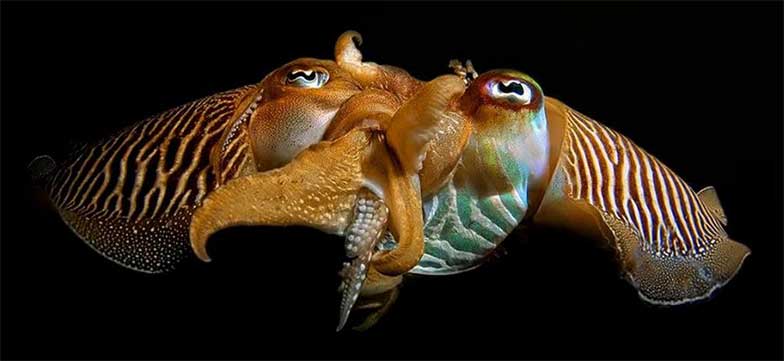
The bulk of an octopus’s nervous system is not in its brain, but its arms. So scientists have studied isolated octopus arms and found that they retain substantial responsiveness to the environment.
It’s depressing. I love eating big molluscs, but I’ve had to cut them out of my diet because there is just too much intelligence there. I’m going to have to cut out pork, too. Chickens are OK? Well, I’m cutting back there, too.

While we’ve been waiting and waiting for the physicists to get their act together and deliver on Mr Fusion home energy sources and flying cars, the biologists have been making great progress on the kinds of things that turn biologists on. The latest development: growing tiny little human brains in a bucket. Only let’s not call them brains…they are cerebral organoids. Hugo Gernsback would be so proud.
Here’s the latest development. Start with embryonic human stem cells, or induced pluripotent stem cells (cells which you’ve reset to a kind of embryonic state by using a virus to transfect them with the genes OCT4, SOX2, KLF4 and MYC, which trigger a change to a pluripotent state). Culture them in a cocktail of chemicals like basic fibroblastic growth factor and retinoic acid, which induces the cells to become neurectoderm, a precursor tissue of the nervous system. Imbed these cells in a gelatinous capsule that gives them a framework on which to grow, and also prevents them from just sprawling out into an amorphous neurectodermal sheet. Let them grow in a spinning bioreactor which circulates nutrients around them, and watch. They begin to form structures resembling those of the embryonic human brain, all by themselves.
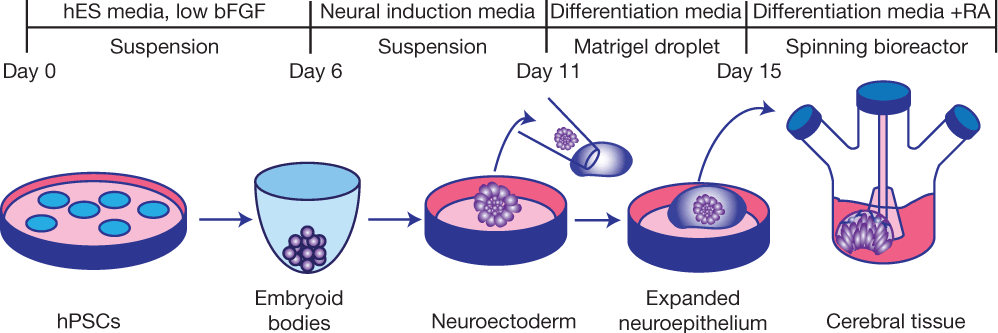
They show many of the properties of normal embryonic brains. Brains develop from the inside out; new neurons arise deep inside, and then migrate outwards along radial glia to the surface. These mini-brains show similar behavior, forming the beginnings of a laminar structure with roughly the same pattern of growth. They exhibit regional specification. We have a forebrain, midbrain, and hindbrain, for instance, and there are molecular markers for these areas; those molecular markers are selectively expressed in areas of the mini-brains, too. During development, our neurons exhibit fleeting electrical activity, especially the production of calcium action potentials (we gradually switch to sodium action potentials as the nervous system matures). These brains have bursts of calcium activity which can be diminished with tetrodotoxin, a nerve poison that affects signal transmission in neurons.

Awesome. Before you start imagining growing complete adult human brains in a vat to the point where they start doing philosophy, though, there are realistic limitations.
While there are regions expressing markers for typical human brain regions, they aren’t well organized — I looked at the sections of cerebral organoids, and while bits and pieces looked familiar, they weren’t in their canonical relationships to one another. It’s a kind of scrambled brain.
The laminar structure of the brain doesn’t fully form — it’s just the rough beginnings. It really is like a very early embryonic brain, and is not going to function to generate thoughts and perceptions.
It’s only brain tissue. They aren’t growing elements of the circulatory system, for instance, so there are no blood vessels delivering nutrients. That limits growth, and the largest cerebral organoids are only about 4mm in diameter. That might only be enough to generate an assistant professor of philosophy. (I joke! Don’t come after me, philosophy fans.)
Now this is pretty darned cool, and would be a shoo-in to win first prize at the Mad Science Fair, but you might be wondering what you can use it for. These are not functional brains, so no, you militarists, you can’t use them to control cruise missiles. What they are good for is studying developmental processes that build human brains (pure science!) and for figuring out the mechanistic causes of serious brain disorders (medical science!).
And the authors turned around and started doing just that. There are known defects that affect the proliferation of cells building structures in the brain, genetic diseases like microcephaly. You cannot do experiments on microcephalic human beings, and it’s been very difficult to generate good animal models of microcephaly — we have such unusual brains to begin with that it’s hard to find a brain analogous in sufficient detail in mice. But here’s what they can do.
They had a patient with microcephaly, with a known genetic cause (a mutation in a gene called CDK5RAP2). They can’t experiment on his brain, obviously, but what they could do is take a few of his skin cells, transfect them with the four inducing genes, and produce a clone which could be cultured in a dish and put through the organoid production procedure and make little tiny copies of his embryonic brain state. Now you can do experiments.
What they observed was that some brain areas in the organoids were smaller (complicated by the fact that overall growth was reduced), and that there more more neurons and fewer glia in affected regions. The hypothesis is that CDK5RAP2 maintains cells in a dividing state, and it’s absence causes premature maturation of neurons, which leads to reduced total numbers of neurons in the adult. They also tried inducing greater CDK5RAP2 in the organoids to rescue the phenotype — the experiment was confused by the fact that CDK5RAP2 overproduction seems to trigger cell death, and they do not have precise control over dosages, but they do find suggestions that glial production is rescued. They also did the complementary experiment of RNAi knockouts of CDK5RAP2 in non-patient organoids, and they did see a surge of neuron production. So it looks like they’re getting a good handle on the cellular processes behind this form of microcephaly.
So what they’ve built is a useful model for studying early brain development in humans that doesn’t involve experimenting on any actual humans. This is going to be useful for all sorts of developmental disorders.
Also, Mad Science Fair contests.
Lancaster MA, Renner M, Martin C-A, Wenzel D, Bicknell LS, Hurles ME, Homfray T, Penninger JM, Jackson AP, Knoblich JA (2013) Cerebral organoids model human brain development and microcephaly. Nature doi:10.1038/nature12517.

I think it’s an anti-Darwin: instead of observations, you get pretty pictures; instead of insights, you get a cloud of murk and lies. Georgia Purdom of Answers in Genesis visited the Galapagos, and now she’s coming out with a book of religious apologetics.
After my return, I started thinking about writing a book on the Galápagos Islands. I wanted people to see that what we think about how and when the Galápagos Islands formed and how the wildlife changed over time has to do with a person’s starting point or worldview. The Galápagos Islands both past and present are a display of God’s majesty in His creation and His mercy in preserving life in a fallen world instead of an “icon of evolution.” I also wanted people to appreciate the diversity and beauty of the wildlife and landscape that is unique to the Galápagos through the 2000-plus photos I had taken.
If you should ever see this book, think about Purdom going to the Galapagos on a sight-seeing trip and learning absolutely nothing, and compare it to Rosemary and Peter Grant who spent decades there, documenting patterns of change in the bird populations of Daphne Minor. I learn something from the Grant’s work, while Purdom’s delusions will just make the world a stupider place.
Give the Purdom book a pass. Get the Grants’ How and Why Species Multiply: The Radiation of Darwin’s Finches