Pharyngula
Evolution, development, and random biological ejaculations from a godless liberal



One of the advantages of working at a small university that puts a variety of disciplines cheek-by-jowl in a single building is that I get exposed to all sorts of different stuff. It sometimes has its downsides — I’m on an interdisciplinary search committee, so next week is consumed with seminars in statistics and computer science, all very mathy, that will sorely strain my brain — but I get to learn stuff all the time, which makes me happy.
So this semester I’m always trundling stuff up and down between the second and third floors for my genetics lab, and the third floor is where all the chemistry labs are taught, so I run into these cool posters that I have to stop and stare at every time I go by. They’re cartograms of the periodic table of the elements from webelements.com, and yes, you can buy them for yourself ($10.14, cheap). Unfortunately, the thumbnails available on their site are fairly low quality and don’t do justice to them — they’re very pretty posters.
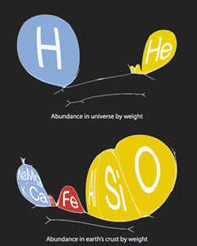
So here’s some perspective for you, two periodic tables where each element is proportionally scaled by abundance (the product of the big bang!), the top one of abundance in the universe, and the bottom one showing abundance in earth’s crust (products of nucleosynthesis in exploding stars).
That’s what the universe is all about: thinly distributed hydrogen and helium in a vast space, with traces of heavier elements occasionally forming in energetic accidents.
Also, any time I see a periodic table anymore — which is all the time — I am reminded of that awful debate with Jerry Bergman in which he claimed that Darwinists were trying to criminalize the periodic table because it revealed that all the elements were irreducibly complex. That’s how out of touch with reality those guys are.

Last night, or 11.4 million years ago, a star exploded in galaxy M82. These photos are about a month apart.
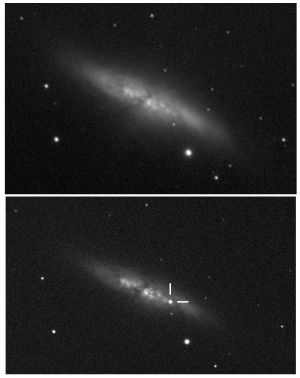
I’m looking at that and thinking, “I bet it was warm there.”
It’s expected to get brighter over the next few weeks, to the point where it might be possible to see it with your home telescope or even a pair of binoculars. Over eleven million light years away, and the supernova is going to be faintly visible from my yard.
Revise my earlier sentiment: I bet it was really warm there.

It’s cold and windy out there, and I can’t feel my toes right now, and so I’m thinking…

Yeah.

All is made clear.

Oh, no, it left one off:
Blogs: A dated description of what it’s like to eat a donut, with links to other blogs by people who like donuts, and excoriations of blogs by people who don’t like donuts.

This entirely not-safe-for-work video purports to tell the true, scientifically accurate story of the Teenage Ninja Turtles. I don’t know — it seems to think all turtles are the same.


Deborah Blum has a terrific story about the toxicity of MCHM, the chemical that Freedom Industries dumped into West Virginia’s water supply (a plume of poison which is now on its way to Cincinnati, and eventually Indiana). The answer on the degree of toxicity is…we don’t know. It’s had minimal testing.
She summarizes the toxicity tests that have been done on animals, which found it is “slightly toxic”, but that it caused suffering in the animals at all levels of exposure. There have been no long term studies done.
Complement that reading with this personal story of a West Virginian living without running water — which also mentions the powerlessness of being poor in Appalachia.