For the rest of us, though, this is adorable.
Pharyngula
Evolution, development, and random biological ejaculations from a godless liberal

For the rest of us, though, this is adorable.

It’s nature’s revenge: a marlin attacked an oil pipeline, causing a 5 day shutdown and costing BP over $100 million.

The attack moose are in training for Keystone XL. It’s not going to be pretty.


If you’re wondering how that photo was taken…

Nate Silver is putting together this journalism startup, and it’s already on the path to failure. I mentioned his oblivious sexism the other day, and now we learn the name of the ‘science’ writer he’s bringing to to cover the environment.
Nate Silver’s highly anticipated data-driven news site FiveThirtyEight launched on Monday, with a controversial figure covering science issues. Silver has brought on Roger Pielke, Jr., a professor of environmental studies at the University of Colorado Boulder, as a contributing writer – a political scientist who comes with a long history of data distortion and confrontations with climate scientists.
That last sentence is a lovely example of understatement. Pielke, both Jr. and Sr., are denialist kooks.
I don’t think I’ll bother reading FiveThirtyEight. “Data-driven,” hah.

You want more on the discovery of gravity waves from the Big Bang? It’s beyond my pay grade, so you’ll have to mosey on over to SciAm for the plain English summary.
Physicists have found a long-predicted twist in light from the Big Bang that represents the first image of ripples in the universe called gravitational waves, researchers announced today. The finding is direct proof of the theory of inflation, the idea that the universe expanded extremely quickly in the first fraction of a second after it was born. What’s more, the signal is coming through much more strongly than expected, ruling out a large class of inflation models and potentially pointing the way toward new theories of physics, experts say.
And why should we care?
The timing of inflation, in turn, tells physicists about the energy scale of the universe when inflation was going on. BICEP2’s value of r suggests that this was the same energy scale at which all the forces of nature except for gravity (the electromagnetic, strong and weak forces) might have been unified into a single force—an idea called grand unified theory. The finding bolsters the idea of grand unification and rules out a number of inflation models that do not feature such an energy scale. “This really collapses the space of plausible inflationary models by a huge amount,” Kamionkowski says. “Instead of looking for a needle in a haystack, we’ll be looking for a needle in a bucket of sand.” Grand unified theories suggest the existence of new fields that act similarly to the Higgs field associated with the Higgs boson particle discovered in 2012. These new fields, in turn, would indicate that other, heavier Higgs boson particles also exist, although with masses so high they would be impossible to create in any traditional particle accelerator. “This measurement is allowing us to use the early universe as a lab for new physics in energy ranges that are otherwise inaccessible to us,” Kamionkowski says.

All the biologists out there know about the heath hen: it’s probably the number one most common example of a recent extinction discussed in considerable detail, because it illustrates so well that extinction is a product of so many factors, from habitat loss to inbreeding to predation to competition to climate shifts to you name it. The last bird died in 1932.
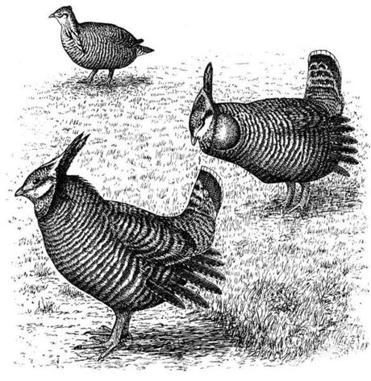
But now, something amazing has been unearthed: a 40-minute movie of the heath hens in their final reserve on Martha’s Vineyard, made in 1918. There’s a two-minute clip at the link. Watch the last dance of the heath hen and feel the loss.

I find myself continually bewildered by the argument against genetically modified food. However, we have no choice, we need to constantly improve the stocks.
We have a great deal to gain from growing GM crops. They offer humanity a way to improve food productivity without having to make further inroads into our planet’s wild places to create more fields for farmers. The position was summed up by Sir Mark Wolpert, the government chief scientist last week, when debating the CST’s report. "The challenge is to get more from existing land in a sustainable way or face the alternative, which is that people will go unfed, or we’ll have to bring more wilderness land into cultivation." From that perspective, the case for GM crops is unanswerable.
Not everyone will agree, of course. Green opponents to GM crops claim they pose a risk to health, though no research has ever produced any credible evidence to back this point. Thirty years ago, it could be argued that we should proceed cautiously because of potential health dangers. That argument is no longer acceptable.
I have a lot of sympathy for the green argument, except that it ignores the real problem to focus on a minor issue. The real problem isn’t that some of our crops carry modified genes, especially since they all do — every single one of our major food plants are the product of intense artificial selection for traits that benefit agriculture. No, the real problem is how much of our country is overwhelmed with monocultured species — most of the botanical diversity of the United States is gone under a layer of wheat and corn and soybeans and pretty much nothing else. Minnesota is 54% farmland, and we aren’t even the most intensely plowed over state in the country.
It seems to me that the green approach would be to encourage more GMOs to increase the efficiency of farmland use; and to struggle to get less land committed to agriculture by ending the corn ethanol boondoggle and by encouraging more vegetarian diets, so less livestock. Worrying about an artificially introduced gene in a crop seems silly when the real problem is that versions of that crop are taking over everything, replacing wetlands and prairie with endless fields of corn, GMO or not.

There’s supposed to be some gigantic announcement coming from the astronomy community today at noon. I think we’ve been burned by the hype a few times before (arsenic life, anyone?), but Sean Carroll thinks this might actually be a significant discovery about Gravitational Waves in the Cosmic Microwave Background. I had no idea what that meant — I’m a biologist, dammit — but Carroll gives a darn good explanation for why it matters. It has cosmological implications about the Big Bang and inflation.
Go read it yourself so that when the announcement comes down and everyone is looking baffled, you can nod sagely and explain to everyone around you what it means.

From the first sentence, I could tell that the opinions of Kristin Cavallari were garbage.
Experts warned against the dangers of following celebrity advice after reality star Kristin Cavallari acknowledged Thursday that she and husband Chicago Bears quarterback Jay Cutler decided not to vaccinate their children.
When directly asked whether she was opposed to vaccines during an appearance on the Fox Business Network program, The Independents, Cavallari said, “we don’t vaccinate.” The reason? “I’ve read too many books about autism and the studies,” she said.
Also, “Chicago Bears quarterback” does not confer any credibility in matters of medicine on Jay Cutler. These are people that should be laughed at.
But then the article cites a doctor:
Homefirst Health Services, meanwhile — if that’s what Cavallari meant — is a Rolling Meadows-based pediatrics practice that embraces home births and shuns vaccines. Dr. Mayer Eisenstein and his practice were the subject of a 2009 Chicago Tribune investigation that shed light on the use of potentially dangerous alternative autism treatments. On the Homefirst website, Eisenstein maintains that “personal religious convictions, not scientific studies, are the main reasons, upon which to base your vaccination decision.”
Is there no accreditation process for medical clinics? How does one that refuses to carry out basic preventive medicine for “religious” reasons, manage to stay in business without the medical establishment — or at least the insurance companies — stomping on them?
The only sensible words in this article…
Alexander said Cavallari’s comments illustrate the problems with celebrity spokespeople, namely that they often have their facts wrong. “Celebrity status does not indicate scientific expertise,” he said.

I’m seeing a lot of silly carping about Neil deGrasse Tyson’s Cosmos — almost all of it is focused on the story of Bruno told in the first episode. The apologists for religion are upset: how dare a science program point out the poisonous influence of religion? Bruno wasn’t really a scientist anyway, so he shouldn’t count! Peter Hess of the NCSE offers up a good example of apologetics.
Unfortunately, the series premiere risks squandering that opportunity through a combination of misleading history and reliance on an antiquated narrative of inevitable conflict between science and religion—and the Catholic Church in particular—that simply is not borne out by the facts. A generation of careful scholarship has given us a nuanced and sophisticated understanding of the long, rich, and complex relationship between religion and the sciences. This latest Cosmos reflects none of that historiography, presenting us instead with what is quite literally a cartoon version of the life story of someone who was not a scientist. Missing were the stories of Catholic astronomers such as Copernicus [delayed publication out of fear; only saw his ideas in print on his deathbed; book was prohibited by the Catholic Church in 1616] and Galileo [tried by the Vatican, forced to recant, spent the end of his life under house arrest], Protestants such as Brahe [Brahe was a geocentrist — a geoheliocentrist, actually] and Kepler [Did you know his mother was tried and imprisoned for witchcraft?] and Newton[Also a mystic, Bible-prophecy walloping, fanatical religious person], or Fr. George Lemaître, proposer of the Big Bang.
Whenever I see one of these guys throw out noise like a nuanced and sophisticated understanding of the long, rich, and complex relationship between religion and the sciences
, I want to ask…what was nuanced and sophisticated about setting a human being on fire? I also think his list of famous scientists overlooks an important trend: between Copernicus and Lemaître, we are seeing the steady triumph of science over religion, that we see the Church forced to reduce the severity of its enforcement of dogma in the face of the overwhelming success of science in accurately describing the world. The Church was dragged kicking and screaming into an era where you don’t get to murder people for disagreeing with your dogma.
It is odd therefore that Cosmos focuses almost exclusively on the marginal case of Giordano Bruno. Of course, I am not defending Bruno’s persecution and death—no decent human being now would ever condone burning a person alive for any reason. Moreover, in 2014 we view legitimate theological dissent very diffferently than did our ancestors.
But the circumstances were quite different 400 years ago. According to the 16th century Italian legal code and the customs of Renaissance politics, Bruno was judged by an ecclesiastical court to be an obdurate heretic for refusing to cease in promulgating his theological ideas. As such he was deserving of capital punishment and was turned over for execution by the civil arm in Rome. In the 21st century we inhabit a very different era, a religiously pluralistic age of largely secular states in which the nature and exercise of authority are vastly different than they were in Post-Reformation Italy.
Is anyone else getting that queasy feeling, like when you read about William Lane Craig justifying the murder of babies by ‘Israeli’ soldiers? Hey, it was OK to set people on fire in 1600! Why are you complaining?
I agree that we live in a very different era in the 21st century. Give the credit to secularism, rationalism, and the Enlightenment, though, because fucking religion fought every progressive change every step of the way, with liberal religion dogging along by discarding parts of the religious nonsense of previous generations.
I don’t think it odd at all that the series brought Giordano Bruno to the fore. This is not at all a show for scientists, but to bring a little bit of the awe and wonder of science to everyone. I think it was a good idea to use a non-scientist as an example of how dogma oppresses and harms everyone. Bruno was an idealist, a mystic, an annoying weirdo, a heretic, and for that, the Catholic Church set him on fire.
Do I need to repeat that? Bruno was tortured to an agonizing death for his beliefs. Full stop. Don’t even try to rationalize that.
Furthermore, Neil deGrasse Tyson’s own words, transcribed by Wesley Elsberry, are crystal clear on the point he was making.
Giordano Bruno lived in a time when there was no such thing as the separation of church and state, or the notion that freedom of speech was a sacred right of every individual. Expressing an idea that didn’t conform to traditional belief could land you in deep trouble. Recklessly, Bruno returned to Italy. Maybe he was homesick, but still he must have known that his homeland was one of the most dangerous places in Europe he could possibly go. The Roman Catholic Church maintained a system of courts known as the Inquisition, and its sole purpose was to investigate and torment anyone who dared voice views that differed from theirs. It wasn’t long before Bruno fell into the clutches of the thought police.
The Church maintained an Inquisition to torture people who didn’t follow Catholic dogma in thought. Let’s not hide that fact. Let’s not pretend it was OK because it was 400 years ago. Let’s not say it was irrelevant because many of their victims, like Bruno, were not scientists. I think it’s a rather important point that the progress of science requires that we not set people who disagree with us on fire.
Wesley makes a very good point at the end.
The point “Cosmos” was making was more basic. At the level of telling people about science, we don’t need a lot of historical nuance about the Inquisition: what they did was so far out of bounds of the way discourse needs to be handled that simply noting the historical divergence is sufficient. “Cosmos” did that, plainly told people they were doing that, and, sadly enough, a lot of people of otherwise lofty intellect managed not to take the point.
I will also disagree with Hess. There is a conflict between science and religion. Somehow, these people think that the historical evidence of people leaving behind their antiquated religious ideas and gradually adapting to a more secular view of the world is evidence that religion and science are compatible.
You know, I’d heard this vague euphemism that the church “immobilized his tongue” to prevent Bruno from speaking heresy on the way to the stake, but I didn’t know how. The answer was provided in the comments:
[on the way to the stake, Feb 19, 1600] As the parade moved on, Bruno became animated and excited. He reacted to the mocking crowds, responding to their yells with quotes from his books and the sayings of the ancients. His comforters, the Brotherhood of St. John, tried to quiet the exchange, to protect Bruno from yet further pain and indignity, but he ignored them. And so after a few minutes the procession was halted by the Servants of Justice. A jailer was brought forward and another two held Bruno’s head rigid. A long metal spike was thrust through Bruno’s left cheek, pinning his tongue and emerging through the right cheek. Then another spike was rammed vertically through his lips. Together, the spikes formed a cross. Great sprays of blood erupted onto his gown and splashed the faces of the brotherhood close by. Bruno spoke no more. … as the fire began to grip, the Brothers of Pity of St. John the Beheaded tried one last time to save the man’s soul. Risking the flames, one of them leaned into the fire with a crucifix, but Bruno merely turned his head away. Seconds later, the fire caught his robe and seared his body, and above the hissing and crackling of the flames could be heard the man’s muffled agony.
Yeah, that’s what the apologists want to dismiss as irrelevant.
