Pharyngula
Evolution, development, and random biological ejaculations from a godless liberal


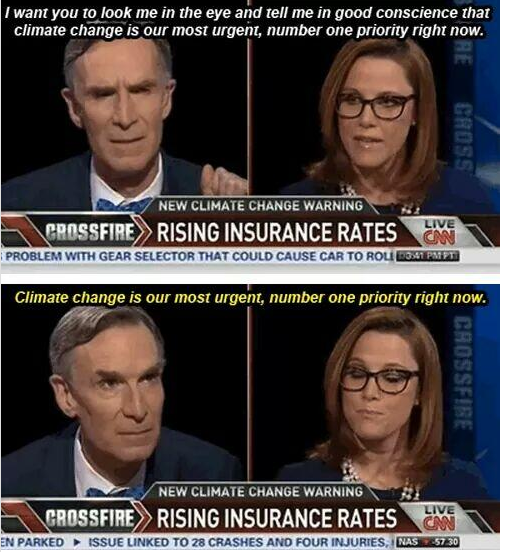
Gah. SE Cupp. She is the worst: a right-wing atheist who fully supports the dishonesty of the Fox News types, and who has no regard for reality. Atheists who bury themselves in a new set of delusions sicken me.
She got into an argument with Bill Nye — that’s a bad sign, since the last loon he had to put down was Ken Ham. She was really peeved that those “science guys” keep confronting climate change denialists with facts. Science bullies her ideological cronies!
“Isn’t it a problem when science guys attempt to bully other people?” Cupp asked Nye. “Nick here had to say, ‘I’m not a denier.’ He had to get it out: ‘I’m not a denier.’ Because really, the science group has tried to shame anyone who dares question this, and the point I’m trying to make is, it’s not working with the public.”
This was after she threw up some statistics, that only 36% of the American public think global warming is a serious threat to their way of life. I’d have two replies to that: 1) polling data on what a deluded public thinks is not a measure of the truth, and 2) the problem here isn’t scientists explaining the science, it’s propagandists like Cupp using dishonest media like Fox News or Heritage Foundation tracts to cast fear, uncertainty, and doubt over the evidence.
Watch the encounter and see Cupp hopelessly outclassed.
Best part of the interview? This exchange:

This short film is intended to “raise awareness of the growing disappearance of honey bees”, a worthy goal, but all I could think while watching it is “ROBOT BEES ARE AWESOME!” I doubt that is the response they want.
Besides, we’re nowhere near making tiny robots as elegant as real bees.
GREENPEACE – NEW BEES from Polynoid on Vimeo.

Years and years of studies by scientists trying to explain women’s behavior by their hormonal fluctuations are gradually falling apart. We’ve heard so many inconsistent, contradictory tales of how fertility/menstruation turns women into unconscious breeders or nurturing mothers, how women are driven to ‘hypogamy’ by their evolutionary instincts (that’s a big one with the MRAs), and how mate choices wobble from alpha to beta over the course of a month, and it’s all incoherent bunkum.
What do women want? Over the past two decades, scientists have endeavored to answer this question by bringing women into their labs, asking about their sexual preferences, and then monitoring their menstrual cycles to try to extract clues from the ebb and flow of hormones in their mysterious female bodies. In recent years, these researchers have told us that the status of our monthly cycle on Election Day can influence our decision to favor Mitt Romney’s chiseled individualism or Barack Obama’s maternal healthcare policies; that our periods determine whether we feel like nesting with our partners tonight or heading out to proposition a stranger; and that our cycle urges us to swing with Tarzan at our most fertile and cuddle up with Clay Aiken when that month’s egg is out of the picture. Last month, psychologists at the University of Southern California published a meta-analysis of 58 research experiments that tested whether a woman’s preferences for masculinity, dominance, symmetry, health, kindness, and testosterone levels in her male romantic partners actually fluctuate across her menstrual cycle. The answer: They do not.
The study, Meta-Analysis of Menstrual Cycle Effects on Women’s Mate Preferences, pretty thoroughly dismisses a lot of the obsessions of evolutionary psychology.
In evolutionary psychology predictions, women’s mate preferences shift between fertile and nonfertile times of the month to reflect ancestral fitness benefits. Our meta-analytic test involving 58 independent reports (13 unpublished, 45 published) was largely nonsupportive. Specifically, fertile women did not especially desire sex in short-term relationships with men purported to be of high genetic quality (i.e., high testosterone, masculinity, dominance, symmetry). The few significant preference shifts appeared to be research artifacts. The effects declined over time in published work, were limited to studies that used broader, less precise definitions of the fertile phase, and were found only in published research.
Typically, good science homes in on a stronger, clearer answer as it progresses, identifying confounding variables and fine-tuning the methodology. It’s a good sign that you’re chasing a non-effect when nothing you do improves your understanding of the phenomenon, and when other researchers struggle to find a measurement that agrees with yours; results that vary with who is producing them are something that fairly screams, “experimenter bias!”
Also telling: they looked at published and unpublished work, and any effect vanished in the unpublished papers. One could wave that away by claiming that those papers clearly did not meet the standard of quality required for publication, but let’s not ignore the file-drawer effect: one measure of “quality” is whether a paper is novel or fits a preconception well or is simply newsworthy (unsurprisingly, stories that proclaim a way to describe women’s sexual behavior are very popular). Look at the table of contents for Science or Nature any week and ask yourself whether those were selected for publication entirely because of their rigor and scientific merit. Anyone who reads the scientific literature to any degree will become aware quite quickly of the fads…and also the troubling preference for papers that use expensive instruments and reagents hawked in the advertising. (I do not think it a callously exploitive conscious bias, but more of a case of being more impressed by the shininess of the toys than the logic of the experiment.)
Purely anecdotal, but I’ve lived with a woman with hormones for going on 35 years, and I’m sorry, but except for the periodic physical consequences of menstruation, she’s basically the same human being every day, and there have been no magic psychological variations that make her prone to manipulation in different ways at different times of the month — and there were never any outward cues that would allow me to estimate where she was in her cycle. It seems to me that since women have minds and relationships can have strong consequences, it’s rather demeaning to suggest that their decision-making capabilities reside in their ovaries.
While I’m at it, I was totally shocked by a story in the Huffington post. The article had a stupid click-baity title, Wide-Hipped Women Have More Sex Partners, Controversial Study Shows, no doubt selected by the editor, but the story itself completely contradicts it. The paper does actually claim that hip width is correlated with how many men the women have sex with (the pick-up artists eyes lit up at that, I’m sure — now, to the bar to scan the clientele for broad hips!), but the content is substantial and actually takes strong exception to the claim. The paper tries to argue that sexual choosiness is correlated with an expectation of difficulty giving birth — that narrow-hipped women see sex as a greater risk.
"I honestly think there are some, I’m just going to say it, pretty shameful omissions in this paper," said Holly Dunsworth, an assistant professor of anthropology at the University of Rhode Island.
The primary problem, Dunsworth told Live Science, is that the distance between iliac crests does not indicate the size of the birth canal, or the internal opening in the pelvis. Nor does the iliac measurement relate to efficiency at walking, Dunsworth added — for that, you’d want to know the distance between hip joints.
"I have an obstetrics textbook here on my desk and nowhere does it say or diagram how big the birth canal is by using bi-iliac breadth," she said. In fact, she said, bi-iliac breadth is the one measurement that is consistently larger in men, because it correlates to body mass.
"They don’t give you the body mass of the women or the height of the women," Dunsworth said.
A lack of gullibility in a HuffPo article? Unbelievable. If only they could get rid of the idiot management there, there actually are some intelligent writers working within that haven of woo.

You need a good basic primer to refute climate change denialists? Dana Nuccitelli rebuts the top ten climate misconceptions.
At the end, he asks if you notice a pattern.
You may have noticed some patterns in these questions. Most are based on false premises and are trivially simple to answer. These ‘top ten good skeptic arguments’ are frankly not very good or challenging.
Oh, man, yes. It’s also the pattern in creationist arguments — they’re not even asking good questions, and they have to struggle to get past the faulty premises in their own views. Well, ‘struggle’ is probably the wrong word — they mostly don’t seem at all interested in learning.
But for climate change, we’re seeing the effects right now.
“For a long time, we have perceived climate change as an issue that’s distant, affecting just polar bears or something that matters to our kids,” said Katharine Hayhoe, a Texas Tech University professor and a co-author of the report. “This shows it’s not just in the future; it matters today. Many people are feeling the effects.”
You really have to work hard at it to be in denial of either climate change or evolution.


Acanthaspis petax, a type of assassin bug, stacks dead ant bodies on its back to confuse predators. Photo by Mohd Rizal Ismail


Check it out: true stories of evolutionary theory.

Look it over, the Avail Programming Language was released to the public just today.
(What a random thing for me to mention, you might be thinking…until you look at the credits.)

You know, fear of holes…it doesn’t bother me at all, but about 20 seconds into this video, you’ll see a pocked surface suddenly erupt into mouths on wormlike stalks, and I wouldn’t want to be responsible for any trypophobia induced heart attacks. Oh, and everything after 1:50 — you might die.
(via Mother Nature Network)