I know, I’m going to need a lot more maturity and discipline.
Pharyngula
Evolution, development, and random biological ejaculations from a godless liberal

I know, I’m going to need a lot more maturity and discipline.

I was tinkering in the lab this morning, trying out a new gadget, collecting embryos, and cleaning and fine-tuning my microscope, when I saw this. Can you guess what I’m looking at?
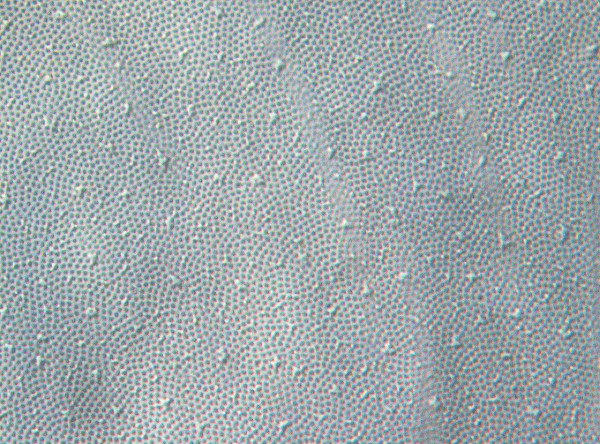
Hints: shot at 40x, it’s not part of the embryo itself, and every zebrafish pro is thoroughly familiar with it.
There was a guess that it was yolk. No! I took a quick picture of the yolk sac in this same embryo, at the same magnification.
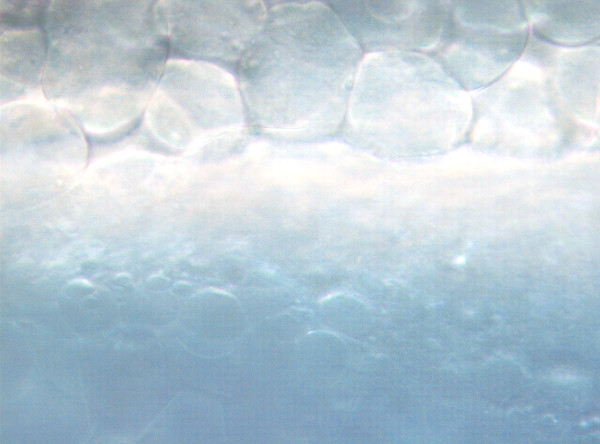
Those boulders at the top are cells, blastomeres. The bright band across the middle is the yolk syncytial layer, cells that bridge the gap between the cellular embryo and the yolk mass at the bottom. See? Nothing alike.
A few of you got it right, or came close: it’s the chorion.

Annalee Newitz writes about the domestication history of house cats. They’re odd in that they haven’t been bred away from the standard wildcat, so the idea is that they’ve only recently been domesticated, and haven’t yet undergone extensive genetic selection. Interesting, but I must disagree with her closing statement.
Or maybe cats will continue to defy domestication. They could carve out a place as one of the only animals to befriend humans without ever falling completely under our control.
“Befriend”? She hasn’t met my cat.

The Face of Evil

I always thought the idea of getting rid of a body by dumping it in an acid bath was impractical and inefficient — it would take such a long time to break down, and would require so much in the way of chemicals. Raychelle Burks does the test, dropping chunks of pork in beakers of hydrochloric acid or sodium hydroxide, and my suspicions were confirmed. This is a bad way to do it. It’s also really gross.
You really need to get a biologist’s expertise for this job. My first thought was dermestid beetles — clean it down to bare bones, then mount the skeleton and store it in plain sight in the anatomy lab. You don’t have any beetles? There’s always Lord Dunsany’s solution.
But for simple practicality, just find a crematorium.

Sergio Canavero is now claiming to have achieved successful repair/regeneration of severed spinal cords by something he pompously calls The Gemini Protocol
. This is simply severing the cord with a sharp knife (good to know he’s not using a dull one) and immediately squirting the cut with polyethylene glycol (which we’ve known for decades will cause cells to fuse). He has photos of rats that he said managed to start walking again two weeks after slicing through their spinal cords.
This is pretty much guaranteed bullshit.
More qualified experts than I say the same thing.
Critics of the proposed human head transplant have been vocal since it was first announced. Commenting on it in 2015, Chad Gordon, professor neurological surgery at Johns Hopkins University, told BuzzFeed : “There’s no way he’s going to hook up somebody’s brain to someone’s spinal cord and have them be functional. On the conservative side, we’re about 100 years away from being able to figure this out. If he’s saying two, and he’s promising a living, breathing, talking, moving human being? He’s lying.”
Jerry Silver, Professor of Neurosciences at Case Western Reserve University, Ohio, works on repairing spinal cords after injury. Commenting on the latest study, he tells Newsweek it is unclear whether to team had truly severed the cord completely. “I notice that in the last paragraph they state ‘In conclusion, we have shown that the paralysis following full severance of the dorsal spinal cord can be reversed—to a significant extent—by immediate application of a fusogen.’ Did they sever only the ‘dorsal’ cord?” he says.
He said the team also claims the axons—which form part of the spinal cord—had regenerated, but “they show no evidence for regeneration.”
“There is no histology [the study of the microscopic structure of tissues] which is the only way to assess what is really going on here,” Silver said, adding the BBB scores—the scoring system used to assess motor function in rats—were unrealistic.
“Two treated animals supposedly recover locomotor skills that are nearly normal (BBB scores of 19 and 20 out of a possible 21 total) and as a group they average a score of 12 which means that they can on average take multiple weight bearing steps. [This is] unbelievable. Too good to be true in my opinion, which mandates that these results will have be independently verified and properly analyzed before this work can be accepted as scientifically valid.”
No histology. Partial cuts? Poor documentation of supposed recovery. This guy is a quack.
By the way, he’s also abruptly dropped plans to do the first human experiment on a man with a degenerative disease, Valery Spiridonov, and is instead planning to do it on an unnamed Chinese victim patient, just as he has announced Chinese government support.
Don’t take Canavero seriously, unless it’s to drag him off to the Hague for prosecution. His proposal is a glory-seeking sham.

Some people expressed surprise that I was at the Midwest Zebrafish meeting. They have meetings about zebrafish? How weird. Only not. What I find weird is that people are unaware of this mundane part of the science experience, so I thought I’d briefly explain it.
Every sub-sub-discipline does this. There are zebrafish meetings, fly meetings, worm meetings, mouse meetings, bat meetings. There are meetings dedicated to specific diseases. There are meetings for organs and tissues: brain meetings, kidney meetings, hair cell meetings, enteric nervous system meetings, ear meetings. There are meetings dedicated to the mechanisms of vomiting. There are meetings with 50 attendees, others with 30,000. They are going on in every city of the country all the time. We are right there under your nose.
Why do we hold these meetings?
Practice. It’s part of student training.
Networking. Bringing together people with similar interests is a great way to make connections.
Sharing new ideas. Sometimes an experiment might not be right for publication, so you get feedback on preliminary results.
Inspiration. We learn all kinds of cool stuff we can try in our labs.
Good times. You know how nice it is to hang out with weirdos with the same interests?
Who gets to go? Anyone. They’re open to anyone willing to pay for registration (which may be a few hundred dollars). You don’t want to go. It’s all very esoteric. This is where we let it all hang out: talks are wall-to-wall high-density jargon in which we assume everyone knows all the basics, or even the advanced stuff. It’s great, but lay people will be bored or lost. This stuff is often so rarefied and narrow that not even science journalists will be interested. It’s often condensed down to 12 minute talks — kind of like blipverts for the most technical stuff.
Sometimes people might wander by the hotel we’re having it in — it happened last night. The poster session for the meeting was held in the atrium, and we had a couple of people stop by and ask what it was all about. That’s great! We had a nice conversation and showed off some of our videos. Most scientists are happy to talk to anyone about the weird stuff we’re doing.
Now you know what it’s all about. Tomorrow I get to go home after an intense weekend…and I get to repeat it again in July.


Free ranging fish tanks! All over the building!
It’s a straightforward gadget: a camera senses the location of the fish in the tank, and uses that to control the steering. Zebrafish are schooling animals, so it would be cool to see them coordinating in mass formations dominating all the open spaces in the building.
Except for the stairs. Stairs would be most uncool.


Hey, veterinarians have to be pretty smart and disciplined to even be in that career, so it’s nice to see how many of them have to be rigorous and skeptical. Here’s an example of the universal problem of quackery explained by a vet:
One reason that many products and treatment methods remain on the market is because of this simple, and not entirely irrational, thought process: “I tried it, my horse got better, so it works!” Unfortunately, even when a horse’s problem improves following treatment, this, by itself, often cannot prove that the therapy was responsible for the improvement. Here’s an example. In other times, people did rain dances when the weather was dry and occasionally, it must have rained. Thus, they kept on dancing. That’s the same bit of logic I’m talking about as applied to determining whether treatments really work, or not.
There are some ethics involved here, as well. I believe that people who provide treatments and therapies for animals have a moral and ethical obligation to prove, first, that they are safe and, second, that they are effective prior to selling them to horse owners (NOTE: Not everyone agrees, as evidenced by the buckets of BS that are currently being peddled). It’s usually not that hard to demonstrate that a therapy doesn’t do any harm to an animal – the treatment is given, the animal doesn’t die, and there you go. Proving that it’s effective can be quite another matter, even if effectiveness is easy to claim.
This is a very common psychological exploit. Most organisms do have natural healing abilities; I’ve noticed over the years that if I have a cut, it magically heals, even though I don’t understand everything that is going on. Unscrupulous humans are able to hover over that ongoing process and claim that they’re the ones responsible for activating the magical healing power, even when they’re not, and there isn’t anything magical about it. We’re usually quite eager to have wounds and disease go away, so we’re psychologically willing to accept the ‘aid’ of said unscrupulous guru.
It’s especially potent for problems that have a variable progression, like cancer or back pains.
And it works on horses, too. Well, not actually on horses, but on gullible horse owners, who often have a deep emotional and financial investment in their animals. Once you’ve got the horse folk convinced, it’s an easy jump to bilking humans over human diseases.
My favorite example is Tellington TTouch, a kind of psychic massage therapy.
[TTouch] is a bodywork and training method based on circular movements of the fingers and hands all over the body. The intent of the TTouch is to activate the function of the cells and awaken cellular intelligence — “turning on the electric lights of the body.” The TTouch is done on the entire body, each circular TTouch complete within itself. It is not necessary to understand anatomy to be successful in speeding up the healing of injuries or ailments, or changing undesirable habits or behavior.
And, according to the unqualified and untrained woman who peddles this crap all over the world, it cures just about everything. Stress, migraines, depression, arthritis, stroke…it even enriches your relationships
!
That’s a pretty impressive list of accomplishments for a system of touching rituals made up by one person based entirely on her own intuition. Unsurprisingly, however, there is absolutely no reliable evidence to support any of these claims. The TTouch web site claims, “We have also gathered a rich legacy of anecdotal evidence to support the effectiveness of TTouch to enhance personal wellness and quality of life” without any apparent recognition that this is meaningless in terms of validating the claims made for the treatment.
Unfortunately, the reason it’s my ‘favorite’ quack therapy is that it is heavily promoted by my university (well, one branch of my U — the backward and problematic Twin Cities branch) at the Center for Spirituality and Healing, the ongoing embarrassment thriving at the heart of one campus in this system. I’m looking at the long, long list of faculty and staff associated with this disgrace and thinking about how the science division at my campus is understaffed, and how all across the university we could use more support for the social sciences and humanities and arts, and how our students keep facing tuition increases, and right there is a fine piece of useless fat that could be cut away, and the loss would immediately benefit the University of Minnesota.
It’s a clear example of bad thinking doing actual harm.

Doug Erwin argues that we’re not in the middle of a 6th mass extinction. It’s not because we haven’t decimated life on planet Earth; it’s because if we were, the catastrophe would be immense, and we ain’t seen nothin’ yet.
“People who claim we’re in the sixth mass extinction don’t understand enough about mass extinctions to understand the logical flaw in their argument,” he said. “To a certain extent they’re claiming it as a way of frightening people into action, when in fact, if it’s actually true we’re in a sixth mass extinction, then there’s no point in conservation biology.”
This is because by the time a mass extinction starts, the world would already be over.
“So if we really are in the middle of a mass extinction,” I started, “it wouldn’t be a matter of saving tigers and elephants—”
“Right, you probably have to worry about saving coyotes and rats.
“It’s a network collapse problem,” he said. “Just like power grids. Network dynamics research has been getting a ton of money from DARPA [Defense Advanced Research Projects Agency]. They’re all physicists studying it, who don’t care about power grids or ecosystems, they care about math. So the secret about power grids is that nobody actually knows how they work. And it’s exactly the same problem you have in ecosystems.
The good news is that we aren’t dead yet! The bad news is that when the end comes, it will be rapid and non-linear and unimaginably devastating. Just to put it in perspective, this is small potatoes compared to a real mass extinction:
For instance, it stands to reason that, until very recently, all vertebrate life on the planet was wildlife. But astoundingly, today wildlife accounts for only 3 percent of earth’s land animals; human beings, our livestock, and our pets take up the remaining 97 percent of the biomass. This Frankenstein biosphere is due both to the explosion of industrial agriculture and to a hollowing out of wildlife itself, which has decreased in abundance by as much as 50 percent since 1970. This cull is from both direct hunting and global-scale habitat destruction: almost half of the earth’s land has been converted to farmland.
The oceans have endured a similar transformation in only the past few decades as the industrial might developed during World War II has been trained on the seas. Each year fishing trawlers plow an area of seafloor twice the size of the continental United States, obliterating the benthos. Gardens of corals and sponges hosting colorful sea life are reduced to furrowed, lifeless plains. What these trawlers have to show for all this destruction is the removal of up to 90 percent of all large ocean predators since 1950, including familiar staples of the dinner plate like cod, halibut, grouper, tuna, swordfish, marlin, and sharks. As just one slice of that devastation, 270,000 sharks are killed every single day, mostly for their tasteless fins, which end up as status symbol garnishes in the bowls of Chinese corporate power lunches. And today, even as fishing pressure is escalating, even as the number of fishing boats increases, even as industrial trawlers abandon their exhausted traditional fishing grounds to chase down ever more remote fish stocks with ever more sophisticated fish-finding technology, global fish catch is flatlining.
Related concept: error catastrophe. One of the properties of organisms and food webs is that they’re surprisingly robust — you can punch holes in them and take out pieces and they just keep going until suddenly, the network can’t compensate and the whole thing just collapses. We’re cheerfully battering whole ecosystems and cheerfully telling ourselves how tough and resilient the world is, and it’s true…until one last damaging blow causes an abrupt disintegration.
Oh, did I say I didn’t know whether to be optimistic or despairing? I lied. I know which one I feel most.
