Marketing is not science

I’ve written about Brian Wansink before, but here you go, a grand summary of the bad science at the Cornell Food and Brand Lab. They’ve gone over an archive of emails, and it’s worse than I ever imagined: they’ve just been churning over crappy studies, looking for garbage associations that will go “viral”. It’s embarrassingly awful.

“That’s p-hacking on steroids,” said Kristin Sainani, an associate professor of health research and policy at Stanford University. “They’re running every possible combination of variables, essentially, to see if anything will come up significant.”

In a conversation about another study in August 2015, Wansink mentioned a series of experiments that “were chasing interactions that were hard to find.” He apparently hoped that they would all arrive at the same conclusion, which is “bad science,” said Susan Wei, an assistant professor of biostatistics at the University of Minnesota.

“It does very much seem like this Brian Wansink investigator is a consistent and repeated offender of statistics,” Wei added. “He’s so brazen about it, I can’t tell if he’s just bad at statistical thinking, or he knows that what he’s doing is scientifically unsound but he goes ahead anyway.”

Everything they do in that lab is stuff I was told way back in the beginning of my career was bad. They do “experiments” without a prior hypothesis — they’re just fishing out of pool of lots of meaningless numbers that they generate by collecting observations of shitloads of variables. Then they crunch away at it until they find a correlation that they can build a paper around, and shop the paper around until it finds a journal with low enough standards to publish it.

In the first year biology class I’m teaching right now, I have a lecture or two at the end of the term on bioethics. This is going to be the case study we’ll go over this year. I’m wondering what’s wrong with Wansink’s education that he never learned that you don’t get to do any of this, since he’s oblivious to his sins.

I also have to point out (probably won’t in class, though) that the real problem here is that Wansink hasn’t been doing science — he’s been doing marketing, and marketing is an evil of capitalism. Please keep your capitalism out of our science, OK?

By the way, this was on Buzzfeed, and Buzzfeed gets a bad rap. I know there’s a big pile of capitalism tainting Buzzfeed, too, which has had more of a reputation for click-baity quizzes and pop news, but their news division is actually pretty good — it’s like a circus that opened a serious news outlet and hired real reporters to staff it, unlike some of the news networks that hired clowns to read the news at you. Virginia Hughes is the science editor there, and she’s serious and smart and is part of a good team that has been doing some exemplary reporting.

Biohackers: irresponsible showboats trusting homeostasis to keep them alive

Look. When this guy thinks maybe biohacking has gone too far, you know biohacking has gone too far.

Zayner is no stranger to stunts in biohacking—loosely defined as experiments, often on the self, that take place outside of traditional lab spaces. You might say he invented their latest incarnation: He’s sterilized his body to “transplant” his entire microbiome in front of a reporter. He’s squabbled with the FDA about selling a kit to make glow-in-the-dark beer. He’s extensively documented attempts to genetically engineer the color of his skin. And most notoriously, he injected his arm with DNA encoding for CRISPR that could theoretically enhance his muscles—in between taking swigs of Scotch at a live-streamed event during an October conference. (Experts say—and even Zayner himself in the live-stream conceded—it’s unlikely to work.)

Josiah Zayner has done lots of stupid stunts. Now he calls himself a “social activist”, which apparently in his mind means someone who does irresponsible and ineffective stunts to provoke the public to be similarly irresponsible. Now he’s waking up, a little bit, to what he’s been doing.

I didn’t realize what my actions could result in. I’m just starting to come to grips with that.

Biology is really, really complicated, minor changes can have radical consequences, and we don’t understand 90% of it. OK, 95%. Maybe 99%. When people’s lives are at stake, you poke at it very, very cautiously, because you don’t know what kind of cascading systems failure you’re going to trigger. The system does exhibit a lot of resilience that helps maintain equilibrium, which means these showboats can play games that mostly do nothing, giving the misleading idea that they’re harmless, but all it takes is one accident to set everyone back. Responsibility is an important concept in science.

Everyone should know by now that Twitter is a bad company

From an inside look at Twitter’s problems with management, technology, and trolls:

At the same time, her defenders say, Harvey has been forced to clean up a mess that Twitter should have fixed years ago. Twitter’s backend was initially built on Ruby on Rails, a rudimentary web-application framework that made it nearly impossible to find a technical solution to the harassment problem. If Twitter’s co-founders had known what it would become, a third former executive told me, “you never would have built it on a Fisher-Price infrastructure.” Instead of building a product that could scale alongside the platform, former employees say, Twitter papered over its problems by hiring more moderators. “Because this is just an ass-backward tech company, let’s throw non-scalable, low-tech solutions on top of this low-tech, non-scalable problem.”

Calls to rethink that approach were ignored by senior executives, according to people familiar with the situation. “There was no real sense of urgency,” the former executive explained, pointing the finger at Harvey’s superiors, including current C.E.O. Jack Dorsey. “It’s a technology company with crappy technologists, a revolving door of product heads and C.E.O.s, and no real core of technological innovation. You had Del saying, ‘Trolls are going to be a problem. We will need a technological solution for this.’” But Twitter never developed a product sophisticated enough to automatically deal with with bots, spam, or abuse. “You had this unsophisticated human army with no real scalable platform to plug into. You fast forward, and it was like, ‘Hey, shouldn’t we just have basic rules in place where if the suggestion is to suspend an account of a verified person, there should be a process in place to have a flag for additional review, or something?’ You’d think it would take, like, one line of code to fix that problem. And the classic response is, ‘That’s on our product road map two quarters from now.’”

None of this means that Twitter is going to vanish soon — after all, COBOL is still around, and software legacies just hang around, decaying slowly, like an assortment of pseudogenes. But still, maybe you should consider jumping ship, since the one way to kill it is to erode its user base. Mastodon is out there, waiting for you with open arms.

Friday Cephalopod: So that’s what octopus porn is like

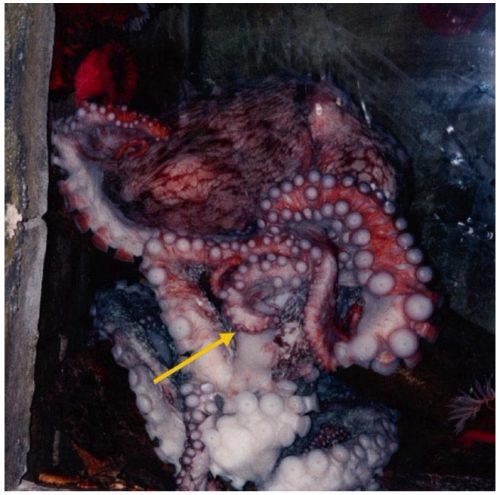
The photograph is, I think, tastefully provocative.

A male and female giant Pacific octopus mating in captivity at the Aquarium of the Bay (San Francisco, California, USA). The male is on top. The arrow points to the insertion of the male’s hectocotylized arm into the mantle cavity of the female. (Photo by Kevin O. Lewand.)

It’s the accompanying text, describing multiple observations of mating, that gets hot and heavy.

A female was placed in a 12,000 l display tank and the male was added 10 min later. The female weighed 18 kg and the male weighed 20 kg. The female was sitting motionless in a lower corner of the tank when the male was added. She was oriented horizontally, facing outward from the corner. As he swam to the bottom, the male inked. He jetted directly to the female and enveloped her with his web and arms. There was then an active intertwining of arms for 2 min. At the end of this period, the female was facing into the corner and the male was on top of her facing the same direction, with his dorsal arms wrapped around her head and mantle. The hectocotylized arm of the male was inserted into the right mantle opening of the female. He was a mottled gray/pink color with frontal and mantle white spots apparent. The mantle was papillose. The female was dull red and smooth. The male’s respiration rate was 5.9 sec/breath, and the volume was judged “deep breathing.”

At 78 min after first contact, there was an increase in the intensity of the mottling and the brightness of the white spots on the mantle of the male as he raised his body up off the female slightly and then settled onto her again, whereupon the intensity of the mottling and white spots dulled. This was likely an arch and pump. At 3 hr 43 min, the male removed the hectocotylized arm. He moved away from the female at 4 hr 1 min. At this point, he was smooth and bright red; she was smooth light pink.

After 17 min apart at the opposite corner of the tank, the male again approached the female. She was in the same corner facing outward. He mounted and grasped her as before and turned mottled and papillose with mantle and frontal white spots apparent. After 3 min, she turned toward the corner as before, so they were facing the same direction. He again held her with his dorsal arms. His hectocotylized arm was inserted into the mantle of the female. They maintained this position for another 4 hr 12 min. He then moved off to an opposite corner of the tank and turned smooth dark red. She maintained a smooth pale pink for several minutes and then turned mottled and papillose. No spermatophores were observed protruding from the female’s mantle cavity as reported by Mann, Martin and Thiebsch, (1970).

Whew. Get back, EL James, there’s a new bestseller in the making. I’m also impressed with the male’s endurance — 3-4 hours? We hoo-mans are not worthy.

Playing games…for Science!

For the past few days (and wrapping up today) I’ve been at the Science Museum of Minnesota as one of a team of advisors helping them on a future interactive exhibit on evolution, which I’m not going to tell you about, except to say that they have an ambitious schedule and maybe you’ll get to see it as early as this summer. One of the things we had to do yesterday is introduce ourselves with a 5 minute talk about what we can contribute to the project, and so I threw together a little something about my background and my experience as a teacher, yadda yadda, and because I could, I put up an illustration on YouTube to play on the screen behind me — so I used this one, which is just a general time-lapse of zebrafish development.

You have to picture me standing at the lectern, saying something like, “…and this is the experimental animal I work on”, clicking on the play button, and turning to wave gracefully at the screen…and discovering that YouTube had inserted an ad at the beginning, and that what I was pointing at was a shirtless, hunky, muscular man flexing and saying something about an exercise or diet program, I don’t know, because I was busy clicking on the “skip ad” button.

Now everyone has a much more exciting impression of my research.

Aside from that little misstep — do not trust YouTube to serve up your sober, serious videos — it’s been an enlightening experience. My colleagues here have an eclectic mix of skills, with theater people, professional game designers, and museum directors all contributing to the construction and critique of this coming exhibit. Our evenings have been spent playing games, looking for ideas that could be used to involve and inform the general public.

I have been introduced to escape rooms. I did not have the slightest inkling these even existed until this weekend. I guess I’ve been totally out of it, and you’re probably going to tell me you’ve been doing these for ages, and make me feel old.

Anyway, for my fellow old codgers, escape rooms are a big booming business right now. The idea is that someone designs an elaborate series of puzzles in a locked room — you have to figure out a hidden code with clues in the room to find a secret switch that opens a concealed door that leads to a room with more puzzles that then fit with clues to reveal more puzzles, for instance, and if you solve them all within a certain time limit you are allowed to escape, or discover the murderer, or save the world, or something. They seem to be hugely popular — a search for Minneapolis escape rooms reveals they’re dotted all over the map.

And now, I’ve gone from a state of total ignorance to having played 3 escape rooms at the Science Museum’s expense.

I’ve learned many things this week — if you want to teach people about science, it’s helpful to listen to theater people and game designers, and it’s good to get away from the model of telling people what the answer is to instead have them figure it out for themselves. Also, escape rooms are kind of fun.

Now if we can just get a few more women and dark-skinned people on the research team

It isn’t at all surprising that ancient Britons were dark skinned — we know the genes behind pigmentation, we have sequenced genomes from skeletons that are thousands of years old, and we know that light skins were the result of a mutation that swept through Europe about 6,000 years ago. So when a reconstruction of Cheddar Man, a 10,000 year old skeleton found in England, is made from the skull plus genomic information, we should expect that he’d be found to have been dark-skinned.

The first modern Britons, who lived about 10,000 years ago, had “dark to black” skin, a groundbreaking DNA analysis of Britain’s oldest complete skeleton has revealed.

The fossil, known as Cheddar Man, was unearthed more than a century ago in Gough’s Cave in Somerset. Intense speculation has built up around Cheddar Man’s origins and appearance because he lived shortly after the first settlers crossed from continental Europe to Britain at the end of the last ice age. People of white British ancestry alive today are descendants of this population.

It was initially assumed that Cheddar Man had pale skin and fair hair, but his DNA paints a different picture, strongly suggesting he had blue eyes, a very dark brown to black complexion and dark curly hair.

The discovery shows that the genes for lighter skin became widespread in European populations far later than originally thought – and that skin colour was not always a proxy for geographic origin in the way it is often seen to be today.

Here’s the reconstruction in a BBC video. Cheddar Man is as we ought to have expected. Actually, the only thing that made me raise my eyebrows is that the research team consists of 6 white men and 1 white woman, kind of like how the SpaceX rocket team was mostly white men, too.

It would be nice if the research effort that is revealing the genetic diversity of our recent ancestors at least reflected a bit of that diversity today.

By the way, the comments on this reconstruction also reveal a tremendous amount of denial from the usual racists who think this is an invention cobbled up by scientists to appease radical leftists. This, also, is not surprising.