What I taught today: farewell to flies (for a while)

A good portion of what I’ve been teaching so far uses Drosophila as a model system — it’s the baseline for modern molecular genetics. Unfortunately, it’s also a really weird animal: highly derived, specialized for rapid, robust development, and as we’ve learned more about it, it seems it has been layering on more and more levels of control of patterning. The ancestral system of establishing the body plan was far simpler, and evolution has worked in its clumsy, chance-driven way to pile up and repurpose molecular patterning mechanisms to reinforce the reliability of development. So I promised the students that this would be the last day I talk about insects for a while…we’ll switch to vertebrates so they can get a better picture of a simpler, primitive system. What we’ll see is many familiar genes from flies, used in some different (but related!) ways in vertebrates.

But today I continued the theme of epistatic interactions from last week. Previously, we’d talked about gap genes — genes that were expressed in a handful of broad stripes in the early embryo, and which were regulated in part by the even broader gradient of bicoid expression. The next level of the hierarchy are the pair rule genes, which are expressed in alternating stripes — 7 pairs of stripes for 14 segments.

First point: notice that we are seeing a hierarchy, a descending pattern of regulatory control, and that the outcome of the hierarchy is increasing complexity. One gene, bicoid sets up a gradient that allows cells to sense position by reading the concentration of the gene; the next step leverages that gradient to create multiple broad domains; and the pair rule genes read concentrations of gap genes and uses the boundaries between them to set up even more, smaller and more precise domains of stripes that establish the animal’s segments.

This is epigenesis made obvious. The 14 stripes of the pair rule genes are not present in the oocyte; they emerge via patterns of interactions between cells and genes. The information present in the embryo, as measured by the precise and reproducible arrays of cells expressing specific genes, increases over time.

So part of the story is hierarchy, where a complex pattern at one stage is dependent on its antecedents. But another part of the story is peer interaction. Cells are inheriting potentials that are established by a cascading sequence of regulatory events, but in addition, genes at the same approximate level of the hierarchy are repressing and activating each other. We can tease those interactions apart by fairly straightforward experiments in which we knock out individual pair rule genes and ask what the effect of the loss has on other pair rule genes. I led the students through a series of epistatic experiments which started out fairly easy. Knock out a pair rule gene that is expressed in odd numbered parasegments, for instance, and it’s complement, the pair rule gene expressed in even parasegments, expands its expression pattern to fill all segments. Sometimes.

Some of the experiments reveal simple relationships: hairy suppresses runt, and runt suppresses hairy. That makes sense. They have mutually exclusive domains, so it’s no surprise that they exclude each other. But then we looked at other pair rule genes which are expressed in patterns slightly out of phase from the hairy/runt pair, and there the relationships start getting complex. Genes like fushi tarazu are downstream from all the others, and their effects are straightforward (their loss doesn’t disrupt the other pair rule genes), but genes like even-skipped have much messier relationships, and the class was stumped to explain the results we get with that deletion.

So I asked them to come up with other experiments to tease apart these interactions. I was somewhat amused: when I think along those lines, I come up with more genetic crosses and analyses of expression patterns — I think about regulatory logic and inferring rules from modifications of the pattern. Students nowadays…they’re so much more direct. They want to go straight to the molecular biology, taking apart the genes, identifying control elements, building reporter constructs to see gene-by-gene effects. I felt so old-fashioned. But we also had to talk about the difficulty of those kinds of experiments, and that often the genetic approach is better for building a general hypothesis that can be fruitfully tested with the molecular approach.

Then we stopped — we’ll come back to flies later, and start looking at some specific subsets of developmental programs. Next, though, we’re going to take a big step backward and look at early events in vertebrates and progress through that phylum until we see how they build segments. I’m hoping the students will see the similarities and differences.

Slides for this talk (pdf)

Sadly, it’s International Women’s Day

It’s that day when we’re supposed to celebrate the accomplishment’s of women. I say “sadly,” because unfortunately there are way too many people out there who would rather sneer at and diminish women’s status in the world.

Case in point: on twitter, I ran across this lovely tweet from one of those repugnant slymepitters.

On #IWD remembered the nearly 0 wimmin – Nobels in science, highbrow art, chess GMs, great standups, but 100s of pop-culture hos #ftbullies

`

Yes. Let’s remember those women.

Let’s remember Lise Meitner, Hilde Mangold, Chien-Shiung Wu, Rosalind Franklin, and Jocelyn Bell — who were all well-qualified (men won the prizes for work equivalent to what they did, instead) to win a Nobel but didn’t get one.

Rather than 0 women, perhaps we should remember Marie Curie and Maria Goeppert Mayer, who won Nobels in physics; Irène Joliot-Curie, Dorothy Crowfoot Hodgkin, and Ada E. Yonath in chemistry; Barbara McClintock, Carol W. Greider, Christiane Nüsslein-Volhard, Elizabeth H. Blackburn, Françoise Barré-Sinoussi, Gertrude B. Elion, Gerty Cori, Linda B. Buck, Rita Levi-Montalcini, and Rosalyn Yalow, in physiology or medicine. Clearly women are not intrinsically incapable of scientific work at the highest levels. Of those whose work I’m familiar with in detail, I have to tell you that McClintock blows me away with the stunning brilliance of her abstract reasoning — I know of no other male scientist whose work is at all comparable (that of course is a matter of taste!)

The relatively lower frequency of women recieving Nobels is not something any man should take pride in; what it really indicates is that we’ve been shortchanging half the human population, depriving them of opportunities to excel. Wait — we’ve been doing worse than shortchanging women; we’ve been depriving all of humanity of the potential in those minds. This pattern of discrimination against women has hurt us all.

Let’s not forget also all the people, men and women alike, deprived of opportunities because of their race or class — deprived by the kind of endemic bigotry that would, for instance, denigrate an entire group of people as “pop-culture hos”. And it’s not just science — it was good of our petty MRA to remind us that we’ve also lost their contributions to art and theater and games.

That’s what I think of everytime some bigot crows about the absence of some group of people from some field of endeavor — it’s a reminder of all that we’ve lost to selfish stupidity.

My university in the news!

Now if only it were good news. It seems we’re the victim of bureaucratic excess.

College administrators have found an interesting new way to strike it rich: quitting their jobs. Upon leaving his role as executive vice president of NYU for a job with Citigroup in 2006, Jacob J. Lew (the current Secretary of the Treasury) took a $685,000 bonus from the university. Harold S. Koplewicz, an executive at the NYU Medical Center, got a $1.2 million severance after choosing to leave voluntarily. Given that NYU’s tuition and fees are among the highest in the nation, we’re curious how students who took out hundreds of thousands of dollars in loans feel about their money going towards generous benefits and severance packages for administrators.

At least NYU is a private institution, so tax dollars are not spent to cover its inflated costs. As the New York Times notes, public universities are just as guilty of letting a bloated and inefficient administration drive up tuition costs. The University of Minnesota employs 19,000 administrative officials employees, and administrative personnel account for 24 percent of its total payroll, compared with only 20 percent in 2001. At Purdue, the number of administrative employees grew by 54 percent in the last decade.

Overall, the number of administrators hired by colleges and universities increased 50 percent faster than the number of instructors hired between 2001 and 2011, according to the U.S. Department of Education.

We’ve felt the pain down here in the trenches, too. Our core biology curriculum was disrupted a bit by the reluctance of our administration to hire replacement faculty — they saved a few pennies by bringing in temporary faculty as replacements and deferring filling tenure track lines. The replacements were good people, but when you’ve got students coming up through a curriculum pipeline, you really want stability and continuity at the base.

The good news, though, is that the blockages have been uncorked and we’re finally expanding our biology faculty from 8 to 9 — a big boost at a small college.

You know who else was a great painter? Hitler.

Sorry for the excessive hyperbole, but I had to counter the sniveling sycophancy in this Fox News puff piece.

They’re impressed that it took “only a month” to teach him to paint like that? It shows. He’s going to go down in history as a great artist? Judging by what is shown in that clip, this is a retired guy with a nice hobby. That’s about it. Good for him — at least he’s not ripping the hearts out of virgins and kicking puppies for a hobby like Dick Cheney — but come on, American Pravda, let’s not lay it on quite so thickly.

I think I’ve just been persuaded that MOOCs suck

I’m convinced. Physioproffe is right: MOOCs are a great big boondoggle. It wasn’t PP’s words (true as they are) that persuaded me, though — it’s that Thomas Friedman has endorsed them, in a godawful column complete with helpful discussion with his driver from the airport.

Just consider this claim:

We demand that plumbers and kindergarten teachers be certified to do what they do, but there is no requirement that college professors know how to teach. No more. The world of MOOCs is creating a competition that will force every professor to improve his or her pedagogy or face an online competitor.

Holy crap. Right now I’m in ‘competition’ with skilled colleagues who were selected for their position on the basis of their teaching skill — I’m evaluated in comparison with my peers. I’ve seen these MOOC-style lectures, and please please please, I would love to be assessed against some person whose interactions with students are entirely through a glass screen, in a format that favors linear lecturing, and considers email a marvelous way to communicate outside of class.

This is what Friedman considers an increase in competition for college teachers? I see a slackening and a reduction of standards…and what the administrators and mouth-breathing ignoramuses like Friedman see is a way to outsource and reduce the costs of the expensive part of an education…the part that is also the only real education component of the process.

What I taught today: heavy on the epistasis

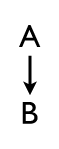
Today we talked about gap genes and a little bit about pair rule genes in flies, and to introduce the topic I summarized genetic epistasis. Epistasis is a fancy word for the interactions between genes, and we’ve already discussed it on the simplest level. You can imagine that a gene A, when expressed, activates the expression of gene B. The arrow in this diagram? That’s epistasis.

epi1

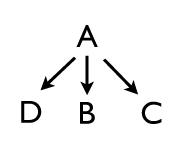
So far, so simple. This could describe how bicoid activates zygotic hunchback for instance. But of course not all epistatic interactions are linear and one dimensional; often one transcription factor will turn on or repress multiple genes — so A might switch on genes B, C, and D.

epi2

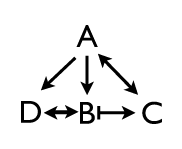
But wait! Now there is the potential for all kinds of combinatorial interactions: maybe C has positive feedback back on A, and B activates D and C, and D activates B, and C represses B. There’s a whole mathematically bewildering world of possibility here.

epi3

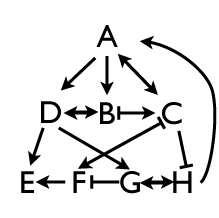
And it gets worse and worse. B, C, and D could have downstream effects on other genes, like E, F, G, and H, and each of those interact with each other and can have feedback effects as well. It’s not at all uncommon to be taking apart the sequence of events of a developmental pathway and discover a whole tangled snarl of epistatic interactions that lead to complicated patterns of gene expression.

epi4

And that’s molecular geneticists and developmental biologists do: they try to tease apart the snarl, asking how each gene interacts with all the other genes in the system, working out the kind of genetic circuitry shown in those diagrams. Often the approach is take it one gene at a time: knock out F, for instance, and ask what happens to the expression patterns of A, B, C, D, E, G, and H. Or upregulate D, and ask what all those other genes do. If you like logic puzzles, you’ll love epistatic studies, because that’s what they are: grand complicated logic puzzles with multiple cascading effects and usually only partial knowledge about what each component does. You’ll either have great fun with it all, or cultivate great headaches.

So most of the class hour was spent going through examples of these puzzles. The gap genes, for instance, are expressed in broad stripes in the embryo, and we can try to decipher the rules that establish the boundaries by taking out components. If hunchback is deleted, what do the giant, krüppel, and knirps stripes look like? Take out krüppel, what happens to knirps? So I led them through this series of experiments, asking them to come up with general rules regulating the expression of each stripe, and then using those rules to predict what would happen if we did a different experiment. I think they mostly got it.

But of course the discussion today was mostly about the gap genes, which are the second tier of genetic interactions (analogous to my third figure above). Next I introduced the pair rule genes, the third tier, rather like my fourth diagram. These are genes that are expressed in alternating stripes corresponding to parasegments in the fly…so we’ve gone from a few broad stripes to many narrow stripes. Each of those stripes, too, is independently regulated, with distinct control regions for each.

The real nightmare begins in the next class, when we start taking apart the many ways all of the pair rule genes interact with each other, and how their position is established partly by regulation by the gap genes and partly by mutual sorting out with combinations of activating and repressing interactions. It’s going to be loads of fun!

Today’s slides.

A little blogging exercise for my students

In my development class, students have been blogging away for the last few weeks, and I asked them to send me links to ones they wouldn’t mind seeing advertised. I’ve told them that an important part of effectively blogging is to link and comment, so they’re supposed to write something this week that adds to one of these posts and links to it on their own blog, and they’re also supposed to leave a comment on their fellow students’ work.

I warned them too that I’d highlight these publicly and urge my readers to look and say a few things: so go ahead and comment, criticize, praise, whatever — I told them that the good will come with the bad.

I suspect I’ll have to explain to them how to kill spam and remove irrelevant or outrageous comments in the next class…

As usual, it’s not the message, it’s the mere existence of atheists

American Atheists have put up a new set of billboards, with a “go godless” campaign theme.

new-atheist-billboard-split-story-top

What’s interesting, though, is the media response:

Atheists ratchet up rhetoric, use billboards to attack Republican politicians

Hang on there…”Go godless instead” is ratcheting up the rhetoric? It seems like a rather mild suggestion to me — presenting an extremist religious position and then offering an alternative is an entirely reasonable approach.

As for attacking Republican politicians…has CNN noticed that the religious right has staked itself out in the Republican party? If Democrats were saying things as stupid as the Republicans, I’m sure Dave Silverman would be ripping on them just as aggressively. And if the Republicans were not basing bad policy on religious dogma, there wouldn’t be much concern about them and they wouldn’t be appearing on those billboards.

Maybe if they sink a lot of the budget into special effects…

There is no accounting for taste or credulity. Universal Pictures is planning to make Eben Alexander’s book into a movie. You remember Alexander; the Proof of Heaven guy, the surgeon who ‘died’ on the operating table and claimed to have visited heaven?

It might be interesting to see the effort. The whole tone of Alexander’s fantasy is one of vagueness, ineffableness, incomprehending awe — he talks about seeing indescribable beings like birds or angels that he can’t do justice to in words, for instance…I don’t think crisp CGI is exactly going to work in his favor.

What I taught today: the great cis vs trans debate

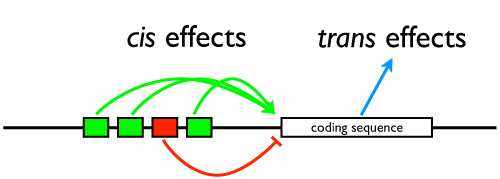
My students get a full exposure to the Sean Carroll perspective in his book, Endless Forms Most Beautiful, and I’m generally pro-evo devo throughout my course. I do try to make them aware of the bigger picture, though, so today we had an in-class discussion/’debate’ (nothing so formal as a debate, and it was more a tool to make them think about the arguments than to actually resolve a question). Fortunately, there’s one really easy exercise we can do in developmental biology, because some big names in the field have already clearly laid out their positions in a couple of relatively succinct papers, so I had a shortcut to bring the students up to speed on the issues. I split the class on Monday, having half read a paper by Hoekstra and Coyne on “The locus of evolution: evo devo and the genetics of adaptation” (pdf), which argues for the importance of trans-acting mutations in evolution, and another by Wray on “The evolutionary significance of cis-regulatory mutations” (pdf), which argues for the importance of developmental changes through changes in cis regulatory regions.

I drew this little cartoon on the board to illustrate the situation: that changes in the coding regions of genes produce mutations that can have broader effects throughout the cell (trans: they can affect other genes not on the same chromosome), while changes in regulatory DNA will have discrete effects on just the gene on the same strand of DNA they are (cis).

cistrans

Then I asked them put together an argument as a group advocating for the significance to evolution of their ‘side’, cis or trans, which they then delivered to their opponent, with opportunities for rebuttal and counter-rebuttal.

Ah, pitting the students against one another…always the fun part of teaching.

There was good friendly discussion. Both sides had to dig into their respective papers to find the arguments, and then restate them to make their point, both of which are good exercises. The battle waged to and fro, and then our hour was up and I asked them to vote for who ‘won’, in the subjective sense of making a good argument and persuasively advancing their position. The results:

Which position do you think makes the best case for the significance of their phenomenon in evolution?

Team trans: 1
Team cis: 0
Both positions are important: 8

Minnesota mildness for the win!

I did think one student comment was perceptive and exposed the whole argument for a sham. If they were to go off to graduate school in developmental biology, they wouldn’t be picking Team trans or Team cis: they’d be pursuing a phenotype or a pattern of interest, and then analyzing how it worked and came to be, and they’d simply accept the evidence, cis or trans or both, however it turned out. Follow the data, always.

Now that’s a healthy attitude.