Why I am an atheist – Mitch Austin

I was raised lightly religious, Lutheran, went to AWANA with friends.  At 14 I joined De Molay.  They say prayers at regular intervals.  The prayers are all non-sectarian, but everyone knows they’re said to Baby Jesus.  It’s also a great way to meet the ladies.  I’m sure most everyone lost their “purity” through club hookups.  Around age 17 that just kinda petered-out (no pun intended) and I didn’t give it another thought.

[Read more…]

A transcript!

The busy beavers have been hard at work and have provided a complete transcript of that discussion between Jen McCreight, Rebecca Watson, Louis, Brownian, and me on Atheism+. Thanks!

Although…never, ever bother to read the comments on youtube. I went to get a link to the video, and found this amazing gem.

Uh, yeah. Elevator Guy ring a bell? It started out as a non-issue, then PZ Myers trumped up a storm and all of a sudden, Elevator Guy is a rapist, sexist misogynist son of a bitch bastard with white cisgender male privilege. Then she found all the traction in the world to make a mountain out of a molehill, and I’m sure she’s gotten more than a pretty penny from the whole debacle, and of course with support from PZ Myers himself.

We don’t even know what he looks like because she’s never said.

The distortions continue. I did not “trump up a storm”, and certainly did not say any such things about this elevator guy…and Rebecca Watson herself hasn’t said anything like that, either. It’s really bizarre to see how disconnected from reality the whispers have become.

Fish are not inside-out insects

It’s a shame I have to say that right from the beginning.

I’m beginning to develop a distaste for computer models of biological processes, which is a shame. From Andrulis to Fleury to Pivar, the field is tainted with people who don’t know a lick of biology but are good at inventing algorithms that go spinning off into never-never land, spawning odd and suggestive shapes that, in their happy ignorance, they assign to real organisms.

The latest is a guy named Eric Werner who, in a surprising change of pace, has a model that does not involve whorls, spirals, vortices, or toroids, the usual objects of crackpot obsessions, and is instead about inversions. He has a model for the production of skeletons, which is his, and which explains both exoskeletons and endoskeletons. “Exo”, “endo”, get it? All you have to do to turn one into the other is to turn the animal inside out.

That’s the other thing about these kinds of modelers — it’s got to be a really simple transformation that does the job all in one step.

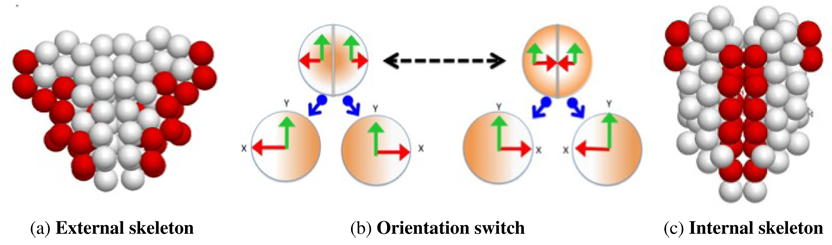
An intriguing unanswered question about the evolution of bilateral animals with internal skeletons is how an internal skeleton evolved in the first place. Computational modeling of the development of bilateral symmetric organisms suggests an answer to this question. Our hypothesis is that an internal skeleton may have evolved from a bilaterally symmetric ancestor with an external skeleton. By growing the organism inside-out an external skeleton becomes an internal skeleton. Our hypothesis is supported by a computational theory of bilateral symmetry that allows us to model and simulate this process. Inside-out development is achieved by an orientation switch. Given the development of two bilateral founder cells that generate a bilateral organism, a mutation that reverses the internal mirror orientation of those bilateral founder cells leads to inside-out development. The new orientation is epigenetically inherited by all progeny. A key insight is that each cell contained in the newly evolved organism with the internal skeleton develops according to the very same downstream developmental control network that directs the development of its exoskeletal ancestor. The networks and their genomes are are identical, but the interpretation is different because of the cell’s inverted orientation. The result is inside-out bilateral symmetric development generating an inside-out organism with an internal skeleton.

My first thought was…an interesting suggestion. We know from the homology of the patterning molecules involved that vertebrates and invertebrates are upside-down relative to each other, so at some point an ancestor flipped (or more likely, the ancestor was morphologically ambiguous in the dorsal-ventral axis), so let’s think about whether that’s feasible. And then my second thought was…wait, no way. That makes no sense at all.

So I read the paper. I was right, it makes no sense at all.

First thing I noticed was that the acknowledgements thank Francis Hitching, a notorious crank, Martin Brasier (no problem there, he’s a paleontologist specializing in Cambrian evolution…but also not a developmental biologist), and Cellnomica, a company that makes the modeling software. I looked. Eric Werner is the president and CEO of Cellnomica, which sort of means he was happily thanking himself for allowing him to use his software, which is nice, I suppose.

But except for Brasier, I’m already unimpressed. That doesn’t matter, though; he will sway me by the data and the evidence, right?

Next problem: there isn’t any. This is one of those totally evidence-free papers; the author didn’t bother to look up anything about the induction of skeletal elements in arthropods and vertebrates, cites nothing but three (!) papers all written by Eric Werner (!!), all published unreviewed in arXiv (!!!), and builds everything from a simplistic premise about how axis information is inherited epigenetically in dividing cells. There actually is a substantial literature on the inheritance of the orientation of cytoskeletal elements in dividing cells in flies and nematodes, for instance — but it’s not as trivial as what Werner proposes, and he doesn’t cite any of it, anyway.

The whole thing consists of the graphical output of simulation runs on his software, like this:


Orientation transform results in inside-out growth. The bilateral multicellular organism on the left Fig.a, where the red cells are on the outside, develops from the founder cells next to its right in Fig.b that have a Back-to-Back orientation. The reversal from a Back-to-Back orientation to a Face-to-Face orientation in the founder cells Fig.b is epigenetically inherited in the progeny. The result of this orientation switch is inside-out development seen in the organism on the right Fig.c where the red cells are on the inside. The transformation is reversible going in either direction depending only on the initial orientation of the bilateral founder cells.

He hasn’t even questioned his premises. Is there evidence of cells producing mirror-image progeny (actually, I recall that there is…but it’s not quite as uniform as he proposes)? Is there reason to think from, say evidence in the fossil record, that ancient chordates are inside-out arthropods? Nope, and Brasier should have been able to tell him so. Is there developmental evidence that this is how skeletons form? For instance, are the progenitors of internal skeletons homologous to the cells of the arthropod cuticle that produce there exoskeleton?

And that’s where I stopped and told myself, “obviously not”. The arthropod cuticle is produced by ectodermal cells that produce chitin. If you turned one literally inside out, the ectoderm would become the endoderm, the lining of the gut…a phylogenetically ancient tissue with homology between arthropods and chordates. It does not produce the chordate skeleton. That job is done by mesodermal derivatives…a tissue that forms in roughly similar ways by ingression/involution of cells during gastrulation in both groups. Mesoderm forms muscle and connective tissue in both arthropods and chordates, and produces bone and cartilage in addition in chordates.

The story is complete abiological and ahistorical bollocks. It’s really nothing but a pointless exercise in making a computer program run its paces, and is about as relevant to evolution as Spore, another game that attempted to model a science and failed abysmally.

It also makes me curious about something else: it was published in arXiv, which is mainly a repository of physics papers, with some abstract biological/mathematical stuff trickling in. Is the physics collection as plagued with drivel as the few samples of biology papers I’ve seen shoveled in there?


Werner E (2012) How to Grow an Organism Inside-Out: Evolution of an internal skeleton from an external skeleton in bilateral organisms. arXiv:1207.3624v1

(via Tommy Leung)

Hitchens’ last eloquent gasp

I just ordered Hitchens’ Mortality; it’ll be out next week. I’m very much looking forward to it in a grim sort of way. You can read the last chapter right now, and incoherent and scattered as those terminal jottings are, it’s still marvelously well-written. My favorite quote so far?

If I convert it’s because it’s better that a believer dies than that an atheist does.

You know the whole book is going to be full of those.

Secular Humanists are not and should not be religious

It is so revealing that James Croft is offended that some atheists have the impression that secular humanism is a religious idea.

In the ongoing discussions around Atheism+ and its relationship with Humanism one issue crops up again and again: the perception that Humanists – at least some Humanists – have an attitude toward religion which the atheists who are excited by Atheism+ do not share. This is often expressed as a reason why a given blogger does not identify as a Humanist, or why they prefer the Atheism+ label to Humanism.

He quotes me. My comments were specifically directed at the Harvard Humanists, not secular humanism — I identify as a secular humanist myself, and there ain’t one germ of religious feeling anywhere in my body. This is another thing that pisses me off about the Harvard Humanists: they no more represent the entirety of humanism than I do the entirety of atheism, but they so easily assume that they do.

For the record, I have no disagreement at all with way most humanists address religion; the major organizations, like the American Humanists and the British Humanist Association, are just fine and dandy, and just as godless as I am. But some do take an awfully admiring view of religion, and unfortunately, they’re the same ones who think they are the be-all and end-all of secular humanism.

Why I am an atheist – Nyq Only

Some christians ask me how I lost my faith or what took me away from god. I think, like many atheists, the question is almost nonsensical – it as if there is an assumed trauma or falling-out: that atheism is like a divorce or the end of a relationship. Perhaps for some it is exactly that, I don’t know. However it is not that I stopped loving god but that I stopped believing god existed and so questions of ‘love’ or any kind of relationship became irrelevant.

[Read more…]

I’m all for concentrating the stupid in one place

Do you remember Terry Hurlbut? Of course not. He’s another boring creationist whose schtick is to claim that creationists really are scientists — after all, Isaac Newton was a creationist. He also maintains something called the “Creationist Hall of Fame” which lists a lot of legitimate pre-Darwin thinkers and 20th century crackpots. His “Hall of Fame” is just a website, but he dreams big: he wants to put up a real building with…what? I don’t know. Printouts of his articles?

Anyway, the semi-interesting thing he wants to do is build that edifice to idiocy somewhere near the Creation “Museum”. It’s a legitimate business plan, I think; the concentration of deluded fools spikes in the vicinity of Answers in Genesis, and that’s his market. AiG has nothing to do with it, though — I wonder if they’d resent someone tapping into their pool of suckers? Or if they’d see it as an addition to their vortex of stupid? It depends on Hurlbut’s ideological purity, I suppose.

That’s another good name

While everyone was getting enthusiastic about Atheism+, Michael Nugent wrote up a Manifesto to promote Ethical Atheism. Here’s the preamble:

In real life, atheism means more than mere disbelief in gods, or belief that there are no gods. If you disbelieve in gods, it necessarily follows that you also disbelieve that we get our ideas of truth and morality from gods. This is a significant approach to two central questions about life, in a world where most people believe the opposite.

This is a draft manifesto for ethical atheists who care about both truth and morality, and who want to promote reason, critical thinking and science; atheism over supernaturalism; natural compassion and ethics; inclusive, caring atheist groups; fair and just societies; secular government; and local, national and global solidarity.

Ethical atheism is more useful than dictionary atheism, because it applies the consequences of our atheism to real life. Ethical atheism is more precise than secular humanism, because religious people can be both secular and humanist, and because ethics affects all sentient beings and not just humans.

I like it, and it’s what a lot of us have been saying all along. I really don’t care what label you attach to it — secular humanism, atheism+, ethical atheism — as long as you support the values behind it.

Hispanic American Freethinkers

I know people who have been looking for this very organization: Hispanic American Freethinkers.

Some Hispanics live without the fear of imaginary beings and superstitions. Some of us put our hope in science instead of prayer, witchcraft, or homeopathic medicine. We have chosen to live without religion, superstitions, spirits, or myths, and to trust reason and knowledge. Believe it or not, we live happy and well adjusted lives serving the community and our loved ones. Sometimes we have struggles, heartaches, disappointments, and trials just like anyone else, but we solve our problems without the comfort or help of imaginary beings such as angels, ghosts, gods, fairies, or even chupacabras. We find strength, joy and meaning in life itself, using secular morals culminating with a fulfilling life. Our goal is to teach Latinos HOW to think, not what to think!

This looks like an excellent source to tap into for speakers at your next meeting or conference, and I think all of us can agree with their goals.