
The queen has a beau!


I was checking on the Argiope female in my backyard, and discovered that she has a little friend, in a web about 10cm away.
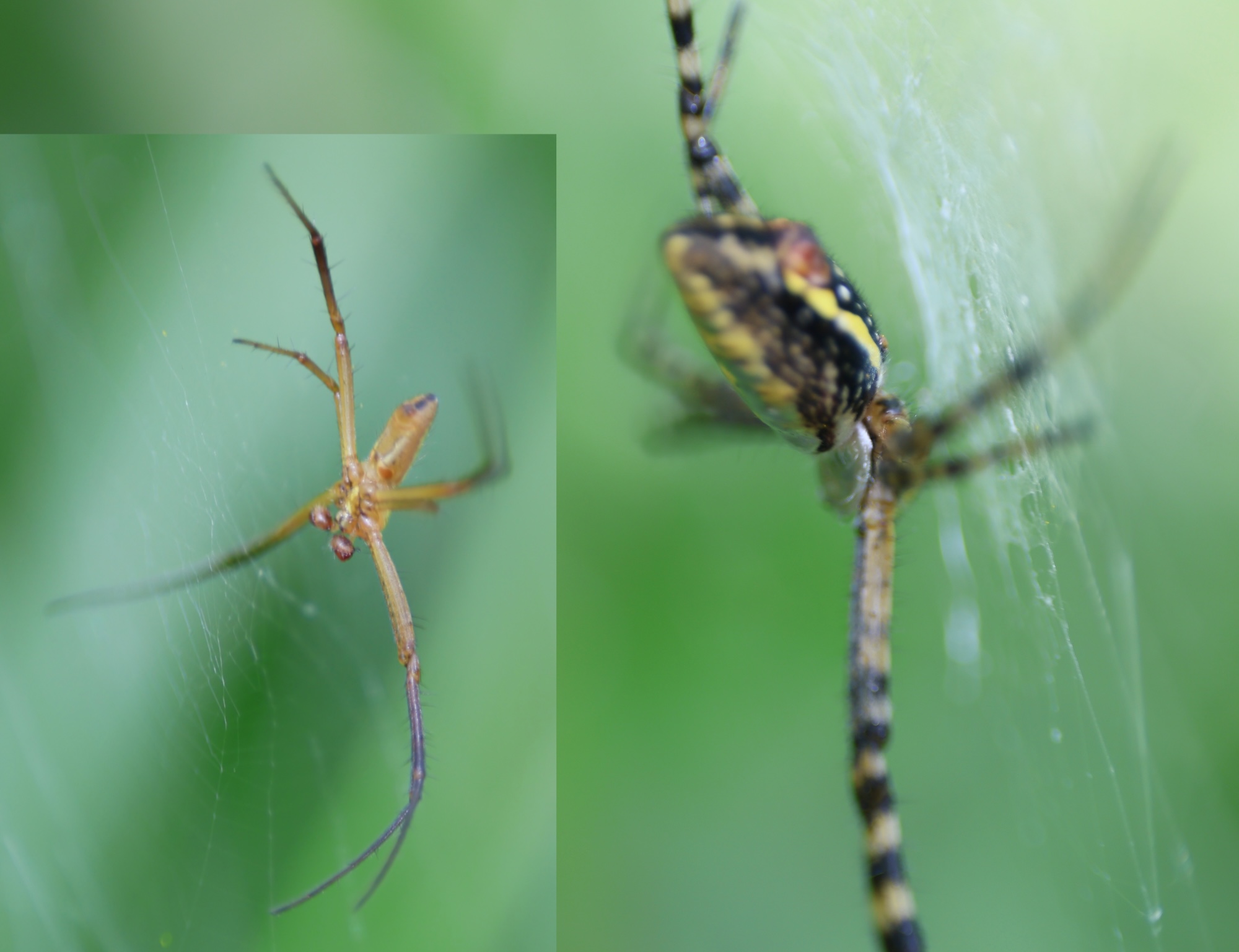
It’s true that the female of the species dwarfs the little males, but look at the gigantic, pendulous palps hanging off the boy. He’s all male.

Comments

  1. Tethys says

    Perhaps in spider social circles it is considered a great honor to provide nourishment for your mate and future egg sac? There are only a few more months of warm weather left for Minnesota insects to complete a growth cycle.

  2. CompulsoryAccount7746, Sky Captain says

    weylguy @2: “Do spiders have testosterone?”

    Sex differences in spiders: from phenotype to genomics (2020)

    We provide an overview of the current knowledge of sex determination in spiders and propose approaches
    […]
    Spiders grow discontinuously through molting, a costly and risky process. […] Evidence is increasing that both instar [dev stage] number and instar duration are plastic traits in both sexes and respond to external conditions such as prey availability and quality, daylength, temperature, and even social cues.

    Growth studies have shown that females and males respond differently to variation in diet. […] Particularly in species with a large sexual size dimorphism, males are affected most strongly by food restriction during early life, while females are generally able to compensate early restrictions if conditions improve later in life. […] females optimize body size if necessary, at the cost of delayed maturation. In contrast, male reproductive success may often depend more strongly on the timing of maturation than on body size, particularly under scramble competition. […] we are lacking the tools to sex early developmental stages and to our knowledge the mechanisms behind growth plasticity are completely unexplored.
    […]
    the formation of sexually dimorphic traits remain largely elusive. […] it remains to be established whether the development of primary and secondary sexual traits is a gradual process that is initiated already during embryogenesis or is initiated only few molts before maturation.
    […]
    Dimorphic development can be coordinated by two main mechanisms. If the sex determining signal is interpreted in each cell from early stages on, sex-specific gene expression and thus development is triggered cell-autonomously. This is the typical mode observed in D. melanogaster [fruit flies]. In mammals, however, dimorphic development is triggered by nonautonomous signals, such as hormones which are mostly secreted from the gonads. It may be interesting to find out whether sex determination in spiders is coordinated cell-autonomously or non-autonomously.

    […] If dimorphic development is highly coordinated in various organs, it is likely that cell-autonomous processes are at play from early stages on. In contrast, the dimorphic development of different organs at different stages may imply that inductive nonautonomous processes are at play.

  3. says

    If I had to guess, I suspect that sex is a cell autonomous process in spiders, as it is in most invertebrates. Dimorphism as a trait isn’t sufficient to rule that out. It would be nice if we had more mutations in spiders and a process for somatic recombination.

  4. says

    Spider Porn! Yes, I know PZ didn’t mean it that way, but it’s just to close to PIGSBREATH pumping the military full of testosterone and comparing penis size!

  5. isochron says

    Shermanj @8: “…pumping the military full of testosterone and comparing penis size!”

    I thought pumping up on anabolic steroids was responsible for what the body-building world came to know as “winky-shrinkage” where ones…uh…parts have a tendency to shrivel.

  6. says

    @9 isochron correctly wrote about steroids causing “winky-shrinkage”
    I reply: Maybe I should have been more complete and said, ‘comparing penis size with a magnifying glass’
    Sometimes I’ve gotta laugh or I’ll just scream into the void.

Leave a Reply