
We’ve got a few monarch chrysalides around the house, but we’ve also noticed a lot of mortality among the caterpillars, which is normal. This morning we spotted this caterpillar, motionless and dying, clinging to the side of the house.
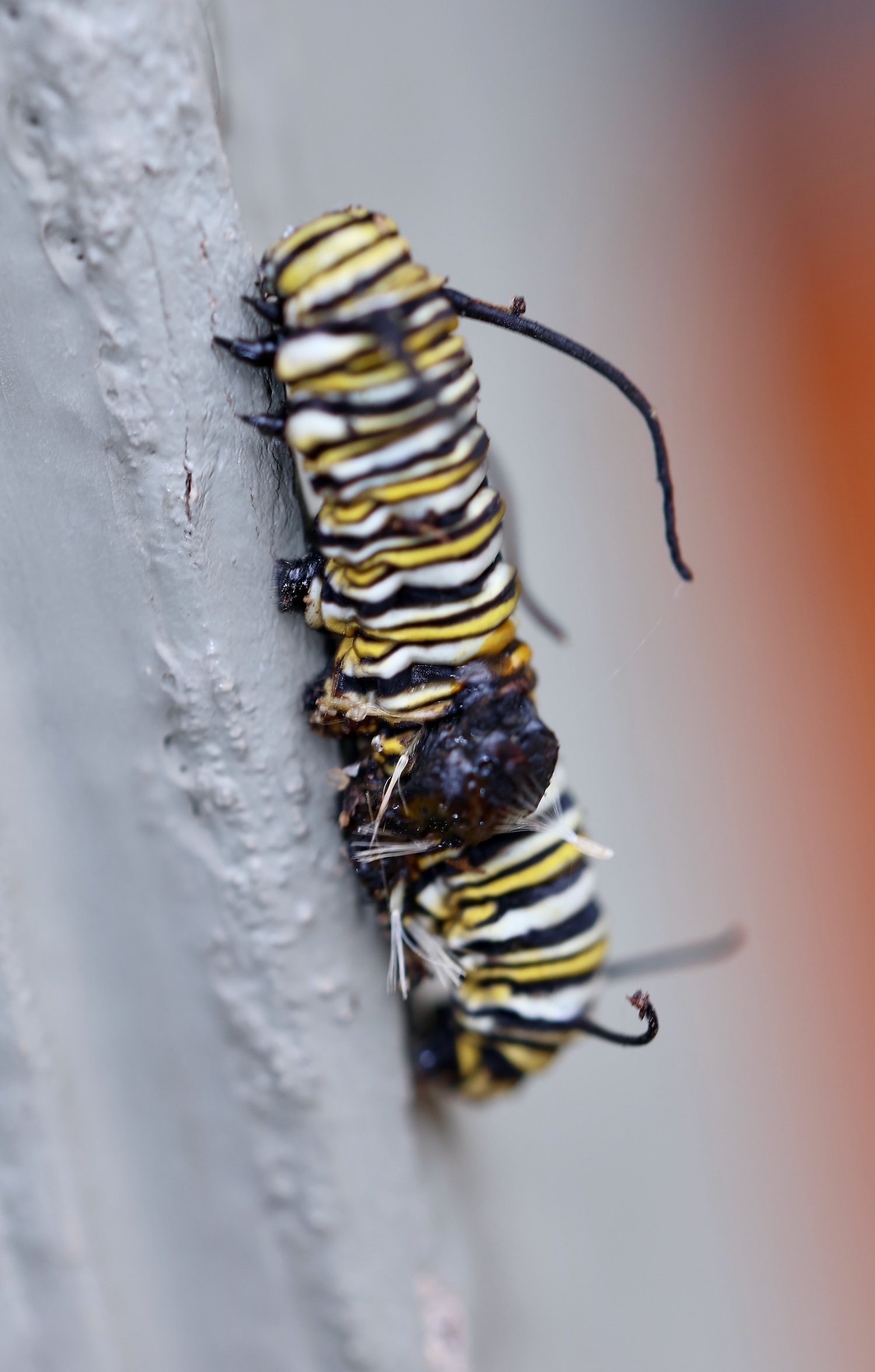
There’s something horrible stuck to its side. I don’t know what it is, so I present it to you, all you caterpillar MDs. Any diagnosis?

Jo Nagai of Kobe, Japan, recently made the news for his collaboration with an American entomologist demonstrating that butterflies retain memories of (some of) their experiences as caterpillars.
I can’t locate the article in which Nagai stated he intends to become a veterinarian, apparently the first to specialize in treating insects. Alas, we may have to wait longer for his advice in this case than the individual pictured can hold out: Nagai will this year enter sixth grade.
I shall draw upon my many years of experience with invertebrate biology and insect medicine to say that it looks to me like some sort of filthy black shit, probably the result of eating too much liquorice and Texas lettuce.
My bet is on a parasitic fungus (think something like cordyceps, but probabely without zombiefication of the patient.
I like fungi.
The black thing is a smaller version of the parasite in the film The Titan Find (with Klaus Kinski as weird menacing astronaut).
A face hugger, implanted during larva stage that got lost.
Pierce R. Butler @1: Lynna posted it in the Infinite Thread. The article summarizes a podcast, where he says that at 37:30.
@4
Did he ever play anything not weird & menacing?
I think that the black blob on the monarch caterpillar is its innards leaking out and drying from where parasites exited its body
For what it’s worth from Gemeni. :)
The black, ruptured mass leaking from the side of the monarch caterpillar is hemolymph (insect blood) mixed with cellular tissue, a condition commonly referred to by hobbyists as “Black Death”. The exact cause requires lab testing, but the visual symptoms are typical of three major threats:
Potential CausesNuclear Polyhedrosis Virus (NPV): A highly infectious virus that targets internal tissue, causing the caterpillar to essentially liquefy from the inside out. The skin eventually splits open and leaks a dark, foul fluid.
Pseudomonas Bacterial Infection: This opportunistic bacteria thrives in humid, unhygienic, or poorly ventilated conditions. It similarly causes internal decay and darkening of the body tissue.
Tachinid Fly Parasitism: A parasitoid fly may have laid eggs on the caterpillar. When the internal maggots burrow their way out to pupate, they tear open the cuticle, leaving trailing wounds and leaking dark hemolymph.
The white filaments on the black masses point to a tachinid, possibly Lespesia archippivora.