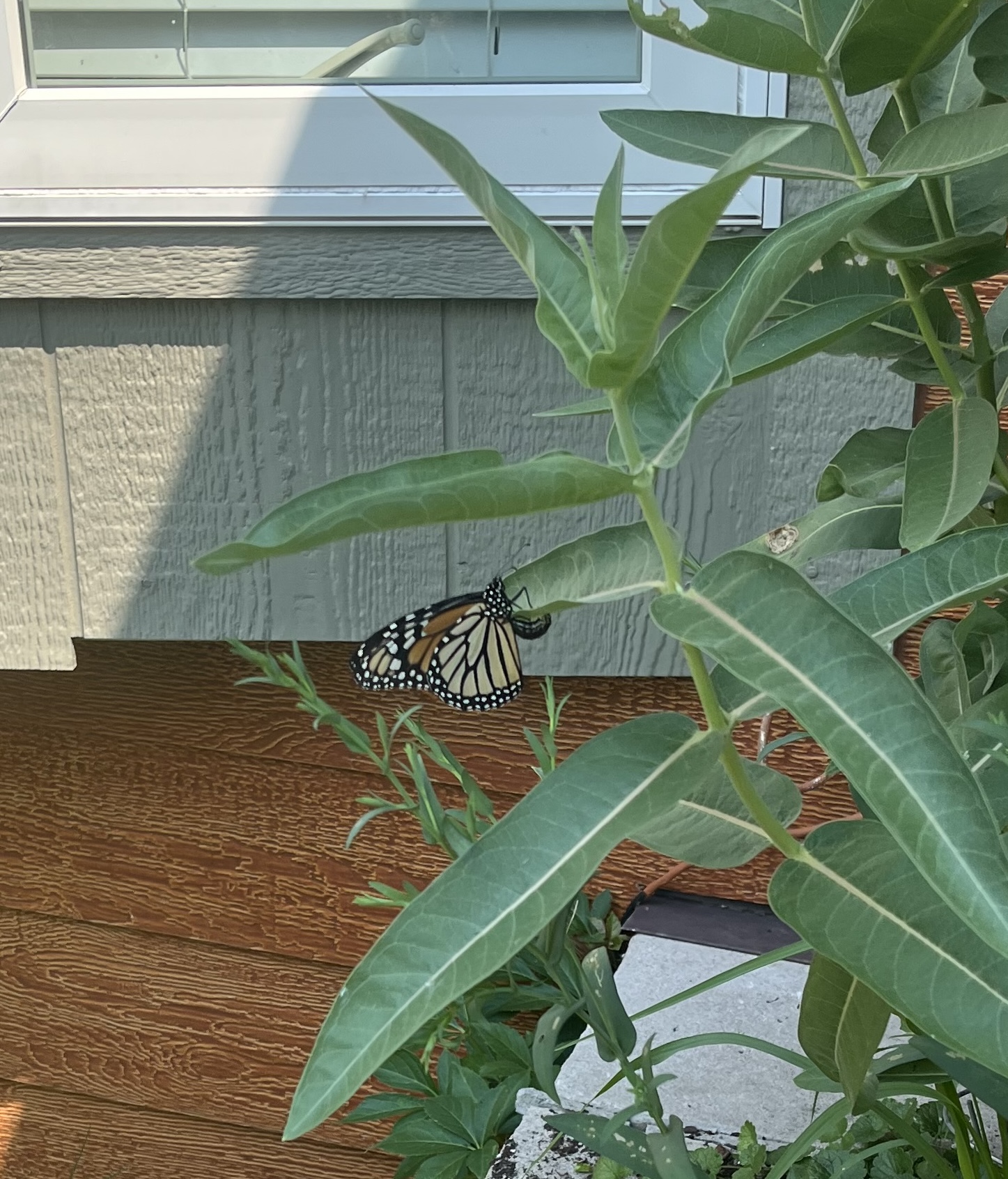
She’s a real beauty! Your milkweed looks like a good place for her to lay an egg.
birgerjohanssonsays
Can you do anything as a layperson to make life easier for the monarchs?
Reginald Selkirksays
Better monarchs than kings.
charleysays
Cool shot! Looks like she’s laying eggs. I just found a monarch caterpillar on one of my milkweed plants.
When I moved into this house in March I wanted to grow milkweed, so I tried to raise them from seed and they all died. Come spring, 20 to 30 pre-existing milkweeds made their appearance in the yard.
John Moralessays
Reginald, ahem. You do tempt me.
Better monarchs than kings.
Those terms are basically synonymous, but only one is gendered.
One out:
A king is a monarch, but male. A queen is a monarch too, but not a king.
See the silly implicit out?
(Better a queen than a king, IOW, is the only one I can think of)
chigau (違う)says
John Morales
Is that comment bait?
John Moralessays
Ah, chigau. A bit too po-faced, was I?
Whether butterflies are better than people is one thing.
(Put it this way; had it been bait, it’d be gone now)
chigau (違う)says
John Morales
True.
StevoRsays
Meanwhile in Adelaide, South Oz, our little at least locally endangered Chequered Copper Butterflies ( Lucia limbaria)* are threatened with the potential destruction of their home thanks to Premier “Possum Killer” Malisantos and his plans to needlessly expand a motor-racing track into the Adelaide Parklands despite having perfectly good alternatives such as racing at the Bend** or on the old, unexpanded Adelaide track where the F1 race used to be and the supercars acurrently race. Just staggering, needless, environmental vandalism. See :
Butterfly Conservation SA has raised concerns over the MotoGP circuit which could damage the environment and habitat of the rare Chequered Copper Butterfly species in Victoria Park.
… (Snip)..
According to a map released by the state government last week, the circuit would be located right next to the colony on a new hairpin bend and close to where the grandstands would be built.
Butterfly Conservation SA chairman Bryan Haywood said the the group “had to be a part of the planning process”.
“We physically need someone on the ground to assist people putting out the fences or building the grandstands to be clear that the footprint won’t be impacting the grassland site,” Haywood said.
“We can’t have thousands of people traversing over the grassland either because that would be equally detrimental.”
The Chequered Copper Butterfly was rediscovered in the Victoria Park grasslands in 2011, becoming the first sighting in the Adelaide Plains in more than 60 years.
@ 3. birgerjohansson : “Can you do anything as a layperson to make life easier for the monarchs?”
Yes!<
Monarchs exclusively lay their eggs on milkweed, their sole host plant, but its availability is diminishing. To aid monarchs and other pollinators, planting milkweed and nectar plants is crucial. Here are ten ways to support them: firstly, prioritize planting milkweed; secondly, include nectar plants for energy; and thirdly, maintain diversity in plant selection. Native milkweed acts as a breeding ground, while wildflowers provide necessary nectar for energy during migration and winter preparation. Clean and maintain habitats by regularly removing contaminated leaves. As monarch populations face severe decline and risk extinction, individuals can take actionable steps to help by minimizing herbicide and pesticide use. Embrace natural weed and pest control methods, such as flytraps or pheromone traps. By actively creating and preserving suitable habitats for monarchs, we can contribute to their survival and ensure the continued beauty of these incredible butterflies.
Oddly enough before that page would load I to pass a different ‘Not a robot test’ of clicking on a colour option. That’s new.
Also see a long list of do’s and Don’ts concluding “..fill your yard with the native milkweeds and nectar plants they need to survive, avoid pesticides, and support efforts to protect monarch overwintering sites in California and Mexico.”
There is much house garden owners can do to help support the survival of the monarch butterfly. Here’s how
Plant Milkweed: Grow native milkweed species in gardens to provide breeding sites.
Create Pollinator Gardens: Plant nectar-rich flowers to offer food for adult butterflies.
Avoid Pesticides: Reduce or eliminate pesticides to prevent harming butterflies and their larvae. Even herbal pesticides can kill monarch larvae. If you need to use ingredients like neem oil, insecticidal soaps, and horticultural oils, apply them after dusk when pollinators aren’t active.
Which also notes :
Make Your Garden Attractive to Monarch Butterflies
(Emphaisis original for sub-heading -ed.)
Create a small mud puddle or add water to sand in a sunny area of your yard and place a flat stone within it. Butterflies will bask on the stone to increase their body temperature and drink from the puddle, which provides essential salts, vitamins, and minerals to supplement their nectar diet. Additionally, you can grow colorful native plants, including nectar-producing ones such as lantana, liatris, echinacea, flowering sages, verbena, bee balm, black-eyed susans, yarrow, and, of course, milkweed.
Albeit at least one of those, Lantana, is an invasive species in some places eg here in Oz so be wary and check onthge weed status of tho species you choose.
@ ^ John Morales : Yes, its true that the Monarch Butterfly is an introduced species that feeds on weedy plants here and that does complicate things locally.
However, it is a popular species with many and the local Bushcare group I belong to as a policy leaves one of its main local food plants Gomphocarpus fruticosus (Swan Bush / Narrow-leaved Cotton Bush)* as a foood source for it because of this and the fact that it really doesn’t seem to do that much harm. Guess that is a bit of a trade off but that’s the consensus position on it.
I meant the milkweed, StevoR. The flutterbyes (my preferred term) are fine.
From my link above, my emphases:
In Australia the caterpillar of this butterfly are the introduced cotton bushes, Gomphocarpus cancellatus (syn. Asclepias rotundifolia) Broad-leaf Cotton-bush, Gomphocarpus fruticosus Narrowleaf Cotton-bush and Asclepias curassavica Red-head Cotton-bush. As these plants are weeds, they are often removed from nature and road reserves.
and
The Wanderer is not a native butterfly. Its foodplant, the milk-weed is a non-indigenous plant which has become a pest in many areas of the coast and the foothills. This problem is compounded by people who grow this plant to encourage these spectacular butterflies to breed. In this way both the butterfly and the plant have been spread to areas of the state where neither of them occurred in the past.
The milkweed is named because of its poisonous sticky sap. It can cause eye and skin problems in adults if they come in contact with it. The sap, if eaten or chewed is poisonous to children and family pets.
It is doubtful we will ever get rid of this undesirable plant from our bushland areas and therefore the
butterfly will always have a food source. The fad for growing milkweed plants to attract the
Wanderer may be responsible for the spread of this plant.
StevoRsays
@ ^ John Morales : True but, well, shrug, that’s how it is for now.
FWIW We also leave some patches of Blackberry (Rubus fruticosus complex) to shelpetr endnagered bandicoots because that’sthe ecological function that weed serves at times and in places in the park.
Pragmatic compromise with hopefully desiable outcomes.
The only “kings” and “monarchs” I want are regal species and eusocial queens. So I approve. Keep an eye open for the caterpillar. I know it’s not a spider, but documenting its metamorphosis might be worth a few photographs if you can get them.


pretty pretty
She’s a real beauty! Your milkweed looks like a good place for her to lay an egg.
Can you do anything as a layperson to make life easier for the monarchs?
Better monarchs than kings.
Cool shot! Looks like she’s laying eggs. I just found a monarch caterpillar on one of my milkweed plants.
When I moved into this house in March I wanted to grow milkweed, so I tried to raise them from seed and they all died. Come spring, 20 to 30 pre-existing milkweeds made their appearance in the yard.
Reginald, ahem. You do tempt me.
Those terms are basically synonymous, but only one is gendered.
One out:
A king is a monarch, but male. A queen is a monarch too, but not a king.
See the silly implicit out?
(Better a queen than a king, IOW, is the only one I can think of)
John Morales
Is that comment bait?
Ah, chigau. A bit too po-faced, was I?
Whether butterflies are better than people is one thing.
(Put it this way; had it been bait, it’d be gone now)
John Morales
True.
Meanwhile in Adelaide, South Oz, our little at least locally endangered Chequered Copper Butterflies ( Lucia limbaria)* are threatened with the potential destruction of their home thanks to Premier “Possum Killer” Malisantos and his plans to needlessly expand a motor-racing track into the Adelaide Parklands despite having perfectly good alternatives such as racing at the Bend** or on the old, unexpanded Adelaide track where the F1 race used to be and the supercars acurrently race. Just staggering, needless, environmental vandalism. See :
Source : https://www.indailysa.com.au/news/just-in/2026/02/26/the-butterfly-effect-claims-motogp-circuit-may-clip-wings-of-rare-species
,* See species wikipage :
Plus
20200912 Herding caterpillars of the Chequered Copper butterfly (Lucia limbaria) a marvellous 5 mins 18 seconds lo9ng on this species symbiotic relationship with the ant species (Iridomyrex rufoniger.
.** See : https://en.wikipedia.org/wiki/The_Bend_Motorsport_Park
Oh, er, make that see wikipage :
https://en.wikipedia.org/wiki/Lucia_(butterfly)
For the Chequered Copper Butterfly.
@ 3. birgerjohansson : “Can you do anything as a layperson to make life easier for the monarchs?”
Yes!<
Source : https://blog.entomologist.net/what-can-we-do-to-help-the-monarch-butterflies.html
Oddly enough before that page would load I to pass a different ‘Not a robot test’ of clicking on a colour option. That’s new.
Also see a long list of do’s and Don’ts concluding “..fill your yard with the native milkweeds and nectar plants they need to survive, avoid pesticides, and support efforts to protect monarch overwintering sites in California and Mexico.”
Source : https://www.birdsandblooms.com/gardening/attracting-butterflies/how-to-help-monarchs/
In addition to :
Which also notes :
Source : https://www.animalsaroundtheglobe.com/monarch-butterflies-are-fighting-for-survival-and-they-need-your-help-5-239827/
Albeit at least one of those, Lantana, is an invasive species in some places eg here in Oz so be wary and check onthge weed status of tho species you choose.
StevoR, ahem. https://butterflyconservationsa.net.au/wp-content/uploads/2016/12/wanderer-for-or-against.pdf
(It is an invasive species in Oz)
@ ^ John Morales : Yes, its true that the Monarch Butterfly is an introduced species that feeds on weedy plants here and that does complicate things locally.
However, it is a popular species with many and the local Bushcare group I belong to as a policy leaves one of its main local food plants Gomphocarpus fruticosus (Swan Bush / Narrow-leaved Cotton Bush)* as a foood source for it because of this and the fact that it really doesn’t seem to do that much harm. Guess that is a bit of a trade off but that’s the consensus position on it.
.* See : https://en.wikipedia.org/wiki/Gomphocarpus_fruticosus
I meant the milkweed, StevoR. The flutterbyes (my preferred term) are fine.
From my link above, my emphases:
and
@ ^ John Morales : True but, well, shrug, that’s how it is for now.
FWIW We also leave some patches of Blackberry (Rubus fruticosus complex) to shelpetr endnagered bandicoots because that’sthe ecological function that weed serves at times and in places in the park.
Pragmatic compromise with hopefully desiable outcomes.
I checked. There is an egg on that leaf.
The only “kings” and “monarchs” I want are regal species and eusocial queens. So I approve. Keep an eye open for the caterpillar. I know it’s not a spider, but documenting its metamorphosis might be worth a few photographs if you can get them.