
You knew I’d have to read an article titled Earliest octopuses were giant top predators in Cretaceous oceans. How cool is that? And then they’ve illustrated it with some very appealing figures.
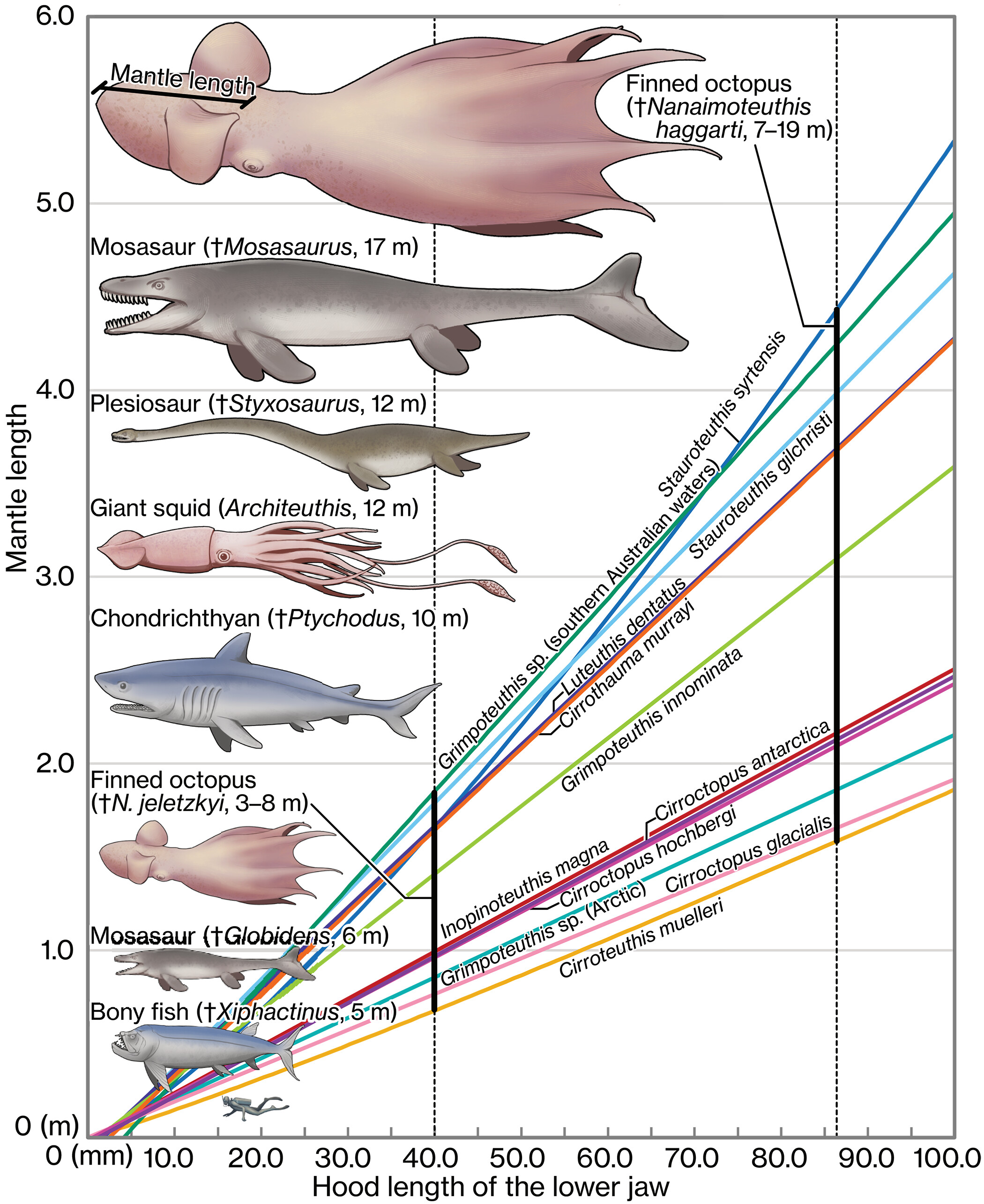
Body size estimation of Late Cretaceous octopuses.
The graph shows an allometric relationship between the length of the jaw and mantle in long-bodied species of extant finned octopus . The name of the corresponding species is shown along each growth curve. The sizes of N. jeletzkyi and N. haggarti based on their largest specimen are indicated by black vertical lines. Reconstruction of these two species, the extant giant squid, and gigantic vertebrate predators in the Late Cretaceous are shown with their maximum total length.
Also, the abstract promises much.
Top predators drive changes in ecosystem structure. For the last ~370 million years, large-sized vertebrates have dominated the apex of the marine food chain, while invertebrates have served as smaller prey. Here we describe invertebrate top predators from this “age of vertebrates,” the earliest finned octopuses (Cirrata) from Late Cretaceous sediments (~100 to 72 million years ago), as identified based on huge, exceptionally well-preserved fossil jaws and their wear. This extensive wear suggests dynamic crushing of hard skeletons. Asymmetric wear patterns further indicate lateralized behavior, suggesting advanced intelligence. With a calculated total length of ~7 to 19 meters, these octopuses may represent the largest invertebrates thus described, rivaling contemporaneous giant marine reptiles. Our findings show that powerful jaws, and the loss of superficial skeletons, convergently transformed cephalopods and marine vertebrates into huge, intelligent predators.
But does the paper deliver? Sad to say, it doesn’t. I was disappointed on how far the authors stretched an interesting technique to reach an excessive conclusion.
What they did was collect fossil octopus beaks and subject them to grinding tomography — basically shaving away the rock, photographing each exposed slice, and using an AI to help reconstruct a detailed 3-D image of the beak that allowed them to view the wear and tear on the beak’s surface, presumably seeing the damage acquired as they chewed their way through their Cretaceous prey. The entirety of the data in the paper is an analysis of scratches and wear on these beaks.
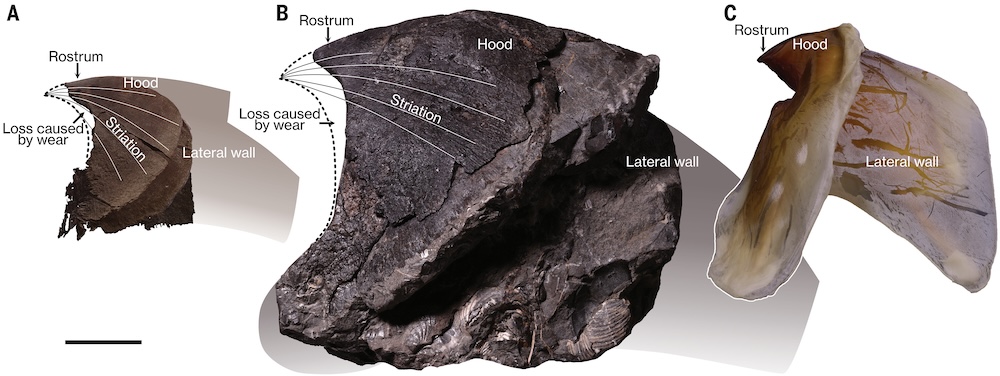
Huge lower jaws of fossil octopuses and of an extant giant squid.
(A and B) The largest lower jaws of the Late Cretaceous finned octopus species N. jeletzkyi [(A) NMNS DS00042 3LmvTpM] and N. haggarti [(B) KMNH IvP 902001]. Both specimens show extensive loss of jaw material caused by wear. (C) A lower jaw of the extant giant squid Architeuthis dux (NSMT-Mo 85956), a species having the largest jaw among modern cephalopods. (A) is a digital fossil jaw visualized as a 3D model; (B) is an exceptionally well-preserved nondigital fossil jaw; and (C) is a modern jaw dissected from a carcass of ~10 m total body length. Solid lines indicate the extension of striation on the outer surface of the hood and broken lines show the estimated outline of the rostrum without wear. The hood and lateral walls lost by weathering, shown as shadowed areas, are reconstructed based on the holotype and specimens in fig. S4. (A) and (C) are exhibited in a mirrored position. Scale bar, 20 mm.
That’s good stuff. No data too small — it’s all data. But wait: this paper contains nothing but measurements of beaks, but manages to expand this into a whole set of conclusions about the marine ecosystem.
These wear patterns suggest that Late Cretaceous giant Cirrata were active carnivores that frequently crushed hard shells and bones. The long scratches distributed on wide areas of their jaw reflect the dynamic use of the entire jaw for dismantling prey. Asymmetric loss of the jaw edges suggests lateralized behavior, which has been linked to a highly developed brain and cognition. This, in turn, suggests that the earliest octopuses already possessed advanced intelligence. Laterality is known in modern octopuses, whose high intelligence matches that of vertebrates. The exceptionally large jaws of adult N. jeletzkyi and N. haggarti suggest a strong bite force because cephalopod jaw muscles enlarge as the jaw size increases. The long lateral walls in their jaws revealed by the new digital specimens reported here show that Nanaimoteuthis had large jaw muscles. The chipping on both the rostrum and jaw edge was caused by strong shear stress beyond the yield point of the most robust part of the jaw. The transverse cracks in N. haggarti are probably a trace of larger shear failures. These large fractures thus suggest a powerful bite. In giant Cirrata, the jaws are smaller than those of contemporaneous Cretaceous vertebrate top predators, which measure ~1.7 m in length. Instead of using a large mouth, the long and flexible arms of octopuses serve for catching large prey. The giant Cirrata probably consumed large prey with their long arms and jaws, playing the role of top predators in Cretaceous marine ecosystems.
All we’ve got are scratches on beaks, with extrapolation from beak size to overall size. From that we leap to the conclusion that these giant octopuses were rivals to mosasaurs, plesiosaurs, ichthyosaurs, and sharks. We assume they’re top predators in the absence of actual evidence of predation or their role in the ancient ecosystem.
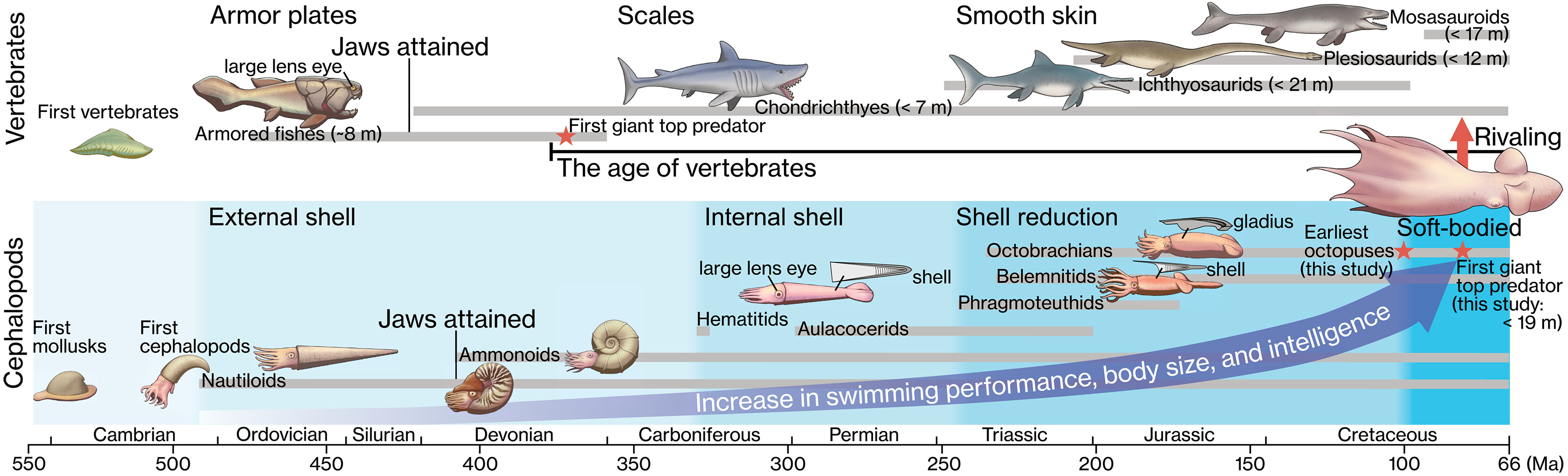
Convergent evolution among marine top predators in the Paleozoic–Mesozoic.
This model shows the acquisition of jaws and the reduction of superficial skeletons in the evolutionary history of marine vertebrates (top) and cephalopods (bottom) to become top predators. The gray horizontal bars show the chronological range of some selected groups of vertebrates and cephalopods. For cephalopods, stepwise reductions of skeletons are indicated by the blue background.
I’m not even going to touch the idea that asymmetric scratches are good evidence of high intelligence.
I am reminded of the speculations of Mark McMenamin, who thought circular shapes in Triassic sediments were evidence of a gigantic Kraken. He also found a broken piece of rock that he extrapolated to claim it was the tip of a giant kraken beak.
At least McMenamin’s extravagant conclusions weren’t getting published in Science.

Wellllll, speaking as a really-not-a-paleontologist, I understand that finding a bone similar to a known species but massively larger is a good clue to the existence of giant forms of said organism – a bit like those absurdly-sized Quetzalcoatlus.
All the rest sounds a bit like someone falling in love with their own scenario. I picture the researchers rolling on the floor hugging the specimens and screaming I WUV YOU MY GIANT KRAKEN… and who can blame them?
CTHULHU ONCE RULED THE SEAS!
(okay, the fossils didn’t show ‘wings’, but they wouldn’t have been preserved anyway)
“I’m not even going to touch the idea that asymmetric scratches are good evidence of high intelligence.”
I will.
It’s a 3 level chain of suppositions:
(Not the most confident claim ever)
I didn’t see any detailed analysis on wear patterns on the beaks of living Archaeoteuthis other than a passing remark. OK the asymmetric wear patterns is evidence of ‘hand’ preference in these animals although handedness is a rather loose term for an animal with 8 or 10 tentacles. Lots of animals of varying degrees of intelligence show a hand preference. Where are the studies showing a correlation for which side you chew on and which hand you use and your intelligence? The evidence for intelligence among living octopus and squids is stronger evidence for intelligence among their fossil ancestors than which side they chewed their plesiosaur from.
I didn’t see any detailed analysis on wear patterns on the beaks of living Archaeoteuthis other than a passing remark. OK the asymmetric wear patterns is evidence of ‘hand’ preference in these animals although handedness is a rather loose term for an animal with 8 or 10 tentacles. Lots of animals of varying degrees of intelligence show a hand preference. Where are the studies showing a correlation for which side you chew on and which hand you use and your intelligence? The evidence for intelligence among living octopus and squids is stronger evidence for intelligence among their fossil ancestors than which side they chewed their plesiosaur from.
Now, that shear forces make predictable deformations is true, and I do believe that research in this direction can be fruitful. If we can replicate the material and run a couple of tests, we should be able to see the amount of force needed, and estimates do appear to be accurate in similar situations (this is used in the engineering of buildings, for instance).
An organism would presumably not develop more power than necessary, so from the forces that acted we may quite reasonably infer something about the materials the octopus chewed.
While perhaps it’s not possible to say for certain that it was an apex predator, we can probably say that the things it chewed were very firm.
Regarding the intelligence, that is a weak claim, and as per a previous comment, it would possibly be interesting to do some research into whether asymmetric loss of jaw edges correlates with intelligence in similar species.
The idea that large beaks correspond to large animals is at least plausible.
I’d definitely not rate the paper as rubbish. Perhaps it’s a bit overzealous regarding probabilities. Again, I’m not against speculation.
There are plenty of large Cretaceous prey species that have very thick shells. Giant clams, crustaceans, ammonites. Increasing beak size could indicate their preferred prey was also getting bigger/ evolving thicker shells. I think this would be far more convincing if they had some shell fragments or bones that have bite marks from the octopus beak.
Most octopods are carnivores, but that doesn’t mean they are apex predators like an Ichthyosaur.