
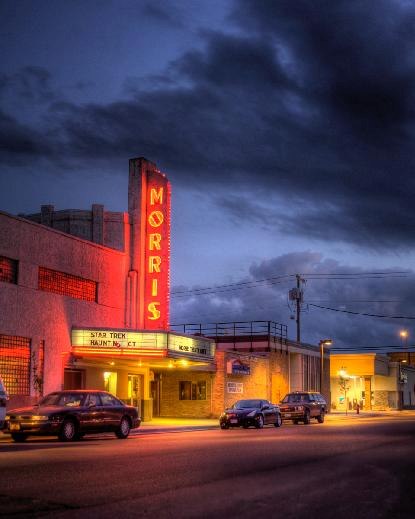
This past weekend, I was trained in the movie business. Our local theater is run as a co-op, I’m a member of the board, and I bravely volunteered to assist in occasionally assisting in running the theater. This meant going in to operate the projector and help with the concessions. Easy, right? Push a few buttons, relieve some of our helpful volunteers, no sweat.
Except it turns out to be a non-trivial exercise. The theater is an old building that has been clumsily revamped to handle a modern movie projection system. The first step is running around to various closets and hidey-holes to flip circuit breakers on, power up various computers and devices, gather up a pair of cash boxes and count money and deliver them to the ticket booth and concessions, and turn on the two projectors, and wait. These are run by old computers that take ages to start up and feature antique Windows software to run everything.
The projector software really does everything for you. It shows all the ads and movies on a tight schedule, and once it’s running you can just ignore the projection until the movie is done. That sounds great, but it’s more like the autopilot on a private plane. It does the job it’s designed to do, but before you can push the button to switch on the autopilot, you still have to do all the pre-flight checks and turn on the engine and get the plane down the runway and into the air. It’s much more complicated than I imagined.
So I’ve gone through the procedure once — it wasn’t enough. I’m going to have to do more run throughs under supervision before I can fly solo.
I didn’t have a chance to watch the movies. I was able to catch the end of The Bride, which was confusing and loud. The star of the weekend was Super Mario Galaxy, which was packing the house — we had a record attendance. I did learn the most of the money made is from concessions, which I’ll have to learn how to do next. This is the first time in my entire life that I’ve worked in retail, and I’m mystified by it.
But the glamor!

Also, all of the young people working there and knowing how everything works are smarter than I am.
Very cool! Those old theaters are neat, and great community resources.
And hanging around young people, also good.
Although you also get that last from teaching, of course. But now they’re teaching you. :-)
They probably think you’re cute and call you Grandpa.
PZ’s next stop…Hollyweird!! Big cars, movie stars, smoking stogie cigars.
hillaryrettig1 @ #3 — “But now they’re teaching you. :-)” I thought students were always teaching the teachers…at least that’s what some teachers say.
Now, you need to get old-timey curly moustaches to go with the glamour. A film boss!
I worked as a projectionist for a while in the 1960s. This was back when theatrical movies were shipped around the country on 35mm film. 70mm film became a thing shortly after I was no longer doing the work; and I gather, from PZ’s description, that everything these days is electronic, which explains why PZ can report that he basically just boots a computer and punches a button, and then the computer does everything else.
Back in the ’60s, the projectionist’s whole job was getting the image on the screen; and it was a lot of work. A reel of 35mm film was good for about twenty minutes or a little more; and so a theatrical movie came on at least five reels, maybe as many as eight. You had to rewind all the reels (they were shipped tails-out), and in the process, inspect the film for damage. There would usually be one or two frames that had some damage that would get hung up in a projector; so you’d have to cut that frame out and splice the two ends together.
There were two projectors that would alternate during the showing. They had carbon arc lights that were very bright (you couldn’t look at them while there were on), and which you had to fire up a couple of minutes before starting the projector and make sure that the arcs were at the focal point of a parabolic mirror at the rear.
Switching from one projector the the other involved looking out a little hole in the wall for a flash of light in the upper right corner of the screen. That would be the cue to turn on the motor that got the film moving. Then you had to open a gate that let the arc light through to the film (which had to be closed while the film wasn’t moving or the film would melt, and maybe even catch fire), and then look out the hole in the wall again for the cue to step on a big button in the floor that would close a shutter in one projector and open it in the other. In some theaters, that would also switch the sound from one projector to the other; but sometimes there was another switch to throw, or knob to turn, to switch the sound.
Then you had to turn off the first projector’s arc light, rewind the reel that just finished to get it ready for the next showing, thread up the next reel, and adjust the carbon rods in the arc light to make sure that they’d be long enough for the next twenty minutes or so. Depending on how quick you were, you’d then have five to ten minutes of boredom before doing it all over again. If this was the last showing for a particular film, you had to rewind twice to get the film tails-out on shipping reels which were usually too flimsy to use in a projector.
It was fun while it lasted. 8-)
billseymour’s comment reminds me of this amazing video: https://youtu.be/ZdPKGNCw7lM
Apparently there was (is?) a real art to running film projectors; among other things the projectionist controlled the aspect ratio of a film, and if they messed up you might see boom mikes and other things that were not meant to be seen. (I learned that from reading Roger Ebert.)
Oh, you whippersnappers have it so easy now. Back in my day, the Morris Theater used film. We’d have to splice together all the reels of the movie when it came in and every night thread it up, switch to the right lens type, and hope nothing went wrong and caught fire.
Skatje: Yes, but judging from some recent photos on PZ’s blog, he did have to walk through three feet of snow to do the job.
Did you also have to flip circuit breakers in the mens’ room, and unlock the corner cubby in the office to find the cash boxes, and do all the stupid accounting? You probably didn’t have to deal with the clumsy Windows app.
Oh, it did too snow all winter long in the ancient days when she had the job.
I don’t think I ever had to mess with the circuit breaker, but the mens’ room would occasionally have a clogged toilet, so I was not a stranger to its particular scents. But yes, also handled the cash boxes and accounting and phoning in the night’s totals to a voicemail line after everyone else had gone home. Towards the end of my time as assistant manager, they switched concessions to using a cash register instead of a single calculator and a metal box. If someone wanted a receipt, we found a scrap of paper to write on. All these newfangled technologies, goshdarnit.
tedw @8: I have no memory of worring about aspect ratio. We showed whatever was on the film, just using different lenses for regular and Cinemascope films.
Skatje @9: was that 70mm? The only splicing I ever did was after removing a damaged frame that would have jammed in the projector. I’ve seen photos of 70mm projection systems; and instead of supply and takeup reels above and below the projector, there were huge reels of film lying flat somehow. That was after my time.
After briefly checking out the video that tedw linked to @8 (which wasn’t actually about the projectors), I clicked on a video called How to Project 35mm Film that I thought might remind me of some of the stuff that I had to do. The projector in that video was much more modern than what I remember; and the threading was a wee bit more complicated than on the oldies, but basically the same idea. Also, although it had an arc light, it must not have used an arc between cardon rods that would wear away at the tips: there didn’t seem to be any way to adjust or replace the carbons between reels. And turning the light on and off was a lot less compilcated (and less dangerous).
billseymour @14: 35mm. There were big platters that we’d wind them on, exactly like this. It goes onto it from the inside out, but when you’re playing it, it’s pulling from the center (which also has its own threading/tension mechanism). The reels would get shipped to us in a few canisters and they all had to get taped together and wound onto that, and afterwards get split back into the individual reels to ship back. We’d even combine two movies on one platter (the 7PM and 9PM showings) so you wouldn’t have to thread it again. You’d try to just peel off the tape to restore it to how it was. We’d also put trailers on the beginning of them. IIRC, some trailers are shipped with the movie, but we would sometimes add one or two at our discretion? Occasionally I’d have to fix frames if something went wrong and caused the projector feed to stop mid-movie — the shutter wouldn’t automatically close, so it’d just melt the film if that happens. The feed process through the projector itself looked roughly like that video. Some of the individual bits really bring back memories — make sure there’s a loop here, the tension is like this there, etc.
So, I tied an onion to my belt which was the style at the time. Now, to take the ferry cost a nickel. And in those days, nickels had pictures of bumblebees on ‘em. ‘Give me five bees for a quarter,’ you’d say. Now, where were we? Oh, yeah! The important thing was that I had an onion on my belt which was the style at the time. They didn’t have white onions because of the war. The only thing you could get was those big yellow ones.
In college in the mid 1970s, one of my friends was studying photojournalism. One of the projects he decided on doing was of the projector room at the local theater. His main photo was of the projector with two huge reels of film on it. He was a great photographer but he wasn’t so good at thinking up titles for his stories, so he depended on me for that. I took one look at his main photo and said the title should be “Big Reels Keep on Turning.” His professor loved it and I was happy for him to get the credit.