
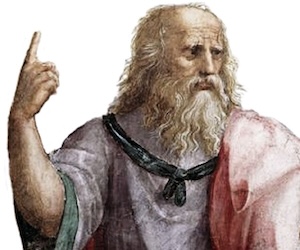
I remember when all the radical lefties were complaining that the university curriculum was too packed with tired old white men, which was true–the Western Canon is overstuffed with old guys. But I always thought the idea was to open the door to more diversity, to recognize more worthy women and brown people, and let the curriculum breathe a little more. It was less about culling Greek philosophers and to introduce more Great thinkers of different backgrounds.
Well, leave it to the conservatives to carry the idea to an extreme. Texas A&M wants to ban Plato.
Texas A&M has decided that Plato is not to be taught, a determination that suggests the problem is not ancient philosophy but what happens when people read it.
As Daily Nous reports, the university has instructed a professor not to teach Plato’s work in a “Contemporary Moral Problems” course, an act that is both historically incoherent and politically revealing. Plato is not a contemporary provocateur. He is one of the foundational figures of Western philosophy, taught because his writing invites questioning, disagreement, and analysis. Treating Plato as expendable makes clear that the concern is not ideology, but cognition in the time of Trump.
Madness.
What else bothers me is that the Texas A&M administration is overstepping their bounds. Administrators do not typically have the background to dictate the curriculum in a university department; faculty must have the autonomy to determine the content of their courses.
For example, most of the courses I teach are established topics widely recognized by all universities. I teach cell biology and genetics using standard textbooks, and further, these were courses long approved on my campus, and I’m continuing a curriculum established by my predecessors. If an administrator tried to meddle in the content of those courses, not only would I be pissed off, my colleagues would join me in protesting.
We also have to be prepared to extend our teaching to include new material — does anyone think an administrator is more up to date on current advances in biology than I am? I’ve also introduced entirely new courses, like my eco-devo course, which wasn’t just a whim on my part. I had to show my sources, and document my teaching plan to my department. I had to get approval from my division. I had to write a proposal that was presented to all the faculty of my university. Administrators had to deliver the final stamp of approval, but that’s just a formality — course content is and should be entirely a product of qualified faculty and experts.
I hope Texas A&M faculty are ready to rise up in furious protest at administrators killing Plato in a philosophy course.

Gotta love the letter sent in response: dailynous.com/2026/01/06/texas-am-bans-plato/
↓
Dear Dr. Sweet,
I hereby submit my S 2026 syllabus for PHIL 111, Contemporary Moral Issues, for mandatory censorship review.
The syllabus has not changed much since I last taught the course. I have made some minor adjustments to the module on Race and Gender Ideology and to the lecture on Sexual Morality. These topics are commonly covered in this type of course nationwide, and the material is discussed in depth in the assigned textbook (Fiala and MacKinnon, 10th edition). I also ask my students to read a few passages from Plato (Aristophanes’ myth of the split humans and Diotima’s Ladder of Love).
Please note that my course does not “advocate” any ideology; I teach students how to structure and evaluate arguments commonly raised in discussions of contemporary moral issues.
If you interpret System Rule 08.01 p. 1(b) as prohibiting these topics, I would like to remind you that the U.S. Constitution protects my course content. Texas A&M is a public institution bound by the First Amendment. The Supreme Court has noted that academic freedom is “a special concern of the First Amendment, which does not tolerate laws that cast a pall of orthodoxy over the classroom” (Keyishian v. Board of Regents, 385 U.S. 589, 603 [1967]).
Another relevant precedent is Sweezy v. New Hampshire. Here is Chief Justice Earl Warren for the majority in 1957:
Restrictions on teaching based on viewpoint discrimination are unconstitutional under nearly all circumstances. If faculty are required to seek prior administrative approval for classroom content, that raises serious concerns about “prior restraint.” Courts have repeatedly distinguished between holding faculty accountable after the fact (for alleged misconduct) and imposing advance censorship of course content. Moreover, restrictions that single out specific perspectives as more problematic than others have repeatedly been found unconstitutional (Rosenberger v. Rector and Visitors of the University of Virginia, 515 U.S. 819 [1995]; Healy v. James, 408 U.S. 169 [1972]).
In Garcetti v. Ceballos (547 U.S. 410 [2006]), the Supreme Court discusses limits on public‑employee speech. However, the Court explicitly set aside the question of whether its analysis applies to “speech related to scholarship or teaching” (id. at 425).
I also note that Texas A&M is a signatory to the 1940 Statement of Principles on Academic Freedom and Tenure, which affirms that faculty are entitled to “freedom in the classroom in discussing their subject… [and that] limitations of academic freedom because of religious or other aims of the institution should be clearly stated in writing at the time of the appointment.” I was hired in 2014, when Texas A&M was an ideologically neutral institution, and I was not informed of any ideologically motivated limitations on academic freedom of the kind recently announced.
Even if you were to conclude that my syllabus conflicts with System Rule 08.01, constitutional protections for free speech and academic freedom would control. As a public institution, Texas A&M should not enforce policies that raise serious constitutional concerns. When a system rule appears to conflict with the First Amendment, administrators should, in my opinion, proceed with caution and seek legal guidance rather than mechanically apply the rule.
I have cc’ed Interim Dean North, as the questions raised in this message may warrant evaluation at the college or system level before a final determination is made.
Respectfully,
Martin Peterson
Sue G. and Harry E. Bovay Jr. Chair
Department of Philosophy
Texas A&M University
John Morales @ 1
The implied threat of a successful lawsuit is more likely to grab their attention than any appeal to logic.
Interestingly, the Discovery Institute is going the opposite way: touting Plato! Their publicist David Klinghoffer has even written a book, published by Discovery Institute Press, about the views of their associate Richard Sternberg. Sternberg thinks that there is Platonic realm of ideal forms and that supernatural intervention from that realm explains how evolutionary change occurs and even how development of larvae happens. See this. I guess they haven’t got the word that Plato is suspect because he raises uncomfortable questions.
Birger, maybe. Alas, that mob has deep pockets.
Also, your rather recent mention in TIT is relevant* here, though for a different tertiary discipline: https://www.newsweek.com/professor-fired-over-charlie-kirk-post-wins-500000-and-gets-job-back-11324020
—
* no link there, but.
Once again, I am so glad that I no longer teach in Texas!
I was just a lowly High School teacher but I taught about Plato. Our Latin III textbook introduced the students to the Greek philosophy that Roman students would be learning from their Greek tutors.
I ran with it.
I started the lesson in the classroom, where I showed them a clip from The Matrix, when the protagonist was waking up from the machine to which he had been shackled.
Then, we moved to the computer lab, where I had the story of The Cave set up for them to read.
After reading the assignment, the students would write a paragraph or two, with their interpretations of why their teacher had just shown them part of The Matrix, followed by a reading assignment of a story written by a Greek philosopher.
It was like watching light bulbs go off above their heads in that computer lab.
We had a lively discussion back in the classroom.
Today’s powers that be in Texas would probably have me tarred and feathered for that lesson plan!
He is one of the foundational figures of Western philosophy, taught because his writing invites questioning, disagreement, and analysis. Treating Plato as expendable makes clear that the concern is not ideology, but cognition in the time of Trump.
That says it all. Can’t have any of that stuff in the bold print.
I can’t wait for the nightmare of Trump to be over. Not sure it will end even if he gets taken out of the picture somehow. Seems to be too much forward motion in the propaganda machine. Too many people with power money and influence won’t want this to reverse.
Well, those readings are from the Symposium, which is a pretty gay book, and even discusses pederasty. So yeah, that Plato has to go….
BTW, let’s not overstate the case: there’s no general ban on Plato, only to the specific units that included the Symposium reading. Which is still bloody stupid. Teaching about an issue is not the same as advocating a particular position — and any decent phil prof knows how to get the students think it through and arrive at their own position. But we can’t have that, can we?
John Morales @ 4
Alas, the links I found to more substantial articled were paywalled…
Thank you.
I do not recall what was said in the excerpts of Plato we were taught, but maybe the powers that be felt a moral panic about ancient Greeks often being into homosexual relations with younger men…
Is there any indication that they even read those passages before banning them,?
Birger re #9 (which you found and I quoted), it is unfortunate that his reprieve is not a vindication:
https://fox17.com/news/local/austin-peay-reinstates-professor-after-termination-over-insensitive-charlie-kirk-post-darren-michael
So it was ostensibly only a procedural error.
Which concedes no actual wrongdoing.
Once upon a time, the entire faculty (all departments) of my university was up in arms about something the administration did. What that was is now lost in the mists of time.
The faculty hit on quite an effective strattegy: at the end of the semester, no professor turned in their course grades. No one.
The admin could, of course, have fired any professor who didn’t submit grades, but, since that would involve firing the entire faculty of the university, and also would not get the course grades out of the professors, that seemed out.
And then the customers, all wanting to know their GPAs, and if they’d passed a prereq course so they could register for the next one, and if they’d graduated that semester, and who were paying hundreds of thousands of dollars for those grades, screamed and screamed.
But, no one can make a professor actually hand out grades.
I don’t know how it ended, but it is legend now, suggesting that it was an at least somewhat successful move.
Wikipedia – Apology (Plato)
[cartomancer is wanted]
@13: I rather like this version: https://existentialcomics.com/comic/100. My Greek Phil prof put that on a slide for class; it’s actually not a bad summary of the text ;-).
In so many ways texass keeps proving that their motto ‘the lone star state’ refers to their approval rating of 1 out of 5 stars. It’s sad, we do business with two ethical companies there.