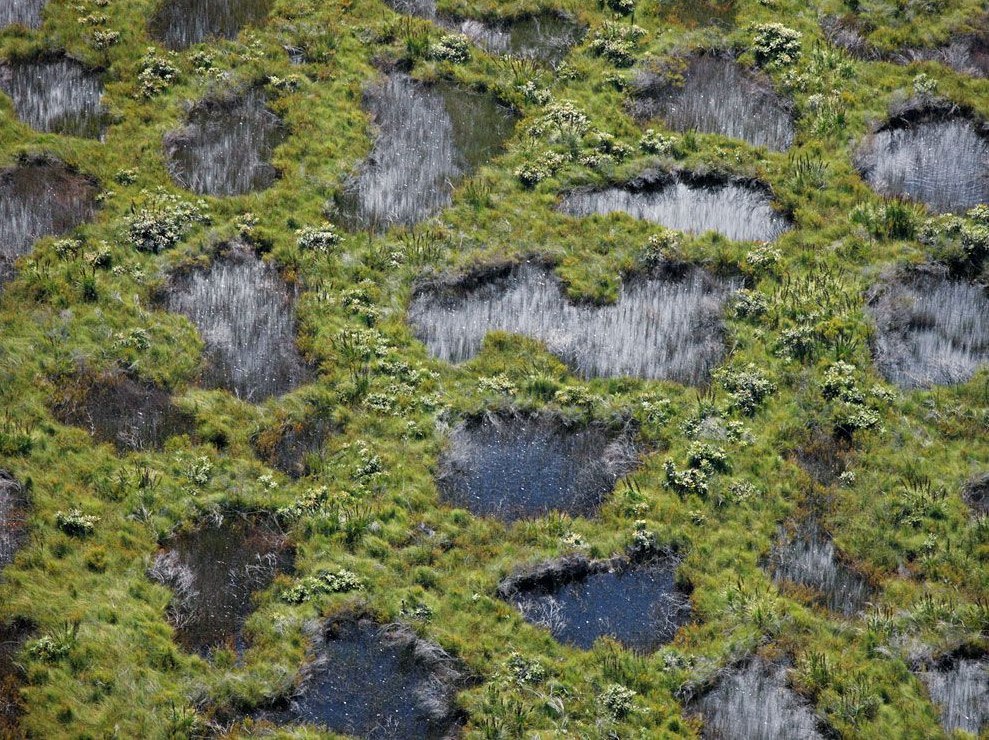
AGGGGGGH!!! Someone blew into the bong and got the weed all wet!
julietdefargesays
Why all the holes in the scum? Maybe made by gas bubbles rising from rotting vegetation? Our Southern algae-covered ponds are often solidly green, and I can attest that they do emit plenty of gas.
aspidoscelissays
julietdefarge – You may want to reconsider the scale here… this isn’t pond scum. It’s hard to be certain of the exact scale, but those “holes” are pools of water somewhere in the vicinity of 3-10 feet across.
quoderatdemonstrandumsays
Great, now all I can think about is a dram of Laphroig and it’s only 14:45 in the UK.
My review of Pharyngula is complete. You can view it at Veridican.com if you like. It’s a good one.
I intend to check back frequently here and at the Freethoughts blog. Thanks for having me.
Don Quijotesays
Aces of peat.
Antiochus Epiphanessays
I’ve been mired down all day with authoring a play on the word “Sphagnum”–I guess moss people wouldn’t get it anyway.
birgerjohanssonsays
Anoxic peat bogs can preserve organic material for thousands of years. For instance, In the Umeå museum we have the world’s oldest ski, more than 4000 years old. (I don’t know if this is more or less than the Dagorlad battlefield)
And this is why I never try to lose a body in a peat bog. Peter Stormare in “Fargo” had the right idea.
DLCsays
“if you value your life or your reason, never go onto the moors after dark!” — Stapleton, The Hound of the Baskervilles
Don Quijotesays
Re my comment at 14:
I have done a very silly thing and made a comment at the behest of an English aquaintance without understanding the significance of it first.
I should like to apologize pofusely for it and if I could, withdraw it.
Rich Woodssays
@Don Quijote #18:
I’d just be happy if you could explain it, please.
Signed,
An Englishman (and certainly a little slow today)
Don Quijotesays
@Rich Woods;
I will explain it although it embarrasses me to do so. Apparently it comes from either a joke, film or TV show (I’m not sure which) where a pirate has a parrot that says “aces of peat” instead of “pieces of eight” because it is dyslexic.
Normally, I would not write things that I’m not fairly sure I understand. I could plead that I was on the outside of a good lunch with some excellent wine and brandy but it is no excuse. The answer is, of course, stay away from the keyboard after drinking.
RFWsays
The scale of the scene seems impossible to determine from that one photo. The vegetation could be a couple of species of moss, but it could also be grayish trees poking up above a thick canopy of lesser trees, or ditto, replacing “tree” with “shrub”.
The only real clue seems to be the reflected scenery in the water, which I presume to be a backdrop of dead trees. There’s a small sphagnum bog near here where you can see dead trees killed by waterlogging of the roots. (This particular bog was probably created by the road interfering with the downhill flow of water.)
So, does anyone know for sure what the scale is?
An interesting example of self-similarity in a landscape.
Xavier Ninnissays
@Glen Davidson, Antiochus Epiphanes
No moss mas, for the love peat, no mas!
aspidoscelissays
RFW – If you’re familiar with plants, it’s not hard to have a general idea of the scale here. Mosses under magnification (and especially sphagnum) just don’t look like that. Visible vegetation is mostly grasses & sedges. The vertical lines visible in some of the pools are, AFAICT, probably not reflections of dead trees, but more likely dried stems of some emergent aquatic plant.
If you’re feeling bored, you can try to match up the particular pattern of pools with aerial photographs. Look about 4/5 of the way up the western side of Fraser Island, Australia.


I smell Tweed and Whisky!
Well, that’s better than Vegemite!
Speaking of peat. This article may interest some readers: http://www.lowtechmagazine.com/2011/09/peat-and-coal-fossil-fuels-in-pre-industrial-times.html
I should save this image for my son, Petey, to use as his profile picture.
Careful now! Or Hobbits go down to join the dead ones, and light little candles of their own.
A picture of a bog?
Think of the chilllldrrreeennnnn!
AGGGGGGH!!! Someone blew into the bong and got the weed all wet!
Why all the holes in the scum? Maybe made by gas bubbles rising from rotting vegetation? Our Southern algae-covered ponds are often solidly green, and I can attest that they do emit plenty of gas.
julietdefarge – You may want to reconsider the scale here… this isn’t pond scum. It’s hard to be certain of the exact scale, but those “holes” are pools of water somewhere in the vicinity of 3-10 feet across.
Great, now all I can think about is a dram of Laphroig and it’s only 14:45 in the UK.
Well this blog is pretty much bogged down today.
Glen Davidson
Meanwhile, up in the shoreline muskeg of Alaska…
DeathMarsh
My review of Pharyngula is complete. You can view it at Veridican.com if you like. It’s a good one.
I intend to check back frequently here and at the Freethoughts blog. Thanks for having me.
Aces of peat.
I’ve been mired down all day with authoring a play on the word “Sphagnum”–I guess moss people wouldn’t get it anyway.
Anoxic peat bogs can preserve organic material for thousands of years. For instance, In the Umeå museum we have the world’s oldest ski, more than 4000 years old. (I don’t know if this is more or less than the Dagorlad battlefield)
And this is why I never try to lose a body in a peat bog. Peter Stormare in “Fargo” had the right idea.
“if you value your life or your reason, never go onto the moors after dark!” — Stapleton, The Hound of the Baskervilles
Re my comment at 14:
I have done a very silly thing and made a comment at the behest of an English aquaintance without understanding the significance of it first.
I should like to apologize pofusely for it and if I could, withdraw it.
@Don Quijote #18:
I’d just be happy if you could explain it, please.
Signed,
An Englishman (and certainly a little slow today)
@Rich Woods;
I will explain it although it embarrasses me to do so. Apparently it comes from either a joke, film or TV show (I’m not sure which) where a pirate has a parrot that says “aces of peat” instead of “pieces of eight” because it is dyslexic.
Normally, I would not write things that I’m not fairly sure I understand. I could plead that I was on the outside of a good lunch with some excellent wine and brandy but it is no excuse. The answer is, of course, stay away from the keyboard after drinking.
The scale of the scene seems impossible to determine from that one photo. The vegetation could be a couple of species of moss, but it could also be grayish trees poking up above a thick canopy of lesser trees, or ditto, replacing “tree” with “shrub”.
The only real clue seems to be the reflected scenery in the water, which I presume to be a backdrop of dead trees. There’s a small sphagnum bog near here where you can see dead trees killed by waterlogging of the roots. (This particular bog was probably created by the road interfering with the downhill flow of water.)
So, does anyone know for sure what the scale is?
An interesting example of self-similarity in a landscape.
@Glen Davidson, Antiochus Epiphanes
No
mossmas, for the love peat, no mas!RFW – If you’re familiar with plants, it’s not hard to have a general idea of the scale here. Mosses under magnification (and especially sphagnum) just don’t look like that. Visible vegetation is mostly grasses & sedges. The vertical lines visible in some of the pools are, AFAICT, probably not reflections of dead trees, but more likely dried stems of some emergent aquatic plant.
If you’re feeling bored, you can try to match up the particular pattern of pools with aerial photographs. Look about 4/5 of the way up the western side of Fraser Island, Australia.