
Good news! The gorilla genome sequence was published in Nature last week, and adds to our body of knowledge about primate evolution. Here’s the abstract:
Gorillas are humans’ closest living relatives after chimpanzees, and are of comparable importance for the study of human origins and evolution. Here we present the assembly and analysis of a genome sequence for the western lowland gorilla, and compare the whole genomes of all extant great ape genera. We propose a synthesis of genetic and fossil evidence consistent with placing the human–chimpanzee and human–chimpanzee–gorilla speciation events at approximately 6 and 10 million years ago. In 30% of the genome, gorilla is closer to human or chimpanzee than the latter are to each other; this is rarer around coding genes, indicating pervasive selection throughout great ape evolution, and has functional consequences in gene expression. A comparison of protein coding genes reveals approximately 500 genes showing accelerated evolution on each of the gorilla, human and chimpanzee lineages, and evidence for parallel acceleration, particularly of genes involved in hearing. We also compare the western and eastern gorilla species, estimating an average sequence divergence time 1.75 million years ago, but with evidence for more recent genetic exchange and a population bottleneck in the eastern species. The use of the genome sequence in these and future analyses will promote a deeper understanding of great ape biology and evolution.
I’ve highlighted one phrase in that abstract because, surprise surprise, creationists read the paper and that was the only thing they saw, and in either dumb incomprehension or malicious distortion, took an article titled “Insights into hominid evolution from the gorilla genome sequence” and twisted it into a bumbling mess of lies titled “Gorilla Genome Is Bad News for Evolution”. They treat a phenomenon called Incomplete Lineage Sorting (ILS) as an obstacle to evolution rather than an expected outcome.
This problem is related to a biological paradigm called independent lineage sorting. To illustrate this concept among humans and primates, some segments of human DNA seem more related to gorilla DNA than chimpanzee DNA, and vice versa. This well-established fact produces different evolutionary trees for humans with various primates, depending on the DNA sequence being analyzed.
In a significant number of cases, evolutionary trees based on DNA sequences show that humans are more closely related to gorillas or orangutans than chimpanzees—again, all depending on which DNA fragment is used for the analysis. The overall outcome is that no clear path of common ancestry between humans and various primates exists, so no coherent model of primate evolution can be achieved.
The recent release of the gorilla genome spectacularly highlights this evolutionary quandary. According to the Nature study, “in 30% of the genome, gorilla is closer to human or chimpanzee than the latter are to each other.”
When you compare the genomic sequences of three related species, such as the human, chimp, and gorilla, you’ll typically find from an average that a pattern of relatedness is revealed: humans and chimps are closer to each other than they are to gorillas, indicating a more recent divergence between humans and chimps than between humans and gorillas. However, that’s an average result: if you compare them base by base, you’ll find genes and regions of the chromosomes in which the gorilla sequence is more similar to the human sequence than to the chimpanzee sequence; if you looked at only that gene, you’d conclude that humans and gorillas were closer cousins, and chimpanzees were more distant.
Is ILS a problem? It complicates the analysis of sequences for sure (although it also can be used as a probe to look at evolution). But it’s not a problem that calls evolution into question; to the contrary, it’s an expected phenomenon.
Here’s why. This diagram illustrates the simplistic, naïve expectation you might have.
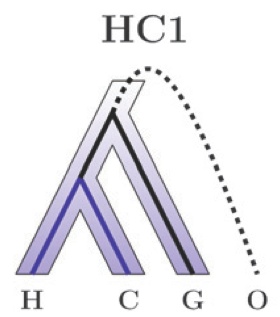
The outline of the tree illustrates the average pattern of sequence similarity, with the conclusion that humans (H) and chimpanzees (C) diverged more recently than humans/chimps and gorillas (G), which diverged more recently than humans/chimps/gorillas and orangutans (O). The solid line inside the outline illustrates the history of a single gene, drawn in black to represent the ancestral state, and then drawn in blue at the time humans and chimps diverged.
This is a gene that acquired its unique differences in the two lineages at the time of the human-chimpanzee split. It fits perfectly with the average pattern.
But just ask yourself: how likely is that? There are tens of thousands of genes in each of these species. Do you really think all the differences popped into existence simultaneously, at one instant when two populations of our last common ancestor discretely and completely separated? Of course not: you’d have to be a creationist to believe in something that stupid.
Here’s another possibility. Speciation wasn’t instantaneous, but a matter of multiple populations existing in parallel, with changes in genes appearing in different subsets at different times, spread out over long periods of time. So sometimes a mutation unique to one extant lineage appeared long before the split, and was just sorted at the time of separation into one lineage or the other.
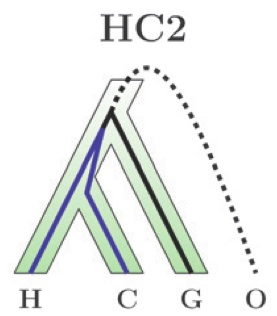
In this case, comparison of the gene in question would give the same qualitative answer — humans and chimps are most closely related — but a different quantitative difference in the time of divergence. But as you can see, it requires nothing weird or unexplainable or contradictory to evolutionary theory: you just have to appreciate the population nature of evolution.
We can go further: different forms of the genes can be sorted into different lineages entirely by chance.

In these cases, we have two different forms of a gene that arose in ancestral population, ancestral to humans, chimps, and gorillas. By drift, one form was lost in the gorilla lineage, but both forms continue to be found in the ancestral manpanzee population; at the time of human/chimp divergence, these gene forms were sorted into different lineages. By chance, these will show either a closer relationship between humans and gorillas or chimpanzees and gorillas.
And the likelihood of HC2, HG, and CG above are equally probable!
So the creationist argument against evolution on the basis of incomplete lineage sorting is very, very silly. The only way you would fail to see ILS is if every genetic difference between two species emerged simultaneously, in lockstep, in one grand swoop. That is, the observation of ILS contradicts creationism, not evolution.
The authors of the Nature paper were well aware of this, and even illustrated it in their first figure.

Phylogeny of the great ape family, showing the speciation of human (H), chimpanzee (C), gorilla (G) and orang-utan (O). Horizontal lines indicate speciation times within the hominine subfamily and the sequence divergence time between human and orang-utan. Interior grey lines illustrate an example of incomplete lineage sorting at a particular genetic locus—in this case (((C, G), H), O) rather than (((H, C), G), O). Below are mean nucleotide divergences between human and the other great apes from the EPO alignment.
We can measure the average genetic distance between the species (the percentages at the bottom of the figure), but we can still see individual genes (the gray line) that branched at different points in their history. This is simply not a problem for evolutionary theory; once again, the creationists rely on their proponents having a foolishly cartoonish version of evolution in their heads in order to raise a false objection.
Scally A, Dutheil JY, Hillier LW et al. (2012) Insights into hominid evolution from the gorilla genome sequence. Nature 483:169–175.
Dutheil JY, Ganapathy G, Hobolth A, Mailund T, Uyenoyama MK, Schierup MH (2009) Ancestral Population Genomics: The Coalescent Hidden Markov Model Approach. Genetics 183: 259–274.
(Also on Sb)

That’s the advantage of not understanding biology at all well–you can claim again and again that the fact that evolution is complex is in fact contrary to (your simple and idiotic misconception of) evolution. And since the prevention of education and learning is their principal goal, they have a bunch of ignorant clods who will believe their every dimwitted “debunking” of evolution.
Ignorance is bliss, for those who have ever only preferred it.
Meanwhile, ID explains it perfectly, as a meaningless whim of the Designer.
Glen Davidson
I’m still kind of surprised that creationists concede that DNA is a really really real thing.
Lots of them don’t.
Oh, they do in the sense that DNA uniquely specifies a human being, like fingerprints, but the idea that genes are actually responsible for things like illness or behaviour or thought is totally alien. No, it’s the hand of God that determines whether you’ll develop heart disease, or schizophrenia, or the ability to recognise faces. No mere matter is responsible for fate – it’s a thing of spirit, not flesh.
That implies that in the other 70%; the gorilla genome is further away than human and chimpanzee genomes are to each other. That confirms the evolutionary model. Creationists never hesitate to jump to the wrong conclusion.
I was looking at the various diagrams and it dawned on me that H and C could be transposed without changing the genetic lineages. Now PZ’s argument makes sense to me.
Par for the creationist course. At least they’re not still asking why we don’t have tails.
ok – so I read the post at Creation Research and this is what I’d noticed:
“It is noteworthy that both the recent gorilla paper and Ebersberger’s report utilize highly filtered data in which repetitive DNA (which comprises a significant portion of the genome) is masked and omitted…”
And then the next paragraph:
“Therefore, the data are always carefully prepared and selected for optimal tree development and should be full of evolution-favorable DNA sequences.”
The author is an idiot.
Does anyone actually care to know why we ignore large tracts of repetitive sequence elements in comparative genomics?
Let’s look at the methods from the original paper:
We constructed a hybrid de novo assembly combining 5.4 Gbp of Illumina paired reads.
So – this is, singly, the reason why you can’t compare repetitive sequence elements. The reads are short, at most 120 bp (this data is supplemental Table 10, but I can’t seem to find it! I’d spend more time looking but I have to work on my own paper today). Even with paired-end reads, you’re getting at most 240 bp, with maybe a distance of, what, at most 200 bp in between the pairs. If you have tandem repetitive elements, or the elements are greater than 500 bp, you cannot place them (especially not with Maq; I don’t know why the authors used Maq and not BWA – Rick Durbin is the PI and it was Heng Li out of his lab who made both aligners; I don’t know what the reasoning was behind Maq but it’s not a choice I’d have made).
Anyway, simply by virtue of a lack of ability to place these elements effectively, there’s actually very little you can do with them. They did go back and do capillary sequencing, but it was not driven by the need to get the repetitive sequence element “just right” but rather for the more important contig assembly.
The dude’s got a PhD from Clemson in genetics but I wonder if this person has ever really *looked* at NGS or read NGS papers before. This is… confusing.
I guess they’re so hung up on their belief that the bible bogey created Adam & Eve that they just can’t get their heads around the fact that our ancestors got it on with gorillas as well as with chimpanzees, before speciation finally put a stop to that miscegenation
What about the DNA sequencing of bonobos and the lesser apes? (Gibbons, I am sure, are less than impressed by the term.) Is that progressing as well?
I’d have to say, I’m more interested in the results than the myriad ways to misinterpret it. It’s a given that data and analyses will not convince the creationists that they have been lied to, nor that they should stop lying.
Well I’ll be a monkey’s uncle! Great article, very informative.
Oh, my …
After reading casecob‘s post, I went to the creationist site to see what was there. I think I need to remove my brain and wash it to get rid of the ick.
Examploids:
And the “gyre” thing.
Every day, science discovers something new, wonderful, and useful.
And every day, the creationists have to make up new lies about it.
Creationists are just baggage being dragged along behind our society and keeping it back.
I vote for “dumb incomprehension,” although I admit creationists are also fond of perpetrating “malicious distortion.”
“Teh sciences, dey so hard!”.
Well, it is a bit hard yes. You sort of need to use your brain. Painful as that may be…
Teh stupid. It burns.
I think the problem is that not enough people are pointing and laughing. More of that should be done. Much more.
That’s a charitable assumption.
It’s a floorwax and a dessert topping.
You’re giving them way too much credit.
Is there not also the possibility that a new mutation could arise in (say) the chimpanzee after the split with humans, so again human and gorilla would be closer. I though that was the scenario PZ was going to respond with. Or am I missing something here?
It… it… looks like they want to be stupid. I think they see it as a kind of sacrifice for their god. And such blatant things. Their criticism is the equivalent to going to an classical concert and publicly mocking the archers in the first row for never managing to shoot a single arrow. As someone who spends every day trying to understand some things better and more consistently, it is incomprehensible to me what goes on in their heads.
Identical twins have identical DNA, but they are different people.
Fingerprints are also not unique – though in the case of fingerprints, the risk for confused identity is usually with total strangers.
I wouldn’t rule out malicious incomprehension.
KG: That happens, but it wouldn’t show up as ILS. In ILS, it’s not a one-off trait you see in one lineage; it appears in two lineages.
PZ,
Thanks, I think I get it now – I was ignoring the role of the out-group.
Nice post, but it is called incomplete lineage sorting.
In case any creationist says that this is an after-the-fact rationalization, this issue was discussed in a 2001 paper that cited an equation for use in this sort of situation from a 1991 paper.
“Genomic Divergences between Humans and Other Hominoids and the Effective Population Size of the Common Ancestor of Humans and Chimpanzees” Am J Hum Genet. 2001 February; 68(2): 444–456.
http://www.ncbi.nlm.nih.gov/pmc/articles/PMC1235277/?tool=pubmed
Search for “When the 53 autosomal segments are considered”.
Why “manpanzee”? I thought it was “humanzee”.
Based on ICR’s logic blood types would be a problem for evolution, as some humans would appear more related to chimps than to other humans.
Thanks PZ – your students are lucky.
As to Creationiots
They are idiots, or they proclaim things that suggest they are.
I really cannot be more more subtle about it.
Not because I am mean – not because I am not a gentleman – but because they are idiots, or proclaim things that suggest they are!!
The stupid hurts.
@WhiteHatLurker
I’m not up to date on the sequencing of bonobo genomes but in this case it would seem that the graphs are only to the resolution of genus. This makes sense when you think about the four different species of gorilla (gorilla) and the three species of orangutan (pongo). Then chimp ceases to refer to the common chimpanzee and instead the pan genus, thus being inclusive of bonobos.
@andrewriding
Thanks! It was mostly idle curiosity, not directly related to the topic of the gorilla sequencing vs pan/homo DNA.
Since we (now) only have one Homo species, I’d like to see how the more closely related of our closer kin match with each other. (Chimpanzee/bonobo)
… and, I think gibbon are cool.
Hm, it is like considering only the word "night" and, having noticed that "noche" and "ночь" sound much like the same while "noite" not so, then decide that this fact discredits the “theory” that Portuguese and Spanish stemmed from the same ancestor language more recently than any of them from Russian.
(Hm, even worse — considering how "noite" is pronounced on both sides of the Atlantic, that would bag Brazilian Portuguese with Russian and Spanish, and leave European Portuguese as the outside group!)
(Hm #2 — okay this is more like convergent evolution, not ILS, as this word did sound identically in Latin, "nox", just similar phonological phenomena ocurred seperately — but still, the creotards’ reaction would be comparable.)
a little off topic, but does anyone know when the genome sequences will be available on ncbi? I could really use them in a phylogenetic tree Im making…
Why do you sometimes see the claim that Orangutans are, genetically and/or biologically the closest other Great Ape to humans? (A school of thought? Dated?)
crys,
According to the paper, the data is already available at the NCBI trace archive.
From the supplemental, it looks to me like it’s here:
ftp://ftp.ncbi.nih.gov/pub/TraceDB/gorilla_gorilla_gorilla/
But there are other gorilla accessions, so you might want to check it out.
It’s amazing that even an ICR “researcher” could write the concluding sentence of Tomkins’ article with a straight face:
I like how the creationist article concludes with the idea that all of this proves the Genesis account of man being created in god’s image. I’d certainly like to see their DNA sample from god that proves this.
Incomplete lineage sorting!!!
I know creationists can’t read big words, but what happened to you, PZ?
Well, yeah, but it’s behind a paywall, and creationists don’t have institutional access.
Those are considered subspecies in every of the few sources I’ve seen, with only the western and the eastern gorilla being considered species. The mountain gorilla is a subspecies of the eastern one.
I thought two (Borneo and Sumatra)? How much is known about the extinct mainland orangutans?
Let’s say both.
Just reading that snippet, my initial thought was that the 30% of the gorilla’s genome was just undergoing a lot of change, which in no way undermines how evolution works.
I have black hair, and more than half of humans share similar hair color to gorillas than to each other. That doesn’t mean that I and other African and Asian people have more in common with a gorilla than a blonde/brunette/red-headed person.
Creationist thinking boggles my mind. How could they misunderstand so hard?
You do however probably have more in common with a Neanderthal than them though.
Ing: Don’t you mean less, not more? Blondes, brunettes and redheads, being (usually) of European ancestry, will tend to have more Neanderthal DNA than Africans (if said Africans have no European or Asian ancestry). Or did I misread you?