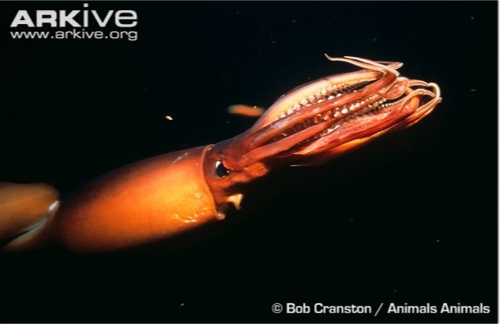
As part of our ongoing campaign here to make you doublecheck to see which one of the bloggers here wrote a post, I offer this story about a mass stranding of Humboldt squid, Dosidicus gigas, near Santa Cruz, California. Hundreds of the poor things have washed up on the beaches around Santa Cruz in the last few days:
Humboldt squid have been seen in much greater than usual numbers in Monterey Bay, where the stranding took place, since 2000 or so. Before that there were more commonly associated with nearby semitropical bodies of water like the Sea of Cortez. Some have conjectured that warming ocean temperatures have encourage the giant squid to move northward.
The Sea of Cortez lies atop a geological rift valley at the north end of the East Pacific Rise, and as a result of the tectonic rifting, which is peeling the Baja Peninsula and some of Southern California away from the North American continent, the Sea reaches depths of about 3,000 meters, or close to 10,000 feet.
In other words, the heating up of a deep rift is thought to have played a role in an invasion of squid. #ftbullies
Santa Cruz is a pretty strongly feminist town, but perhaps the squid were aiming for the boyzone tech communities of Silicon Valley, just across the mountains.
More prosaically, it’s possible something similar to the well-known seasonal red tide bloom might have poisoned the squid. Apparently some of the dead squid have tested positive for domoic acid, a bioaccumulative algal toxin.
Really, the best thing about this story is the San Jose Mercury News’ description of the Humboldt squid:
The dark red squid beached during the weekend are 2 to 3 feet long with enormous eyes and long tentacles extending from their mouth. Their predators include blue sharks, sperm whales and Risso’s dolphins. They eat 50 to 60 different species of fish, can change their size from generation to generation to cope with varying food supplies, and can reproduce in huge numbers. The larger females produce translucent egg sacks the size of a small car containing 20 million to 30 million eggs.