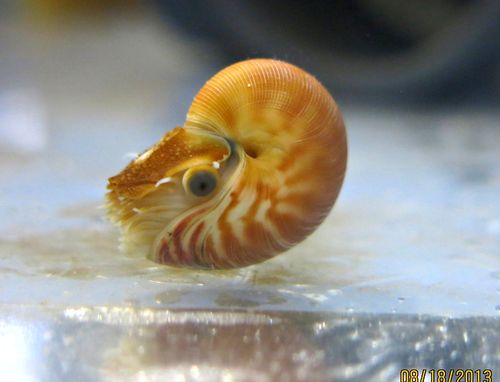
There’s more! A whole series of photos of nautilus hatching from the Birch Aquarium at Scripps!

There’s more! A whole series of photos of nautilus hatching from the Birch Aquarium at Scripps!

Tzortzis has learned that claiming miraculous knowledge in the Qu’ran has “become an intellectual embarrassment for Muslim apologists”. Progress!
Regrettably, the scientific miracles narrative has become an intellectual embarrassment for Muslim apologists, including myself. A few years ago I took some activists to Ireland to engage with the audience and speakers at the World Atheist Convention. Throughout the convention we had a stall outside the venue and as a result positively engaged with hundreds of atheists, including the popular atheist academics Professor P. Z. Myers and Professor Richard Dawkins. During our impromptu conversation with Professor Myers we ended up talking about God’s existence and the Divine nature of the Qur’ān. The topic of embryology came up, and Professor Myers being an expert in the field challenged our narrative. He claimed that the Qur’ān did not predate modern scientific conclusions in the field. As a result of posting the video[8] of the engagement on-line we faced a huge intellectual backlash. We received innumerable amounts of emails by Muslims and non-Muslims. The Muslims were confused and had doubts, and the non-Muslims were bemused with the whole approach. Consequently, I decided to compile and write an extensive piece on the Qur’ān and embryology, with the intention to respond to popular and academic contentions.[9] During the process of writing I relied on students and scholars of Islamic thought to verify references and to provide feedback in areas where I had to rely on secondary and tertiary sources. Unfortunately they were not thorough and they seemed to have also relied on trusting other Muslim apologists. When the paper was published it was placed under a microscope by atheist activists.[10] Although they misrepresented some of the points, they raised some significant contentions. I have since removed the paper from my website. In retrospect if this never happened, I probably wouldn’t be writing this essay now. It is all a learning curve and an important part of developing intellectual integrity.
Of course, he now has a new strategy:
The Qur’ān allows multiple and multi-level meanings.
Our understanding of natural phenomena and science changes and improves with time.
The Qur’ān is not inaccurate or wrong.
In the case of any irreconcilable difference between a Qur’ānic assertion and a scientific one, the following must be done:
Find meanings within the verse to correlate with the scientific conclusion.
If no words can match the scientific conclusion then science is to be improved.
Find a non-scientific meaning. The verse itself may be pertaining to non-physical things, such as the unseen, spiritual or existential realities.
#1 and #2 are correct. #3 is assuming what they want to demonstrate. #4 is an exercise in rationalization, and cannot generate new knowledge; it’s an admission that science will drive progress and understanding, while the religious apologists will follow along behind and try to steal the credit.

OK, that’s enough. The proprietor of the Monday Metazoan keeps lurching over to big furries — where are my clackety arachnids? My slimy molluscs? My exotic weird phyla? It’s always these mammals, like just now this poor, tiny newsphoto of …AWWW, IT’S A BABY RHINO…


The faculty were melting down. It’s going to be a busy week — I have syllabi to finalize and multiple meetings to attend and cranky fish to fuss over (Morris has toxic water everywhere, full of minerals, and we’re dependent on the RO system to clean up the crap…and they’re shutting it down and flushing it with chlorine this week. What? Yikes!). And then I have other things I’m stuck with.
Tomorrow evening at 7:30 I’m doing a book event on KFAI radio. There goes my afternoon and most of the evening.
This weekend we have our Bridge to Biology program — a huge number of our incoming first year students in biology get taken out to the Lake Itasca Field Station, where we try to lose them in snipe hunts get them enthused about science and biology. I’ll be out there with a microscope and cameras and embryos (I hope, if the RO system doesn’t poison everything).
Oh, yeah, I’m preparing all my class stuff. I’m teaching cell biology and cancer biology this term. Any students reading this? You can get a jump on everything by reading the first couple of chapters of Life by Sadava et al., we shall be marching through the first third of this book in the cell biology class. In cancer biology, we’re going to focus on The Emperor of All Maladies by Mukherjee for the first few weeks, so read that whole thing now. Then once you all know what horrible things cancer does to people, we’ll dive into the mechanisms. You’re fortunate, too: last time I taught this, we used Weinberg’s Cancer Biology text, which is really aimed more at graduate level work; this time around we’re using Hesketh’s Introduction to Cancer Biology. The first two words in the title will make it a less daunting exploration, I hope.

Tell them to go read this article summarizing the case for vaccinations.
How do we know that scientists and doctors are right?
I’ve been asked about this quite a bit lately. One person asked me “why aren’t we getting peered reviewed research from other points of view?” The reason is quite simple: there isn’t any.

Ray Comfort has been doing a great job of stirring up his minions on twitter, who, without exception, seem to be as ignorant as he is. I already mentioned one, Republican Mom, who combines dismal stupidity with chipper smugness, but there are others. And they seem to be going after everyone with a reputation for defending evolution. I’m not feeling besieged, though: it’s more like a swarm of fluff.
They’re also going after Carl Zimmer (and a bunch of the names he mentions are familiar — there aren’t that many of them, but they’re all really noisy and each one is peppering lots of people with the stupid). He’s now written a very nice post explaining their error.
Here’s what creationists like Comfort always do to deny evolution: they demand an example of a new feature evolution, of evolution in action. Then we give them one (we have many) in some species of bacterium or fish or whatever. They ignore it (seriously, they promptly wave it away and pretend that what we’ve told them isn’t what they asked for), and immediately turn to all the other traits of the organism that are still unchanged, and announce, “Well, it’s still a bacterium.”
It’s infuriating. Here’s a single-celled organism that evolved two tails; “it’s still a single-celled organism.” Here’s a fish that evolved armor plating; “it’s still a fish.” Here’s a fruit fly that evolved a whole new mating signal; “it’s still a fruit fly.” Notice what’s common in every case: the conscious denial of what you just told them. It’s not just ignorance, it’s willful ignorance.
There’s no way around this game. They demand something that evolution does not predict, and claim its absence falsifies evolution. If I had an experiment in which a population of single-celled bacteria evolved into a multi-cellular mouse while recorded by a video camera (which would falsify all of our evolutionary theories, by the way), they’d ignore the miracle and say, “Well, they’re still both made of cells, aren’t they? It’s still cells.”
Once upon a time, a population of apes evolved an upright, bipedal stance — but they still had hairy ape bodies and binocular vision and grasping hands — they were still apes, but they were on the long road to us. And we are still apes with a host of shared attributes with chimps and gorillas and orangutans. When you see Ray Comfort and he denies that he is an ape, point out that by his “they’re still just X” argument, he has scapulae and hair follicles and a liver and jaws and an autonomic nervous system just like a chimp, and if he’s going to deny the evolved differences, he’s still just a chimpanzee. He’s still got a spine, just like a fish, so he’s still just a fish. And he’s bilaterally symmetric, just like a worm, so he’s still just a worm.

The name “Flamboyant Cuttlefish” is perfect, and if you watch the video you’ll see even better why they deserve to strut.

Hmm, maybe I should retroactively get my kids’ names changed to “Flamboyant Myers”. Or at least their middle names. It’s got to have an effect.

Something that really, really annoys me is reading a paper discussing a rich and complex data set in which the authors squink their eyes tightly and use statistics to zoom in and stare fixedly at one parameter. It happens all the time. It’s as if some scientists think it’s a triumph to reduce a phenomenon to one single simple cause, rather than appreciating the diversity of inputs.
The latest example is a study pegging yet another medical procedure as the cause for autism, in this case, early induction of labor and augmented delivery. Autism is probably a perfect target for these kinds of silly approaches; it almost certainly has a wide range of contributory causes, and it’s always a mystery to the parents of affected children, who look for answers. It’s the vaccines, they say. No, it’s the drugs we took during pregnancy. No, it’s the doctors who did funny business in the delivery room.
Fortunately, we’ve got Emily Willingham to actually look at the forest.
When she looks at the data, she finds that the authors are right, that there’s a correlation: if a mother gets both induction and augmentation, there’s a 27% increase in the chance that the child will later be identified as autistic.
What they don’t tell you is that the same data set shows that having a college-educated mother increases the odds of autism by 30-33%. And that smoking during pregnancy decreases the chance of an autism diagnosis by 14%.
Wait, stop! If you’re pregnant, don’t take these numbers as an indication that you need to start watching more Glenn Beck to make yourself stupider, and that you need to take up a tobacco habit. You’re looking at the tree again and ignoring the forest. What these correlations suggest is that we should be looking into some property of the population that unites them — that each one in itself is not necessarily causal, but that they are common symptoms of the true link. We need to see the big picture to puzzle out the answer.
And sometimes interpreting the phenomenology of a single parameter analysis would lead to a bad result: I can pretty much guarantee you that being a heavy smoker during pregnancy is much worse for the fetus than non-smoking.
Willingham does see the bigger picture.
This study didn’t show that induction or augmentation during childbirth substantially increases the risk for autism, although it hints at a greater influence of socioeconomic status and by implication, healthcare access. If anything, based on earlier literature, it adds a slight if only mathematical confirmation of the perception that births involving autistic children can be associated with more complications, such as the presence of meconium, gestational diabetes, and fetal distress, than births involving non-autistic children. And that points to induction and augmentation as useful in these situations, not as problematic, and certainly does not affirm them as a risk.
Oh, look, it’s practically a jungle!

OK, that’s not saying much. Lots smarter. Here she takes apart his stupid video.

I’m sure no one would be concerned by this at all: certain Xerox machines in certain scanning modes make a marvelously specific compression error. A number 6 might become an 8, or a 1 is turned into a 2. Photocopy a page with a column of numbers, and who knows what you might end up with.

This could not possibly be a problem for anyone, could it? At least it doesn’t convert 4,540,000,000 into 6,000. That would be worse.
(via Making Light)
