
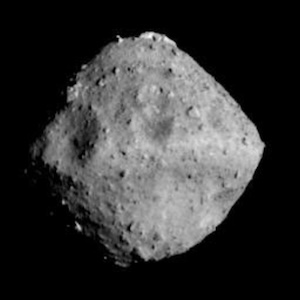
Samples have been analyzed from two carbonaceous chondrites in space, Ryugu and Bennu, and they’ve been found to contain common organic molecules, specifically, the building blocks of DNA. That’s cool, not particularly surprising, and it’s good stuff to know…but then we get all these pop science articles speculating that life came from space. No, no, no — it tells us that these organic molecules are universal, that they can be assembled by all kinds of physical/chemical processes, and that nucleotides (for instance) do not require synthesis by living organisms. Chemistry is everywhere, but biology isn’t. Unfortunately, these kinds of observations always provoke people to babble about life, or at least the ingredients for life, falling from space. I don’t buy it.
Scientists have discovered all five nucleobases—the fundamental components of DNA and RNA—in pristine samples from the asteroid Ryugu, according to a study published on Monday in Nature Astronomy. The finding strengthens the case that the ingredients for life are abundant in the solar system and may have found their way to Earth from space, according to a study published on Monday in Nature Astronomy.
OK, yes, it’s quite likely that some organic molecules fell to Earth from outer space. But please, think a little bit quantitatively. There are clouds of organic molecules in space, but they are incredibly diffuse and poorly concentrated. There are asteroids that are made of condensed lumps of carbon with richer concentrations of these molecules, but they are drifting in the vast empty volumes of space, and only occasionally falling to Earth, adding droplets of nucleotides to the Earth’s oceans.
Meanwhile, the Earth itself is a gigantic crucible containing 1,386,000,000 cubic kilometers of water, with a complex pattern of heating and cooling, and immeasurable interactions with minerals and other organic molecules. It is a far weightier contributor to biochemistry than a thin, almost undetectable, vapor of scattered molecules in space. But these stories always get excited about the thin vapor rather than the fact that Earth itself is a rich churning cauldron of geochemistry that is going to be far more responsible for the wealth of biologically relevant chemistry we find ourselves swimming in.
This is not to discount how interesting these asteroid analyses are. They’re telling us that natural, unguided mechanisms can produce the biomolecules that make up life. The asteroids, though, are not likely to be where they originated here, on planet Earth, which is already a great place for building them.
The article says something else that irritated me.
Now, following the discovery of all five nucleobases in the Bennu pebbles, Koga and his colleagues have found the complete set in Ryugu. The findings lend weight to the so-called “RNA world” model of abiogenesis. In this hypothesis, early life on Earth depended solely on RNA as a self-replicating molecule, laying the biological groundwork for later, more complicated systems that involved DNA and protein-based organisms. The extraterrestrial samples from Ryugu and Bennu provide evidence that at least some of the nucleobases that made up these early lifeforms came from outer space.
No, this observation says nothing relevant to the RNA World hypothesis. It neither confirms nor refutes it. Nucleobases exist, we’ve known that for a long, long time, but I don’t believe that the earliest life on Earth depended solely on RNA, and finding nucleobases in a lifeless rock is not evidence that life was solely spawned from those few components. Were there no other molecules in them? No sugars, no amino acids, no polycyclic aromatic hydrocarbons, no carboxylic acids? There are a great many complex organic molecules found bubbling in the soup of our oceans, aren’t they a more likely source of life than a dead lump that’s been floating in space for billions of years?
Sorry. It’s a good bit of science, but I get cranky when I read these ill-informed unwarranted speculations that ignore more substantial science.

‘five nucleobases’ – I thought there were only four. I didn’t know about uracil. I must have skipped that day in organic chemistry class …. and biology glass … and probably a few others.
DNA has 4. RNA has 4, but replaces thymine with uracil. So, 5.
Now what is possible is that perhaps the giant celestial body that smacked into the earth to create the moon (which is commonly called “Theia”) was the sole harbour of the biochemical components that make life possible. Now you might argue that the elements in all celestial bodies should be approximately equal if they formed at about the same place in the protoplanetary disk. But it is quite possible for a celestial body to travel outward or inward in that disk, at least before an equilibrium is found. Therefore Theia might have brought some components, and might have simultaneously been responsible for some of the debree that makes up the asteroid belt.
Similarly, the idea that life originated somewhere, then got kicked off the planet it was on by a huge impact, spent millions of years in space, and then impacted a planet and proceeded to prosper greatly, is so ridiculous that it is always surprising to see it trotted out again and again.
So space-seeded abiogenesis was homeopathic. /s
But, PZ their conclusions sound so sciency! The moon is made of green cheese and fragments fell to earth. so, of course, life came to earth from outer space,
Seriously, I do appreciate your imparting of biological knowledge to enlighten us (especially those of us who are not biologists).
“The Andromeda Strain” was not a documentary?
Well, I never.
Perhaps Theia was also the source of the hydrocarbons/carbohydrates (same thing) that rained down upon the ancient Israelites as manna? It could have picked them up as it swung by Venus and Jupiter.
Honestly, one of the few things you could get from this sort of thing is, well…
A lot of organic molecules are explicitly left-handed or right-handed, and can exist in either form. Biological processes will generally only produce one of those forms because all the biological processes are already of a given handedness; non-biological processes can produce either or both forms. (Look up ‘racemic acid’, essentially a non-biological form of tartaric acid; study of this stuff dates back to Pasteur.)
It’s an open question as to whether or not life on other worlds has an even chance of being in either handedness. There are some quantum physics reasons to suggest that one particular handedness might actually be preferred, but it’s far from certain. What is certain is that once any sort of self-replication takes off, whichever handedness is used by those biological molecules will take over rapidly.
Where this ties into ‘life from space’ is that the presence of asymmetric biological molecules arriving from space could influence which handedness life takes up wherever they land. So if this is a significant thing, you’d expect life to at least tend to form clusters of handedness, where all worlds with ‘life’ in a region would be using the same subset of isomers, and ‘mirror life’ wouldn’t be found within that region, but might form competing clusters.
Dibwys @4, quite right. I don’t see “life” surviving after floating around in the vicious bath of high-energy radiation that is space for a million years.
jenorafeuer @9, there may be some quantum physics tending to show that one handedness is preferred. But it is overwhelmingly more likely that some process of assymetric catalysis got going on earth, over-producing one enantiomer at random, which then became the standard. In other words, just chance.
Almost anything can become part of catalytic systems and affect catalytic processes: salts, metal ions, clay, the surface of rocks, the surface of ice, the presence of other organic molecules, anything that might be on primordial earth. They don’t have to be very selective or very fast or very effective catalysts, just ones that produce even slight excesses of one enantiomer faster than they do the other enantiomer.
Humans, of course, can do assymetric catalysis very well.
@pzmyers I so saw that coming. As far as I know, it may though sometimes even be good to have an open mind regarding new theories…
If you have a non-polemical argument why my theory should be absurd, please do share it.
By the way, if your posting is construed to mean that you claim that the hydrocarbons specific to life exist throughout the solar system (which is so far unproven), then let me respond that hydrocarbons are very diverse, with different physical properties (in particular density) that could lead to different locations where these materials would have been in the proto-planetary disk.
I believe that a possible way of sorting this out could be to look for the abundance of hydrocarbons on different planets. Heavy hydrocarbons ought to be insufficiently unstable in order to be evaporated by solar winds, so that an unusually high concentration of hydrocarbons on earth (as opposed to other planets) would lend a certain amount of credence to my theory, whereas an even distribution would perhaps support your claim.
Of course, the earth could as well have been right in the center where the hydrocarbons are, but the point is that I wanted to argue that the “life from space” theory is NOT absurd in all its variations.
[drdrdrdrdralhazeneuler — PZ is mockingly alluding to Velikovsky, who famously conflated hydrocarbons with carbohydrates (Worlds in Collision)]
By the way, due to the late hour I’ve made a mistake: In post #13, when I wrote “hydrocarbons”, I meant “hydrocarbons essential to life”.
And not even that is true, because it appears as though in your language, hydrocarbons can’t have any functional groups. I should really have written “organic molecules essential to life”.
IANAGeologist, but I suspect that, if our planet was a heavily bombarded ball of lava for its first n00,000,000 years, possibly the nucleobases from which we all have descended did fall from the sky, what with the nucleobases of the planet-forming materials having been cooked down to their elements.
Likewise for the dihydrogen monoxide in all of our cells and sippy cups. Every atom on the planet formerly drifted through space for megamillennia. Eventually each atom here will return to the same condition, with no memory of the brief interlude spent spinning around on/in a warm ball ~12,756 kilometers in diameter (though a few may have skipped places across the periodic table).
And as to the Velikovsky reference, I am too tired now to judge whether Velikovsky was motivated by greed, or whether he simply had too much respect for religious sources.
What I can say is that I do not see why it should be wrong/undesirable/discouraged to propose a hypothesis that appears not to be contradictory to the present state of knowledge in any obvious way. To the contrary, I do believe many scientific theories were at first mere speculation, and then the evidence came in to confirm them.
Well, actually we know there is life out in space – because we sent it there!
There’s life in the Artemis II Integrity craft, life in the International Space Station and I’m pretty sure China has some of their taikonauts aboard one of their space stations too.
By the way, since you mention water on earth, there appears to be a theory saying that water itself was delivered to the earth via icy planetesimals or even (you may have feared it) the collision with Theia (https://en.wikipedia.org/wiki/Origin_of_water_on_Earth#Extraplanetary_sources).
And it’s of course precisely the mechanism and reasons that I described and that you’ve doubted, with organic molecules replaced by water ice. And of course Theia might really have migrated from the outer solar system.
I am beginning to sense enormous quantities of win here.
drdr,
I do. It’s pure speculation, for starters.
And it is otiose since the hypothesis adds no explanatory power and is not required by any observation.
Worse, it creates a new explanatory debt because now one needs to account for why endogenous synthesis is insufficiently explanatory.
Also, though life needs those molecules does not entail those molecules form life, and the talk is about life not about molecules. Convenient ad hoc, too; pointing out that carbon and hydrogen are common in the cosmos does not justify a higher‑level speculative claim that life comes from the cosmos.
Golly! And the constituents of the Solar System accreted from gas clouds INNNN SPAAACE!
(Woo!)
First of all, to address two points at once (me using essential molecules instead of life itself and the possible insufficient conditions on earth): It is clear that whatever the environment in outer space was like during the time of the protoplanetary disk (or after) it was different from that on earth. Even today we humans do experiments in space in order to see whether chemical reactions might have a different outcome in zero g. Thus, whatever molecule you like might have had a better chance of forming in space.
Then, note that I do not claim that the space hypothesis is the more likely one. But as of now, it’s definitely viable, and many theories can be proposed that are not always a-priori absurd.
And finally, if we didn’t have these organic molecules on asteroids, the probability for these theories WOULD decrease somewhat (in my view). That is what the phrase of the poor writer (“strengthens the case”) might well have indicated.
Dr. Myers is well-known to be notorious for trashing almost every scientific theory/science fiction novel/piece of political commentary that he can get his hands on. Don’t complain if I (very mildly) argue in favour of my own case here.
PZM@8,
Now, now! You stole that from the great scientist, historian, and general polymath Immanuel Velikovsky, didn’t you?
No, he isn’t. He’s “well-known to be notorious”* for calling crap, crap.
*I really dislike unnecessary redundancy!
I’m sorry, but I appear to have comprehensively argued in favour of the position that the article he quoted and even my own speculations do not happen to be excrements. Note that there have not been any refutations based on fact or logic.
The claim of notoriety based on re-iterated public behaviour may have been a slight exaggeration.
What happens to organic molecules when they are heated to the temperature of, oh I don’t know, let’s say molten lava?
Yeah… but not so wide open your brain falls out! And a “theory”, in scientific usage, is a coherent explanation for a significant amount of empirical data, not a random notion pulled out of your fundament.
garnetstar @10:
That’s basically what I said when I had ‘ What is certain is that once any sort of self-replication takes off, whichever handedness is used by those biological molecules will take over rapidly.’ Basically if there’s any quantum mechanical preference, all it’s going to be able to do is tilt the probabilities one way or the other of which handedness is preferred before the metaphorical ball rolls off the peak of the hill, because once it starts rolling it’s not stopping.
My point was that biological molecules on interstellar asteroids could also alter the probabilities before one particular handedness becomes entrenched, and could in theory alter the probabilities in a detectable way. If there are a lot of worlds that have at least reached a molecular replication level of ‘life’, then if organic molecules traveling between star systems is a common thing, we’d expect the pattern of which worlds had which handedness to follow a pattern much like mold growth on agar, where it can spread out from multiple points until the growing spots run into each other; each growth region may or may not may be a different handedness, but the growth regions around the oldest starting points would tend to be all of the same handedness.
So I’m not even saying this is happening, I’m just saying that if it is, there is at least theoretically a way to test the idea, if one that we’d need a lot more exoplanet knowledge to even start looking into.
The chemical reactions that lead to the arising of the materials essential to life probably only can happen within a certain temperature/pressure range: If the conditions are too heated, the molecules would disintegrate, whereas if they are too cold, the reaction wouldn’t even take place (say). I would imagine that in the proto-planetary disk, there was a whole gradient of conditions, so that reactants would almost surely have met exactly the right conditions. Products and educts could also have travelled from one place to another, becoming educts of further reactions, leading to the buildup of more complex structures.
On planet Mr. Lavaface however (which would already, almost by the definition of a planet, have cleared out its orbit path from lesser objects, such as floating gases) conditions would be comparatively uniform (and quite possibly destructive to organic chemicals, as was pointed out above by a different commentator).
BTW Here’s what Wikipedia describes as a “theory”:
https://en.wikipedia.org/wiki/Theory
Of course, it is most unfortunate that he resorted to rude and defamatory language more worthy of a schoolyard bully than of people genuinely interested in science.
That being said, the evidence that supports my very own speculations would include the cited asteroid sample, some results of ALMA (https://www.almaobservatory.org/en/about-alma/how-alma-works/capabilities/dust-and-molecules-in-space-astrochemistry/), models that model planet movement in the solar system, by analogy the possible origin of water as linked to above, results that show the degeneration of organic matter under extreme circumstances, and so on and so forth.
By “he” I mean Mr. KG from #26.
Heh. That is most amusing, drdr.
At the top of that very article, a pointer to the relevant one is provided:
(That’s a confession you’re not being scientific)
it seems to me that under this idea that life came from outer space is the idea that earth is separate and in some way special and life was “created” here
but the evidence at least to me is pointing to the opposite that we are not separate from the processes of the universe and are just another celestial body and the “building blocks” occur everywhere all the time. The earth did not in any way form spontaneously as it is today but went through a long process from supper nova to gas cloud to the rocky planet just like every other . We have not found life any where yet because we have not been looking for very long and the size, the distances and the time involved are not in any human scale at all
“We have not found life any where yet because we have not been looking for very long and the size, the distances and the time involved are not in any human scale at all”
Yeah, but implicit in ‘life’ is ‘life as we know it’.
Obs, if one defines life thus, its potential niches are rather small.
Carbon-based, water-solvent biochemistry utilizing nucleic acids and proteins, constrained by liquid-water stability and chemical-bond integrity under narrow temperature, pressure, gravity, and electromagnetic flux ranges. Obs, not applicable to most of the universe.
But if it’s defined as a process, well… SF considers other possible versions.
The potential versions and niches are not so limited.
e.g. Life as a process is a template-driven physical energy dissipation system used to recursively repair and replicate the system’s own physical boundaries against thermodynamic decay.
(Still need an external energy source — sunlight or bound chemical energy or decay or whatever — but a localised entropy engine)
[addendum — SF types listing — my inputs, but AI massaged for convenience]
• Silicon‑Based Life
Organisms using silicon’s bonding repertoire to form complex structures under high‑pressure or extreme‑temperature conditions; exemplar: the Horta.
• Plasma‑Based Life
Entities of ionised gas held together by self‑maintaining magnetic fields, with coherence governed by magnetohydrodynamic processes; exemplar: the magnetovores in the Galactic Center sequence.
• Nuclear Life
High‑density beings on neutron‑star surfaces, using the strong nuclear force to drive ultra‑rapid metabolism and replication; exemplar: Dragon’s Egg.
• Gaseous / Nebular Life
Macroscopic, sentient clouds of interstellar gas whose cognition emerges from electromagnetic feedback loops and gravitational self‑organisation; exemplar: The Black Cloud.
• Dust‑Based Life
Coherent structures of charged interstellar dust grains using electrostatic interactions to encode information and process energy; exemplar: The Black Cloud.
What do you think of David Deamer’s wet-dry cycles in the margins of hot springs for the beginnings of long-chain RNA?
https://www.pnas.org/doi/10.1073/pnas.2412784121
@JohnMorales The article “Theory” does, in its third paragraph, contain a summary of the article you linked to.
And I am, of course, being scientific, even having proposed or linked to several mechanisms for testing my theory. In fact, not being irrefutable in principle appears to be able to be a characteristic of a truly scientific theory in the early stages.
“Your theory, which belongs to you, is yours.”
No worries.
#22: The Notorious Dr Myers does not “trash” every scientific theory/science fiction novel/piece of political commentary. He exercises rational skepticism and refuses to accept every half-assed idea without criticism.