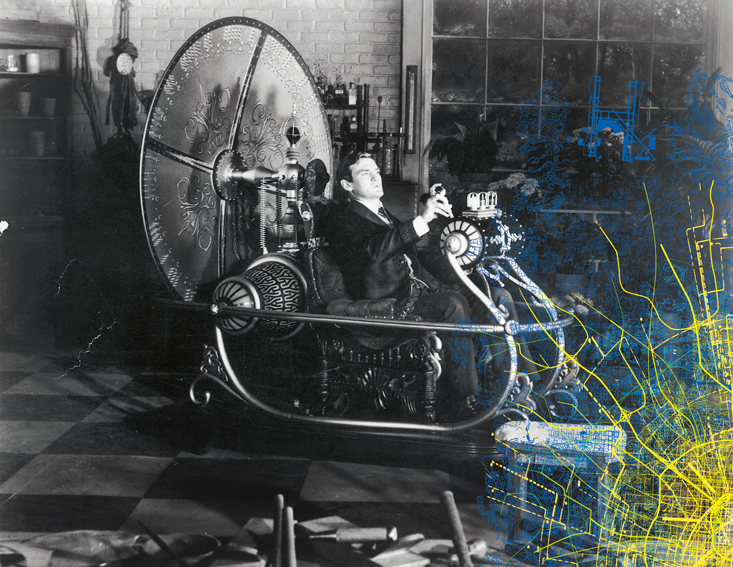
Things change. You change. You can never go back again. Over the last few months, I’ve been on a time-travel reading jag, and I revisited some books I haven’t looked at in at least 30 or 40 years, and sheesh, was I disappointed. I guess my lesson is that if ever I do manage to travel backwards in time, I shouldn’t do it, because everything old just sucked.
First up, Hawksbill Station, by Robert Silverberg. It was published in 1968, and it shows. Hawksbill Station is a penal colony in the Cambrian, time-travel is one-way so you’ll never get home again, and the government was casting all the hippie-type “revolutionaries” there. Silverberg has some odd ideas about what 60s era protesters did; his protagonist reminisces about casually raping women (no, that’s not what he’s being punished for) and how his apartment was “stacked with sprawling exhausted naked females”. There are no women in the story — the powers that be keep men in separate penal colonies, separated by millions of years — so Silverberg doesn’t have to write any women characters. Nothing really happens in the story, except that they eventually learn that two-way time travel has been perfected. It’s a time-travel story that doesn’t actually use the time-travel concept, and could have instead been set in a prison in the middle of the Pacific or the Sahara, so I was disappointed that there wasn’t even the slightest attempt to pursue the magic of seeing what the Cambrian was actually like. It was ploddingly written, too, and was a slog to get through, even though it’s short.
Please, please, please, if you’re going to write a story about going back to a distant time, use the time period. That’s the whole point!
I thought the next one would have to be better: Mastodonia, by Clifford Simak. I have more respect for Simak as a writer than I do Silverberg, but again, he makes the same mistake. In this one, a semi-retired professor and his archaeologist girlfriend have bought a farm in Wisconsin that has a mysterious crater on the property — it’s the site of an ancient spaceship crash. Their time-travel method is a bit of a reach. One of the aliens survived, and has been living there all this time, and it has the power to open time-tunnels to anywhere in the past. The magic alien is just an arbitrary gimmick to give them time-travel capability, but otherwise that particular aspect of the story goes nowhere.
But hey, it starts out fun! The protagonist accidentally stumbles into one of the time-tunnels, and sees a herd of mastodons before stumbling back. This is where I’d expect a professor-type to be excited about the ability to study the past, and a host of ideas to light up behind his eyes — at least, that’s what would happen to me. But no. No, not at all.
They start trying to figure out how to get rich off this discovery. Most of the novel is taken up with the pair jetting about the country trying to set up lucrative deals to use the time-tunnels. Primarily, they make arrangements with a safari company to send rich clients back to the Cretaceous with elephant guns to shoot dinosaurs. There are no ethical concerns expressed. There is no consideration of what one could actually learn from the Mesozoic. Nope, it’s all wheelin’ and dealin’, and complaining about how the IRS was going to take their money and how terrible it was that the government was stepping in to regulate their business when one expedition of rich fucks gets eaten by a pack of giant carnivores.
Jesus. Capitalism really does ruin everything. It certainly made this book boring.
Now I’m thinking that there are few good books about time-travel. One exception is Bones of the Earth, by Michael Swanwick. Most of the story is about the machinations of the people who police time-travel, but it gets one thing supremely right, the wonder and awe of scientists who actually get to sample the biology of the past. They recruit researchers by just showing up at their lab with a small dinosaur head in a cooler, and that’s enough to get them excited and whip out their scalpels, to start drooling over the possibility. They have conferences on dinosaur systematics, physiology, and anatomy! That rings true. Swanwick actually captures how his protagonists would think.
Another exception is The Anubis Gates, by Tim Powers, which I consider the very best time-travel novel ever written. This one isn’t focused on the science, though, but will instead appeal to anyone who fantasizes about using a time machine to explore 19th century literary history. Come on, you know we all want to have a conversation with Lord Byron and Keats, right? It does get a little (OK, a lot) twisty with a plot about trying to achieve immortality via a body-jumping magical werewolf, but at least in that one the rich capitalist is most definitely the bad guy.
Have you got a favorite time-travel story? My primary conclusion isn’t that time-travel is a terrible premise for a novel, but that any SF novel written before about 1980 has a high probability of being total crap. Prove me wrong.