
The Probability Broach, chapter 15
(If you don’t know where the title is from, allow me to introduce you to the Lyttle Lytton Contest.)
Let’s review what The Probability Broach has told us about how its world works.
L. Neil Smith’s North American Confederacy is an anarcho-capitalist society with no police, no laws and no justice system. Furthermore, everyone is armed and ready to kill at a moment’s notice.
According to its author, what makes this society function—as opposed to collapsing into an endless war of all against all—is that there are unwritten rules which everyone respects.
People in the NAC have free speech; no one will blow your head off because they don’t like something you said. If someone attacks you and you shoot them in self-defense, that’s allowable; but if you disarm them, you can’t execute them in cold blood, you have to turn them over to a neutral third party for a trial. Everyone has private property rights; you can’t break into someone’s house and take it over just because you like it better than yours.
Got it? Good. Now let’s look at some passages in the text which show that this is all a dirty lie.
As we saw last week, our heroes know that the villain, John Jay Madison, is plotting to take over the world. But they have no proof. They’re sure that the evidence is in Madison’s house, but there’s no such thing as a search warrant here. So they resolve to do the only thing they can do, which is to illegally break into his house and retrieve it themselves.
Ed and Win Bear are parked outside Madison’s house, engaged in the time-honored ritual of the stakeout:
“Look out!” Ed whispered. We slumped farther down as a pair of enormous black hovercars—the Frontenac, lately repaired, and its twin brother—came around a corner and pulled up in front of the house.
This is the car that fired on Win and almost killed him. The fact that Madison owns it still doesn’t help them, because there’s no law enforcement to which they can report this incriminating fact.
Ed offered me a set of goggles with half-inch slabs for lenses. I started to strap them on, thought better of it, and simply held them before my eyes. “Infrared?” I asked. The images were in color, the hues wildly distorted. The Frontenacs were still black, but the landscaping was sickly shades of red-violet.
“Paratronic. Convert almost anything to visible wavelengths, with pretty strange results sometimes, depending on the—quiet!”
A gang of people have emerged from Madison’s front door. Two of them are Madison and his butler. The other two are people Win recognizes all too well, because they’re from his world.
One is Otis Bealls, former boss of the murdered physicist Vaughn Meiss. The other is Oscar Burgess, the scarred secret-police thug who tried to shut down Win’s investigation.
None of this comes as a surprise to Win, but he wonders just how deep this plot goes:
The gears in my head were grinding. I wasn’t surprised that SecPol had been on my trail, but Burgess himself? Unless they had their own Broach working, he must have followed me to Fort Collins, into the lab, and out through Meiss’s machine. How many others had made it through before the one we’d found got buried in the collapsed excavation?
Fortunately, the villains are leaving. They pile into their car and drive off. Once they’re gone, Ed and Win circle around to the back side of Madison’s mansion.
They crouch by the door, and Ed pulls out an unfamiliar device. Pay close attention to this part:
Ed produced a device, slid out an antenna, and unfolded a sharp-pointed ground stake.
“This is my defeater—like the one our burglar used.”
“I hope it works better than his did.”
As you may remember, in an earlier chapter, Win was almost murdered by an assassin who broke into Ed’s home. The hitman got in with the help of a defeater, a piece of tech that disables someone else’s burglar alarms.
As I pointed out at the time, there’s no non-criminal use for such a device. The fact that you can go out and buy one—apparently there are businesses that manufacture them—has unsavory implications for the NAC. Why would that business even exist, if everyone here is so unfailingly respectful of everyone else’s private property?
And now we find out that Ed Bear, one of the heroes, owns one too!
Ed explains that his defeater works on a different principle: it connects to his computer at home, and if they trip any sensors, his computer will “start arguing” with Madison’s computer and delay the alarm from going off. Once that happens, they’ll have a few extra minutes to make their getaway.
My hands shook as I accepted another gadget. “S-sorry. I’m used to working the other side of the burglary game!”
“Calm down! You don’t hear my teeth chattering, and I’m not used to it, either.”
This is an outright lie. It has to be. If Ed isn’t used to burglarizing other people’s houses, why would he own a device whose only purpose is to help him do that?
But wait, you say. Maybe Ed is an honest man who never usually stoops so low. Maybe he bought the defeater just for this job.
Nope—because as the next paragraph shows, he owns other burglary tools too, and he has experience with them:
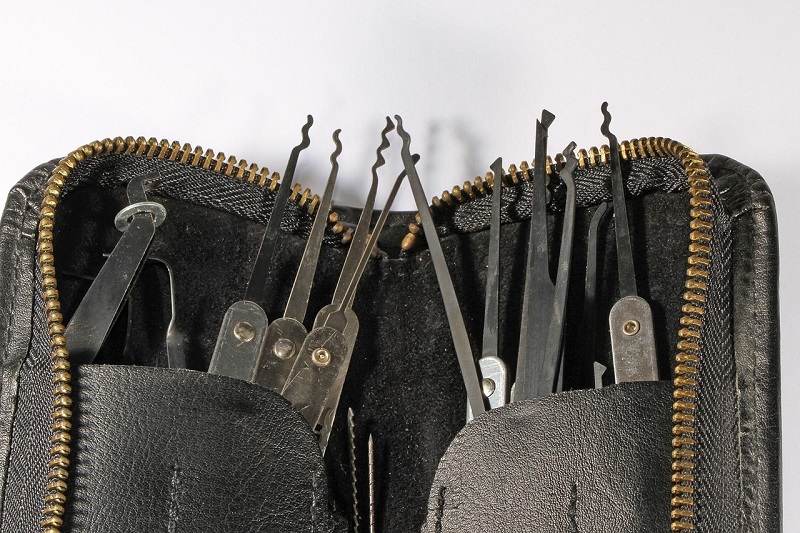
The back porch wasn’t locked, but the floorboards were real groaners. By the time Ed was doing things to the back door with tiny tools, I was surprised my pants were still dry. He taped the latch to keep it from springing shut.
Lockpicking isn’t something you just pick up! It takes lots and lots of practice to be good at it. (People like Lockpicking Lawyer just make it look easy.) There’s no way Ed would be able to do this on his first try. He’s clearly done it before.
Based on this chapter, all the NAC’s rhetoric about the sanctity of private property rights is so much lip service. They all say it, but no one believes it. Everyone in this world owns crime stuff and has practice in using it.
This tracks with other evidence from the text. It’s supposed to be illegal to torture or threaten a captive, but Win did just that, and his friends all overlooked it. They were a little upset, but they didn’t cast him out or shun him, the way people in the NAC are supposed to do to wrongdoers.
The conclusion to draw from this, even if the author didn’t intend it, is that these unwritten “rights” are worthless. People in the NAC hypocritically claim to respect them, but flagrantly violate them whenever it serves their interests. I’d argue that that’s unintentionally realistic, and exactly what we should expect in a society like this.
New reviews of The Probability Broach will go up every Friday on my Patreon page. Sign up to see new posts early and other bonus stuff!
Other posts in this series:
Glad the site’s back.
Glad to be back! That took way longer than it should have, I was worried that people would start to lose hope.
RationalWiki was gone for more than a month a while back. I’m beginning to suspect they might actually be targeting skeptic websites, as conspiratorial as that sounds.
Nah, that doesn’t really sound all that paranoid — especially given that FTB’s last days-long outage had, in fact, been caused (IIRC) by some asshole troll who didn’t like what he’d seen here.
How did he shut down the whole site? And how was no one able to fix it for days?
Unfortunately, a lot of independent websites (FTB for sure, and I bet RationalWiki as well) are run as a hobby, on shoestring budgets. There’s no dedicated tech support. That makes them very vulnerable to any kind of disruption.
Last time, I seem to recall, it was someone who filed some kind of spurious copyright claim with our hosting company.
I thought was a bogus hate-speech or offensive content claim.
“There’s no murder here, because everyone carries a gun at all times!”
was convincing too many people so Smith tried
“There’s no burglary here, because everyone carries lockpicks and burglar-alarm-disablers at all times”
If that doesn’t work, he’s switching to “There’s no arson here, because everyone carries gasoline and fuses at all times.”
“There is no kidnapping here, because… hey look, a kidnapping!”
“Paratronic. Convert almost anything to visible wavelengths, with pretty strange results sometimes…”
This deserves a heapin’ helpin’ of LOLWUT?! First, “paratronic” isn’t even a word (not in the Urban Dictionary at least); and second, WTF do they mean by “almost anything?” UV, IR and X-rays? WiFi or CB-radio signals? How about sound waves? Charged particles? Positrons? Paratrons?
And if this “paratronic” stuff gets “pretty strange results sometimes,” then what good is it? And why would it only get “pretty strange results” only “sometimes,” and not more regularly?
“Paratronic” is Smith’s technobabble word for any kind of magical technology that exists in the NAC but not our world. Night-vision goggles, dimensional portals, and probably floor wax and dessert topping too.
Every SF author is allowed (or assumes himself or herself to be allowed) one made-up technology with a made-up name (some of them abuse the privilege!). Paratronics is nothing compared to the might of rhodomagnetic-tech, or positronic brains.
Oh man, Rhodomagnetics, that takes me back to days of reading ‘World’s Best SF’ collections back in school decades ago…
Then there’s “Star Trek” with warp drive, matter transporters AND dilithium crystals (which strangely enough, are useful for just about everything BUT crystal-healing). And quatrotritikele, which Kirk knew nothing about despite it being a crucial component of Federation food supplies…
Ed explains that his defeater works on a different principle: it connects to his computer at home, and if they trip any sensors, his computer will “start arguing” with Madison’s computer and delay the alarm from going off.
Yeah, sure, because Ed and his friends all know Madison’s home-security system has a “if sensors are tripped, listen for arguments from outside computers (via channels created by outside devices) before deciding whether to sound alarms” function. Because that’s how home-security systems work in the NAC, I guess…? (Maybe that’s an unwritten subroutine machines all obey out of goodwill?)
The conclusion to draw from this, even if the author didn’t intend it, is that these unwritten “rights” are worthless…
One more plausible conclusion is that the author was just an idiot and a loony who either didn’t have a decent editor, or had one he refused to listen to.
Another is that the author was writing satire the whole time, and waiting to see how many libertarians got the joke.
Or maybe it’s the first of those, leading to the second: he started out writing “serious” fiction, but then, as his editor painstakingly explained how ridiculous it all was, he simply said “Screw it, keep it as it is and we’ll just see how the readers react!”
That whole bit is weird. Ed is a private detective, he has better reason then most to have those things and have some experience with them. More over, his is a world where that sort of thing is likely the only way for Ed to do his job.
I suspect the author just reflexively went with the world has little crime without thinking through just how much of Ed’s job is a crime to other people.
Based on prior exposure to this sort of thinking, I’d be willing to bet that at least a good chunk of the ‘thought’ processes going on with Smith really boiled down to “It’s only a crime when bad guys do it; we’re the good guys, so when we do it, it’s not a crime.” It’s inherently a belief that the righteousness of the cause is more important than the actions taken in support of the cause, and thus any act, no matter how heinous it may seem to others, is perfectly fine if the cause is just.
In other words, it’s basically a variant on Wilhoit’s Law.
“It’s only a crime when bad guys do it; we’re the good guys, so when we do it, it’s not a crime.”
“…And any non-bad-guy who catches us at it will know we’re the good guys, and not question us.”
Glad you’re back. I see the book didn’t miraculously get good during the gap week.