
Every once in a while, I hear these stirrings from scientists that there can be an objective morality, and that by following reason and evidence we can achieve great advances in ethics and reduce human suffering. I agree, in part. I think reason and science are the only ways we can implement our goals effectively, and that we should be empirically assessing our progress and making changes as necessary in a rational way. But — and this is a huge exception — science is not sufficient. Scientists are flawed, and while you can use science to optimally reach a particular goal, setting that goal in the first place is not determinable by scientific methods.
As a useful corrective to the scientific optimists, I suggest you read Francis Galton’s Memories of My Life, and try to do so with an open mind. That’ll be hard to do, because he says things that we now regard as repugnant, that we learned with hard lessons in the 20th century, lessons he did not experience. I think if Galton had lived through that period, he would have adjusted his opinions accordingly; charitably, I think I can safely assume from his writings that he had a sincere concern for improving the state of humanity, and that all that he proposed would have been for the betterment of individuals.
Man is gifted with pity and other kindly feelings; he has also the power of preventing many kinds of suffering. I conceive it to fall well within his province to replace Natural Selection by other processes that are more merciful and not less effective.
Try to keep that in mind when you read these quotes from his chapter on “Race Improvement”. He’s a scientist with only the highest aspirations for others. But he’s also a flawed scientist with imperfect knowledge, and a human being with a heavy freight of prejudices. He doesn’t realize that he’s paving the road to Hell with his intentions.
Here are the words of an upper middle class Victorian gentlemen who proposes to judge people and determine the value of other lives.
The most common misrepresentations now are that its methods must be altogether those of compulsory unions, as in breeding animals. It is not so. I think that stern compulsion ought to be exerted to prevent the free propagation of the stock of those who are seriously afflicted by lunacy, feeble- mindedness, habitual criminality, and pauperism, but that is quite different from compulsory marriage. How to restrain ill-omened marriages is a question by itself, whether it should be effected by seclusion, or in other ways yet to be devised that are consistent with a humane and well-informed public opinion. I cannot doubt that our democracy will ultimately refuse consent to that liberty of propagating children which is now allowed to the undesirable classes, but the populace has yet to be taught the true state of these things. A democracy cannot endure unless it be composed of able citizens; therefore it must in self-defence withstand the free introduction of degenerate stock.
Note what he considers both undesirable and heritable: Poverty. Crime. Intelligence. He can glibly divide humanity into classes, some of which are “undesirable”. He is looking for humane ways to prevent undesirables from propagating.
He has high moral aims! Keep that in mind; if it were actually true that poor people birthed children who were genetically determined to be poor, shouldn’t we do something about it? Of course, he’s not thinking it through: he can’t legitimately claim that poverty is biologically heritable (it sure is environmentally influenced, though!) and he certainly doesn’t seem to comprehend that poverty is a consequence of an unequal distribution of resources.
He’s also incredibly unaware of his own peculiar biases, biases that leap out to the more modern eye.
Most notabilities have been great eaters and excellent digesters, on literally the same principle that the furnace which can raise more steam than is usual for one of its size must burn more freely and well than is common. Most great men are vigorous animals with exuberant powers and an extreme devotion to a cause. There is no reason to suppose that in breeding for the highest order of intellect we should produce a sterile or a feeble race.
So “great men” are big-bellied men? Where is cause and effect here? Where is the evidence?
One of the dangers of science is that sometimes individuals get so captivated by that heady feeling of success and progress — and let’s not get carried away too far in the other direction, science definitely works and is a far better tool for understanding than any other process — that they forget the limitations, and assume that there every thought is pure and vindicated by scientific triumphalism. Francis Galton seems to have forgotten the meaning of the word humility. Your every opinion is not the same as scientifically-evaluated fact.
Speaking of arrogance and bias:
I may here speak of some attempts by myself, made hitherto in too desultory a way, to obtain materials for a “Beauty-Map” of the British Isles. Whenever I have occasion to classify the persons I meet into three classes, “good, medium, bad,” I use a needle mounted as a pricker, wherewith to prick holes, unseen, in a piece of paper, torn rudely into a cross With a long leg. I use its upper end for “good,” the cross-arm for “medium,” the lower end for “bad.” The prick-holes keep distinct, and are easily read off at leisure. The object, place, and date are written On the paper. I used this plan for my beauty data, classifying the girls I passed in streets or elsewhere as attractive, indifferent, or repellent. Of course this was a purely individual estimate, bat it was consistent, judging from the conformity of different attempts in the same population. I found London to rank highest for beauty; Aberdeen lowest.
I should like to see a complementary set of prick-holes made by the women he so judged, who were then given the opportunity to evaluate the beauty of Francis Galton. Further, I’d like to see a pair of assessments, the first made before the women were told what he’d been doing, and the second after. I think it would be apparent that far from being objective scientific measurement, this was an appalling exercise in subjectivity.
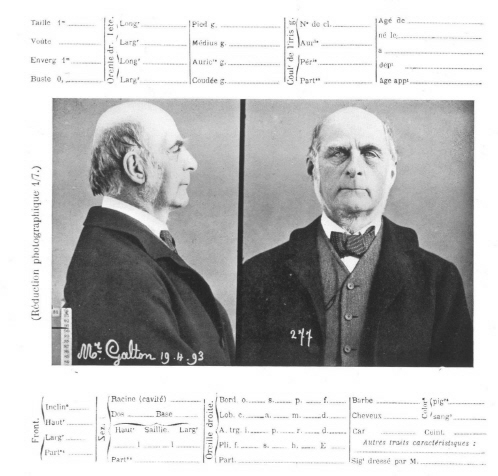
There’s also the bias of the chosen parameters: women were judged for beauty, their most salient characteristic, while Great Men were judged by the size of their guts.
And here’s the dangerous part: that a person can then claim that their views are blessed by Science and Darwin’s Law of Natural Selection. You can’t argue with me; I have the authority of Science, no matter how racist or sexist my views might be.
I venture to offer an explanation of this apparent anomaly which seems perfectly satisfactory from a scientific point of view. It is neither more nor less than that the development of our nature, under Darwin’s law of Natural Selection, has not yet overtaken the development of our religious civilisation. Man was barbarous but yesterday, and therefore it is not to be expected that the natural aptitudes of his race should already have become moulded into accordance with his very recent advance. We men of the present centuries are like animals suddenly transplanted among new conditions of climate and of food; our instincts fail us under the altered circumstances.
My theory is confirmed by the fact that the members of old civilisations are far less sensible than those newly converted from barbarism, of their nature being inadequate to their moral needs. The conscience of a Negro is aghast at his own wild impulsive nature, and is easily stirred by a preacher; but it is scarcely possible to ruffle the self-complacency of a steady-going Chinaman.
Now if you accept these prejudices as true, we cannot avoid Galton’s rational conclusion.
It is known that a considerable part of the huge stream of British charity furthers by indirect and unsuspected ways the production of the Unfit; it is most desirable that money and other attention bestowed on harmful forms of charity should be diverted to the production and well-being of the Fit. For clearness of explanation we may divide newly married couples into three classes, with respect to the probable civic worth of their offspring. There would be a small class of “desirables,” a large class of “passables,” of whom nothing more will be said here, and a small class of “undesirables.” It would clearly be advantageous to the country if social and moral support as well as timely material help were extended to the desirables, and not monopolised as it is now apt to be by the undesirables.
Pretend that there actually was a class of “undesirables,” people destined to be rotten wastrels who would increasingly drain society of its worth (further, suppose they are the poor rather than, say, investment bankers). You could legitimately argue that Galton’s solution is a good one. Wouldn’t that be a dilemma for all us godless liberals; we’d have a logical solution to a real problem, that would require a most illiberal course of action to reach an advantage for our country.
But of course, being a scientist doesn’t mean one is right. Declaring a course of action to be beneficial for society ought to be met with questions about “beneficial for who?” Premises for a claim that seem to do nothing but mirror common social prejudices ought to be questioned, and one good use for science is to test those claims…and perhaps finding that those foundations are rotten ought to be grounds to deny that the authority of science is backing up one’s actions.
And even if every claim was true, it doesn’t necessarily narrow our course as much as some would claim.
Anyway, whenever someone announces that science tells us that particular path is the one true path, or that their arguments are unassailable because they are Scientific, I always turn to high-minded scientist Francis Galton. Imagine a society that tried to actually implement his ideas…oh, wait. Imagine? Read a history book.

Science making claims as to the desirability of individuals can only be “scientific” if this science takes into account the economics, the power structures, wealth creation and distribution,and how that affects the well being of a society as a whole and the status of the individuals within this society.
What is desirable as a society is again then not a scientific discussion, but a political one. Unless science can show with evidence which society is most desirable – Marx tried that before.
Great Men were judged by the size of their guts.
What do we know about the Galton-gut? Somehow, I suspect it was large.
Quetelet was the originator of ideal height/weight charts (which morphed into the tabular form used in the 50s-70s and were set to a simplified formula to give BMI) and made his charts by asking his friends that he considered attractive, “how much do you weigh?” A little more sciency than a creationist but not much.
Wasn’t Galton, like, Darwin’s cousin or nephew or something?
Teach the controversy!
A cousin. They had Esrasmus Darwin as a common grandfather, but not a common grandmother.
This reminds me of a conversation I was having about the death penalty. My friend thought it good to remove murderers from the population. I pointed out that 1, people with low levels of personal restraint, likely to comit murder in the heat of the moment, might also be likely to have children at a very young age, meaning they’re already in our gene pool, and 2, the most important point, murderous intentions are not known to have any genetic component.
In his defense, he thought everything you’re born with is genetic, so was only more confused and suspicious when I tried to explain epigenetics and nutrition and classical conditioning….
Yes, Galton was Charles Darwin’s cousin. Darwin’s son Leonard was a longtime Chair of the British Eugenics Society, succeeding Galton himself in that office. Clearly, a hereditary taint!
aw.
I wanted to laugh about this too, but of course he doesn’t actually say anything like that. (He seems to be referencing a high rate of metabolism instead.)
This brings an anime trope to mind: In a lot of shows, the hero is a big eater, and I mean really big, filling the dinner table with “a light snack,” leaving towers of empty dishes and bowls in his wake. But he doesn’t gain weight. Though a lot of these heroes probably burn up all that energy fighting monsters and firing chi blasts.
Of course, these days, fatty foods are cheap, so obesity is more common among the poor while wealth makes balanced diets easier.
Science like big guts and it cannot lie. You other scientists cannot deny.
…
I have no shame.
Bronze Dog, good point. Hell, Toriko takes that trope a step further and makes it the point of the show.
If I wasn’t already a dyke, this man would have done the trick…
Not all that surprising to discover that, even back then, women were being judged by a bunch of pricks.
Chomsky put it a certain way: “Science talks about very simple things, and asks hard questions about them. As soon as things become too complex, science can’t deal with them… But it’s a complicated matter: Science studies what’s at the edge of understanding, and what’s at the edge of understanding is usually fairly simple. And it rarely reaches human affairs. Human affairs are way too complicated.”
a thoughtful and interesting post. thanks pz.
In fact, Chuck Norris once ate 20 pounds of steak in 1 hour, and in the first 3/4 of that hour he had sex with the waitress.
(…Strangely, that fact isn’t at the link. But there are two pages of other Chuck Norris facts about steaks there.)
gendered pun!!!
Hey, check his name. Francis. Coincidence? perhaps…
Here’s my problem with trying to determine scientific morality;
Is it better to be an herbivore or a carnivore?
The two are incomparable. Both are strategies for gaining food which have had a huge amount of evolutionary success, as do scavenging and photosynthesis. Science can understand the consequences for those actions, and can determine optimal strategies, but in the end, the two are neither “Better” nor “worse” than each other, and in many ways those two roles are complementary and required in a system.
I think in many ways, our values potentially axiomatic and incomparable. One person’s desire to minimize human suffering is another person’s failure to punish moral transgressors. One person’s desire for equality is another person’s desire for hierarchy. Science can illustrate the consequences of these actions and show optimal methods for achieving these goals, but it cannot declare one superior to the other, if the underlying value system is more important to the individual than the consequences of that value.
I have to disagree with this. I presume we agree on one thing: that good and evil have no existence outside advanced minds. This leads to an important conclusion, however: if we want to learn anything about them, we need to look inside minds. Good and evil correspond to real physical states of the substrates of minds (usually brains), and in principle can be measured.
Now, what is morality? Morality is simply doing what is good. So morality is doing things that bring about a particular class of physical states in brains and avoiding certain other states, corresponding to ‘evil.’
The goals of morality are in principle determinable by (probabilistic) knowledge of the effects of different actions on the states of brains.
Note that the things you complain about with regard to Galton are points were he got his facts wrong.
This is my problem with many in the skeptic community. With the desire of some to keep their skepticism “apolitical” they lose touch with the big picture and propose simplistic ideas and goals any ignore the complexities of social interaction. So many social issues are so complex that you can’t squeeze them down to a simple testable hypotheses and so they get dismissed as “unscientific”. You know, like lots of stuff in the soft-sciences.
I understand this desire to keep things simple because hard-science is good at discovering hard facts but the problem is that over dedication to this kind of thinking means that minds get poisoned and it can turn into a world-view where some of these people think they are the rational ones for sticking with the ideas they can “prove” and the people crying for change are often dismissed as emotional. Then they come up with ideas, morals, and world-views that are myopic and kid themselves into thinking that they are just because they can “prove it”.
…and some are just assholes.
Ah but his great nephew,[1] Josiah Wedgwood (the MP), was one of the most vehement opponents of eugenics laws in England and led the parliamentary opposition to the proposed Mental Deficiency Bills of the nineteen teens; it still passed but was weakened (which may be one reason why Britain never had the mandatory sterilization laws that many US States and other European countries had). Hansard has a listing of some of the debates
PZ is right that we can’t ignore that the eugenicists claimed science as supporting them and that many were scientists. They were also products of their time and place just as we are products of our time and place.
[1] by marriage, or his first cousin twice removed by blood (and a first and second cousin once removed to Leonard). But the Wedgwoods (which included Charles Darwin) were clannish (helped by the pottery firm still being family owned and run at that time). I don’t know what his religious views were though; he was not a scientist (did have training as an engineer).
OK, I’ll bite.
By what methods it is determinable then ?
Religion ? If that is the case, we may as well as give up on the whole atheism thing. In other words, we are screwed.
Magic ? Well. There is no magic, so we are screwed either.
Divination ? The same as the above. we are screwed.
Throwing dice ( or using other random generator ) ? Hope no one seriously suggests that …
Subjective preferences ? That is just nihilism by other name and we are screwed again.
Traditions ? Well, after we ditched many respectable traditions like feudalism, state religion, slavery, subjugation of women, I think it is a little too late to declare traditions to be the source of our goals.
Cultural preferences (aka Cultural relativism ) ? Putting aside the fact that this is just nihilism multi-player, it means bye bye universal human rights ( = we are screwed ) this way.
Something else ?
Well, let me see. Maybe purely deductive approach.
Deriving goals from generally accepted axioms. Trying that, however, we will soon discover that there are no universally accepted axioms from which moral goals could be derived.
And also there are no deductive rules that take descriptive premises, and produce prescriptive conclusion.
And even putting those issues aside, this would be in the same direction as letting science to set your goals, only infinitely worse.
Seems that there is no other way than science…
And we have to have a method. Otherwise, well, any for any behavior there exists goals, which are rationally best achieved by it.
So if we leave the ‘goal’ part arbitrary, we will not be able to judge any behavior, even the most extreme one… and are thus screwed for good.
And one more thing. Declaring science to be inapplicable in a certain area because of some previous botched attempts, would obliterate science entirely.
Imagine we would, after the failure of Phlogiston theory, declare chemistry to be outside of the domain of science.
(note to the resident trolls and bullies, I will from now on respond only to rational arguments. anything else is going to be ignored)
Very interesting post! I’m always fascinated to see how important eugenics was in early 20th century intellectual life. It’s funny to see what was considered “modern” and “progressive” at various times.
Speaking of eugenics, I read an interesting thing recently that hypothesised that average human intelligence might be lower now than it was, say, 2000 years ago, since being dumb is less likely to get you killed these days, and better transmission of information means that most people only really need to be smart enough to understand the explanations of humanity’s most intelligent outliers in order to be useful to society.
I haven’t spent enough energy on it to have an opinion on that theory, but it’s an interesting thought!
…I can’t remember where I found it, though :/
[Also, why do my empty lines disappear all of a sudden when I submit a post? Makes it much harder to read!]
@frankensteinmonster
Well done, you’ve identified the Hard Part of being human.
Now you just need to come up with a solution, and you’ll be the most famous person to ever live!
(Now you might consider this trolling, but if you really don’t understand why science can – by its very definition – not provide you with goals unless you have already decided what you want to accomplish, I really don’t feel guilty about trolling you.)
I recommend to you the thoughts of Jacob Bronowski; specifically his discussion of science as a democracy of the intellect (Ascent of Man, chapter 13, “The Long Childhood”. The personified focus for his discussion was John von Neumann, a brilliant mathematician working on game theory. Bronowski’s caution is that, in his assessment, von Neumann failed to complete his work in part because, in his last ten years, “he gave up asking himself how other people see things.” He was “in love with the aristocracy of intellect,” which can only be destructive to both science and civilization.
Science is not “objective,” but is based on a moral commitment to knowledge as a public good. That is not a universal value. Political value often is based in a restriction, even an obfuscation of knowledge. Scientists are as susceptible as anyone else to the temptations of political power; but at least we might try to notice when we are chipping away at our own moral foundations, by dividing and classifying people as the first step to marginalizing them and dismissing their knowledge and opinions. Science is a social project, from which we exclude others at our own peril.
Thank you, PZ, for continuing to remind us of that.
…just to be clear, what I’m saying is that the answer to your question – “by what methods it is determinable then?” is “by none, unfortunately”.
“Desirability” isn’t a physical property of things in the universe, it’s a category made up by human beings. So whatever we decide is desirable is ultimately arbitrary – the best we can do is find a consistent system of deciding what we declare to be “desirable”, and then working to achieve that. The latter being what science is for.
Claim :
Evidence : ?
I am saying that some things are not decidable by a simple logical approach; where you take them afterwards may be.
So for instance, something I take for granted, that equality of opportunity is a good thing to have in a society, is determined by empathy and social values instilled in my upbringing. In order to achieve the kind of life I want to live, I can advance arguments along those lines…but I cannot come up with an argument that equality is an intrinsically better thing than, say, competition and stratified division of labor. I can come up with rubrics to make my case, but those are value judgments, too. If I assess by productivity and wealth of the upper classes, the latter probably wins; if I assess by aggregate human happiness, the former.
Science won’t tell you whether happiness or productivity are better goals. It might tell you a measure of both is important. But where you set your priorities is not set by some kind of Science 8-Ball.
.
If it is really arbitrary, then there are infinitely many systems of goals. and no rational way of deciding between conflicting ones. which means we are screwed.
It also means there are an infinite number of ways to “win the game”, or to lose it.
We can always try to pick a winner over a loser, you know.
Frankenmonster, my answer to your question in one word is this: empathy. The slightly longer version is the Golden Rule, or “Do as you would be done by.” Empathy is pretty much the sine qua non of a moral system. The best way to avoid most major moral screwups is to simply ask yourself “Would I want to be treated this way if I was female/poor/Jewish/whatever?” Clearly this was the failing of Galton, Hitler, and all of our local species of MRA trolls. It’s why sociologists warn about the danger of seeing a person as the “Other” — once someone is the Other, then you don’t have to bother applying empathy anymore.
A contributory factor for empathy is imagination. It helps if you’re actually able to use your imagination to place yourself in someone else’s shoes. particularly if their experience is substantially different from your own.
As an aside, since I work in a field of the Humanities, I would argue that as I see one of the primary purpose of most Art as helping humans develop their senses of empathy and imagination. When we read a novel or watch a play or listen to music, it gets us about as far as it is possible for our species to go inside another human being’s head. In most cases, that makes us better people.
.
Uh no. If the goals are arbitrary, ‘winning’ or ‘losing’ is meaningless. Because any outcome is ‘total victory’ under one arbitrary set of goals, and ‘game over’ under equally arbitrary other goals.
.
So ultimately, all you can say to those not sharing your upbringing is appeal to emotion and subjective preferences ( aka values ). I feel sad and hopeless when the Great PZ Myers says this. No offense.
This sounds like nihilist thinking where one shouldn’t even bother trying. Step back, take a deep breath, and figure out how to define a goal, or even series of goals that will be good for the progression of humanity.
@brucegee1962 #30
.
Empathy and the golden rule are quite good as goals go. But the question was not “what goals we should have” but “by what method should we determine which goals we should have”.
.
Declaring goals to be arbitrary is nihilism. And it was not me who did it here.
But the rules are not arbitrary. They are constrained by the very real world in which we live and evolve. If you want an absolute answer to moral questions (or any other questions), of course you are screwed. What constitutes a “win” or a “loss” may not even be known for generations. (Was agriculture a good idea? It seems to have worked out well, but it produces a lot of methane, and lots of other problems, so..? Was even leaving the ocean a good move?) We do what we can, and assume that knowing a bit of the most probable truths about our reality will help steer us in a “better” direction. We can’t know it all, and what we do know is flawed; and as always, the trick is to not fool yourself, and as Feynman said, you are the easiest person in the world to fool. Yep, in the long run, you’re screwed. But just because all you can do is to try to pick a winner, that doesn’t mean you have to give up.
PZ: (#27)
But happiness is by definition your goal. Happiness is having access to things you value (ie things that make you happy). Value is just another name for things you want, ie ‘goals’.
The only “absolute morality” I could identify is survive and propagate. Beyond that, it’s all opinion and rationalization.
A lot of things we label as “ethical” are innate evolutionary traits (e.g. parenting, socialization), such as the choice to cooperate for long term gain at the expense of short term gain. Most of the time, philosophies are just attempts to justify personal desires, biases and ambitions.
@Frankenmonster 34
Science is much better at being descriptive than at being prescriptive. So if we wanted to look at all the various creatures in the Cambrian explosion and attempt to scientifically determine which adaptations were successful and why, science would have some useful answers. But if we were to look at a planet at a pre-Cambrian stage and ask, “Which kinds of creatures might arise and have the best chance of being successful?” then science would pretty much draw blanks. There are simply too many variables.
You ask the question, “Empathy and the golden rule are quite good as goals go. But the question was not “what goals we should have” but “by what method should we determine which goals we should have”.” There are two different ways we could read that question. If you want to ask the question, “Are societies that practice empathy likely to have an inherent evolutionary advantage over societies that promote selfishness,” then I actually think science might have some pretty good answers for you. There have been several studies on the development and advantages of altruism recently, for instance. But if you want to ask, “Is there scientific process that will lead to a successful method of making moral decisions,” then the answer is pretty clearly no.
And if you look at what you wrote, you should realize that the question “by what method should we determine which goals we should have” is hopelessly circular. “What goals should I have?” “Well, it depends on what results you want.” “But how do I know what results I want until I know what goals I have?” Etc. etc.
Well, there’s a pretty basic logical underpinning to the Golden Rule, which is “If I promote the Golden Rule and follow it myself,
But it isn’t relevant how you came to have those views. What’s relevant is why those are good views, if they are: why you (and possibly other people) should have them.
This is the same basic trap I’ve seen a lot of people fall into, especially with evolutionary explanations of morality. They’ll talk about how altruism evolved in primates or what-have-you. That’s all fine and dandy, if their particular account’s reasonably accurate. It’s a valid (and much more believable) alternative explanation compared to, say, a creationist claiming altruism is magic which was poofed into existence by a dictator in the sky. But it’s not giving anyone a reason why they should be altruistic rather than not, much like claiming “god says so” isn’t giving anyone a reason to follow his commands (or be just like him or whatever). It’s not a valid answer when “why should I do that?” is the question.
What do you mean by “intrinsically better” anyway? Why would it matter whether or not it’s intrinsic? And intrinsic to what/whom? Society as a whole, and if so, which one? Every person in every society? Maybe it doesn’t matter, but it’s just not clear what this is saying.
You want certain things and not others, which is saying that you think they’re better. So, you can ask this: if other people do not think that way, what can you do about it, if anything, which you think would be better than other things you could do?
Suppose you think chocolate ice cream is better than vanilla. Is there some reason why you’d prefer that other people think just like you? No, probably not, in that case. However, when it’s something like equality, you generally do want others to come to approximately the same conclusions, although there is still a lot of wiggle room because they’re not experiencing all the same things as you are. That’s because equality is the sort of thing that has consequences for other people in ways your personal preferences about ice cream do not. So if we know what those consequences are (at least some of them), then we can know some things about what their preferences are and why they have them — again, not how they or their ancestors or cultural peers came to have them, but their own reasons why those are preferable rather than not. And you can evaluate whether or not those are rational, factual, relevant, coherent, etc. It’s definitely not “science,” but it’s not magic or meaningless, arbitrary verbiage either.
Apparently you don’t even need a history book. Here’s “widely respected” evolutionary psychologist Geoffrey Miller on present day Chinese eugenics programs http://edge.org/responses/q2013.
Will evo-psych ever bottom out?
the example of “Francis Galton’s Memories of My Life” highlights what I find so irritating about the latest hit on PBS Downton Abbey. it is so story about the restrictions of classes and the distribution of power.
but to the question how do we set our goals it does not matter where we start when we set out to set goals it will end in a political decision. Is not that how we ever decide to do things collectively whether it is formally with a vote or not but the agreement to proceed would have to be described as being in the political area wouldn’t?
If we were to decide to use science to set our goals that would be a political decision.
In discussions like this it seems that it usually starts at the top instead of at the most basic level of biology first.
The top being what is best for a human society and the bottom being the animal survival of the fittest level taking into account what we know of how that has been going on with earths historical record of life.
were screwed if you mean that we have to make an ongoing agreement as to how to proceed and do not have a flawless authority to tell us what to do so it will work out perfectly once and for all.
some times a good screwing is kind of fun! :-)
uncle frogy
The last sentence in my last post should have been cut.
One other thing — I think there’s pretty strong evidence that many of the beliefs that we think of as ethical may actually have been selected for when early human cultures began to differentiate culturally and compete with one another for resources.
Imagine a fertile valley with two tribes living at opposite ends. The society on one end teaches that it is virtuous to sacrifice oneself in order to protect the weak members of the culture. Cooperation and communication are prioritized, and women, children, and the old are given special benefits and a good share of the food. On the other end is a dictator-run society. Whoever is strongest owns everything, women and children are property to be fought over and awarded to whoever is strong enough to keep them, and the old are useless and discarded. Infighting is very common. Surely within a very short amount of time, the “good” group is going to outcompete the “evil” group. The cooperators will make better hunters, for one thing, and the increased experience they receive from their older members will make them better prepared to respond appropriately to uncommon situations. One of the strongest selectors will be the women and weak members themselves, who will quietly defect to the “better” village in the middle of the night once they learn they are likely to be treated better.
Incidentally, one of the things that made me hold onto theism for about a decade longer than I should have was the “universal nature of good” argument — notions of good are fairly constant throughout all societies throughout the world, therefore god. It was the thought experiment above that made me suddenly realize that god was unnecessary to the equation.
I can’t get past the concept of rating women for attractiveness using “prick-holes”.
Science will never guide you toward the One True Morality (TM) because it’s just a method. It will tell you very effective ways of implementing what you’ve decided is the OTM, oh yes indeed…just look as Nazi Germany.
The one partial exception to this, I would claim, is animal ethology. The studies on apes by de Waal and Fouts absolutely floored me; at the very least, they raise some seriously theologically-challenging questions as to what morality is and which beings do and do not have a “soul.”
And we observe in our closest animal relatives many of the same game-theoretic strategies we see in ourselves. Thinking of reality as a fractal, massively-iterated game of Prisoner’s Dilemma explains a lot, everything from the Golden Rule itself (first stated in positive form by Confucius, NOT Jesus!) to the “viral threshold” for an idea or meme to take root and spread.
My own opinion on it is roughly as follows: morality is not built into the fabric of existence, but there most certainly can be moral facts which emerge from the nature of the beings which hold them (i.e., are not constructed as an act of will of deductive logic). We are social animals, and by observation of other social animals, we find we have similar morals. We also have systems of pain, pleasure, etc built in by billions of years of evolution, and it is on these systems that morality acts; indeed, it seems to be built on those systems, whereby unpleasant emotions caused by violating the “social contract” actually cause body changes and reactions akin to physical pain. It’s not “perfect” as we well know, which is more evidence it evolved instead of being put there from above.
@40 Consciousnessrazor
So I see you addressed the point I was making as I was typing it.
Well, for one thing, there’s a selfish motive for following the Golden Rule: “If I use and promote this rule, then the chances are increased that others will use it as well towards me, and thus I will benefit; furthermore, the benefit for actually doing it will be greater than if I just pretend to use it, because I’m likely to get caught.” In fact, since our society has evolved to the level of material prosperity that it offers us precisely because of the value it places on altruism, it has also evolved to put in place various incentives that reward altruism and punish selfishness, and if we are wise we will take note of these.
@frankensteinmonster – 18 February 2013 at 12:58 pm (UTC -6)
I beg to differ. Declaring that goals are arbitrary is just honesty.
I would like to thank PZ for posting this very interesting, and rather terrifying, account of the beliefs of Francis Galton. I think that one thing to keep in mind is that while scientists can be positively awful at thinking clearly about morality, philosophers are only somewhat better in this regard.
There is no reason to suppose that in breeding for the highest order of intellect we should produce a sterile or a feeble race.
Galton was addressing this to those members of his class who considered intellectuals to be feeble specimens, and feared that Galton and his ilk would turn England into an effete ivory tower.
It’s hard to grasp what he did NOT know that we learned in grade school science class: vitamins, iodized salt, protein needs …. yes, the wretched poor produced wretched children, because ot their wretched nutrition.
@49/Tsudonimh
I’d say that’s less a failure of science qua science than a failure of Galton; being ignorant of what turns out to be some very fundamental concepts of nutrition and growth, he produced wrong conclusions. GIGO, as is said…
There’s a conflict between individualistic versus collectivist goals in human social organization. Maybe we are best suited by a “right” combination of both? And who do i mean by we? What would be “right” for one person, might not be so for another. This would have to be arbitrated at a higher level of organization than the individual, but where to draw the line?
the premise here is flawed. The function of science is not to find true paths, it is to explain and predict, and then work to REJECT those same explanations and predictions through rigorous experimentation.
You make the same mistake as Galton.
…but you know far better than he did.
point being, it wasn’t science that was at fault in informing the situation in Galton’s time.
it was Galton.
That’s not always the case. People don’t all want to be treated the way you do, so you can’t reliably expect them to return the favor to you in a way which benefits you, since they may not have liked it or may try to “benefit” you with something you don’t like. But this is all beside the point.
Even when it’s true, I still don’t see how that (i.e., “I will benefit”) by itself could justify saying it’s good. That’s the problem. And I don’t give a fuck if long ago fairies floated down from the big rock candy mountain and pooped “altruism” into the world, because its origins or immediate physical causes (e.g., neurological causes) just don’t fucking matter, except to a scientist who’s studying that sort of thing. But we’re not studying that sort of thing right now. We’re asking why anyone should do it.
Is this not another iteration of what Sam Harris calls “the Value Problem”? I’ve seen varieties of this objection raised again and again in discussions (dismissals) of “The Moral Landscape”. However, despite the fact that Harris anticipated this objection in the book and dealt with it, and that he has similarly dealt with it in response to his critics, I’ve never seen anyone explain why Harris’s defense doesn’t work. Science cannot scientifically justify a commitment to empirical evidence and logical coherence. There is no logical argument which can convince someone to pay heed to logical arguments. This problem attaches to basically everything, but it is only with respect to morality that anyone thinks it’s a problem. A person who denies that morality relates to the well-being of conscious creatures is in the same position as one who denies that physics relates to objects in motion. And yet we’re only asked to take one of these people seriously. We should take neither of them seriously. The Value Problem is a non-problem for physics, and it is a non-problem for morality.
Azuma Hazuki @45
This is brilliantly phrased. Morality certainly has a rational component, and this is why cultures that have never been in contact with one another are able to converge on the same moral principles. One way to explain this would be to say that it emerges from our evolutionary history. Reciprocal altruism, empathy, compassion and so on all have an evolutionary basis, but I don’t think this entirely why maxims like the Golden Rule have been independantly discovered hundreds of times. I think there are certain ‘moral facts’, as you say, that could be elucidated by intelligent machines given the assumption that suffering is bad.
the best we can do is find a consistent system of deciding what we declare to be “desirable”, and then working to achieve that.
… A system which ought to yield the same results for “desirable” over time, if you wish it to withstand the charge of arbitrariness. I.e.: that which is “desirable” today ought to be considered “desirable” hundreds of years from now. And by “consistent” do you mean that it would consistently yield the same results irrespective of the individual? With such a system, in other words, there could be no disagreement because everyone would assess the same situation and come up with the same answer every time, right?
(Unless you want to say that “desirable” is simply an individual aesthetic preference, in which case you’re not talking about objective morality, merely abitrary subjective states) The really good attempts such as Kant’s categorical imperative or Rawls’ veil of ignorance try to establish objectivity either by mooting self-interest or appealing to it in an “enlightened” form.
Thinking of reality as a fractal, massively-iterated game of Prisoner’s Dilemma explains a lot
No, because that’s circular reasoning. The prisoner’s dilemma is an abstraction of an occasionally-ocurring subset of reality; it should therefore be no surprise that occasionally parts of reality resemble the prisoner’s dilemma. It’s like the people who find a fractal pattern in nature and reduce it to a formula and then say that the formula somehow controls nature – actually the situation is exactly the reverse.
Well, the less we could talk about Harris, the better….
But you do bring up a good point. People talk about the “is/ought gap” and so on, as if there were some uncrossable divider between them. But this sort of metaphor is really only useful to make people stop thinking about it so the conversation will end — at least, that’s how it’s generally used, whether or not it has other uses. It’d be more useful to think of it as an “is/ought distinction,” in which the problem is making that distinction clear. We shouldn’t confuse them, but we can keep thinking. It’s certainly not an easy problem, but we don’t need to go around making these grand claims that the whole thing is impossible.
Why? They (almost certainly) won’t be the same people living in the same conditions hundreds of years from now. Scientific laws aren’t “arbitrary” because their results differ according to what the conditions are, so even though morality isn’t a scientific discipline, isn’t this setting up a different kind of standard for it? We’re talking about what people should do, so there’s no reason to leave people out of it. There’s no reason to expect some abstract thing which is entirely independent of our psychology, our cultural backdrop, or any other factors which make us what we are.
The only thing science can add to morality is principles of investigation, and enquire whether certain factual bases of moral behaviours are empirically justifiable. This certainly isn’t a closed door for the question of whether there is an “objective” morality. Perhaps there is a buried monolith somewhere that has steered a natural course that we are unaware of. You know, whatever you want to imagine it might be. But saying that it is possible, and that we should have our minds open to what further investigation brings about, it doesn’t solve the problem of the here and now, that science has *not* given us that kind of factual bases to direct morality (though it has falsified pseudo-facts like social darwinism).
My view is we just wing it. Just like the human body has a tug of war among the outside world, and diseases, and attempts healthy balances, so does the social world attempt healthy balances, and learns from the past how certain actions play out. The specifics of understanding actions and consequences can be further analyzed in terms of game theory, the desirability of outcomes, the rationality of purported aims, or whatever. But all these ultimately are approximations, with no necessary lines of convergence except for the recognition that people want to live, want to belong, and want to avoid suffering.
So keep the prize in sight, and if science wants to check in periodically about new discoveries that may impact how we exist with each other, then we’ll give an ear.
There is no objective morality in the sense that what is ethically right for (most) humans isn’t necessarily so for other animals. Take lions: infanticide would be considered ethically justifiable by a lion taking over a pride, (although the lionesses might have a different view on that). That is due to the different ways in which we & lions propagate our repective species.
To a lesser extent, so it is with people: those who favour individualism will have some different moral values compared to those who favour collectivism.
There are, however, some moral “facts”, (subject to various conditions), that just about everyone (human) can agree on, & most probably ‘normal’ humans always have & always will agree on them. It’s these conditions that render the “facts” to be somewhat less than 100% objective. I guess this is where the disputes arise.
It astounds me sometimes how frequently people don’t seem to get this. (And it makes me wonder what I’m missing that I don’t see why people don’t get this.) The scientific method, like skepticism, like atheism, like civility, is just a tool. It’s a good tool, but it’s just a tool. Use tools, but don’t become so obsessed with them that you start to think using the tool is the end in and of itself.
@petermilley – 18 February 2013 at 5:33 pm (UTC -6)
Perhaps because humanity is still so used to using religion as an end in and of itself? (Like Christianity in the European Middle Ages.) We used to use religion as a source of both epistemology and of values. We make the move to science as our source of epistemology, but then we try to use science as a source of values and this effort fails. To me this is like an incomplete revolution in values.
Why? They (almost certainly) won’t be the same people living in the same conditions hundreds of years from now. Scientific laws aren’t “arbitrary” because their results differ according to what the conditions are, so even though morality isn’t a scientific discipline, isn’t this setting up a different kind of standard for it?
The problem with that is that under such a morality, you can then justify anything by claiming it’s part of the attitude of the times. I.e.: slavery made perfect moral sense because agricultural machinery wasn’t good enough at the time. If you’re trying to establish a system for discriminating right from wrong, it would seem to me that it needs to be time invariant – it should always give the same results. That seems to me to be the only way to keep it from becoming purely subjective. Put another way – if slavery is wrong today, you want a moral system that argues why slavery was wrong 300 years ago – otherwise it’s not really a system about what’s right and wrong, it’s merely a system of what’s customary at that time. Extrapolating forward, will we someday conclude that the vegans were right in the 20th/21st century? If we will, then we should be able to reach the same conclusion, using the same moral system, today as our descendants will 100 years from now.
I guess Nietzsche said it best:
It’s certainly not an easy problem, but we don’t need to go around making these grand claims that the whole thing is impossible.
The is/ought problem was Hume’s way of explaining the problem of moral induction. He rightly points out that a lot of the time people will talk about how things are, and how things ought to be, but sort of do a philosophical Gish gallop past the point where they argue why things ought to be that way. There’s a lot of handwaving.
The reason there’s a lot of handwaving is because it’s hard. Like you say it’s not an easy problem – but it may actually be an impossible problem, thanks to our incompleteness of knowledge and our apparent inability to inductively move past simple things like “the golden rule” In fact, let’s take the golden rule as an example because it’s one of those prescriptive moral arguments that amount to a statement of how things ought to be “(we ought to) do unto others as we would have them do unto us” but – why? One can observe that there are lots and lots of people who apparently do not do unto others as they would have them do, and suffer no harm thereby and appear not to acknowledge that it is a moral wrong. So, we’re left trying to argue why the golden rule applies and have to come up with all kinds of elaborate arguments about enlightened self-interest and benefit of the group, but that quickly becomes a quagmire when someone points out that in some game theory models cheating is advantageous and someone else points out that “enlightened self-interest” is really sneaking a subjective morality in the backdoor, etc.
I don’t think anyone is saying it’s impossible. But it’s kind of hard to be sanguine about it when Kant and Rawls and Russell and Mill and Bentham arguably took their best shots at it and failed. It doesn’t look good.
frankensteinmonster,
I think the difficulty you are facing is that you are seeking discrete answers to questions that defy easy categorisation. Your repugnance at the concept of arbitrariness is telling. Arbitrariness is everywhere in science, from special relativity (where all inertial frames of reference are equally valid, and therefore it is completely arbitrary which FoR one uses to make calculations), to the very core of scientific reasoning whereby p<0.05 was chosen as the working definition of statistical significance for most purposes.
The fact that these and many other scientific principles are arbitrary does not make them nihilistic, let alone impractical, unscientific, or non-objective.
I guess Nietzsche said it best:
He said a lot of really cool-sounding stuff but it was mostly along the lines of “argument by bug-eyed assertion.” When Hume writes about the handwaving around the is/ought chasm, it’s as if he was looking into the future and saw Nietzsche coming.
Furthermore, listing a whole bunch of sources of appalling moral guidance each of which claim to have ultimate truth to them ought to perhaps make you reject the concept of absolute morals and embrace honest arbitrariness instead.
@Marcus Ranum – 18 February 2013 at 6:28 pm (UTC -6)
Nietzsche was sort of a douchecanoe, but he was a very smart douchecanoe. The reason I think his “Madman” passage is appropriate is that it gets at the way we have an epistemology called science, but we lack clarity on values.
I think one of the things many people like FrankieMonster don’t understand is continual improvement. This is the core of many quality systems, be it six-sigma or cGMP/IQH. One doesn’t have to generate absolute morals at this time. One needs only generate “good enough” morals at the moment, but continuous review is required to make sure that the morals are behaving as you expect, and that the premises you based the morals on hasn’t changed. Continuous change results, making for continued “good enough” results that are consistent with the present standards. Which , as the c in cGMP says, is CurrentGoodManufacturingPractices, which changes as industry and regulations change.
I’ve seen the term “nihilistic” used a couple of times and I’d like to observe that the idea of “moral nihilism” is that the nihilist witholds judgement about the notion of objective morality because they have not been convinced there is such a thing. Or, a more dogmatic version might say they’re sure there’s no such thing. The former is a skeptical position, whereas dogmatic nihilism strikes me as a sort of contradiction in terms.
(* there are a bunch of different nihilisms – like skeptics some nihilists are only nihilists about bigfoot, i.e.: sort of libertarian nihilists ;) whereas there are other nihilists who reject what hasn’t been adequately demonstrated, which is a position similar to pyrrhonian skepticism)
Just saying “agricultural machinery wasn’t good enough” wouldn’t justify slavery. It is something which has changed, yes, but it’s irrelevant. If that somehow made it so that slaves didn’t suffer, then we could talk. (That talk would mostly be about whether that thing we’re discussing is anything like “slavery” in the sense anyone in the real world would ever seriously use it.)
If that part of the equation changes — the part that indicates that people would or wouldn’t suffer because of it — then I don’t see why we shouldn’t adjust our moral views as a result. Certainly not just because you’ve decided (somehow) that there must be some principle of invariance, or else they’re not ‘really’ doing morality at all. Things can change, including what does or doesn’t cause harm, and it just seems downright stubborn to me to insist that we can’t or aren’t allowed to account for that.
I sure do. My theory is that slaves suffered 300 years ago, just like they do today. That’s why it was wrong then and why it’s still wrong now.
(I also have a theory about brontosauruses, but I will save that for another time.)
This (Sam Harris-esque moral “philosophy”) is where accusations of scientism are actually valid. Science really, truly cannot determine values. It can determine subvalues (if you have,for example, that your ultimate goal is increased human happiness, science may be able to determine what values you could hold/pursue in that direction), but ultimately we have to make some non-scientific judgement.
Certainly not just because you’ve decided (somehow) that there must be some principle of invariance, or else they’re not ‘really’ doing morality at all.
I’m not saying that. I am, however, arguing that if someone claims to have a set of rules or a process for discerning right from wrong, it ought to produce the same outputs given the same inputs. Otherwise it may as well be replaced with a ouija board. Some of those inputs are the time, because that has a great deal to do with popular attitudes – which is something that we cannot avoid observing change over time.
Otherwise you don’t have a system for discerning right from wrong, you have a bunch of observations about the world as it is at any given time and how some people feel about some aspects of it. That’s why the attitudes of the past are important: because they illustrate quite clearly that people do not behave as if there are objective morals at all; they never have. You can isolate some statements such as “killing others is bad” but those appear to really mean “killing me is bad” because those statements are very often uttered by the winner standing over the corpse of the loser.
It seems to me that it’s fairly easy for humans to establish a system of selfishness. A system of morality appears to be a lot harder.
Sure. But practically speaking, you never will get the same inputs exactly, like I was trying to say. So if there’s some way to tell the difference between a broken system and one which is working as intended, we should be pretty clear about that.
What does this mean? I can tell you how slaves feel about being slaves. Is that merely a societal ‘attitude’ they have about slavery, or is the fact that they’re suffering perhaps a little more significant than this makes it seem? I mean, if that sort of thing isn’t relevant, what is?
I think I just realized a better way to explain what I meant in the previous comment. If you want to have a system of morality, then what you’re trying to do is establish an algorithm that tells you right from wrong. It’s like establishing a scientific principle: you discover that (for example) light intensity falls off with the square of the distance. That’s a rule that was extrapolated from observation about the world around us – it works forward and backward in time and works in any situation unless there’s some kind of exceptional condition that breaks it (and is explained). Let’s say there’s a scientist sitting there with a bunch of light-meter readings taken from different places in space and time, of a known light-source – it’s a great big table of hundreds of pages of data. If what we’re saying is that morality is something that’s dependent on popular attitudes at the time, then you don’t really have a moral system – an algorithm – the underlying rule – that works backwards and forwards in time. All you have is the hundreds of pages of data regarding what your sensor picked up at a variety of locations at a variety of times.
I can tell you how slaves feel about being slaves. Is that merely a societal ‘attitude’ they have about slavery, or is the fact that they’re suffering perhaps a little more significant than this makes it seem? I mean, if that sort of thing isn’t relevant, what is?
It’s totally relevant! So are the feelings of the slave-owners.
Let’s use a slightly less fraught example; I probably shouldn’t have introduced slavery into the argument. Sorry about that!
Let’s consider eating meat. Since Bentham, we’ve been offered provocative arguments for why eating meat is morally wrong. Lately, those arguments have become much more refined – personally I find some of them irrefutable. So, if you went back in time to 1500, let’s say, with a modern vegan’s arguments about why meat eating is bad, what kind of response would you get? If there’s such a thing as an objective morality, I’d expect that someone in 1500 would be just as convinced by the vegan’s arguments as they would be today. But strangely, I doubt that would be how it would work, which makes me think that maybe there are not shared, underlying rules of right and wrong. Now fast forward us to the year 2300, at which time everyone is a vegan and they look upon horror at 21st century society and how it treated animals. They would be pretty justified in asking, “if there is such a thing as objective morality, why didn’t you horrible people in 2013 all become vegans, like decent people would?”
What I’m getting at is that for someone to offer an argument that there is an objective way of determining what is right and wrong, their nethod needs to explain the fact that it only appears to work at a given instant in time.
There are several reasons which I could suggest, though. For instance, ethical systems based on fairness, empathy, and reciprocal altruism, when implemented, reduce the number of people being harmed/exploited/etc. This in turn reduces the probability that any given individual will be subject to harm etc. another reason is that cooperation allows for greater total benefit than individual action, and in many cases allows things that individuals simply cannot do by themselves. Cooperation requires trust (yes, collective activities can be organized by force or compulsion rather than trust, but the quality of outputs is considerably lower, and the application of force requires that resources be diverted from doing whatever the goal is, further reducing the amount of output relative to more cooperative methods). Thus, it can be rationally stated that it is worthwhile for individuals to follow such a code if they have reason to believe that others will also do so.
Okay. To stick with your example for a bit (even though I’d rather not use it), I’d like you to tell me why we are taking out the slaves’ feelings, or the “popular attitudes” among them at the time (Whichever time, perhaps right now). I’m saying taking that out of the picture is analogous to not making any observations of light in the first place. Sure, you can do something other than that if you want; but why go around saying that’s “light-observing” when it’s something else?
Why? Do you expect people to all be convinced by scientific facts, because there is such a thing as objective empirical truth?
There’s nothing about objective morality that means it has to be true at all times. The morality of eating meat is determined by the consequences of eating meat, and much about the consequences of eating meat has changed since 1500. There is no reason to assume that the morality of eating meat hasn’t changed. Perhaps it hasn’t changed, but it very well may have, and that doesn’t undermine any claim to moral objectivity.
OK, I see my alternate explanation didn’t make you happy. I’ll stick with the fraught example of slavery.
I’d like you to tell me why we are taking out the slaves’ feelings, or the “popular attitudes” among them at the time
I’m not saying that we should. But, if we don’t then we don’t wind up with a system that works forward and backward in time, because you’re also taking out the popular attitudes of the slave-owners. I completely agree with the argument that the suffering of the slaves is a constant, but if there’s an objective morality that is not simply a record of popular attitudes, I’d expect that the slave-owners would have felt the same repugnance at the idea of human chattel that you or I would feel today. They didn’t? Why not? Could it be because there’s no underlying objective morality and that “popular attitudes” are all there is? That’s moral nihilism.
In Dallilama’s comment above he points out that cooperation is rational because it’s beneficial for everyone, whereas compulsion is less efficient. Let’s accept that as true (I do) then why is it that through most of human history, compulsion has been the name of the game? Would going back to prehistory and explaining to King Thag that compulsion is not efficient have worked? If not, could it be because there is no objective morality that King Thag shares with the rationalist who argues that cooperation is more efficient?
This whole idea of objective morality is premised on the assumption that human behaviour can be reduced to data and inputs. I agree that would help to make an objective morality ascertainable, but that’s just not what life presents us. We all know that the morality of a situation revolves around both actions and intentions (or interpretations, or other mental states). You are dealing with things that cannot be quantified. It does make sense that objective morality can exist and change over time. Hey, if a person thought they were a witch and deserved to die, and everyone agreed, then doing so is a heck of a lot different from today when we know there aren’t any witches.
Anyways, stop getting tripped up about data inputs. Objective morality can simply mean that in any given situation one course of action is going to be among the most, or even the most, moral thing to do. Science’s role in the game is to make sure we have as few false assumptions present in order to make that assessment, not in making that assessment.
Do you expect people to all be convinced by scientific facts, because there is such a thing as objective empirical truth?
When someone is claiming there’s an objective morality – a reliable way of discerning right from wrong – wouldn’t you expect it to, um, work? If not, why not?
Doctors of the period also did terrible (to our eyes) things based on ignorance and prejudice. So does that mean that medicine shouldn’t be scientific but instead based on something else? Surely the story of N-rays proves that physics is impossible as well.
Sorry, but this is kind of a dumb argument. It might be possible for morality to be objective or it might not be, but the fact that scientists have imperfect morals is unrelated.
You are dealing with things that cannot be quantified.
Then you are saying there is no objective morality. I’m OK with that, if you are.
Objective morality can simply mean that in any given situation one course of action is going to be among the most, or even the most, moral thing to do.
Oh, so there’s an objective morality, it’s just that nobody knows what it is? And if some of the inputs into your process of deciding what’s right and wrong cannot be quantified, then how am I supposed to determine if you’re not just flipping a coin or using a ouija board?
Sounds to me like a shorthand for saying it’s just a matter of opinion. I’m OK with that, apparently we’re all moral nihilists here.
(It’s 3:00am in Hamburg where I am, and I need to get some sleep for tomorrow. So I’m tapping out now. I think you guys understand my point, and it’s OK if you choose to reject it or not.)
oh Marcus, don’t be such a blockhead. I made the distinction between objectivity and ascertainability. Just because something isn’t ascertainable to precision doesn’t mean it isn’t objective. Take the “reasonable person” standard in law. It’s objective, but yes open to interpretation. The goal is to narrow down the range of interpretations so that we all know what we are talking about.
Alright. How hard is it exactly to see that not-giving-a-fuck about the slave-owners’ attitudes toward their economic system is the appropriate response here? If this is supposed to be some Earth-shaking problem for morality itself, then I guess I just don’t get it. If you balance what happens to the slaves with what happens to the slave-owners, then you end up with very little “harm” to very few people in a society without slavery, while in exchange you get a very great benefit for a very large number of people, which means it’s a positive change. When I say it really is a good, positive thing to abolish slavery, I’m definitely not claiming that slave-holders (or others) would agree with me about that, because they must also know what really is good. I don’t claim anyone must know anything.
the problem of the morality of slavery isn’t that morality changes with the times. it is that it changes with knowledge. If people didn’t have the reasons we have today for doubting the innerrant nature of the bible, then we can’t say they were not justified in basing their moral outlook upon it.
aggressivePerfector,
You should comment here more often. :)
To your points: I think it’s a slight mistake to assume that we’re looking for something as complicated as good/evil, when the simpler distinction of good/bad also exists. The latter maps more directly to feelings — we know intuitively what bad feelings are, while the notion of evil feelings is unclear and contested at best — and I think this is a strong point in its favor. Given that, we should also concern ourselves with physical states which are similar in less advanced minds, since they are fairly likely to correspond to experiences with valences of good/bad.
Have you read The Hedonist Imperative?
There are a number of reasons. In no particular order: King Thag does not expect that others will behave in a cooperative manner with him; he believes that they will kill him with sticks if he doesn’t maintain iron control (He may not be wrong about this; it can definitely be a self-fulfilling prophecy). Cooperation is in many ways harder than compulsion; Thag needs to actually convince people that his plan will benefit everyone, and that’s hard, especially if it doesn’t. Thag is getting a big slice of a small pie; telling him the pie could be larger but he’ll have a smaller proportion may not be convincing, especially since his portion may be smaller in absolute terms. Thag has invested a lot of his energy and identity in being King; it’s a huge ego trip. He is unlikely to be terribly receptive to arguments that he should give that up, anymore than, say, religious people who have their identity wrapped up in that tend to be, no matter how much a gay Christian would benefit from ditching the self-loathing. Further, if Thag isn’t the first king in his area, there is considerable social impetus saying that he’s got a right to be where he is, God(s) said so, and it’s just the way that nature is.
Thag is such an arsehole. He never listens to anyone.
@43 brucegee1962:
Of course, there is the reverse scenario: that God (or, more broadly, the Divine) is a human construct that embodies the “universal nature of good.” The problem with religion is that it fetishizes the symbol, rather than what it represents…in the same way, for example, that Republicans get very, very upset over flag-burning while lighting their cigars with the Bill of Rights.
Where does empathy come from, anyway? I think I learned mine from example, from my parents, and from Sunday school. Does the fact that I learned empathy from such a dubious source as the Gospel of Matthew invalidate the concept altogether? That’s the impression I’ve gotten from my interactions with other people on this blog. But if the compassion and altruism I learned from my religion was based on a lie and a total fiction, then where should it have come from?
There is another possibility, you know. Rather than compassion and altruism being based on a lie, you can say that they have been expanded through imagination, that such works as Matthew or other mythologies inculcate. A “false” map of cosmic significance doesn’t diminish the validity of a feeling that emotions and faculties can be imagined and appreciated cosmically. Of course, science can step in to evaluate the truth or knowability or certainty of all claims. But keep the good, keep the depth, which is the quest for the transcendent. I think we are creatures who have a need for the transcendent in whatever way. The more we reach and fail, the more we learn to appreciate our limitations. We judge less, finding we are all frail and needy, and love more.
I would, however, that it isn’t “religion” that embodies the universal nature of good. It’s platonism, which religions have integrated. There is no universal nature of good in the old testament, for example. Just a whimsical god behind all sorts of scattered fuck ups
Would evil exist outside of a consciousness to define it?
Would green exist outside of a consciousness to define it? Certainly, the spectrum would exist. But it would merely be another portion of the spectrum, like any other. There would be no one to define the breadth of ‘green’, to name it ‘green’, or to observe that it was specific to unconnected things. No consciousness, no language, no ‘green’.
That said, it’s harder to define a source of ‘evil’ that doesn’t begin with a consciousness. You could say disease is evil, but it’s really no more evil than cold or anything else in nature. It’s unpleasant, and unpleasant things would still exist without consciousness. But perpetrating unpleasantness upon other consciousnesses, that is truly evil.
Genius Loci:
Even if you had, no, it wouldn’t.
Mirror neurons and social pragmatism, aka enlightened self-interest.
Crissa, did you just watch the new vsauce vid on youtube? If you haven’t, you should
Anyway I think the ontological status of evil is an interesting one. However, I would keep to my earlier point that I don’t think a theory of moral absolutes is required in order to have a view of an “objective” morality. labels can vary, and perhaps “evil” is ultimately more useful as an intensifier than a specific descriptor. But whether morality can exist without consciousness…I just don’t think so. You need an imposition of a conscious will, and a means to judge whether that was justifiable.
One newer approach that I’ve been thinking about is Nassim Taleb’s concepts of “fragility.” The basic concept is that the best results in organisms is to make them antifragile, and that comes by introducing greater amounts of volatility that they can adjust to. So you move away from binary or manichean language to describe a moral outlook, and instead to complex responses and preparations.
llbguy writes:
Take the “reasonable person” standard in law. It’s objective, but yes open to interpretation.
Yeah, but when you apply that to a standard of right and wrong, it doesn’t seem to me like interpretation works, since you’re then left with what amounts to a matter of opinion, or the fiat of the powerful.
the problem of the morality of slavery isn’t that morality changes with the times. it is that it changes with knowledge.
OK, but that seems to work out to the same thing. Then you’re left with the problem of someone saying “X is not wrong” and having to accept it as true because the speaker is ignorant. I think that the “ignorance of the law is no excuse” argument would apply, here. We, today, would judge a slave-owner as doing wrong but because the slave-owner didn’t have the knowledge we have today are you saying that the slave-owner (from his perspective) is not wrong, but from our perspective he is wrong?
(again: I wish I hadn’t gotten started with slavery as the example, perhaps you’d prefer to consider the problem in terms of a hypothetical future vegan, who looks upon all of us as morally wrong because we participate in animal cruelty. What kind of objective moral system can we claim to have if we say that we are not wrong right now, but accept that we may later be wrong?)
If our idea of what is right and wrong is dependent on our knowledge, isn’t King Thag (who doesn’t even know what cooperation is) morally right when he bashes his subjects head with a rock to compel their actions? From our more enlightened perspective we can say he’s wrong. But to him he’s right. This doesn’t seem like much of an objective moral system to me.
I would keep to my earlier point that I don’t think a theory of moral absolutes is required in order to have a view of an “objective” morality. labels can vary, and perhaps “evil” is ultimately more useful as an intensifier than a specific descriptor.
The problem with saying right/wrong (or “evil”) is just a label and is open to interpretation is that then you’re left arguing over what amounts to a matter of opinion. Our hypothetical future vegan might say that we’re wrong, and we might say we’re not – if it’s just a matter of opinion, then why not forget having a moral system and just ask King Thag what is right?
By the way, it’s my opinion that religion plays an important role in all this because it short-cuts these questions. It allows King Thag to make an argument that’s not obviously unsupported, even though one end of it rests on clouds. “But, King Thag? Why should we listen to you?” the people ask. And King Thag says, “King Thag has divine imprimatur!” the people are then left looking around for god and King Thag can point them to this book that says (in effect) “Render unto Thag those things that are Thag’s” and it saves Thag a great deal of overt head-bashing. Thag can stump 95% of the people, and only has to head-bash the annoying ones who won’t accept theology as a way of leaping the is/ought chasm.
Why is ‘arbitrary’ always conflated by some people with meaninglessness?
(Almost)* all language is arbitrary – it’s just a set of symbols of one sort or another that can only convey meaning based on mutual agreement. It’s not objective, universal, or unchanging.
That doesn’t make it useless, or meaningless.
Do we have to assume some Platonic Objective Language hanging out in space somewhere for language to have any meaning?
Why then must we assume the same with morality?
– – –
Ok, then, let’s make the assumption that the human species only got where it is today due to prehistorical meat eating. (Not, I think, a totally unreasonable assumption.) It gave early humans the extra nutrition required for them to survive, and eventually develop all of the excess brain power we have that allows for what we call civilization.
Was it therefore moral?
Presently, eating meat is unnecessary, diet-wise, for the vast majority in the first world. In fact, it’s been shown to be not especially good for you, and certainly not good for the environment.
Is it therefore moral?
Research suggests that it may be possible in future, to genetically modify meat to be much less bad for you, and to ‘farm’ it without any actual suffering animals involved.
Under these circumstances, would meat eating be moral?
– – –
*I say almost because I am simply ignorant of the current understanding of how innate language is for humans. I don’t know if that’s a settled question one way or another, or still open, or presently vexed.
There’s no conflict between morality being objective and it being a matter of opinion. It is both. It comes back once again to the issue of ascertainability. There is an objective morality, but knowing with certainty and precision what it is requires a great deal of information, much of it inherently speculative in that it relates to the future consequences of hypothetical events. It’s a matter of opinion because we are limited by imperfect knowledge.
It’s no different from the existence or not of extraterrestrial intelligent life. It’s clearly an objective matter. Either such life exists or it doesn’t. But it’s also a matter of opinion because we just don’t know enough to say.
I think there’s an insight to be gained here from the theory of relativity. The question “what is the speed of this car?” doesn’t have a single universal objective answer; there’s no universal rest frame to compare to. But the questions “What is the speed of this car relative to the road?”, and “what is the speed of this car relative to the Sun?” both have objective answers; all observers can agree on what those answers are.
Our problem with moral questions is that we’re using the terms “right” and “wrong” as if they were universal qualities which could be imputed to actions, as charge is imputed to electrons. But “right” and “wrong” are value judgements and thus always made relative to some system of values and preferences – a moral framework. When we describe some course as “right”, it is always short for “right according to this moral framework for these reasons”.
By encouraging people to be explicit about the framework they’re using, we can get answers which are objective in the same way that “the speed of the car relative to the road is objective”; and, when people are using different moral frameworks, we can get some clarity about standards of judgement.
This doesn’t get us a Universal Objective Morality – there is no reason to believe any such thing exists. But it does have some useful features. It allows us to detect _hypocrisy_, the case where people’s own moral framework condemns their own actions. And it draws quite a distinction between moral frameworks with a component of equality, where we’re all supposed to play by the same rules, and those with intrinsic inequality/privilege where a minority get rights that the majority don’t get – you can argue for your special status, but if you have to do so openly you’re going to get some pushback from everyone you’re declaring inferior.
So, we can’t offer a Universal Objective way in which the Holocaust is bad, without reference to some explicit moral framework, because all moral judgements are relative to some framework. But we can say it’s bad with respect to any moral system in which it’s preferable for people not to get murdered. And if your moral framework says it’s OK for people to get murdered, I’d rather you say so as soon as possible, so I can stay the hell away from you/oppose you.
Sawells, you can make the same point about hard science too, but no one ever does. The statement that acceleration due to gravity is 9.8m/s/s (or whatever it is… I’m a lawyer and a long, long way from high school physics) is only “true” relative to certain assumptions involving the value of empirical evidence and the endurance of physical laws. Physics cannot justify those assumptions. The fact the acceleration due to gravity appears to be constant doesn’t mean that it is. But no one casting these kinds of doubts gets taken seriously by physicists, and that’s as it should be. If they were, there could be no science of physics.
The problem is that people who make identical objections about morality are taken seriously. Sure, we can’t prove that morality relates to the well-being and suffering of conscious creatures, but it’s almost certainly true and practically no one seriously doubts it. This is precisely the same situation that physics is in with respect to assumptions about objective reality and unchanging physical laws.
Ah, now here is a useful question. And the answer really does depend on the information you have. Say we have a person claiming they have a bomb in a school and it will detonate in 3 minutes. The police quickly arrive and kill the guy with seconds to spare. They then see he had no bomb, and that he had a history of mental illness. Immoral to kill him? No, and because they made the best decision they could under the circumstances with the best available information.
So the same with the vegan in the future. He has more information about the impact our actions have on animals. Ignorance IS an excuse, just like it excuses killing the pseudo-bomber. Now if you’re saying that the future vegan’s assessment isn’t dependent on new facts, that he condemns us for ignoring a morality that was in our face and we choose to ignore it, then that’s different. But I don’t think that’s really a useful scenario because we can’t usefully posit the grounds that might be.
I think it is useful to compare and contrast “objective morality” with “objective truth”. The problems you seem to be having with objective morality are things you can equally have with truth. But just because people don’t agree completely on what the truth is doesn’t mean we throw our hands up and say it is all opinion. That would be the end of science. It’s objective not because it smacks of consensus, but because people can independently arrive at the same results, controlling for all subjective factors. Take the example of the maxim “it is wrong to kill innocent people.” We see this observed everywhere. Sure, there are exceptions, mainly dealing with specific situational variations. But it is not in the same category of statements as “blue hats are the best.”
I think what you are asking is “are there objective moral imperatives?”. This is where you are getting twisted. The answer very well may be no. If you kill someone in the desert and no one finds out, then you won’t suffer any consequences. But if there are no *natural* means to enforce a natural objective morality, that only means there are no natural *rights*.
@Marcus Ranum:
“Argument by bug-eyed assertion” is fair (and hilarious) but I think you’re missing what Nietzsche was trying to do. He spends a lot of time arguing that there is no such thing as objective morality, only competing systems of values — a sentiment that I suspect most here would agree with. And then he spends a lot of time trying to determine which value systems are better competers and for what reasons.
He actually describes what he’s trying to do in Beyond Good and Evil in the middle of a great part lambasting Kant and other rationalists for their top-down approach to ethics. Nietzsche thought (and I agree) that the correct approach was a bottom-up, empirical, Baconian study of ethics and moral behavior as they are exhibited by human beings in the real world.
It’s important to note that he was not, for the most part, arguing about matters of fact but about the relative merits of different value systems for which there is no “matter of fact”. So “argument by bug-eyed assertion” is fair but not really a criticism considered in context.
Drewvogell,
I’m also a lawyer, so we’re both out of our leagues in this science stuff. But I would correct you on your claim that the principle of uniformity of nature is just an operating assumption. We have good evidence that it is true because it has been shown to be reliable. the problem of induction only impacts the question of logical necessity. Morality faces the problem of logical necessity as well, but it also faces the problem of empirical testability. I think a more apt comparison for judging the plausibility of objective morality is mathematics. 1/x is an unknown quantity when x=0. But that doesn’t mean it is therefore subjective. You can evaluate the limits and see positive trends.
@libguy:
Could you define “objective morality”? What is it you think this objective morality is exactly? What form does it take? Presumably an “objective morality” would be normative; what is the mechanism for normativity?
Are you talking about a hard-wired objective “moral circuit” in the brain or some Platonic code of conduct written in 300-foot invisible fiery letters in the sky? I just have no idea what you’re talking about in the first place.
daniellavine, I think the whole topic is fascinating, and have no real insights about mechanisms, just questions and responses. However, my running definition of “objective morality” is that it is the contention that the “rightness” or “wrongness” of a particular action can be determined in the absence of human cognition. Any species with a sufficiently evolved consciousness and an appreciation for cause and effect would be led to conclude that certain actions, in certain situations, are better than others.
It is interesting to ask whether it is normative. To me, this might even be a second order question, whether it is moral to be moral, whether it is “right” to be “right”, whether morality requires moral imperatives.
Marcus Ranum
Because it doesn’t work as well for anyone, and works really poorly for everyone who’s not King Thag (The thing is that if he would admit it, Thag would win too; the really rich in the industrialized world are considerably better off than pretty much any dictator of a banana repuplic, and have a lot fewer people trying to kill them to boot.)
Yes, it’s part of the social support structure I mentioned earlier. Plus, Thag can hire some clever folks to be his priesthood, and they’ll come up with complicated bullshit to justify what Thag (and they ) get up to, which is sufficient to stump or co opt most of whos left, so they only have to bash in about 1% of the heads, and every time they do, they say “See what happens if you get on God’s bad side?”
You don’t need any new knowledge; from Bartoleme de Las Casas onwards, there were plenty of people who were saying that slavery (Specifically, the slavery of Africans and Indians as practiced by Europeans from the 15th to the 19th centuries; I expect there were abolitionists elsewhere too, but I don’t know about them) was an intolerable moral wrong the whole time.
@llbguy:
I must admit, given your answer your arguments leave me entirely flat.
Why should this be so? Is there any reason for thinking this besides your naked assertion that it is so?
@llbguy:
To be clear, I think you’re essentially making an argument from “lack of imagination.” I think you’re failing to appreciate the variety of moral values already extant on earth, let alone the variety of possible moral values.
Even taking something as straight-forward as “It is immoral to kill a stranger on sight” seems subjective to me. Many hunter-gatherer groups do have had a propensity to do so and in many times and in many places doing so would have been the optimum strategy for survival — and not just for survival but for protecting one’s own tribe and way of life.
Others take a very different view and believe it is better to die than to kill. Even on the subject of self-defense it seems to me moral views are incredibly varied.
Do we chalk this up to much of the human race having “wrong” or “incorrect” morals? If so, how can we claim that our morality is the objective one and the other morality is wrong? Wouldn’t we be judging the other value system on the basis of our own? And wouldn’t that make it a subjective judgment ultimately?
As I noted above, if you can predict the outcomes of your behaviors, it is clear that some behaviors will bring on negative consequences, while others will bring about positive consequences (This doesn’t necessarily result in a morality beyond survival, depending on what values are being used for positive and negative results, but almost everyone would agree, for instance, that being stabbed to death is a negative outcome, while having shelter and enough to eat is a positive one.) If enough people come to the same conclusions (certain of which are inevitable given any conception of cause and effect, e.g. “If I hit someone hard with a rock, they’ll be injured or dead afterwards”), and agree about what positive and negative outcomes are (No one wants to be injured or dead, so no hitting people with rocks) you have an ethical code.
daniellavine, the reason for thinking that there is an objective morality is the patterns we observe among moral judgments. People independently arrive at systems of morality that resemble others at broad levels. The question “why” may be a faulty question, as it denotes purpose. So take gravity. You don’t get anywhere asking “why” it occurs. “How” is where investigations are led. So something like herd survival is an explanation for the factual patterns. Yet we can ask if it is a sufficient or otherwise justified explanation. Though I will say that understanding a “how” can lead us to understanding a “why” if the evidence points in purposeful diretions.
I don’t think anyone has pointed out yet — at the point in history when slavery began to be instituted, the standard practice — endorsed by Yahweh, no less — when you conquered an enemy was to kill all of the men, women, children, and even the cattle. Judged against such a standard, slavery seems like a kind, progressive, even moral alternative.
I do think moral standards change over time. Maybe it wasn’t immoral to kill a rhino back when Teddy Roosevelt was having his safaris, but it dang sure as heck is today when they’re being wiped out. I don’t think I’d even go so far as to say that it’s always immoral to kill the last member of an endangered species — I’m sure the Australian aborigines who hunted down the last of their megafauna had no idea what they were doing.
daniellavine, we can look at this from another perspective. the claim “there is an objective morality” has the sister claim that “morality is subjective” is false. To me, saying that morality isn’t easily comprehensible because of the array of observable variations is an argument from ignorance. If I can follow the claim “morality is subjective” and see that it results in contradictions, then I have a good case for saying that it is false. To me, the stronger argument is to question whether morality exists or not. If we can’t put our fingers on it, and observe that people will do what people will do, that doesn’t suggest to me that morality is subjective. That suggests to me that there is no such thing as morality.
I suppose the kind of mechanism you’re looking for would be people evaluating whether some action is good or bad (for someone or something, not necessarily as if it’s inherent to the action itself). People do not exist as 300-foot invisible fiery letters in the sky, that much is certain. To say that it’s objective is to say that it’s possible for such a claim to be true or false. You’re saying there is a fact of the matter about what is good or bad, for someone or something, in a given circumstance. If someone claims “murder is bad,” and you reply “that’s true” or “that’s false” or “that’s generally true, but sometimes… [blah blah blah],” you are evaluating that claim and (at least implicitly) saying that it’s objective.
If your reply were instead something like “there is no such thing as badness,” you are evaluating that claim and saying it isn’t objective. If that’s the kind of position you have, you’d have several options for how you do evaluate what it is, but whatever the case may be, you do not think such things can be true or false.
Claiming it’s objective is not claiming that anyone knows some complete or consistent set of all the true/false claims, or has some process to figure out what they are. It is simply the claim that they belong in that category, rather than some other category.
You can ask analogous questions about “objective scientific/empirical facts.” If there are any, what kind of things are they? Are they written in the sky? No. Did people have to invent ways to find out what they are (if there are such things), then recalibrate their ideas about them as they learned more and more stuff? Yes, they certainly did.
@Dalilama:
But not an objective one. It’s still based on specific and arbitrary values — in this case, “valuing survival”.
@llbguy:
This could be true for any number of reasons. It could be a simple matter of contingent history: the value systems of which you are actually aware are broadly alike — this does not imply that all value systems are broadly alike and especially not that all possible value systems are broadly alike. (This is why I think this is an argument from “lack of imagination”.) Or it could be true because of our physiological similarities — what each of us considers good outcomes in a physiological sense are broadly compatible and so value systems that lead to those outcomes are adopted quite broadly.
There are other possible explanations as well. This observation does not indicate or even hint that there is such a thing as “objective morality”.
I’m not sure how the stuff about gravity is relevant to the question of whether there is such a thing as “objective morality.”
The classic thought experiment: if you could reduce all human violence by 99% by torturing one person to death on a world-wide TV broadcast every year would it be moral to do so? Your “objective morality” needs to lead to a decisive answer to that question. Good luck with that.
It’s an admission of ignorance, not an argument from ignorance. Your theory doesn’t account for the observed variations and therefore your theory is inadequate. This is not an argument from ignorance, this is a properly skeptical point of view with regard to moral theories.
Or it’s an abstract noun like “justice” or “democracy”. This is just getting silly.
What are the contradictions “morality is subjective” leads to? You don’t mention any. I guess I’m supposed to take your word on it?
Daniellavine
Kindly define what the hell you mean by objective, then.
Not until you provide a causative mechanism by which such a thing might take place we don’t, anymore than physics has to deal with what would happen if the force of gravity fluctuated on an hourly basis. It doesn’t, and there’s no mechanism which could cause it to, so until/unless one shows up, we can state objectively that that doesn’t happen, and forget about it entirely.
strange gods before me:
Thanks for the vote of confidence.
To clarify my position, I make no distinction between ‘evil’ and ‘bad,’ but I accept the point that ‘evil’ could carry the wrong connotations for some people. (Though it seems that anybody who sees evil as different to bad would benefit from having their identity pointed out.)
Certainly, less advanced minds (or even differently advanced minds) can also exhibit physical properties of the kind we are talking about. I even explicitly avoid the assumption that advanced minds need to be housed exclusively in brains.
@consciousness razor:
No, not at all. if someone claims “murder is bad” and I argue with them, I am in all likelihood arguing from the perspective of my own subjective value system. Alternatively, I can look at what people adhering to other value systems have to say about murder — from their subjective perspectives. I am simply denying that there is any one perspective that automatically supersedes all others.
Again, I don’t have to say or even believe “there is no such thing as badness” to be able to admit that any definition of “badness” is going to be subjective. That is, I don’t think there is a single canonical definition of “badness” that is true for everyone, everywhere, at all times. That is (in part) what I mean when I say “there is no such thing as objective morality.”
@Dalilama:
Then I’m simply not going to take your arguments seriously either.
@Dalilama:
Notice my first comment was to ask for a definition of “objective morality”. I’m not sure what “objective morality” is supposed to mean in the first place. BUT:
What’s objective about it? Is there anything worse than being hit with a rock? Are there circumstances in which one might be willing to be hit with a rock to forestall some greater evil? If a family is faced with the prospect of being hit by rocks is it more moral for the parents to try to avoid getting hit by rocks (since that is the basis of our ethical code, after all) or is it more moral to protect the children from getting hit by rocks?
The answers to these are subjective. Someone who values her own survival over the survival of loved ones will answer one way and someone who values the survival of loved ones over her own will answer the other way. Is one set of values or the other inherently “better”? If you can establish that you might have taken a step towards finding an objective moral code — as long as you can avoid begging the question by introducing a moral judgment into the comparison.
For example, I think protecting defenseless children is more moral than avoiding pain or injury, but I think this on the basis of my pre-existing moral values, which I admit to be subjective. I have no factual argument for why defending the defenseless is preferred to selfish pain avoidance.
Since Dalillama objected so strongly to my use of a thought experiment, try finding an objective answer to this one:
“Is capital punishment ever good?”
daniellavine:
Sorry, but I think I was describing what it means accurately. You can think otherwise, but that’s what the claim is.
So you say.
Okay. Go ahead and deny that. But whether or not you do, it isn’t the claim there is “one perspective which supersedes all others.” That would be a kind of ‘absolute’ morality, but it isn’t like saying it can be true or false, which is why those are not the same thing. You can certainly be a pluralist, and you certainly don’t need to think morality somehow exists somewhere in outer space with no reference to human beings at all, just to think that it can be true or false.
Again, I’m just trying to define the terms, since they’re philosophical jargon which you asked about. You can disagree with the claims implicit in those definitions, but you seem to have forgotten what the question is that you asked.
As I’ve said several times now, it doesn’t need to be “true for everyone, everywhere, at all times” just to be considered true. You can say that this is a good thing this person did in this situation, because you’re taking those specific facts into account. Yet for some other person in some other situation, those same facts do not obtain, and those can imply other things are good for that person instead. You’re claiming something about that’s impossible? Presumably, you’d have no problem saying there is a fact of that matter about what kind of situation a person is in while another is in a different one, so those sorts of differences obviously are not relevant to the question at hand.
If you’re just going with your definition anyway, why bother to ask what it means? Why even bother to discuss it with anyone?
well daniellavine it is perfectly within your rights to take the armchair skeptic approach and say that you aren’t convinced of the evidence for an objective morality, and answert that there are just actions and consequences as the default or null hypothesis. But you haven’t provided the kind of variations to which you speak that my understanding doesn’t grapple with. I’m perfectly happy to address is if I know the specifics of your objection.
That’s not a rebuttal. To assert that it might be a matter of contingent history, you need to go further to offer that as an explanation. If this were a testable model, then we should expect *more* variation, wouldn’t you say? I would expect to find anthropological ruins of many socieities who just suicided themselves, because it would just be one among many equal contingent possibilities. But I don’t think that’s what we really find. This is just needlessly throwing dust up.
for the contradictions of subjective morality, take this example. I believe that hurting others is wrong. You believe that hurting others is right. You try to hurt me me. I cannot escape. I can only stop you by hurting you. Yet obviously I can’t do that. But if you hurt me, then that would be a violation of my morals to let that happen. It’s a paradox. I can only get out of it by saying: 1) there is no morality; 2) morality is useless; or 3) one or none of us is right, objectively speaking
@Consciousness razor:
I simply disagree and I’m not sure what else there is to be said.
You haven’t provided any evidence.
I provided at least one:
“Is it ever moral to kill a stranger on sight?”
You completely ignored it.
This doesn’t demonstrate a contradiction for subjective morality. In fact, it doesn’t even follow logically. Why does it violate your moral principle of non-violence if someone else entirely commits the violence? I’m against violence but I don’t hold myself personally responsible for all the violence that’s committed by other people.
Even overlooking this bit of nonsense, there’s no paradox here. You think it’s wrong to hurt people, I think it’s right. I hurt you, you have no redress because you believe it’s wrong to hurt me. There is no contradiction anywhere in there.
Yes it is. Your claim was that the degree of agreement between different value systems demonstrates the existence of objective morality. I argued that no, there are other possible reasons for this degree of agreement besides objective morality and offered a few examples. Under any reasonable definition of “rebuttal” that constitutes a rebuttal.
I offered contingent history as a possibility, not as the correct answer. I am not claiming to have a definitive argument, only to undermine your argument by establishing the existence of plausible competing hypotheses.
I wouldn’t say, but I do suspect you’re underestimating the actual amount of variation between ethical systems. Some people on earth think its a moral good to cut clitorises off infant human beings.
I would actually expect “suicide societies” to be subsumed by other societies, not to simply disappear and leave really good ruins. Historical and archaeological evidence suggest that this is actually pretty plausible.
Well, you could start by saying that your comments have nothing to do with what philosophers mean when they talk about different kinds of meta-ethics. That’s one option. Another is to explain why I’m wrong about that, with something a bit more substantial than the fact that you disagree because you personally mean something else by it. I don’t particularly care if you disagree. I’d like to know if I’m wrong, or else that you know that you’re wrong. Maybe there’s no way we can actually say anything substantive about this, because neither of is wrong. But I strongly doubt it.
@consciousness razor:
I’m trying to figure out where the root of our disagreement is. What you call “absolute morality” here is what I’ve always taken “objective morality” to mean.
I think the problem is this: I think moral propositions are only true or false with reference to a particular value system. I don’t think the truth or falsehood of a moral proposition is inherent to that proposition or to the universe itself but can only come from being evaluated under a particular set of moral assumptions — a value system. As such, some proposition P might be true under some value systems and false under others with no way to adjudicate the truth value of P in any global sense.
Strictly by the usual definitions of “subjective” and “objective” this would mean that I believe morality is always subjective, never objective.
Does this help you make sense of where we disagree? I’m still not so sure.
I’m fairly certain my usage is in line with that of meta-ethicists. I’m not really sure how we might establish that one way or the other, though. Any suggestions?
I ignored it because it is asinine. I can think of plenty of ways in which it would be moral, like if you mistook him for a bomber, and the necessities of time required you to shoot first, ask questions later. If you think that because people will evaluate different moral claims differently means there is no objective morality, then do you think that because people will calculate pi differently means it can’t be calculated? I really don’t understand what you are getting at.
llbguy:
Whether or not it is asinine, you cannot honestly accuse me of not providing an example. I’ve actually offered several and you’ve addressed none of them, except now to call one asinine. I think your arguments are asinine as well. See how far we’ve come.
I’m not sure this is a constructive use of my time. You can’t even state what you mean by “objective morality” in the first place and yet you insist on its existence. This seems to me like a sort of religious faith.
No, pi has a precise definition and its value is fixed by that definition. “Good” and “bad” do not have any such precise definitions, and so the moral values of particular actions do not admit to the same sorts of calculations as the value of pi.
“Good” and “bad” seem to me to depend on the life-history of the person making the moral judgment. This is pretty much exactly what I mean by “subjective”. They do not have fixed, definitional meanings and so two people, both of them perfectly rational and lucid, come to different moral judgments about the same action — because they are using different private criteria.
If these two people were to get together and define “good” and “bad” very precisely and to fight their moral intuitions and to only evaluate moral propositions under the agreed-upon definitions then the situation would be comparable to calculating pi. But that’s not how human morality works.
@llbguy:
Is capital punishment ever morally justified?
See, I thought this is where you were getting hung up. saying there is objective morality doesn’t mean there is an absolute morality. I never said there was absolute morality. I’m open to the possibility that you can have different actions that are both “right” coexisiting. A mass murderer has his finger on the trigger of a radioactive device. I have a gun with one bullet. I don’t want him to cause me a slow agonizing death. So I can try to kill him or try to kill myself. flip a coin.
And maybe that’s a bad example. But the inability to resolve moral dilemmas, or the fact that others have them resolved them differently doesn’t immediately make one jump to the conclusion that everything is subjective. I don’t think you appreciate the narrowness of the claim. YOu yourself admit that things may depend on specific value systems. Well chuckles, those value systems may be arbitrary, but they are objective. If you want to evaluate the value systems, that to me is a second order question.
You have the same issues in law. Some people ascribe to the legal theory of positivism, that there is nothing behind the content of laws except for the potentate’s will. It may lack necessity, coherency, and even consistency. But it is still objective. It’s just tied to a contingent source.
yes
What is “objective” about them? It seems to me that they are inherently subjective.
I disagree. I don’t think capital punishment is ever morally justified.
I take “objective morality” to mean that one of us is definitely right and one of us is definitely wrong.
But I don’t believe in “objective morality” — I don’t believe either of us are objectively right or objectively wrong. I think our rightness or wrongness depends entirely on which value system we use to evaluate the claim “capital punishment is sometimes morally justified.”
I’ve never seen this distinction between “absolute” and “objective” morality made before consciousness razor did the same thing a few comments up. Maybe you guys could clarify what exactly it is you mean by “objective morality”, then? It seems to change with the wind.
Demonstrate to me how “Capital punishment is sometimes morally justified” can be shown to be true or false in the absence of human cognition.
Sure. I would never claim “there can be only one!” so we don’t disagree about that. So would you say scientific facts are not objective? Because they’re all theory-laden too: those facts, if there are any, need to be in reference to some “value system” about what truth-claims are, why they matter, how we should go about determining them, what they can and cannot imply about other truth-claims, etc.
That’s where we disagree, and I have no idea where you got your “usual definitions.”
You could say the answer’s basically right there in the terms: subjectivity involves subjects. It is mind-dependent rather than mind-independent. But I think it’s a lot more confusing than that makes it seem. It’s trivial to see that there wouldn’t be science without some kind of sentient with a mind to do it, but that certainly doesn’t imply science isn’t “objective” in the relevant sense.
If you ask some person about an objective scientific fact, like how much Mars weighs, they can all in principle reach at least approximately the same conclusions, because it isn’t all separately in each their heads that Mars exists or has weight or has some particular weight or can be weighed or what exactly happens when something is ‘weighed.’ However, if that weight changes, they could all get a different result which would be approximately the same.
But then you can ask some tricky questions. Do we really know where ‘weight’ come from and how do we go about knowing that with any certainty? What’s the best way to go about knowing what something weighs or what weight itself really is? Is it made of particles, or the bending of space, or are little angels tugging on everything to give them weight? Are we only talking about the phenomena of gravity we each experience separately, or do we somehow bypass all that to get to the thing itself in absolute terms?
That probably doesn’t make the issue clear enough. But is there any point where we start getting “subjective” by saying what we think is happening (while others may think differently) or what our values are, or what are goals are in getting this information? People tend not to think of epistemology (or science) as a kind of value-system; but if you do recognize that at least to some extent, then you may not draw the subject-object line in the same place as you would’ve otherwise.
daniellavine, I don’t think you are coming to these questions honestly. You just want to keep throwing dust up, and wait to see whether something incontrovertible will emerge. I don’t think anyone really *knows* whether there actually is an absolute moral standard. The point is that it is a question worth thinking about, and if science can tell us more information about ourselves, and increase the range of knowledge we have in determining just actions, then it is worthwhile. And if what we ultimately discover is that everything is contingent, then we make do with the contingency. What’s best for humans may not be what is best for martians. maybe martians have an afterlife and we don’t, which changes the moral framework surrounding killing. So what? Something can be situational and contingent but still objective.
As for capital punishment, you can cook something up. 6 people are on a desert island. Resources can only support 4. One person kills another. They are a proven threat to others. You can’t lock him up and feed him for his life as that depletes resources. So kill the sonofabitch. Hey, wish the situation were less bleak. But you do what you gotta do.
so the martians are looking on the desert island. the guy was executed. they concur it was the best thing to do, given what we know. It’s not farfetched.
If I use apparatus X under Y conditions and get measurement Z that is an objective fact. Any subsequent interpretation of Z as supporting or falsifying any particular theory is a subjective judgment. The theory-ladenness of observations only comes into play when one tries to interpret measurements, but I would say the measurements themselves are objective.
In a word, yes, I think the objectivity of science is greatly exaggerated. I agree with Kuhn that science consists of human communities with their own value systems and that these value systems are often the reason behind various theoretical commitments.
But I do think the “is/ought” distinction is important here, and I don’t want to get too deeply into questions of scientific fact because we’re really discussing “ought” questions.
Then stop talking to me. I don’t really want to engage with anyone who concludes I’m arguing in bad faith on the basis of nothing at all.
“Capital punishment or the death penalty is a legal process whereby a person is put to death by the state as a punishment for a crime. The judicial decree that someone be punished in this manner is a death sentence, while the actual process of killing the person is an execution.”
Your example does not involve a state or a legal process so it does not constitute capital punishment.
It’s not far-fetched, but it’s still a supposition and not an argument. Why shouldn’t the Martians conclude otherwise?
@llbguy:
“Objective” in what sense of the word “objective”?
Fantastic. So can we agree that the subjectivity of ethics is also greatly exaggerated?
Why should I conclude that because science is more subjective than most people think that morality is therefore more objective than most people think? That’s not a logically valid inference.
I’m still having trouble understanding what you mean by “objective morality.” Here’s wikipedia’s definition of “objectivity”:
“Objectivity is a central philosophical concept, related to reality and truth, which has been variously defined by sources. Generally, objectivity means the state or quality of being true even outside of a subject’s individual feelings, imaginings, or interpretations. A proposition is generally considered to be objectively true (to have objective truth) when its truth conditions are met and are “mind-independent”—that is, existing freely or independently from a mind (from the thoughts, feelings, ideas, etc. of a conscious subject). In a simpler meaning of the term, objectivity refers to the ability to judge fairly, without bias or external influence.”
I cannot see how that contradicts my usage and I cannot see how it is consistent with your usage.
@llbguy:
Contrary to your snap judgment, I am arguing in good faith and I’m really honestly trying to understand your perspective and to accurately convey my own. So going back through your comments I found this:
I don’t think people do arrive at systems of morality “independently” — I think they learn systems of morality from other people. And this is one of the reasons I think systems of morality do have so much in common — they have common ancestors just like biological organisms. They’re related systems of morality, not independent systems of morality.
okay, then we’ve moved beyond morality to questions of legal theory. It’s a question of statehood rather than moral actors. It’s an interesting question, but it’s shifting the goal posts.
Well you’re right, they don’t have to agree. But what is important is that they *can* agree. If they can, then it is not dependant on human cognition. So it is not important for me to prove that they will agree, only for you to prove that they cannot. Well maybe that’s absurdly impossible. But I don’t think it’s an unproductive line of thought. And hey, if they arrive at a better determination because they know more about how the universe works, then that just means that we need to have their knowledge to make better decisions.
Okay, maybe we can try this distinction from a summary of Kierkegaard’s philosophy on wikipedia (http://en.wikipedia.org/wiki/Philosophy_of_S%C3%B8ren_Kierkegaard#Subjectivity):
“What is subjectivity? In very rough terms, subjectivity refers to what is personal to the individual—what makes the individual who he is in distinction from others. It is what is inside—what the individual can see, feel, think, imagine, dream, etc. It is often opposed to objectivity—that which is outside the individual, which the individual and others around can feel, see, measure, and think about. Another way to interpret subjectivity is the unique relationship between the subject and object.”
so something can be contingent, situational, but not unique to an individual. Whether your moral hypothetical includes Bob, or whether it replaces Harry, it doesn’t not affect the parameters of the question. I’m open to the possibility that not ALL morality has to be objective. you can have room for personal moral dilemmas, like whether allowing myself to cough violates my own moral imperative to remain quiet on Sundays. So the proper sphere of objective morality, that science can shine a light on, is on the actions that affect different people the same way. Killing does the same thing to different persons. But maybe this does touch on another aspect. The degree to which you allow for objectivity may vary with one’s willingness to discount our uniqueness. And the degree to which you admit objective morality will vary based on what we assume how people individuate themselves apart from their sense of what they ought to do.
Lots to think about.
I suppose this does require more finesse. The point is that similar consequences may point to similar causes. In assuming that determining objective morality is a fruitful enterprise, I’m also assuming that we can learn it, so there the sense that it is mind dependant, where greater examination will point to greater and more enhanced convergences. Before you object, yes I can see the circularities forming. I think this might mean revisiting definitions.
yes, it was a snap judgment. I only hope you can see where my frustration was. If that is now unfounded, then I apologize.
It’s valid to infer that we could agree, since I have no qualms about agreeing with you that science’s objectivity can be exaggerated.
But maybe we don’t. You certainly seemed to be using “objectivity” in reference to science in all the various senses it has; and by saying it’s “exaggerated,” claiming that at least some are not entirely objective, or at least are more subjective than not-at-all in any sense of the word. So if we took the same approach to ethics with the same degree of flexibility with the terms, we could ask a similar question about it.
Sure. I think the content of one individual subject’s mind isn’t sufficient to describe what most people are actually talking about when they talk about ethics and make normative claims. But even though minds are obviously involved in this very trivial sense of “subjectivity” you insist on using, I don’t think that implies anything whatsoever having to do with a subject, at some point in the process, somehow drags the rest of it into the realm of subjectivity, so that there’s nothing else we can say about it or no point in going further to even look at the rest.
It’s not shifting the goalposts at all. I believe that all questions of legal theory are moral questions — questions about how a society ought to be run. In fact, that’s a big part of why I used this example.
No, the possibility of agreement is not the criterion here. You’re trying to demonstrate an objective moral truth so you need to demonstrate that the agreement is guaranteed. My position is that they might agree or they might not so I don’t understand why I would ever have to establish that they must disagree. That’s not my position in the first place! All I’m saying is there’s no reasons the Martians — or another human being — wouldn’t come to a different moral judgment.
In other words, that morality is subjective or relative.
Yes, but the relative importance of that “same thing” differs from person to person. Some people think the preservation of life is the most important thing. Others believe that heroic self-sacrifice is the most moral end in the world. This is why morality isn’t objective — because people have different value systems. This is exactly the same argument I’ve been making all along.
Please give me an example of an objective moral truth and justify it without reference to any type of moral assumptions.
I don’t think this is what I’m saying. It’s not a trivial sense of subjectivity. I’m arguing that given a moral proposition there is no fact of the matter — it has no inherent truth value.
I’m getting the sense that you guys are taking “moral objectivity” to mean “moral universalism” whereas I’ve been taking it to mean some form of “moral realism.” But I also think “moral universalism” can only be justified using a value system that privileges it, say by favoring “fairness” over “avoidance of harm.” Someone who believes avoiding harm is more important than being fair simply will not buy into moral universalism without a sea change in that person’s existing value system.
I’m essentially arguing that you can’t get an “ought” from an “is” and so moral propositions only have truth values with reference to particular value systems, which are necessarily subjective things. There are no objective, impersonal, mind-independent value systems, and so moral judgments cannot be made independent of mind. I think this is less trivial than what you’re reading me as saying.
@llbguy:
Why do you object to every single example I’ve tried to use? I’ve tried to play along with your arguments, but apparently mine can be dismissed without a second look. I can maybe understand why you’re frustrated, but I’m pretty freakin’ frustrated myself.
Agreement is not necessary for objectivity. Evolution can’t even muster majority support in this country. Not even theistic evolution. And yet, it’s objectively true. The lack of agreement just means that at least some people must be wrong.
Objective morality just means that moral claims can be either true or false, and are made so by virtue of facts about the world. It doesn’t mean that we can necessarily know which moral claims are true and which are false, and it certainly isn’t necessary that everyone can agree on the matter. It also doesn’t mean that a moral claim, to be true, must be true in all circumstances. It just means that moral claims are true or false by virtue of facts about the world.
@drewvogel:
While you’re right that agreement isn’t necessary for objectivity, neither is agreement subjective for objectivity until it is established that the agreement is not a contingent matter of fact.
Other than that, I am claiming that moral claims are neither true nor false by virtue of facts about the world unless we count personal, subjective value systems as “facts about the world”. In other words, I’m arguing that there is no such thing as objective morality.
First para should have “sufficient” in place of the italicized “subjective”.
well i think there is definitely a moral element to it. But also questions of political efficacy. Same with war. There’s just too much to unpack. Like whether we can properly take a state as being a moral actor. Anyways, call it a dodge if you want. But it’s really only for the sake of time, and not wanting to overly confound issues.
I don’t necessarily agree. I mean, many people will root objective morality in the dictates of a god. and as we knkow about gods, they change their minds. This doesn’t change the objectivity of the moral claim in that it is rooted in what god wants at the time to the best we can understand it. To me objectivity and ascertainability and certainty are just properly kept distinct. All that needs to be demonstrated is that our moral claims are not dependent on our personal assessments of them. I don’t know where you want to put the burden of proof. Should that be established?
Well how about this one. People should act with a consideration that others hold different values than they do. The slipperiness of values can themselves be reduced to an objective fact. No good?
Considering that it’s a proposition I think is 100% false, yes I’d like to see you prove it if you can.
No good. Why should people act with a consideration that others hold different values than they do? “Should” is exactly one of the words you’re supposed to be avoiding. “Should” is another way of saying “ought”. This is an undisguised moral assertion, not a demonstration of an objective moral facts from facts about the world.
And I’m not saying the truth is “inherent” to a proposition itself. You always have a very big, complicated context in which a proposition is being given. (And I think we at least agree there is a fact of the matter about what that context is, that macroscopic entities like people don’t simultaneously exist in different contexts which aren’t consistent with each other.)
If someone proposes “X should not have stolen the bread from Y,” there are reasons for why that’s true or false which can vary according to the situation X and Y were in. Those can even pertain to how X and Y think and feel about it, for example. Maybe Y doesn’t care, because Y knows X was starving and desperate for the stolen bread and wouldn’t do that kind of “harm” in normal circumstances, so given those considerations, Y evaluates that the proposition above is false.
If Y didn’t have a problem with it, what can you actually say about that? That it’s neither true nor false that X shouldn’t have stolen it? You can’t tell Y they’re wrong (or right) about it, since you think neither of those concepts apply. But you somehow have to say Y is mistaken or confused anyway… about what, exactly? What their judgment is made of, where it comes from, what kind of thing a judgment is?
That’s really just a type of realism, but I’m honestly not that certain what I think about all the ins-and-outs, so I’m really not picky.
Incidentally, I personally agree that people should act with a consideration that others hold different values than they do, but I agree on the basis of my personal, subjective value system. I would not claim that this is an objective truth that I can demonstrate on the basis of only facts about the world. Any argument I make against this sentiment is not because I disagree with it but to establish that someone could rationally make a moral case against it — but such a person would have to have a very different value system than my own. In other words, I’ll be playing devil’s advocate if I have to argue against this.
Yes, I agree. I think this is exactly what provides the illusion of objectivity to some moral statements — because we all exist in such similar contexts. I think we take the contexts for granted and that’s when we start thinking that some moral statements are objective.
I’ve already responded to this exact line of argumentation from you:
I, subjectively can judge that X shouldn’t have stolen it. I, personally, subjectively can decide “it was wrong for X to steal that” is true or false. You’re wrong that I don’t think those concepts apply. I think they do apply, but only subjectively.
I don’t think there is any universal, global, fact of the matter whether X was wrong to steal from Y. I think any judgment that X was or was not wrong to steal from Y is a personal, subjective judgment.
In other words, I don’t think it is an objective fact that X was wrong to steal from Y. I think that’s purely a subjective value judgment — one that pretty much any human being in our culture would agree to, but that’s exactly what I was saying about “context” up above. If we can state the context before hand then we can essentially state up-front what value system we’re going to use to judge the action. This is like llbguy’s example about calculating pi — if you provide an objective definition for “good” and “bad” then we can come up with “objective” moral judgments by adhering rigidly to those definitions and agreeing to call that the “objective system of morality.”
But that’s not the case for real moral judgments in the real world.
I can see a problem here. You say you can’t have an objective moral system without reducing it to subjective beliefs. But then how did you come by your subjective beliefs?
Should we introduce new terminology? Objective morals, Subjective commitments?
But now we’re talking more about whether any can be universalizable, which is a separate issue from whether any can be true or false.
I mean, you can think of “truth” as this absolute, unchanging, universal, cosmic thing. On the other hand, you could be a little less grandiose about it, simply by being more specific about exactly which proposition you’re making, so it’s clear what the exact conditions are in which you think the proposition is “true” since there may be others in which it’s “false.”
Then what is that supposed to mean? What weight does “subjective” carry here? You don’t expect anyone (or everyone) to agree with you? You don’t need a reason for thinking a particular way, because deep down it’s just an inexplicable, private feeling that you have? These are just guesses, but I really don’t understand.
I don’t get this either. If you used my example, a person using one “value system” could say stealing is always wrong no matter what the context, while another could say that sort of thing is okay in that context.
@llbguy:
I don’t know what you’re asking me. I don’t think you can have an objective moral system at all unless you precisely define moral terms such as “good” and “bad” and get everyone to rigidly adhere to those definitions while making moral judgments. But even this is terribly problematic! I don’t think human beings are even capable of adhering to a moral system like that. Moral judgments seem to me to be made largely on the basis of emotion — some moral commitments are thought out and logically justified but the justification is still some personal emotional resonance with some abstract like “fairness” or “prosperity” or “hard work” or whatever else. I don’t think human beings make moral decisions by determining whether particular propositions are true or false in the first place.
This has to do with where I think I get my “subjective beliefs”. I think my personal, subjective value system was formed over the course of my life along with the rest of my mind. I don’t know the details and I don’t think anyone else does either, but it seems to me people learn (or don’t) moral values by trying to relate to other human beings socially. Since the earliest exposure to other human beings is family I think value systems are usually learned primarily from family. On the other hand I’ve personally observed in others and in myself a tendency for people to shift their moral commitments to suit new cultural milieus. So I think value systems change over time, are learned implicitly through social interactions, and are at least partially based on emotion.
Or you can talk about ethical theories like utilitiarianism. You can claim that there is an ethical theory that is the best possible theory and that whatever that theory says about a moral proposition goes. OK, but it’s the “best possible theory” by what measure? Who says that’s the best theory? Why do some people like rights theory and some people like utilitarianism? Ultimately whether any particular moral theory should be universal is a subjective judgment made on the basis of one’s personal value system — the messy, emotional one I talked about above.
I just don’t see any secret option “C”. Or even “B”. The truth of a moral proposition always comes down to what I personally believe in my heart of hearts. Even if I want to mediate to a rationalistic ethical theory I’ll be choosing my rationalistic ethical theory on the basis of my pre-existing moral beliefs.
@consciousness razor:
You’re on the right track, though you’re being a little pejorative about it. Hopefully my answer to llbguy was enlightening. “Subjective” here means that there is no way to derive the truth value of the proposition “it was wrong for X to steal the food” without reference to some external, disputable definition of “wrong”. That the meaning of moral terms like “wrong” or “ought” varies from person to person. I would have taken this as self-evident but there’s the variety of human experience for you.
I’m talking about a hypothetical situation in which both those people with different value systems agreed to some hypothetical ethical theory that would make all their moral decisions for them before the incident so that after the incident they are bound by oath to reach the same moral conclusions as each other. I think that’s about as close as you can get to “objective morality”.
daniellavine,
And I know you’re going to hammer away at me for saying “objective morals” again. But I do think the issue of the *source* of personal morals creates problems for that position.
here’s a couple more runs at objective morals, though. First, the Wittgensteinian language game scenario. You may be more knowledgeable than me here, so I’ll keep it brief. It seems to me that you can say “morality” is objective to the same degree that “language” is objective. And that is to say that regardless of the speakers, at any moment in time you could lift it and see that it has such and such rules that people must abide by to use it. So the thinking is that if morality is simply a play within linguistic parameters that have acquired meaning, you’ll still arrive at a sense of morality that is objective. It is only not foundational, not “rooted” in anything except for linguistic evolution. So throw that out there as one kind of approach.
the second run is, going back to what I said should be abandoned, the capital punishment case. You said that there could be no moral justification for that. But we can crack it open to get clarity on your insights here. If there is no moral justification for it, how do you get away with saying there are no objective morals? And I know you hedged this with issues of certainty, that objective means “definitely right or wrong.” But even saying that, can you say there is NO moral justification for it without saying it is definitely wrong?
@llbguy:
Interesting take on it, but I feel like all you’re talking about with this language game thing is “the commonly-held moral value in a particular culture at a particular time in history”, not “objective morality”. I mean, it’s objective inasmuch as we can examine a culture and distill a set of prevailing moral “rules” — objective in the sense that a scientific measurement is objective — but I still don’t see how this would be any kind of “objective morality”.
In the case of capital punishment: I think that any legal process has to admit the possibility of failure. As a result, I think that it is immoral for a legal process to end someone’s life given that no restitution could ever be made to the falsely accused. I personally believe that the possibility of failure is the overriding concern in matters of capital punishment; as a result, it is my personal conviction that there is no moral argument that anyone could make to justify capital punishment.
Someone with different values might quite reasonably say that there are dangerous, irredeemable people in prison whose escape we cannot risk. Such a person might favor capital punishment. If that was the case I would disagree that they had morally justified capital punishment. I would still say that capital punishment is morally unjustifiable. But presumably this hypothetical person would simply disagree with me. This is pretty much exactly why I think morality is subjective. Note that this disagreement is taking place within the same culture and language.
Is that so? Well then… you write that in 300-foot fiery invisible letters in the sky, and I might stop to consider whether I give a shit.
Nope. Let’s quote some of that:
How’s this supposed to be relevant to whether or not something can be true?
When people disagree about empirical facts, then what? Suppose we just stumbled upon it and haven’t picked a side in the disagreement yet. Is it inconsistent to claim that there is a fact of the matter, even though we don’t know what it is, haven’t decided which side is convincing, or even whichever one we happen to like the most? Why would a lack of agreement about an alleged fact imply there cannot be any such fact whatsoever? Why would it depend on any of that?
What’s a “value system,” and how can you have different ones while at the same time having the same “ethical theory”?
And again — how is this even supposed to be relevant to whether or not something can be true or false? You’re just saying it is so, but I don’t get the reasons. It can’t be true or false if we don’t follow which of those steps you outlined? If we don’t agree in advance or if we don’t agree after the fact? (I don’t really get why we’d bother doing both.) Or is it if there’s not some kind of agreement?
daniellavine:
i suppose the nugget from the language game aspect is to arrive at this question: does objective morality require a foundationalist view of objectivity? Because this is ultimately the case from sociobiology that evolutionary biology explores. Can efficacy be an objective moral criterion?
I personally believe that the possibility of failure is the overriding concern in matters of capital punishment; as a result, it is my personal conviction that there is no moral argument that anyone could make to justify capital punishment.
This is presumably because you think that punishment must be fault-based to be justifiable. But why would you not extend “fault” to be an objectively meaningful concept? I mean, if you are left with saying that one person’s fault is another persons’ virtue how can you justify punishment at all, let alone capital punishment. If morals are essentially vaporous and change with the winds, how can you ever permit of any kind of moral authority? You could say that what results are just necessary fictions. But then would you have any reason to assert that some fictions were better than others? On what basis?
Furthermore, would you ever consider your personal convictions to be persuasive to others? How could they be, if they were subjective? You can also say that green is the best colour. I may or may not agree. But you could never say that I was persuaded to agree.
@llbguy:
What’s your definition of “efficacy”? How do we come up with an objective definition of “efficacy”?
I don’t see how you could have a non-foundationalist objective moral system but I am happy to entertain ideas or examples.
I absolutely advocate questioning the objectivity of the concept of “fault”. I think everyone should do this. I think the idea of “fault” is largely culturally constructed — in no small part out of legal necessity. That said, I do think “fault” is a useful fiction. If you ask me to justify the idea of crime and punishment I’m just going to quote a bunch of standard moral justifications for defining crime and administering punishments. That’s basically that. Efficacy works fine as a justification in establishing law and order. I just don’t think it works as a justification in establishing objective morality.
I’m pretty sure I said that morals change slowly in response to events in the social environment, not “with the wind”. I think the value systems of people within a culture are actually usually very similar — people in the same culture tend to come to similar moral judgments. In fact, that’s implicit in my argument that people’s morals tend to change to reflect those of the people they socialize with. So I tend to think people close together on the social graph come to broadly similar moral judgments but elsewhere on the graph, three or four steps removed, people come to very different moral judgments. I think you can even point to over-generalized broad patterns of moral values with terms like “fundamentalist Christian”, “east coast liberal”, “hippy”, “libertarian”, and so on. Honestly I’m not enthusiastic about the idea of “moral authority” in the first place but people seem to do just fine establishing it, exploiting it, and falling for it without listening to anything I have to say. Some fictions are better than other because some fictions keep me from getting murdered in my sleep. That doesn’t make those fictions objectively moral — it just makes them nice for me.
@consciousness razor:
Not in the case of an empirical question where the boundary conditions are nicely set by cultural expectations as I was talking about in terms of “context” earlier. But we’re not talking about those — we’re talking about moral propositions. I am essentially arguing that you can’t get an “ought” from an “is”. It’s ridiculous that I should have to do this because this is fairly well-established at this point. All you have to do me wrong is show me how to do it. Show me a way to make objective moral judgments and I’ll have to concede that there is such a thing as objective morality. I’m just not aware of any way to do this.
As I already explained and you rather hastily dismissed, I think people make moral judgments on the basis of learned emotional responses. I’m calling the complete set of learned emotional responses a “value system”. For example, one might value liberty more or security more; or one might value individualism more or collectivism more — these preferences are rather frequently referred to as “values.” I’m talking about a system composed of such values.
Let’s take your example from earlier. Is the proposition “X was wrong to take the food” true or false?
I don’t know what you think about this scenario. I honestly think that if X stole the food because he was literally starving then X was justified in doing so and Y was kind of an asshole not to offer in the first place. I think the idea that stealing is necessarily wrong is predicated on a host of cultural assumptions about the inviolability of personal property and so forth that are a part of our culture but not necessarily a part of a lot of other cultures. I doubt the moral objectivity of judgments about the rightness or wrongness of stealing on this basis.
The relevance of the “value system” stuff to the truth or falsehood of the proposition is the word “wrong.” I kinda don’t think it was wrong to steal the bread but I suspect a lot of people would believe otherwise. I think this difference of opinion about the truth or falsehood of that moral proposition is a result of our having different value systems. I think it is false because when I hear the story my heart bleeds for poor hungry X. You think it is true because when you hear the story you are aghast at the treatment of poor, innocent Y. I don’t think there is any fact of the matter, though. I think it is just us idiots with our idiosyncratic opinions.
@llbguy:
Just realized I skipped over your really interesting question:
No. I think it is incredibly rare for anyone to change a moral judgment on the basis of reasoned argument. I think there are ways to morally persuade someone. I’ve already said I think morals are formed on the basis of social interactions which implies that people change their morals to get along better with other people. I also think that when two people with similar value systems disagree on a moral judgment one can often frame the issue in such a way that the other will come to agree. I would not expect to be able to convince a hard-core RWA that capital punishment is wrong. I might be able to convince an east coast liberal or a libertarian. Heck, an east coast liberal or libertarian might convince me that sometimes capital punishment is justified.
So I’m going to use a new term. Two people might have two incompatible value systems. But I do think there is a lot of falsity and deception propping up the RWA. Do you think one person’s moral assessment can be more *congruous* to a set of events than another? And by asking this, I’m actually making an appeal to an expansion of imagination. not a lack. This would be similar to the claim of C.S. Lewis in the Abolition of Man http://www.columbia.edu/cu/augustine/arch/lewis/abolition1.htm
libguy,
This response is in reference to your comment 110. To refresh, I had compared the assumption that morality relates to the well-being of conscious creatures to the assumption that physical laws are unchanging. You countered that we have a great deal of evidence to suggest that we can indeed rely upon our expectation that physical laws will not spontaneously change. Quite so. But that is not proof. And the question that is asked again and again by moral skeptics is “What is the proof that morality relates to well-being?” But there’s just as much evidence for the moral claim as there is for the other claim, which is why so few people can seriously doubt it. You may have noticed that another common element in arguments like this is something like “Look, I personally agree that morality is about well-being, but that’s just my own subjective opinion, and it can’t be proven.” Yeah, exactly. Practically everyone agrees that morality relates to well-being, just as practically everyone agrees that physical laws won’t spontaneously change, although neither claim can be proved.
So what’s the evidence-short-of-proof for the well-being assertion? Find a moral argument anywhere on the internet, and take a look at the reasons people give for their positions. Whether the word is used or not, well-being crops up over and over and over again. The debate over corporal punishment, in my experience, typically comes down to a dispute over the facts involving the consequences of corporal punishment for child development. The anti-corporal punishment side produces studies demonstrating that corporal punishment is ineffective as punishment and carries with it a risk of significant harm, while defenders respond by attacking the studies and producing anecdotes purporting to show the benefits of corporal punishment to the child. It’s all about well-being.
The only issue is proof. There is little doubt that morality is about well-being, just as there is little doubt that physical laws will continue to hold. But for neither of these claims is there anything like proof. We have good reasons to believe these things, but not proof.
So what do you do if you find yourself in a conversation about physics with someone who does not think that the physical laws are constant? You walk away. And I suggest that if you ever find yourself in a conversation about morality with someone who denies that morality is concerned with well-being, you should walk away. In neither case does the lack of proof, or the existence (potential or actual) of doubters undermine the objectivity of the subject under discussion.
@drewvogel:
I’m not denying that morality has to do with well-being; I’m denying that there is an objective definition of the term “well-being”. I also don’t appreciate the way you seem to be trying to imply that I’m being unreasonable; I’m not saying much that moral philosophers haven’t been saying for at least a few hundred years now.
This is not my position. My position is that the meaning of “well-being” is my own subjective opinion and can’t be proven.
And from the RWA’s perspective there’s a lot of falsity and deception propping up your moral position. So how do I decide which of you is really deluding him- or herself? As far as I can tell, I can only do so on the basis of my own pre-existing moral convictions.
Let me be clear about something because your question seems to suggest some confusion here: I think facts matter when it comes to making moral decisions. Facts about the world such as the fact that human beings need to eat to survive and that human beings need social interaction to stay sane. I think these facts do constrain what sorts of moral systems are reasonable, and in fact constrain what sorts of moral systems arise as a matter of fact. I don’t think facts are irrelevant to moral questions.
But I don’t think facts are ever sufficient to decide the truth value of a moral proposition. I think some sort of moral assumption is always required. All you have to do to convince me otherwise is to adduce a single example of moral proposition whose truth value can be determined with only reference to physical facts and not any reference to moral assumptions.
So I think a given moral outlook can be made untenable by facts about the world, but I don’t think any particular moral outlook could be justified purely on the basis of facts about the world.
On the other hand, try arguing with someone with an untenable moral outlook. They’ll simply argue with or ignore any evidence you offer that their value system conflicts with the facts. Indeed, they’ll probably have a very different view on what constitutes “facts” — as we’ve all seen with creationists dozens of times or more. How do you argue with such a person?
libguy:
I had no intention of implying that you were being unreasonable. I don’t know how I managed to give you that impression, but I apologize for having inadvertently done so.
Also, I referred to an argument which often comes up in these discussions, as seen on this very thread. But I did not impute that argument to you.
Ok, so we don’t need to prove that morality relates to well-being, but we do need to prove some “objective” definition of well-being? I don’t understand what you mean. What’s an objective definition, and why do we need one for well-being, and why does not having one mean that morality is not objective?
Well-being is a vague concept, I’ll grant you, but I don’t see that as a problem. Sam Harris responds to this objection by considering “health”, also a vague concept which means different things to different people, at different times, and under different circumstances. And yet there really are important objective differences between, say, having cancer and not having cancer, and I’ve never heard anyone claim that the science of medicine is not objective. What additional problem do we face with well-being that makes such a big difference?
Oh dear, I’ve just realized that I misdirected (at least) my last response. Again, apologies.
In passing, I’d just like to highlight the non-identity of these:
1. Facts sufficient to establish the objective rightness of a moral claim.
2. Facts sufficient to persuade a given individual of the rightness of a moral claim.
@drewvogel:
I already posted a definition of the term “objectivity.” For a definition to be objective it must not make reference to any private or subjective concepts. So to define “well-being” in an objective way you would have to provide a definition that does not commit any moral assumptions but references only objective facts about the world.
I don’t think you can. I think any definition of “well-being” is going to involve some personal moral preference. That is why I think morality is always subjective — because different people value different things differently, and therefore there is no one fixed meaning for “well-being”. If there is no one fixed value for “well-being” then there are many moral propositions that do not have fixed truth values and therefore cannot be objective moral truths — the truth values depend on individuals’ idiosyncratic ideas of “well-being,” not on some system of morality outside the mind of any human being. “Objective” means “outside the mind of any human being” so this means that objective morality is impossible.
This is all stuff I’ve already explained in this thread.
If you’d like to prove otherwise, simply adduce a single example of an objective moral proposition and show me how it is derived with reference to only objective facts. This is very simple. I’m saying there’s no such thing and all you have to do to prove me wrong is show me there is such a thing.
I wasn’t saying these two things are the same. I am saying there are no facts sufficient to establish the objective rightness of any moral claim. If you can prove me wrong by doing so please have at it, but simply repeatedly insisting that no there is such a thing as objective morality is not convincing.
This “argument” is really a non-sequitir. There is no objective definition of “health” but there is an objective definition of “having cancer”. “Health” and “having cancer” are two different things, not the same thing. Yes, a person with cancer is less healthy everything else being equal than one who does not, but what if we compare a marathon runner with colon cancer to a 300 lb diabetic with no cancer?
Now, I don’t believe that medicine is a science. There is such a thing as scientific medicine; it is also called medical research, but this is different from medicine itself. Medicine is to medical research as engineering is to physical science. I also don’t believe medicine is objective; I’ve already discussed with consciousness razor the fact that I don’t think science is particularly objective either.
But we do have an additional problem in the case of morals that we do not necessarily have in the case of medicine: the “is”/”ought” problem. You cannot get an “ought” from an “is.” You cannot make a factual argument that implies a moral preference. All moral preferences are subjective, none are based purely in fact.
Again, please disprove this by adducing a single example. I would love to see you guys blow the lid off at least 200 years of moral philosophy. You will make history and be published in metaethics journals.
Ok, thanks for clarifying your position. I shall now take my own advice and walk away.
@drewvogel:
Seriously? You asked a question, I answered it. Can you not even explain to me what you mean by objective morality? I think asking for an example is pretty reasonable. Why don’t you think so?
Or at least point out what’s wrong with my reasoning. I’m not trying to be unreasonable, I really don’t understand what you guys are trying to tell me by saying “objective morality” exists.
I think this implies that you think I’m being unreasonable. I’d appreciate an explanation of why you think so.
I’ll also point out that I’ve many times requested examples of “objective moral truths”. No one who has been advocating for the existence of such things was able to adduce a single example. From my perspective that’s pretty damning. All I’m asking is for you to explain what you mean by “objective moral truths”. If you cannot do this then I’m going to maintain I’m justified in being skeptical of the idea of “objective moral truths.”
Flouncing certainly doesn’t make your argument any better.
I don’t think you are being unreasonable. I just don’t really see the point in arguing that morality is objective with someone who doesn’t think that medicine is objective. I don’t mean for that to sound insulting.
But objective morality is a hard case to make, particularly for an atheist who can’t point to a magic book as the source of objective morality. It’s a controversial view for a reason. Although it tends to be more controversial among scientists, it seems to me, than philosophers. In philosophy, moral realism is not a fringe view. It’s well within the mainstream range of opinion.
Medicine, on the other hand, is a much, much easier case. I really don’t see anything subjective about it. The science of medicine has produced a body of facts which are true independently of how anyone feels about them. And that’s all I mean by objective. HIV causes AIDS. That’s true, and it’s made true by facts in the world concerning HIV and AIDS.
To me, that’s the easy case. So if we can’t agree on that, why bother with the much, much harder case of morality?
But what the hell… I’ll try to at least clarify what I mean with an example: corporal punishment.
Consider the claim “Corporal punishment is wrong.” My position is that this claim is objectively true, and it’s made true by facts relating to the (lack of) efficacy and the (unintended) consequences of the practice. Study after study has shown that corporal punishment is not effective (relative to other options) and that it carries a risk of lasting harm.
That this claim is objectively true just means that the facts which make it true are objective. It doesn’t mean that I expect everyone to agree with the claim, or that the claim can necessarily be proved. Proving stuff is always a tricky business in science. There is, at least in principle, always the possibility that additional facts will come to light. Perhaps I’m wrong about corporal punishment, and additional studies will identify a specific method that works extremely well and carries no risk. Even so, it is objective facts about the world that make the claim true or false.
The universe doesn’t care about us, but we do. That’s the is/ought separation in a nutshell.
Facts inform decisions, but can’t determine them.
I never claimed medicine has nothing to do with facts or science. I never claimed that medicine does not make use of objective facts in the course of making diagnoses and prescribing remedies. In fact, I will happily admit that it does do so. However, please see my discussion with consciousness razor about the theory-ladenness of observations and the problems of trying to interpret objective empirical facts within a theoretical framework.
Basically, much of medicine is based on theories. On my understanding of science, these theories should not be accepted uncritically as “true” — some or all may very well be overturned by future evidence. Basic observations of a patient’s symptoms can yield a number of different diagnoses depending on the doctor. I’m reading Oliver Sachs’s book “Hallucinations” right now and he cites a wide number of people who were misdiagnosed on the basis of symptoms — for example, a great number of epileptics are diagnosed as having “atypical migraine.” People who experience auditory hallucinations for any of a variety of reasons, including epilepsy, migraine, or narcolepsy, are often misdiagnosed as “psychotic”. There’s been an example going around the internet of a study in which several people went in for psychiatric evaluations and mentioned “hearing voices” and simply on that basis were diagnosed with psychosis.
We can look back at the history of medicine to see how disease is socially constructed. And in many ways it is socially constructed. That does not mean that the social constructs don’t delineate useful patterns among the underlying fact of the matter but it does imply that medicine is practiced on the basis of individual judgments about the meaning of particular symptoms. Basically I’m agreeing with Kuhn that science isn’t objective in the first place.
We don’t have to agree. I’m still just trying to understand what you mean in the first place. I know what you mean by saying medicine is objective, so while I disagree I don’t see a lot of need for hashing that issue over. But I keep trying to point out a difference between medicine and ethics that you keep ignoring: you cannot get an “ought” from an “is”. In medicine, we try to get an “is” from an “is” and I think the way we do this is not objective, but in principle maybe it could be. In ethics I do not see any way in principle to get an ought from an is — at least not without a host of disputable supporting assumptions (moral axioms).
This certainly helps, but please note terms like “efficacy” and “consequences” and “effective” and “harm” all seem to me to be subjective terms — or at the very least, you haven’t defined them.
My claim is that when if you do define them you are smuggling in your own moral preferences. You decide to use a definition of “efficacy” that just so happens isn’t satisfied by corporal punishment whereas some other definition of “efficacy” might. You do this because you actually have a pre-existing moral preference against corporal punishment and so any definition of “efficacy” that suggests corporal punishment might make sense in some situations is unacceptable to you.
So in other words, I don’t think this conclusion is based purely in objective facts. The conclusion is still based on moral preferences which you have tried to disguise using words like “efficacy,” “consequences,” and “harm”. This is the same thing Harris does with “well-being.”
Please bear in mind that I personally and subjectively also find corporal punishment abhorrent so it is rather difficult for me to argue there are value systems that could justify it. I would never accept such a value system as my own. Nonetheless, I still believe that this is merely my idiosyncratic individual moral preference, not an iron law of nature.
Perhaps you can define your terms such that you can justify the claim “corporal punishment is wrong” on the basis of only objective facts, but you haven’t done so yet. I would like to see you do this but I honestly don’t think you will be able to.
Here’s an interesting moral question in this context: do you think suffering is necessarily bad? Or are there cases in which suffering is morally good?
@vaiyt:
That is wonderfully succinct — nicely said.
Good discussion. Thanks everyone. Final thoughts…
I agree that rescuing objective morality is a tough task. Daniellavine, I agree that we cannot escape presuppositions in order to talk about it. However, as you say, facts matter. And I agree with Drew that though morality is elusive, we seem to share common meaningful frameworks that make the project of improving our existence and behaviours worthwhile. My initial thoughts still remain, that though we can’t put our fingers on things, humans do have the capacity to make moral decisions that are more “right” than others. If the basis is ultimately contingent, then that is just a fact we have to live with. Science has a role in elaborating the contingency, and understanding why we make choices the way we do. However, there is a reductionist trap that we should continually aim to avoid, and sentiments that are worth developing in response to it. Articulating this further will be my own pursuit, and maybe further topics will give me greater opportunity to revisit and articulate this.
Yes, and pay attention to all the parts where I indicate that I don’t think it needs to be all-or-nothing when it comes to calling something “objective” or “subjective.” I think people are often extremely vague about this sort of thing (e.g., when they call morality “subjective” but also similar claims), so I wanted to try to draw out what exactly is supposed to be “objective” about science so that some kind of comparison could be made. But just because the sciences have a drop or two of subjectivity in it here and there, you’re going to say all of it gets tainted.
I don’t see the point in that. Does “objectivity” refer to anything at all? I’m fairly sure we could talk about a continuum (or continua) without lumping everything into one vague category; and if not, the other vague category, which we just (subjectively?) invented for this discussion. But this discussion hasn’t been going anywhere for a while. I’ll at the very least call the sciences “objective,” because I really don’t see any reason to do otherwise. I suppose that means I think you’re being unreasonable. Maybe not entirely unreasonable, but unreasonable enough that it’s just not worth it to me to keep dragging this on.
Umm, sure. Except that I think it’s more than “a drop or two” and I already specifically said it’s not all “tainted”. In fact, “tainted” is a highly misleading term here because it is rather emotionally charged — it has a clearly negative connotation and I don’t think subjectivity in science is a bad thing (as long as it’s recognized for what it is).
I provided a definition. Does anything fit that definition? If not, then I suppose not. But I’m not the one arguing that “objective moral systems” exist in the first place.
I do believe in an external world where actual events happen — and they objectively happen. If I walk by a tree one day and I walk by a stump on the next day I’m perfectly justified in assuming that someone came by and cut down the tree between my walks. I don’t think we have direct access to this world of objective fact — I think everything is mediated through our sensory systems and ultimately our minds and there’s a lot of processing done on any data impinging on us from this objective world of facts.
However, I don’t believe that morals exist in this objective world of facts. I think morals are a purely subjective phenomenon. I don’t think this is so terribly complicated. There’s an objective fact of physical reality whether or not we have any direct access to it but there’s no reason to believe there’s an objective fact of morality. Morals are different from trees and rocks. A completely different category of entity. There’s no reason that the word “objective” should have to apply to anything in the moral domain just because it applies in some cases in the physical domain.
This is the difference between moral arguments and scientific arguments that I keep bringing up and you keep ignoring.
Says you. I’ve gotten plenty out of this discussion. Well, not my discussion with you, but my discussions with llbguy and drewvogel have been quite worthwhile.
Big loss for me, I’m sure. Of course, from my perspective it could be you who is being unreasonable. I guess that’s another subjective judgment for you.
So just to be a little more clear, the use of the word “objectivity” in discussions of morals is to highlight the difference between the physical domain where it makes perfect sense to talk about “objective reality” and the moral domain where it does not make sense to talk about “objective reality.” There is no objective moral reality. Morality is a purely subjective phenomenon. Again, in contrast to physical science which is not purely subjective.
“Is it ever moral to kill a stranger on sight?”
You completely ignored it.
You are in a war; a napalm strike hits a unit near yours. You run over and discover a horribly burned person who is still alive; they croak, “kill me, please” and you draw your service pistol and shoot them.
Why is ‘arbitrary’ always conflated by some people with meaninglessness?
I don’t think it always is. Some of us jump from “arbitrary” to “matter of opinion” to “individually interpreted” and “nobody’ll agree.” I would consider one of the critera for a system that allows us to decide what right/wrong are is that it’s repeatable (same inputs give same outputs) Repeatable is more complicated than it might appear because I’m implying that if given the same inputs you would repeatedly decide what is right/wrong in a given situation and so would I.
Otherwise our means for determining right and wrong could just as easily be a coin-toss, which is random and I would say is also pretty meaningless. (For a process to be non-repeatable it would have to ignore some of its inputs, which would be another way of saying that it’s not treating them as meaningful)
Ok, then, let’s make the assumption that the human species only got where it is today due to prehistorical meat eating. (Not, I think, a totally unreasonable assumption.) It gave early humans the extra nutrition required for them to survive, and eventually develop all of the excess brain power we have that allows for what we call civilization.
Was it therefore moral?
Well, I’d say that one of the inputs into our decision would be that there weren’t any cruelty-free alternative sources of protein at one time, and perhaps in 2213 there are – so our change would not be the process by which we make our moral decision, but rather the inputs into that decision-making process. We might even go a step further and say that people at that time had no alternative and it simply did not occur to them that there was an alternative (because there wasn’t!) so of course they made the decision that they did – but if our future vegan went back in time and explained everything to them they’d agree that killing for meat was wrong (but they had no choice) so you’d make them aware of the fact that they were doing wrong and then they/you’d forgive themselves/them for it.
I see someone thinks I’m being a blockhead about this, but I’m throwing these questions out in good faith. It’s a topic I’ve wrestled with for a long time and I’m probably being irritating because I’m approaching it by questioning some of the propositions that have been put forward rather than advancing a particular position of my own. I’m doing that at least in part because I don’t want to post multi-page responses. ;)
To recap a little bit, here’s roughly the line of reasoning I’m working along.
A “moral system” is a way of determining what people consider right and wrong, good and bad. In other words, it can be thought of as a process with inputs that result in an output in the form of right/wrong/undecided. I’d further argue that if a system resulted in only outputs of “undecided” then it’s not really a moral system, since it doesn’t accomplish our goal of deciding what is right or wrong (we can accept that occasionally there may be problems that come back undecidable) one of the other important properties of such a system would be that its results are consistent for the same inputs. In other words, if I ask the system “is slavery wrong” I will always get the same decision. If a variety of people use the system, they will get the same decision (unless that person is wrong and deliberately mis-applies the system) Thus, if a person says “no, slavery is right” we would actually have a basis for saying that they were wrong. Otherwise we wind up with a morality that doesn’t really deal with right or wrong since it reduces to a mass of personal preferences of each individual. The repeatability question is what movitated my earlier questions about moral systems that give the same results regardless of time – that’s because we can salvage the idea of a moral system being repeatable if the knowledge available to people at the time is one of the inputs into it. Thus our meat-eating ancestor of 100,000bc is going to get a different answer from our hypothetical vegan of 2213 because the inputs are different: the ancestor has no awareness of the option of cruelty-free nutrition whereas the future vegan has no experience with the option of cruelty-based feeding. The moral decision-making process each might follow would be the same but they get to a different result because the inputs are different.
Of course, the idea of inputs into a moral decision-making process as being something that can be quantified in the process is highly idealized. It may be so highly idealized as to be arbitrary. In which case I’d argue we withold judgement that a moral system is a possibility and adopt a position of moral nihilism until those issues are resolved.
I’ll be over here with King Thag for the meanwhile. ;)