
What I taught today: a little old-school history of embryology

This is an abbreviated summary of my class lecture in developmental biology today. This was the first day of class, so part of the hour was spent on introducing ourselves and going over the syllabus, but then I gave a lightning fast overview of the history of developmental biology.

Classical embryology began with Aristotle, whose work was surprisingly good: he approached the problem of development with relatively few preconceptions and fairly accurately summarized what was going on in the development of the chick. Most of this old school embryology is descriptive and was really a narrow subset of anatomy, but there were a few major conceptual issues that concerned the old investigators, in particular the question of preformation (the plan of the embryo is laid out in the egg) vs. epigenesis (the plan of the embryo emerges progressively). Aristotle, by the way, was on the right side of this debate, favoring epigenesis.

In the 19th century, development was seen as a progressive process that paralleled the hierarchical organization of nature — that is, developmental biology, what there was of it, was coupled to the great ladder of being. This is not an evolutionary idea, but reflects the view that there was a coherent pattern of greater and lesser development that was part of a coherent divine plan for life on earth. The German ‘Natural Philosophers’ pursued this line of reasoning, often to degrees that now look ridiculous in hindsight. In contrast, there were developmental biologists like Karl Ernst von Baer who wanted nothing to do with a cosmic teleology but instead preferred to emphasize observation and data, and simple minimal hypotheses.

In the late 19th century, developmental biology split into two directions. One was a dead end; Ernst Haeckel basically lifted the explanatory framework of the natural philosophers, replaced divinity with evolution, and tried to present development as a parallel process to evolution. Von Baer had already demolished this approach, and despite a few decades of popularity Haeckelian recapitulation died as a credible framework for studying evolution in the early years of the 20th century. The other direction developmental biology took was Wilhelm Roux’s Entwicklungsmechanik, or experimental embryology. This was an approach that largely eschewed larger theoretical frameworks, and focused almost exclusively on observation and experimental manipulation of embryos. It was a successful discipline, but also divorced mainstream developmental biology from the evolutionary biology that was increasingly influential.

As examples of Entwicklungsmechanik, I discussed Roux’s own experiments in which he killed one cell in a two-cell embryo and saw partial embryos result, an observation that fit with a preformationist model, but more specifically a mosaic pattern of development, in which patterns of development were encoded into the cytoplasm or cortex of the egg. Those experiments were seriously flawed, however, because the dead cell was left attached to the embryo, and could have deleteriously affected development. The experiments of Hans Driesch were cleaner; he dissociated embryos at the four cell stage, cultured each blastomere independently, and discovered that each isolated cell developed fully into a complete, miniature larva.

Driesch, unfortunately, interpreted these results to imply that there was an entelechy, or guiding intelligence outside the embryo, and that the only conceivable explanation was the existence of purpose behind embryology. This was also a dead end; the modern explanation for the phenomena is that they regulated, that is, that cells determine their fate by interacting with one another, rather than some kind of cosmic plan. And that’s really going to be a major focus of this course: how do cells communicate with one another, how are genes regulated to set up coherent and consistent patterns of gene expression that produce the organized cell types we find in an adult multicellular plant or animal?

That set up the next lecture. Entwicklungsmechanik, while representing a solid and productive research program, quickly reached its limits, because what we really needed to examine were those patterns of gene expression rather than trying to infer them from observations of morphology. The big breakthrough was the melding of developmental biology and molecular biology — most of the modern developmental biology literature focuses on examining interactions between genes. So on Wednesday we’ll get another fast overview of the molecular genetics research program, and a bit of evo-devo.

Slide thumbnails (PDF)

Did you have to remind me?

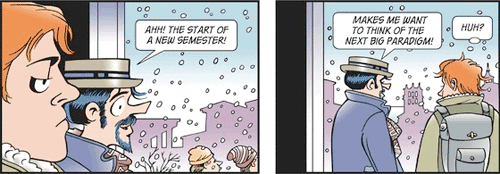
I wake up this morning to discover Doonesbury telling me stuff I already know.

newsem

Yep, classes start for me tomorrow at 8am. I have a lighter load than the grueling mess last semester, and I also get to teach my fave class, developmental biology. No new paradigms this time, though — I think it worked fairly well the way I did it last time, with a mix of once weekly lectures and lots of class time dedicated to discussion and analysis. I’ll also be compelling my students to set up blogs and write about science publicly, so I’ll occasionally be linking to a lot of student work.

One thing I’m considering doing differently…I might post summaries of lectures and discussion topics here, if time allows. Public exposure of all the stuff that usually goes on behind the doors of the classroom? I don’t know if the world is ready for that.


I’m including the syllabus for my developmental biology course. Just in case you think I’m totally slacking with just one class, I’m also teaching a course called Biological Communications, a writing course that tries to get students to read and write in the style of the scientific literature, and am also doing individual studies with 5 students.

MOOCs in perspective

I like the idea of MOOCs — massive open online courses — as ways to help spread the information at universities to a wider public. I don’t like the idea that these can replace real universities, though. It buys into the assumption that what universities deliver is big brains talking at a passive audience, when that’s only a small part of the experience. Scicurious is unimpressed, too.

Look, you want to learn? These online courses are a good supplement, and give you an opportunity to hear from experienced instructors. But if you really want to dig deep, there’s the disciplined grind as you try to master the minutia of a subject, there’s the hands-on lab experience, there’s give-and-take with peers and professors that you really need to bring it home. MOOCs just don’t do that.

An insider’s perspective on Dover

Via Ron Sullivan, who posted a link on the Great Blue Evil, an amusing story about a visit to Big Bend National Park in which the ranger in residence turns out not to be from around there:

Bob Hamilton 65, is a retired biology teacher and high school principal from Carlisle, Pa. He works six months a year in Big Bend and five more in Yellowstone.
I ask him where he was principal. He says York. I ask what school. He says Dover.
My eyes must’ve been wide as dinner plates. My insides roiled with barely contained glee.
My unexpressed response: No shit!
What I say: “The infamous Dover High School?”

That’s this Dover, the school district in Pennsylvania where creationists pressured the local Board of Education to introduce “Intelligent Design” into the high school biology curriculum in January 2005. Parents sued the Board, which subsequently got its collective ass handed to it in court. The judge’s 139-page opinion on the case called the change in curriculum “breathtakingly inane,” for instance.

Apparently, the inanity was taking people’s breaths for a few years before 2005:

Hamilton, who retired as principal of Dover High School in 2002, stood on the ground floor of Dover’s Intelligent Design era. He saw the storm brewing.
“Don’t quote me on this, but I knew that board was going to get us in trouble,” he said.
There was no doubt I was going to quote him on this. I think he realized this. I hope so, anyway.
“There are great kids in the community,” he says. “The kids in the community in no way reflect the ideas coming out of that school board. None of those people had any connection to the kids.”
According to Hamilton, then-school board president Donald “Daddy” Bonsell used to haunt his office and harangue him on behalf of the burgeoning wingnut conspiracy. Bonsell badgered Hamilton to do his part to get Intelligent Design into the Dover curriculum.
“He came in one day, and finally I told him, ‘OK, I’ll put Intelligent Design into the curriculum … if you start a petition and get all the local ministers in the community to sign it saying they’ll allow the teaching of evolution in Sunday school,’” Hamilton says.

I like the fact that this guy “retired” by continuing to teach kids about science on the National Park Service’s dime. Good for him.

Thank you, teachers

Victoria Soto, age 27, apparently died yesterday while trying to get her students into a safer spot in their classroom at Sandy Hook. She stood between the murderer and her students, and he killed her.

This is Soto right here.

[Updated to add: Andrew Revkin shares more on Soto’s colleagues Kaitlin Roig  and Maryrose Kristopik: “Kaitlin Roig locked her students in the bathroom and kept them safe, while Victoria Soto was trying to do the same when she came face-to-face with the gunman and was shot, execution style. Maryrose Kristopik barricaded her music students in a closet, while the gun man fought to get in.” Roig and Kristopik survived, thankfully.]

I spent a little time thinking about Soto and her colleagues this morning. I’ve known quite a few grade school teachers over the years. Until 2009, I was married to one. And I realized as I was thinking about Soto that there’s not a single one of those grade school teachers I’ve known, my ex- emphatically included, who I could imagine doing anything but jumping between the gunman and his or her students.

I know that’s an argument from incredulity. I know teachers are human beings, and human beings freeze up when they’re frightened. But I’ve also seen the sacrifices grade school teachers make on days the media don’t notice. Over and over, day in and day out, with no hope of any relief outside of leaving the job.

And for this they get to be one of the most denigrated groups of professionals in the United States, targeted every single goddamn year for one “reform” after another, vouchers from the fundies and charter schools from the liberals,  forced by law to take every spark of individuality and interest out of their curricula and then blamed when their students lose interest, resented their pensions and their health care by people who then blame them when their kids turn out to be apathetic.

Once the media horror dies down about Soto and her co-workers’ sacrifices, I guarantee you this: public school grade school teachers will go right back to being the despised class. “Union thugs.” “With three-month vacations.” “Teaching kids their ABCs.” All the idiotic, ill-informed, right wing anti-intellectual myths will rev up again as if nothing had happened. And in the meantime the people the Fox pundits despise will go on teaching kids to read and do math and treat each other with respect.

In other words, it’s not really that much of a jump to imagine all the teachers I know instinctively taking a bullet to protect their kids. To a first approximation, every single one of them does the same thing every waking moment, giving up their lives by increment to give their students a chance at a better life.

I don’t at all mean to trivialize the sacrifice Soto and her colleagues made by comparing it to, say, having to buy pencils on your own dime because the Republicans cut your district’s budget even further. What I’m saying is that given the kind of peson who chooses to remain in the profession despite all the sacrifice and opprobrium because they want to help kids, Soto’s tragic sacrifice isn’t in the least surprising. It’s what teachers do.

So I just thought I’d take a moment to thank those of you reading this who are, or who have been, grade school teachers for your routine heroism. We don’t recognize it enough.

[Read more…]

The Ebert Solution

I agree with Roger Ebert: he has a suggestion for how we can improve American education.

What I think we need are smaller classrooms, better pay for teachers, and an emphasis on fundamentals rather than frivolity. Although I am in favor of physical education, I believe most school sports foster a flawed culture. The news that Allen, Texas, has constructed a high school stadium costing $60 million filled me with incredulity. What does that have to do with education? I was much cheered by the new documentary “Brooklyn Castle,” about how a team from an inner city junior high school won the national high school chess championship, and didn’t need a stadium at all. They were coached by a couple of great teachers.

Defining “frivolity” is tricky: are geometry and basic writing skills serious, while teaching Shakespeare is frivolous? I think there should be an emphasis on acquiring essential skills like reading and arithmetic before graduation, but there’s also a place for enthusiastic teachers communicating the joys of a specialty. Of course, I think that would naturally emerge if we had adequately funded and staffed schools.

As for the $60 million high school football stadium: there are some school district administrators who ought to be fired for irresponsible behavior, and a lot of parents who voted for that monstrosity who ought to be ashamed. But they’re probably too ignorant because of their deficient, sports-soaked educations to be aware of it.

Minnesota mooks don’t like MOOCs

Every once in a while, some news comes down from on high that reveals that the people we’re trusting to lead don’t have a clue about what they’re doing. Now Minnesota’s Office of Higher Education has banned online courses, specifically the excellent suite of free online courses from Coursera.

We do have a law on the books that has the goal of shutting down diploma mills — you shouldn’t get to browse a website and be awarded a Ph.D. in quantum neuroscience. But Coursera doesn’t do that: they don’t issue degrees or even credits, they just provide massive open online courses for free. So you can learn stuff. For free. You don’t go there so you can pretend to learn and get a fancy diploma to hang on your wall, it’s just free information.

This ban is utterly unenforceable and absolutely ludicrous. All you Minnesotans should take your laptop or iPad into the bedroom or bathroom or someplace private, turn off the lights, and browse Coursera — I recommend the biology section, obviously. Oh, look: Rosie Redfield has a course on practical genetics. That should be good. Sign up for something.

Now feel the thrill of being an outlaw. Go commit crimes: learn something.

Hey, maybe the Minnesota OHE is trying reverse psychology on us?

Crown Clade of Creation

I’ve been writing at Coyote Crossing/Creek Running North for nearly a decade, and in the decade’s worth of archives there are a handful of posts that really seem like they ought to live here. So every month or two I’ll dust one of them off, if it’s not too horribly outdated, and put it here for your delectation or dissection.

This one is a 2006 review of the abysmal “biology” “textbook” Biology: God’s Living Creation, published by the creationists at A Beka Books.

[Read more…]