
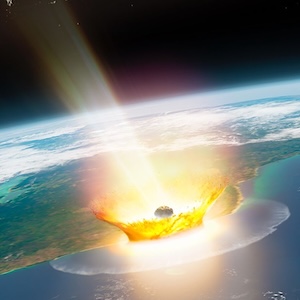
We all know that the dinosaurs were wiped out by a massive meteor strike, 65 million years ago. We know where it struck: off the Yucatan peninsula, forming the Chixculub crater. What I didn’t know was that the impact was so fierce that the site was burning hot for millions of years afterward.
The collision was intense enough to cause deformation far beneath the surface. Subterranean effects reached 35 km (almost 22 miles) down, and included the melting an immense amount of rock. Exposure to seawater made that rock porous. As hot water seeped into the pores, a hydrothermal system formed. The hot water gushing into an isolated region of the freezing depths could have attracted microorganisms and possibly other life forms that were otherwise struggling to survive.
…
Traces of argon found inside a rock are indicative of potassium decay. Since the gas will also escape from molten rock, this provides a measure of when the rock solidified. How much time has passed since that rock melted can be determined from potassium-argon dating, which involves measuring the amount potassium-40 isotope present relative to the argon-40 it decays into. Levels of argon meant the hydrothermal system stayed heated from 66 million years ago, when the asteroid first hit, to 58 million years ago.With 8 million years of heat and nutrients, life had more than enough time to colonize the hydrothermal system in the Chixculub crater. Pickersgill also ran computer simulations of hydrothermal activity in that location. Results suggested that cooling to 90° C (194° F) took between 1.5 and 2.3 million years after the impact at depths of one kilometer. Cooling to below 50° C (122° F) took up to 5 million years, still enough heat for colonies of microbes to thrive. After 6 million years, significantly less hot water was flowing, and by 8 million years, the flow had ceased. These results matched the rock age found by isotope analysis.
The impact had consequences for millions of years — it killed the world and set a pot to simmer for long ages afterwards.

Okay, wow. I suppose it makes sense with how much raw energy would have been involved in the collision, but millions of years is also a long time for my monkey brain to contemplate.
From the aliens in The Simpsons:
Kang: “Be a shame to set fire to one of them!”
Kodos: “Things burn!”
The time scales associated with astronomical and geophysical sciences simply boggles my tiny human brain. I struggle with concepts such as the music I listened to as a teenager is now 50 to 60 years old which is older than the music my parents then listened to when they were teens. Now consider that the rocks we see in today’s Sierra Nevada began being formed 400 million years ago as magma that never broke the surface and cooled underground over 10’s of millions of years to become the granite-like rocks there today. That much time is inconceivable.
Video: Phil Plait reading an excerpt about that impact from Death from the Skies at DragonCon 2009 (9:46)
Dang! There goes my plan to cool Venus by a big sunshade in space. The round rocky things apparently conserve heat forever. I will have to create a dimensional gate to the Kuiper belt, and circulate a coolant through giant radiators.
Hmmm, after 140 MY of same-old same-old, we get just the right rock at just the right angle at just the right place to let a bunch of shrews take over… suspicious or what?
[before you jump on me, this is intended to be humour related to Goldilocks Principal]
So what does the ‘Nuh-Uh!’ from AiG et al look like?
Have the paleontologists found any fossils with signs of adaptation to a uniquely hot environment?
indianajones,
Like this: https://answersingenesis.org/geology/radiometric-dating/
Pierce R. Butler @ 8
There are plenty of bacteria and archaea adapted to hot environments, but so small organisms are only indirectly preserved by stromatolites, and by the isotope levels they leavw behind.
birgerjohansson @ # 10: … so small organisms are only indirectly preserved by stromatolites…
Microbes wouldn’t leave
anymuch heat adaptation in the fossil record, but with eight million years and an already-complex biota, I would sort of expect the macro-organisms might evolve something unique to the hot-crater environment: furlessness, perhaps. Of course, if most of that environment was under water, that would complicate finding such fossils, not to mention distinguishing them from regular hot-spring fauna/flora.They would certainly comprise the ultimate ring-species specimens, though.
Hydrothermal vents currently support entire ecosystems of specialized creatures that feed via chemosynthesis. Tube worms, yeti crabs, mussels, shrimp, etc…. I don’t know if most of these animals had evolved before this impact, but chemosynthesis is theorized to be the way the first life on earth operated.
Chixcalub isn’t quite as deep as mid-ocean rift zones, so it’s possible it supported a broader range of animals than are found in the abyssal / lightless depths of the oceans.
Stromatolites are collective microbial/algal organisms that require light to photosynthesize, and thus are found in coastline and near shore waters.
66 million
CJ Sprain, PR Renne, GP Wilson, WA Clemens, Calibration of chron C29r: New high-precision geochronologic and paleomagnetic constraints from the Hell Creek region, Montana, Geological Society of America Bulletin (2018), doi: https://doi.org/10.1130/B31890.1.