
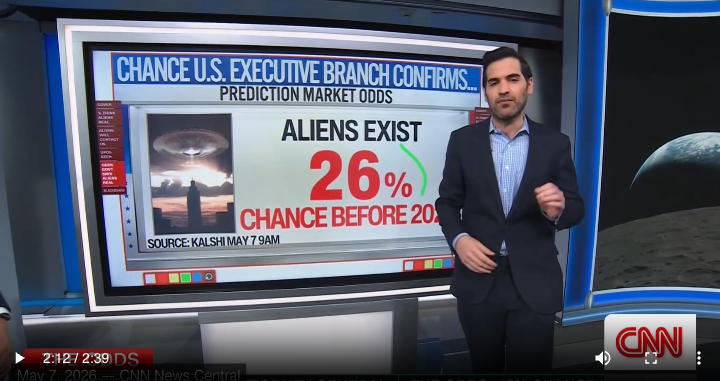
I really, really, really dislike Harry Enten, the annoyingly hyperkinetic weirdo on CNN who stands in front of an image board and waves at poll numbers and tells us how important they are. I despise all the poll nonsense on the news media — learn to talk about issues and policy rather than the horserace. Now it’s gotten even worse, because he’s not babbling about legitimate, credible polls, it’s all about numbers extracted from prediction markets, which are also paying the networks for promotion.
Since December, CNN has featured Kalshi in a segment called “The Odds” at least 115 times. In these segments, Harry Enten, CNN’s chief data analyst, frequently suggests that Kalshi predictions are more accurate than other sources. While polling relies on volunteers, Enten repeatedly reminds CNN viewers that prediction markets are driven by people who “put their money where their mouth is.”
On January 7, Enten highlighted that, in six days, the odds on Kalshi that the United States would buy part of Greenland by the end of Trump’s first term increased from 12% to 36%. Enten said this was proof that “the people putting their money where their mouth is” are “absolutely taking this seriously.”
“Whoa… way up there now to 36%,” Enten exclaimed. “A tripling in less than a week. My goodness gracious.”
Wishful thinking by gullible people is not evidence.
The good news is that some people are trying to take down these corrupt companies.
On Monday, Minnesota Gov. Tim Walz signed a total ban on futures trading platforms like Kalshi and Polymarket. The Trump administration filed a lawsuit Tuesday to prevent the ban from going into place on Aug. 1, with the CFTC arguing its authority supersedes the state’s ability to regulate futures trading. Notably, Trump’s son Donald Trump Jr. is a strategic advisor for Kalshi and has invested in Polymarket through his venture capital firm.
You can tell that Kalshi and Polymarket are not to be trusted just by looking at the scumbags who are investing in it. They’re parasites all the way through. It makes me suspicious of the Young Turks that they are also taking Polymarket money.
These are just barely legal gambling sites. Let’s make them illegal.
P.S. There is no evidence that we are imminently going to get evidence that aliens exist.

Kalshi and Polymarket have two kinds of users – those who are gullible, and those who have inside information.
So: does someone out there have inside information on the existence of aliens? I have seen the evidence released, and it is not convincing. Furthermore, the people pushing it’s aliens looked at the same evidence and found it convincing, in the process proving that they do not understand simple concepts such as parallax and bokeh. Which tells me: if there is additional evidence that has not been released, I have no reason to think the alien-pushers have interpreted it correctly.
Since these are prediction markets, they should be amenable to simple scoring for how accurate they are.
Which has been done already. Here is one example.
The two largest ones, get some right and some wrong.
Polymarket is 67%
Kalshi is 78%
What is lacking here is a control group.
How accurate at forecasting are 5 university professors or 5 crystal ball mediums or 5 whoevers that claim to be able to forecast the future by using knowledge, common sense, or super powers, compared to the betting market ones.
Dose Enten know that most gamblers lose? That’s why casinos* and betting sites make money.
*Unless it’s run by Trump.
The bet isn’t whether aliens exist. It’s whether the US declares that aliens exist. Which grifters can actually do at will.
Yes the sites should be banned but the currently leadership are making bank on them, and that’s all they care about.
TYT are NOT trustworthy!!!!!!!!!!!!!!!!!!!!!!!!!!!
There is still a 100% chance Trump wants to nuke a hurricane just to see what happens.
Of course aliens exist… whose deportation is being ramped up by the orange menace from day one. And I really don’t have confidence that the casino will not push for this definition even if it is convenient.
larpar @ # 3: … casinos* …make money. *Unless … run by Trump.
We don’t have all the numbers, & I don’t have the acumen to analyze them well – but from scattered reports of junk-bond financing, shady bookkeeping, money laundering, transfer of debt from other Trump™ operations, etc, I strongly suspect the one person you named came out ahead.
An adequate investigation would add up to a full-employment program for forensic accountants for over a decade (not even counting what we’ll need for you-know-who’s post-casino enterprises).
@6
He may be considering the political equivalent:
Trump looking ‘very strongly’ at Australia-style retirement system: ‘Taking that, making it sharper’
Does he really believe a a president with the ratings he has would be allowed to touch America’s retirement system? That would be like licking the third rail of politics.
Did someone say “Trump”?
.
So THIS is why people like Trump have not been eliminated by evolution:
“Some dark personality traits may help the body handle stress more easily, finds new study”
.https://sciencex.com/news/2026-07-dark-personality-traits-body-stress.html
That’s precisely the very same claim as
“Some dark personality traits may not help the body handle stress more easily, finds new study”
(Silly headline, no?)
Three (main) kinds of users actually – those who are gullible, those who have inside information, and those who are using these sites as a means of manipulating the perception of public opinion. The “odds” they produce, which news organisations are now treating as equivalent to (if not better than) opinion polling, can be trivially manipulated by anybody with deep enough pockets – indeed, that is the whole point. The mistake is to think that anybody “putting their money where their mouth is” is always going be primarily concerned with not losing, when in fact the very, very rich are perfectly happy to spend a lot of money to manipulate public opinion.It’s like an opinion poll in which you can literally just buy whatever outcome you want, if you’re rich enough!
There are also other issues, starting with how they decide what options you can bet on, all the way through to how they decide what “actually” happened: Prediction Laundering: The Illusion of Neutrality, Transparency, and Governance in Polymarket
Red Bull certainly leaves a bad taste in my mouth – not that I drink it – after what they ddi tomark Webber and Danny Ric in F1.
@ ^ Dóh! Wrong thread, sorry. Thought I was on the Taurine one..
Like most of the other insanity and quasi-religious bullshit that’s come from hyper-capitalist Republicans, this whole idea of “prediction markets” started with libertarians, and their religious reverence and almost literal deification of “The Market” as the perfect infallible rational mechanism to solve all our problems and answer all our questions (while making money and thus proving how perfectly rational they were). Who can you get answers from if you despise academics and intellectuals, and don’t ever want to admit that non-profit-seeking experts might be right about anything? You create a “market” and pretend you’re “crowdsourcing” the job of finding answers or solutions, and thus bringing EVERYONE’s wisdom (incentivized by the possibility of getting paid, which of course always ensures honesty and rationality) to bear, not just “Big Gummint” or “the elite(s)”. This is clearly the brainchild of people who don’t understand jaque merde about any form of human interaction except “markets,” and don’t have much of a clue about those either.
And I don’t think those libertarians ever imagined what an absolute clusterfuck and scam their fantasy would turn out to be. They really were (are) that stupid, bless their little hearts.
Nah. Straight-out gambling. Just obfuscated enough.
Not libertarianism; scamming the rubes.
John: First, “scamming the rubes” is a large part of what libertarianism is, and what it exists to facilitate. With many (or most) libertarians themselves being among the rubes who serve (knowingly or not) as tools to scam other rubes.
And second, yes, “prediction market” gambling is indeed a libertarian idea, and a logical outgrowth of libertarian “freakonomics” and “rational market” ideology.
You figure that because modern tech-libertarians are currently the loudest champions and financial backers of platforms like Polymarket, the entire concept must be ontologically dependent on their specific ideology. Inspired and originated by them.
I get it. But more correlation than causation. A bit backward.
Me, I reckon it’s just another form of betting. Internet-mediated gambling, weakly obfuscated.
The idea is hardly new, either:
cf. https://en.wikipedia.org/wiki/Parimutuel_betting
(Or, for USA context: https://www.aeaweb.org/articles?id=10.1257/0895330041371277)