
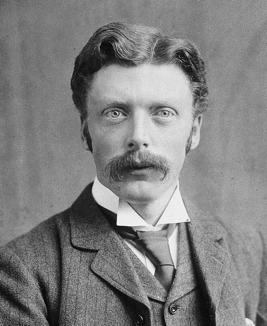
My favorite quote/concept of all time is this one:
Everything is the way it is because it got that way.
D’Arcy Wentworth Thompson
(allegedly)
It affects everything I look at, and it’s the perfect sentiment for a developmental biologist/evolutionary biologist. It’s what I do for a living: see something, ask how it got that way (because that is the most important question), and try to track down the causal events that led to this outcome. It’s also the fundamental flaw in creationism, because they look at things and don’t care about the how or the process or the mechanism, it’s always explained by “god did it” with no interest in how their god did it.
But the quote always bugged me, too, because it’s not in On Growth and Form, Thompson’s awesome summary of his perspective. It’s a perfect expression of Thompson’s vision, so I continue to use it and think it, but it sure would be nice to know where it came from.
Fortunately, Glenn Branch tracked it down over a decade ago.
As far as I can tell, the line is actually due to Kenneth E. Boulding (1910–1993), whose obituary in The New York Times described him as “a much-honored but unorthodox economist, philosopher[,] and poet … renowned less for a single contribution to economics than for a large number of interesting intellectual and moral insights that both charmed and challenged his fellow social scientists.” In his 1953 “Toward a General Theory of Growth,” Boulding referred to “the D’Arcy Thomson [sic] principle … that at any moment the form of any object, organism, or organization is a result of its laws of growth up to that moment” (emphasis in original), citing On Growth and Form. (Boulding was a prolific writer, so there may be earlier statements of the principle that I missed.) By 1968, if not earlier, Boulding was using the familiar vernacular formulation, although he always credited the insight, if not the words, to Thompson.
It’s not hugely important — I’m not into hero-worship, although Thompson comes close to being a hero — but it’s nice to tidy up the record.

I want a suit like that. But not today, it’s too hot.
Peter Hammill and Terre Roche agree:
“I want a suit like that.”
Interesting how “men’s formal fashions” changes every half-century, more or less.
I think that sans-culottes is still in style. Act accordingly.
I’m missing something, I think? Someone help me.
“Things are what they are because they are caused by other things.”
Um, yep. And the quoted bit seems to say the same thing using many more words.
I prefer a slightly different formulation:
Isn’t this just a rephrasing of empiricism? I love it, it really drives the point home.
It also reminds me of another aphorism: All of history almost didn’t happen.
The sentiment is about the ‘what’, not about the ‘how’.
It is also tautological; it cannot be that “Everything is the way it is because it didn’t get that way”.
—
Similarly tautological and vacuous; it merely rephrases “History is what happened”.
Might as well say ‘All people almost weren’t born’, makes as much sense.
Almost as vacuous as ‘it is what it is’.
Yes, but cricket mothers can seriously alter enbryonic development timing, so their offspring can really blame them for a lot of stuff.
“How cricket mothers control the developmental timing of their offspring”
.https://phys.org/news/2026-06-cricket-mothers-developmental-offspring.html
There is a parallel process at work with the aphorism, “I disapprove of what you say, but I will defend to the death your right to say it.” In both cases the source’s complex concepts were distilled into a pithy, memorable statement by a second party and the result was later widely attributed back to the first party source as an original quote.
The quotation is often attributed to the 18th century French writer and philosopher Voltaire (the pen name of François-Marie Arouet), and is consistent with his views, but that particular statement was apparently coined in 1906 by British historian Evelyn Beatrice Hall. Hall later clarified that she was not quoting (or translating) Voltaire directly, but expressing what she called the “Voltairean principle,” a summary statement of his views.
Perhaps “Everything is the way it is because it got that way” should be called the “Thompsonian principle” for clarity. No doubt there are many [Mark] Twainian and [Benjamin] Franklinean principles as well. It’s a thin line between principle and misquotation.
Finding out the truth about your “heroes” is always good. And if the truth you discovered is just that you’ve always attributed something to them that wasn’t theirs, but they never claimed it was theirs? That’s a pretty mild revelation, by today’s standards. You’ve discovered a new clever person to appreciate; that’s way better than a hero.
I don’t think it’s a tautological or vacuous statement. It’s a reminder that things were not always as they are now, and they got to where they are through a process, and understanding that process is important. If that sounds a little obvious well… if it was obvious enough to everyone, we wouldn’t have to argue with creationists and anti-evolutionists, who seem to believe the opposite.
The two are not mutually exclusive.
For example, a conjunction of premises and a valid argument yield a tautology between the conjunction of premises and the conclusion. That is, (((P_1 \land P_2 \land … \land P_n) \rightarrow C)) is a tautology.
[grr, stupid partial implementation of markdown]
((P_1 ∧ P_2 ∧ … ∧ P_n) → C) is a tautology.
Anyway, tautologies can certainly be useful, which I think is your intended point, devnll.
(Similar to equations; obs A=B is the mathy equivalent of a tautology, yet equations can also be useful)
Evidently false. Both have a what and a how; only one is actually scientific and sensible, but both have them. See?
Their concept is prelapsarianism (the original) for your “It’s a reminder that things were not always as they are now”, and there is still a process: .
Anyway, my basic point @7: The sentiment is about the ‘what’, not about the ‘how’.
In either case, in fact, in all cases.
Another example of a transformed quote is “It ain’t the things you don’t know, it’s the things you do know that ain’t so.” Traditionally attributed to Mark Twain, it seems instead to have developed from a line by Josh Billings, “I honestly beleave it iz better tew know nothing than two know what ain’t so. “
@7, 13, 14, and 15
Obnoxiously impulsive word chopping ignored. Yawn.
[meta]
Heh. I know. It’s semantics. Actual meaning. The sense of things.
(Boring, right? Much better to use slogans instead of thinking)
Obviously cringe sniping not ignored, Hemidactylus.
<smirk>