
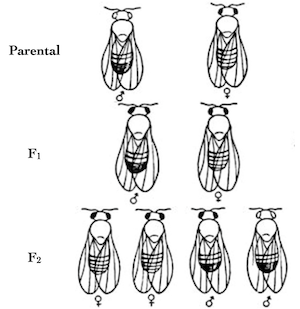
They have just completed the first half-semester experiment, a complementation test with two loci in flies, and we sat down in lab and did an analysis of the data. Perfect execution! We got the expected result (the genes complemented each other) and all of the students are now officially masters of basic fly breeding.
Then, just because the F1s from that cross were all heterozygotes at two loci, we went ahead and did another cross with them, your classic dihybrid cross, which should result in 4 phenotypes with a ratio of 9:3:3:1, according to that old guy Mendel. It did! It’s always thrilling to do these simple experiments that we all take for granted and see that, by god, Mendelian genetics actually does work under these specific conditions, and even a gang of undergraduates who’d never looked at Drosophila before can do it.
We’ve got another experiment in progress, a mapping cross that we started before spring break — we have to overlap experiments a little bit so we can get them all done in a single semester. I’m impressed with this bunch, though. They’ve got the potential to be fabulous geneticists. So hire them after they graduate!
(I don’t actually expect most of them to want to go on to careers in genetics, but they could. They have the potential.)

Congrats!
One of the fun things about doing actual labs is getting data and seeing that random chance has an effect… but it goes down with more data. Back when I taught, having students first analyze their own results for a lab, then look at the class results to see if increased measurements helped get something more in line with theory, was always a nice part of the labs.
This is why there are so many cannabis strains around these days.
It used to be said that Mendel massaged his results a little to make 9:3:3:1 even more perfect. But the ratio is the ratio and can’t be anything else, and the bigger the sample the closer the ideal ratio will be approached.
@3: My recollection of that episode (and I can’t be arsed to go rooting around the internet to confirm this just now) was that Mendel’s results were too perfect; there should have been more statistical slop, given random assortation of alleles. But then actual botanists pointed out that pollen grains from the same meiosis often stick together, thus the assortation isn’t quite as random. (Something like that).
You ought to print your students “Master of Basic Fly Breeding” certificates.
nomdeplume@3–
Yes, the expected outcome is often* the single most likely result, but it’s a bit trickier than that. The larger the sample size, the lower the probability of getting the exact predicted outcome (i.e. 500,000 heads in a million coin tosses is staggeringly unlikely), but the higher the probability of getting close (i.e. the chance of getting zero heads out of a million fair tosses is even more unlikely).
(*The “expected outcome” of a fair die roll is 3.5…which is impossible to achieve on a single roll and therefore should not be expected…)
I tried looking into Mendel’s trials to see if I agreed with the accusations of data-fudging, but his monograph was not, shall we say, written in a modern scientific style and the thought of burrowing through reams of his oddly structured results put me right off.
Proportions in fruit fly crosses often come out a bit off, because the marker phenotypes have fitness effects. If you take bigger and bigger samples, they won’t necessarily get closer and closer to the idealised proportions.
Way to go.
You be teachin’.
Mission accomplished.