Why do creationists shy away from gene duplication?

A new review article on Evolutionary causes and consequences of gene duplication has dropped. It’s nothing novel to well-informed biologists, but it’s another nail in the coffin of creationism. Not that they will care; we’ve been explaining that common genetic mechanisms can routinely increase the information content of the genome, and that we can witness how new genes with new functions arise, and it never sinks in.

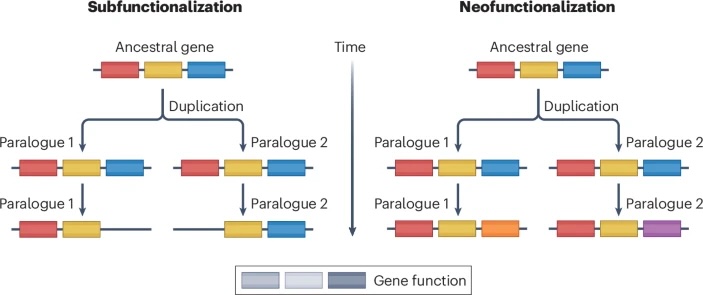
Gene duplication is the primary mechanism by which new genes emerge. Models and empirical studies have shown that paralogous genes are maintained because of dosage benefits, the partitioning of ancestral functions or the acquisition of new functions. However, the underlying molecular mechanisms and the relative importance of the factors driving evolution towards one fate or another have remained difficult to quantify. Recent advances in experimental and computational methods, such as gene editing, deep mutational scanning and ancestral sequence reconstruction, have enabled molecular analyses of duplicated gene evolution across timescales. Combined, these approaches are revealing how adaptive and non-adaptive evolutionary forces shape the modern fates of gene duplicates.

I imagine some might leap on the phrase “remained difficult to quantify,” but that’s the point of the paper: new techniques have been developed that allow us to quantify those details. The review specifically brings up multiple examples.

Divergence in interaction specificity following duplication has profound consequences on cell biology. For instance, the neofunctionalization of steroid receptors, a family of hormone-activated transcription factors with roles in development and stress responses, evolved following multiple rounds of WGD[whole genome duplication] in vertebrates. Although one paralogue maintained its ancestral interactions, the other acquired mutations, conferring on it the capacity to bind different hormones and DNA motifs. Studies of transcription factors in plants, yeast and other organisms have identified many paralogues that diverged in their specificity for transcription factor binding sites and distal regulatory elements. Such divergence in interaction specificity has enabled multiple species to acquire novel regulatory modules over time.

The conclusion discusses some of those mechanisms.

Evolutionary biologists have long been interested in the fate of duplicated genes. Long-standing questions include which factors promote the fixation or long-term retention of duplicates, and their divergence in terms of sequence, expression, interactions and function. Multiple emerging technologies have enabled directly testing how adaptive and non-adaptive forces drive the evolution of paralogues. For example, fitness functions derived by tuning expression level with synthetic biology tools have enabled testing whether increases in protein abundance due to duplications are beneficial or not. Deep mutational scanning and comparisons between extant and reconstructed pre-duplication ancestral sequences facilitate the identification of mutations that alter a particular function. In particular, comparisons between different paralogues have shown that the fixation of function-altering mutations is often contingent on the presence of other mutations that originally had no effect on fitness. Similarly, other paralogues can become dependent on each other if their heteromers become the only functional unit. Therefore, multiple sources of evidence highlight the role of non-adaptive processes in the evolution of duplicated genes.

Continuing to combine and develop new methodologies will help to address open questions about the fates of paralogues. Although the likelihood of functional divergence between paralogues increases with the age of the duplication, the time required to reach functional divergence might vary depending on the pair of paralogues. In fact, multiple underlying factors may contribute to variation in the rate of functional divergence, such as the type of function performed by the paralogues. In turn, progressive changes in functions such as catalysis and binding specificity are likely to modify the fitness functions of the paralogues, allowing natural selection to distinguish between them. Ultimately, assaying such subtle and progressive mutational effects on gene function will help to better trace the evolutionary history of paralogues and the forces that shaped them.

It’s a nice summary of the problems and potentials for studying evolutionary gene duplications. I’m adding it to my list of papers to study in greater depth.

Creationists will pretend it doesn’t exist.

Angel F. Cisneros, Soham Dibyachintan, Frédéric Bédard, Simon Aubé, Pascale Lemieux & Christian R. Landry (2026) Evolutionary causes and consequences of gene duplication. Nature Reviews Genetics https://doi.org/10.1038/s41576-026-00935-5.

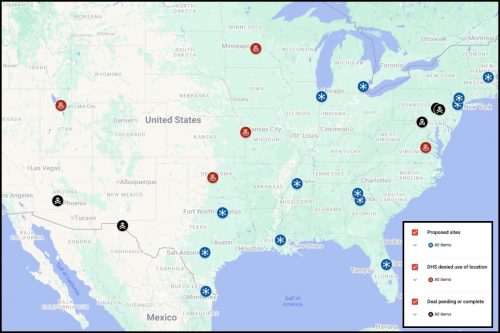
Is your community on this map?

ICE is spending hundreds of millions of dollars to buy up industrial warehouses all around the country. These are planned concentration camps.

Among the proposals for these camps is the construction of biohazard incinerators.

The one in Minnesota, in Shakopee, has been blocked so far by community activism. That one was a bit surprising: Shakopee is mainly known for Valleyfair, a seasonal amusement park, and the Minnesota Renaissance Fair. It would have kind of wrecked the family weekend if the kids had to deal with smoke from the crematorium drifting over the celebration.

We’re one short step away from building ICE death camps.

How bad can country-western music be?

I just heard another musical performance from the Toilet Paper USA alternative half-time show, this time by Lee Brice. It’s a perfect caricature of a country-western song.

I just want to catch my fish, drive my truck, drink my beer
And not wake up to all this stuff I don’t want to hear
Like the same kind of gun I hunt with, just killed another man
The only thing mine ever shot was deer from my deer stand
I just want to cut my grass, feed my dogs, and wear my boots
Not turn the TV on, sit and watch the evening news
Be told if I tell my own daughter that little boys ain’t little girls
I’d be up the creek in hot water in this “cancel your ass” world

It ain’t easy being country in this country nowadays
The direction, the finger’s pointing when everything goes up in flames
Saying I’m some right-wing devil ’cause I was down South, Jesus raised
It ain’t easy being country in this country nowadays

Pathetic whiner. This has got to be a joke — if I were asked to write a mocking satire of a country-western song, I’d churn out something that bad. He already gets to do all the things he listed, except that he doesn’t like to hear anything he might disagree with. This is a song about a world where everyone who has a different opinion than he does has to be silenced, while he whimpers about being persecuted.

I usually try to make excuses for despising the whole country-western genre — there are a few artists who break the boring goddamn conventions — but no, not any more. These people are anti-artistic leeches.

Darwin was not the final authority on anything

Sal Cordova is promoting this very silly book review on Reddit, which is the only reason I’ve seen it. The International Journal of Organic Evolution published a review of a book titled Rereading Darwin’s Origin of Species: The Hesitations of an Evolutionist, which is taking a deep historical perspective, comparing Darwin’s idea of evolution with the modern theory, and noting serious conflicts between the two. This is totally unsurprising. The reviewer, Alexander Czaja, adds an odd twist to it, though, title the review An approaching storm in evolutionary theory, threatening dire consequences if evolutionary biology continues to promote the cult of Darwin and his flawed theory.

For about 10 years, something important has been brewing in the world of evolution, a great storm that, unfortunately, has so far only made itself felt among a few biologists, historians, and philosophers of biology and evolution (Jablonka & Lamb, 2005, 2020; Laland et al., 2014; Müller, 2017; Pigliucci & Müller, 2010; Skinner, 2015). Reading the work of most practicing biologists, one hardly sees any sign of this gathering storm. On the contrary, in standard textbooks and popular literature, no winds of resistance have been felt, and the ship known as the Modern Theory of Evolution (MTE) sails safely and undisturbed from its usual academic course. It remains to be seen how strong the storm will ultimately be.

Dramatic, much? It’s hard to take the author seriously when he is pushing such an extremely distorted version of modern science. The Modern Theory of Evolution is unconcerned about Darwin’s theory of evolution because we don’t read the Origin anymore. It’s out of date, obsolete, and no longer relevant to the study of evolution. I was never assigned to read the Origin at any point in my academic career, and I’ve never assigned it to my students ever since. It’s a well-written text in an old Victorian style, but since we’re not studying changes in literary English over the last 150 years, it’s not really relevant to an education in biology.

The theory of evolution has evolved significantly since 1859, so it’s no surprise that looking back on the original idea we see discrepancies.

To get straight to the point: The book has no intention of capsizing the MTE ship or to unseating the modern theory but puts forth some provocative theses against the generally accepted view that Darwin was the first modern evolutionary thinker in history: the authors try to demonstrate that there is a wide gap between Darwin and evolutionists today. The most daring of their theses states that Darwin was not an evolutionist in the modern sense of the word. Indeed, the authors question the appropriation of Darwin by proponents of the MTE, who have always placed him and his Origin of Species at the conceptual center of their own model. The book provides compelling arguments that the MTE is based on a highly distorted and anachronistic picture of Darwin, both of his time and main work. Having set forth their case for a fresh look at the Origin, the authors delve deep and meticulously in Darwin’s main work, by uncovering its neglected ambiguities and contradictions. After years of collective Darwin euphoria, in which—as the authors self-critically note—they themselves actively participated, it is now time for a more critical approach. The authors call it “returning Darwin to the human dimension” (p. x) and they wonder “[w]hy has it taken so long for us to realize that Darwin’s commitment to evolutionism was incomplete?” (p. 6)

I fail to see how anyone can claim that “the MTE is based on a highly distorted and anachronistic picture of Darwin”, since it is not based on Darwin at all. Like any scientific theory, it changes to accommodate the evidence, and there has been an astonishing amount of evidence incorporated into the MTE. We don’t worship Darwin, we don’t regard the Origin as holy writ, and we know that Darwin had doubts and errors: witness his reaction to Fleeming Jenkin’s objection that evolution was incompatible with his model of blending inheritance, or the sad debacle that was his promotion of the idea of gemmular inheritance.

We’ve had bigger “storms” than anything modern science has come up with: Darwin missed out entirely on genetics, population genetics, molecular biology, and genomics, and now you want to tell us we’ve been slavishly following a 19th century version of evolution? Psssht, get out of here, ya looney.

Epstein left a slime trail everywhere he went

I got up this morning, checked the news, and saw this awful face staring out at me. Auggh.

Plumbing the Epstein files is like diving into a sewer. Another name that keeps coming up is Ken Starr, the evil prude who prosecuted Bill Clinton, and became good buddies with Epstein.

Starr, who died in 2022, was a close personal friend and professional contact of Epstein, and was the key lawyer who helped Epstein clinch a plea agreement in 2008, which is how Epstein avoided federal sex-trafficking charges and served a reduced sentence.

On 23 August 2018, Epstein appeared to ask Starr about a report that was to be released about Kavanaugh and the Starr investigation. Starr responded: “No writing for now. The release should be a non-event for Brett. I get criticized in one portion of the report, but no finding of illegality.”

Too bad we can’t dig him up and kick his corpse around. But Brett Kavanaugh is still around, unfortunately, and his name gets thrown around in the Epstein files quite a bit.

Jeffrey Epstein sympathized with Brett Kavanaugh during the then-supreme court nominee’s contentious 2018 confirmation and even suggested Republicans should have been harder on Christine Blasey Ford, who had accused Kavanaugh of sexual assault.

Epstein called the pending judiciary hearing “a trap!”, adding “Iye [sic] been through many of these. MANY!! She will cry, make sordid allegations. Say she feels bullied, fearful, traumatized. Every thing bad in her life was s result of the rape attempt. Suffered anxiety! Her relationships with men etc. this is a very special skill set needed.”

His suggestion was that even more intense defamation of the victim was necessary. He identified with Kavanaugh, and said that he had also been through MANY!! similar accusations (I wonder why a serial rapist and pedophile had such frequent experiences…). One has to wonder about the similarities, though.

Those of us who opposed his nomination to the Supreme Court are further vindicated, at least. Now, how can we get this mini-Epstein thrown off the court for good?

Maybe figure out the meaning of life over Spring Break?

My wife got me the perfect Valentine’s Day card.

I’m afraid I got her nothing. I had a severe flare-up of my back injury, and spent much of Valentine’s Day lying in an emergency room experiencing such intense agony that I was certain that I was going to die. Now it’s the day after, I didn’t die, but I’m now covered in patches and doped up on Valium. My response to my recovery was “Oh no, now I’ve got to prepare a week’s worth of lectures that include a whole lot of in-class problems, and I’ve got to make sure the lab crosses are on track,” so I’ve spent Sunday morning frantically updating lectures and sending notes to the students under the assumption that today was Monday and I needed to be ready for my 12:45 class.

I somehow moved from imminent fear of death to imminent fear of missing an hour of class is a serious long term concern over priorities to work over in my brain. I’ll put it on my list of things to get done this week. After I get through classes and labs.

An easy genetics quiz

I said I had to compose a simple quiz on Mendelian genetics today, and here it is. I’m drug-addled right now, so I couldn’t handle anything at all complicated, so you’ll probably laugh at how basic it is. My philosophy with these quizzes is that I just want to make sure they understand the fundamentals, and later (like next week) I give them something more challenging, and this quiz basically summarizes Mendel’s principles.

Being doped to the gills right now just guarantees that I won’t hit them with anything too tricky or difficult.

Briefly summarize Mendel’s first postulate, and explain under what conditions it fails.

Briefly summarize Mendel’s second postulate, and explain under what conditions it fails.

Briefly summarize Mendel’s third postulate, and explain under what conditions it fails.

Briefly summarize Mendel’s fourth postulate, and explain under what conditions it fails.

If you cross true-breeding vestigial winged, brick red eyed flies to true-breeding long winged scarlet eyed flies, what will the F1 progeny look like?
a. vestigial winged, scarlet eyed
b. long winged, scarlet eyed
c. vestigial winged, brick red eyed
d. long winged, brick red eyed
e. none of the above

What will the genotype of the progeny be?
a. vg+ st+
b. vg- st-
c. vg-vg- st-st-
d. vg+vg- st+st-
e. none of the above

If you cross the F1 progeny to each other, what proportion (0-1.0) of the F2s will have long wings?

If you cross the F1s to each other, what proportion (0-1.0) of the F2s will have scarlet eyes?

What proportion (0-1.0) of the F2s will have long wings AND scarlet eyes?

If you do a backcross, crossing a vestigial winged, scarlet eyed F2 to one of its F1 parents, what proportion (1-1.0) of the progeny will be long winged and brick red eyed?

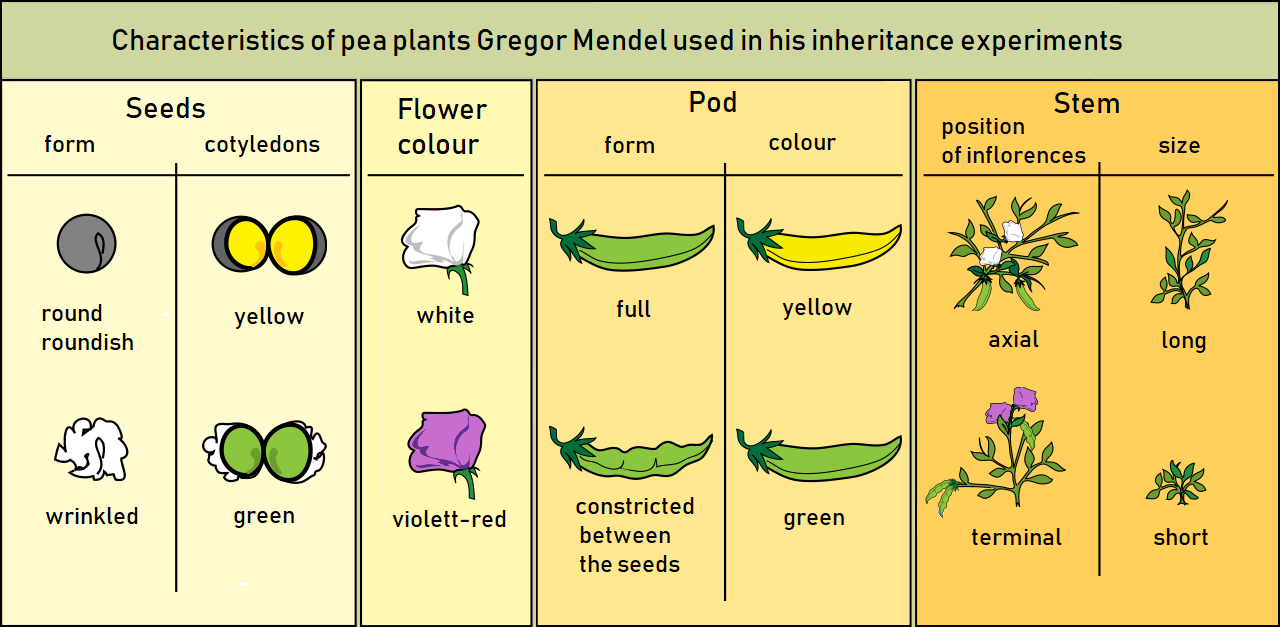
In pea plants, white flowers (w) are recessive to violet flowers (W), constricted pods (c) are recessive to full pods (C), dwarf (d) is recessive to tall (D), and yellow pods (y) are recessive to green pods (Y). In your garden, you have some true breeding pea plants that are tall, white flowered, with full green pods, and another set of true breedings plants that are dwarf and violet flowered, with constricted yellow pods. By some whim of fashion, your friends would like some dwarf white flowered plants with full yellow pods.

You do a cross of your available plants. What will the progeny look like?
a. Tall white flowered with full green pods
b. Dwarf violet flowered with constricted yellow pods
c. Tall violet flowered with full green pods
d. Dwarf white flowered with constricted yellow pods
e. none of the above

None of the F1s meet your friends’ criteria. If you cross the F1s to each other, though, what proportion of the progeny will be dwarf white flowered plants with full yellow pods?

You have 10 friends. How many F2 seeds will you have to collect and grow to adulthood to find a perfect plant for each one?

Then you have a clever idea. What if you backcrossed the F1s to your existing stock of dwarf and violet flowered, with constricted yellow pods? What would be the frequency of dwarf white flowered plants with full yellow pods be in that cross?

At the end of your gardening exercise, you conclude that
a. that was easy! I should volunteer to do more gardening for my friends!
b. maybe I need to get less picky friends

I ATEN’T DED

Just letting you all know. I feel like I ought to remind everyone that you carry your self in a bloody gelatinous goo cradled in a bone bowl that you hold about 5 feet above the ground while tottering about on two long sticks, and a fall is a traumatic catastrophe, that no sensible designer would allow to persist. We ought to have four legs, or better yet eight, and our brain ought to be held much closer to the ground. Stupid evolution.

Also, the drugs we take to permit better healing ought not to put you in a stupor that leaves you chronologically confused and incapable of calculating the force generated by a 5 foot fall under an acceleration of 9.8 m/sec2. Stupid medicine.

Stupid weather.

Anyway, I’m told it takes 3-5 days to recover from a stupid fall like this. I’m right on track, and insist that I will be recovered enough to inflict more genetics on my students by Monday. I’m supposed to be delivering an online quiz/exercise today, and I’ll have to see how that goes. Would you want to take a quiz composed by an addled brain?

I hate ICE and ice

This morning I started walking to work, and I stepped on some ice and went flying, to fall flat on my back, my neck, and my head. I remember that, and I recall curling into a fetal position, and then somehow magically I had gotten up and walked to the science building, climbed the stairs, and gotten in to my office. I have no memory of walking. But a half hour later I texted my wife, “I might need hospital” and blacked out again. Then she showed up in the office, and then somehow I’m in the emergency room. I kept blacking out.

Lots of tests followed. I was concussed but there was no brain bleed and no broken bones. I’m in serious pain, and my rib cage periodically clenches like a fist, but I’m coping with the aid of tramadol and some other muscle relaxant. I have a note from the doctor to excuse me from work for a few days, but come on, my job is not physically demanding, I think I can power through with the assistance of my wheelchair and a few drugs. Because I’m a stupid macho man.