
I said I had to compose a simple quiz on Mendelian genetics today, and here it is. I’m drug-addled right now, so I couldn’t handle anything at all complicated, so you’ll probably laugh at how basic it is. My philosophy with these quizzes is that I just want to make sure they understand the fundamentals, and later (like next week) I give them something more challenging, and this quiz basically summarizes Mendel’s principles.
Being doped to the gills right now just guarantees that I won’t hit them with anything too tricky or difficult.
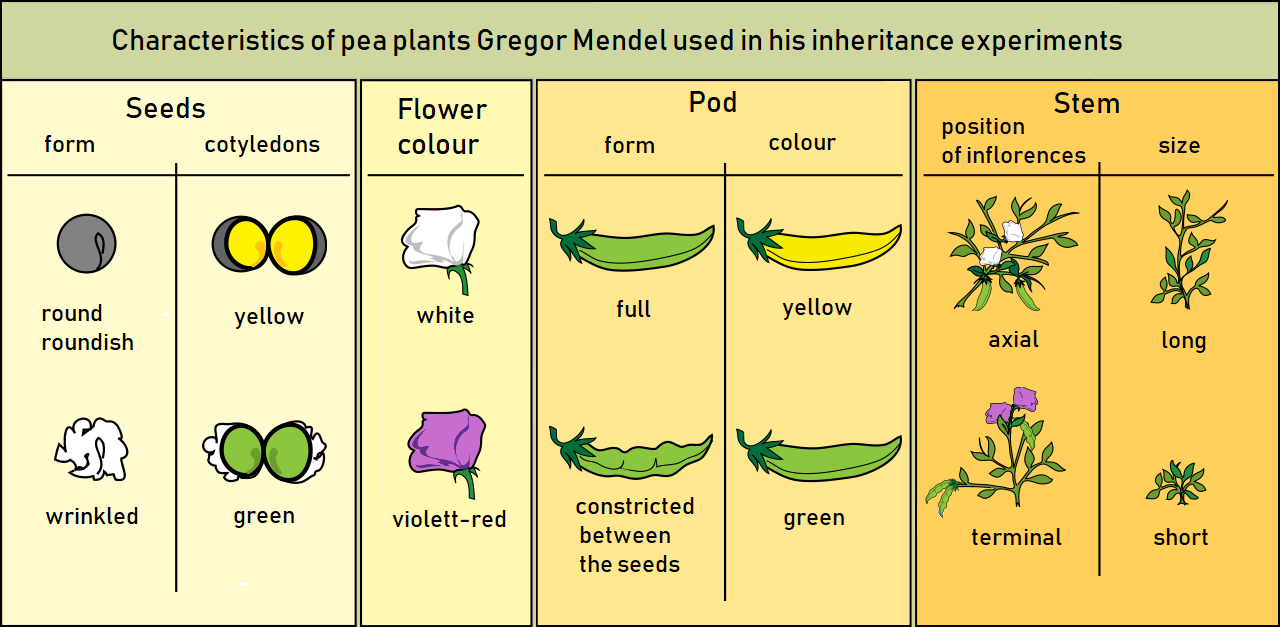
Briefly summarize Mendel’s first postulate, and explain under what conditions it fails.
Briefly summarize Mendel’s second postulate, and explain under what conditions it fails.
Briefly summarize Mendel’s third postulate, and explain under what conditions it fails.
Briefly summarize Mendel’s fourth postulate, and explain under what conditions it fails.
If you cross true-breeding vestigial winged, brick red eyed flies to true-breeding long winged scarlet eyed flies, what will the F1 progeny look like?
a. vestigial winged, scarlet eyed
b. long winged, scarlet eyed
c. vestigial winged, brick red eyed
d. long winged, brick red eyed
e. none of the above
What will the genotype of the progeny be?
a. vg+ st+
b. vg- st-
c. vg-vg- st-st-
d. vg+vg- st+st-
e. none of the above
If you cross the F1 progeny to each other, what proportion (0-1.0) of the F2s will have long wings?
If you cross the F1s to each other, what proportion (0-1.0) of the F2s will have scarlet eyes?
What proportion (0-1.0) of the F2s will have long wings AND scarlet eyes?
If you do a backcross, crossing a vestigial winged, scarlet eyed F2 to one of its F1 parents, what proportion (1-1.0) of the progeny will be long winged and brick red eyed?
In pea plants, white flowers (w) are recessive to violet flowers (W), constricted pods (c) are recessive to full pods (C), dwarf (d) is recessive to tall (D), and yellow pods (y) are recessive to green pods (Y). In your garden, you have some true breeding pea plants that are tall, white flowered, with full green pods, and another set of true breedings plants that are dwarf and violet flowered, with constricted yellow pods. By some whim of fashion, your friends would like some dwarf white flowered plants with full yellow pods.
You do a cross of your available plants. What will the progeny look like?
a. Tall white flowered with full green pods
b. Dwarf violet flowered with constricted yellow pods
c. Tall violet flowered with full green pods
d. Dwarf white flowered with constricted yellow pods
e. none of the above
None of the F1s meet your friends’ criteria. If you cross the F1s to each other, though, what proportion of the progeny will be dwarf white flowered plants with full yellow pods?
You have 10 friends. How many F2 seeds will you have to collect and grow to adulthood to find a perfect plant for each one?
Then you have a clever idea. What if you backcrossed the F1s to your existing stock of dwarf and violet flowered, with constricted yellow pods? What would be the frequency of dwarf white flowered plants with full yellow pods be in that cross?
At the end of your gardening exercise, you conclude that
a. that was easy! I should volunteer to do more gardening for my friends!
b. maybe I need to get less picky friends

A quiz would have ended after the first set of questions. This seems more like a test. : )
It’s a quiz. It’s done online, and the students are encouraged to work with each other to solve it.
c. Alderman make the best marrowfat peas.
Does Ray Comfort know the genetics of bananas…………?
I don’t think I was ever taught Mendel’s postulates as such, but when I looked them up, I recognized them all. The questions about the peas were all quite familiar to me, and easy. So, hurrah for Mr. Coder, my High School Biology teacher in 1975.
The fruit fly questions were a problem. I recall eyes being either red or white, not two shades of red, and the gene notation used is utterly unfamiliar to me. Is that something that came into use only in the late 20th century?
That the universe exists, and resembles to some degree our sense perceptions of it.
This fails if solipsism is true; if the universe is a simulation or dream or hallucination.
It also fails if the universe does not resemble in any substantial degree our sense perceptions of it. We have no idea what Plato was doing in that cave, but it was probably illegal.
“You have 10 friends.”
Now I know you’re drugged. I don’t have that many friends even in my dreams.
Good to see you spelled “colour” correctly, though, you drug-addled colonial!
tonykehoe #7
Maybe the “10” was in binary.
It is not simple enough for Republican politicians or fundamentalist Christians.
Something for PZ to watch during the holiday.
A Different Bias:
“Trump Forced to Abandon Blanket Tariffs on Steel Now”
Roses are red
Steel beams are hard
Trump is folding
Like a Valentine card
.https://youtube.com/watch?v=Mj-rL0nBv3Y
.
Predator: Badlands (2025) | Sisters Torn Apart — Ya Seeks Revenge
.https://youtube.com/shorts/mQ76teWJ6TM
For some reason DJT makes me think of Yautja victory rituals…
I ended up with green wrinkly flies.
Reminds me of http:\xkcd.com\2501\ only about biology.
I want to breed a six-foot fly with Jeff Goldblume’s head.
.
-Here is advice from a Black psychologist about how your students can protect their mental health in the face of government repression.
“ICE Killings Hit Too Close To Home: How Black Americans Cope” .https://share.google/TkSGkElfxadiHcrrQ
Even though I work in medicine and deal with genetics on a regular bass, I would need to go back to my undergraduate textbook to remember how to do those problems. But my genetics professor was great; thanks to her I know that arginine and guanine are purines thanks to her suggested mnemonic: “Aggies are pure; pure what I will let you decide.”
UT was a great school back in the 1980s; I hope it recovers from what Abbott and his cronies are doing to it. And A&M too.
I just tried to do this, not having done this for an age. For the (before) last question though, I think that wouldn’t work because violet (W) is the dominant allele, and after a single generation there are no ww’s present. Or am I just ignorant here?
But I didn’t know what the dominant alleles were in the fly exercise. Or was one to deduce that short and brick were both recessive for the exercise to yield an unambiguous answer for a single specimen? That would make it a less than trivial exercise!
Does anyone know what Mendel’s fourth rule is? The formulations also appear to vary from source to source.
I also realised that I don’t know the standard notation for these kinds of exercises at all.
I would very much like to try gardening, but unfortunately that appears to be a pipe dream in my miserable situation…
Also, is the question with the 10 friends meant to be a trick question? Because these are supposed to be probabilities, right?
In fact, we have the following
Theorem 1
The backcrossing produces in a fraction the right result if and only if the old reserve is recessive wherever the desired result is
Theorem 2
In this case, the backcrossing is advisable (if one is only interested in the phenotype of the resulting generation) if and only if
(1/4)^(# b_j rec.)(3/4)^(#b_j dom.) < (1/2)^(#b_j rec) (1/2)^(#b_j dom, a_j rec.)
where a_j are the phenotypes of the previously present population and b_j the phenotypes of the desired population.
This is proven from the independence rule and the resulting frequency formulas for the result alleles.
If this result happens to be unknown, I’m thinking about writing this down somehow.
I once asked a prominent biologist in Belgium if we know enough about genetics to GM more plants to develop the kind of root systems that have symbiosis with nitrate-fixating bacteria, but he said way too many factors were involved. Maybe one of your students will one day untangle this problem?
.
-Totally off-topic. I include it to give you a warm, fuzzy feeling after you have done the genetics quiz.
.https://youtube.com/watch?v=9MTEa45FjXY
Theorem 2 may be further simplified by using (1/4)^(#b_j rec) = (1/2^(2 #b_j rec), which yields a criterion with only three powers.
Is someone going to post the answers for those of us who, as biologists, make pretty good electronics techs??