Juan Cole makes an interesting point in light of Mamdani campaigning partly in Arabic.
Because so many Arabic speakers have immigrated to the United States since the end of the old Nazi-like immigration quotas in 1965, many Americans may think of Arabic as recent language in the United States. Nothing could be further from the truth.
Because he thought he was going to land in Muslim-ruled Asia, Columbus brought along interpreters on his voyage, including Luis de Torres, who knew some Arabic. De Torres was of Jewish heritage, but by then all Jews and Muslims in Spain during the reconquista had been forced to at least pretend to convert to Catholicism. It is likely that the first words a European said to a Native American chieftain in Cuba were “as-Salamu `alaykum,” Arabic for “peace be upon you.”
Wait a moment…but farther north, the first Old World greeting a Native American would have heard might have been in Old Norse. But they were white, so American audiences would be unsurprised.
Alternatively, the first greeting might have been an axe to the face, because Vikings might have exercised raiding extincts, rather than trying to be neighborly. (Columbus turned out to be rather nasty himself — first contact, no matter who it was, could be ugly.)
Of course, those Norwegian settlements proved to be temporary, and Scandinavians did a poor job of colonization until the 19th century, when my great-great-grandparents finally made it over the Atlantic. Muslim settlers had a better record.
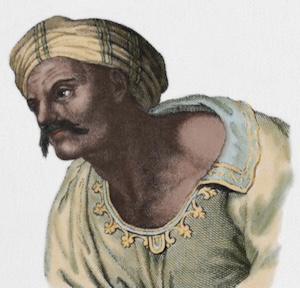
Hundreds of thousands of Arabic-speaking Muslims fled Spain rather than convert. While most went to North Africa, it is clear from the genetic record that many covertly went to the New World:
“Oteo-Garcia and his colleagues conclude . . . that the Arab and Berber heritage is much higher in Latin American than in contemporary Valencia, which shows that a lot of Moriscos must have exited to the New World (even though that was supposedly against the law at the time). They write, “One final point, highlighted by the survival of North African-related ancestry in substantial proportions until the seventeenth century, is the widespread presence of such ancestry in present-day South Americans ”
Karoline Cook points to the way Moriscos were perceived by Spaniards in the New World as having useful artisanal skills, such that they sought to bring them over. Some were brought as slaves and never sent back.”The territories of Texas, Arizona, New Mexico and California thus had Arabic-speakers, many of them crypto-Muslims, for generations — throughout the 1500s and 1600s. One Arab woman from a crypto-Muslim community in Spain who married a Spanish gentleman and was taken to Mexico City, Maria Ruiz, ended up being tried by the Inquisition in the late 1500s for having retained her Muslim beliefs.
Isn’t it curious how Americans avidly gobbled up the idea that Leif Erickson and his merry band were early European visitors to the Americas, but this is the first I’ve heard of Arabic-speaking brown people adapting and thriving in these continents in the sixteenth century?