
[It’s been a while since I’ve revived an old Pharyngula-safe post from my old blog, and it seemed like we have the appropriate theme going here today.]
Biologists have long assumed that evolutionary psychology, a controversial branch of psychology that ascribes many common social behaviors to genetics, is a muddled blend of half-understood evolutionary biology, selective data mining and resentment of women’s changing roles in society.
A new study, published in today’s issue of the German publication Unwirklichen Genetikjournal, does not challenge that assessment. But it does suggest that some men may be genetically predisposed to believe in evolutionary psychology, a finding that may well suggest future methods of treatment of the psychological malady.
Believers in evolutionary psychology maintain that feminism sets itself in opposition to millions of years of anthropoid evolution, and is thus futile and inhumane to men. Allegations made by believers include references to putative differences in math skills between men and women, a supposedly irresistible but entirely non-visually stimulated female attraction toward powerful and/or arrogant males, and the existence of a genetically preordained male right to multiple female sexual partners.
Many such men hold to these beliefs despite an absolute lack of supporting scientific evidence, says Dr. Ulrike Mann-Esser, chair of the sexual anthropology department at Universität Ulm and the study’s lead researcher. “But we had no way to determine why this was so until last year’s discovery of the locus taedius.”
The locus taedius, discovered accidentally last year by a graduate student working with David Gelernter, is a section of the human hindbrain that shows significant electrical activity when a person retrieves long-term memories that he or she does not find interesting.
In Mann-Esser’s study, 200 male subjects, who had small electrodes implanted in their locus taedius and glued to various places on the skin, were asked to stand outside the door of a glass cubicle and open the door for anyone trying to enter. Inside the cubicle was a male Pilates instructor posing as a researcher. A handful of highly attractive female graduate students were instructed to approach the cubicle, ignore the subjects while the door was opened, then proceed into the cubicle and place a hand on the chest of the “researcher.” Levels of locus taedius activity were recorded for each subject.
“By setting up a stimulus that often spurs EvPsych statements in the susceptible,” says Mann-Esser, “we hoped to be able to detect increased locus taedius activity among those men who had half-remembered bits of evolutionary biology come to mind from high school. The skin electrodes measured galvanic response and thus sexual arousal, which allowed us to determine which subjects were merely trying to recall female sexual anatomy from textbook figures so that we could exclude them from consideration.”
At first, approximately fifteen percent of male subjects showed significant locus taedius activity without sexual arousal. “We thought that seemed rather high,” says Mann-Esser, “until the Pilates instructor’s boyfriend showed up and two-thirds of that fifteen percent showed dramatic galvanic response changes.”
Further study by Mann-Esser’s team found a surprising commonality among the five percent of subjects showing clinical signs of susceptibility to evolutionary psychology, which the team refers to as “Desmond Morris Syndrome,” or DMS. Ninety percent of the DMS-positive subjects shared a single allele, first isolated by researchers at the University of Lucerne. The recessive allele, named luz-R, was absent from the remaining 95 percent of test subjects. (The corresponding dominant allele, luc-ID, has been tentatively linked to critical thought faculties and penis size.)
Mann-Esser admits that the existence of a “DMS gene” is confusing from an evolutionary standpoint. “Most genes persist because they contribute to reproductive success in one way or another. Sometimes this is in surprising ways, such as the gene for sickle-cell anemia, a crippling condition for those possessing two copies of the gene, but conferring resistance to malaria to heterozygous individuals with one normal gene. But the luz-R gene is strongly correlated with complete reproductive failure due to sexual selection against the gene by human females.
“It may be that early human populations carrying the recessive gene in their genome benefited from having certain individuals who were more likely to stand there and lecture the lion about how man is clearly the most fearsome predator on the savannah and then be eaten, thus allowing the rest to escape. It’s puzzling, though. We clearly need to study the issue further.”
One evolutionary psychology partisan maintains that evolutionary psychology itself holds the key to understanding the existence of the luz-R gene. “It’s ridiculously obvious, and has been proven time and again beyond the point where any rational person not swayed by politically correct feminism could dispute it,” says BigBoyBob87, a frequent commenter on a number of feminist blogs.
“You only need to look at sage grouse,” continues BigBoyBob87. “They reproduce by leks, in which a group of males converge in a spot to attract females and only the alpha males get to mate, while the others complain about the alpha males being big jerks. Anthropologists have proven that that very same evolutionary psychology observation is a major theme in Paleolithic art, as in for instance the Mousterian Pluvial cave painting Females of Breeding Age Always Mate With Damn Metro sapiens and Toss Us Nice Guys on Communal Trash Midden.” [See figure 1.]
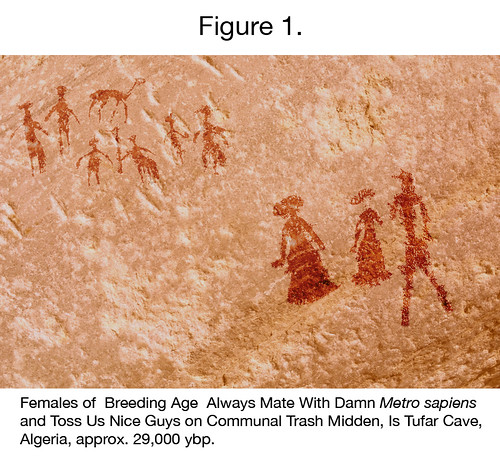
When asked how any of the preceding actually supported his contention that DMS conferred selective fitness on men with the luz-R allele, BigBoyBob87 suggested that this author was only parroting the feminist line in order to get laid.

Snortle. Mann Esser, indeed ;-)
I feel bad… I made it about 2/3 of the way through the piece before I realized…
LOL
I swear I first read that as locus tedious.
Okay, I think you’ve made your point.
Speaking as a psychologist (by education, not practice) with a keen interest in evolutionary psychology, the frustrating thing is that the good quality, careful, academic work in the field gets completely overshadowed by the idiot pop-psychology crap, not that certain academics aren’t equally at fault for never having quite their heads around Dennett’s notion of greedy reductionism.
As a field, I look at the current situation as being somewhat akin to the teething troubles that evolutionary biology had with Social Darwinism and nope that it turns out to be something evolutionary psychology will grow out of over time and the best work in the field does provide some useful insights into the genuinely interesting stuff like evolutionary foundations of cognitive biases.
The sex differences thing was done by Donald Symons at the end of 70s and his work has never really bettered, I just wish some people would leave it alone unless they’ve something genuinely interesting – and properly evidenced – to add to Symons’ work.
Please don’t hesitate to revive more. This is stupendous.
I’m so sleep-deprived it took me at least 5 minutes to get the “luz-R” bit; my groggified brain kept trying to resolve it to some variety of “lulz.”
Sorry PZ – I made it as far as “Unwirklichen Genetikjournal” i.e. “Journal of unreal genetics”………
This isn’t written by PZ.
Looks like sailor1031 didn’t make it to the end OR start at the beginning.
Would you mind linking to some? And not being snarky but could you ensure it’s not actually research from another field with an evopsyche commentary?
I don’t believe I have ever read an Onion-like research paper. Thanks for the snorting laughter.
(:
It’s not April yet.
“It may be that early human populations carrying the recessive gene in their genome benefited from having certain individuals who were more likely to stand there and lecture the lion about how man is clearly the most fearsome predator on the savannah and then be eaten, thus allowing the rest to escape. It’s puzzling, though. We clearly need to study the issue further.”
One the most annoying features of modern studies of the evolution of humanity has been the hunting hypothesis. The idea that the crucial feature of the evolution of humanity was the rise of “Man the Hunter”. Supposedly hunting led to all sorts things like greater intelligence etc, and it made early man a feared hunter and predator. It was closely allied to the “Killer Ape” idea of early man. What is fascinating is how little real evidence there is for “Man the Hunter” until fairly recently. Certainly there is evidence that early man sometimes ate meat but the idea that Australopithecines were like modern day Hunter-Gatherers is just silly. I further note that such ideas generally ignored 1/2 the human species the assumption was that Men evolved and Women did not.
In fact it appears for most of history man was preyed upon and the evidence for this, certainly in comparison for the sparse evidence for hunting until recently, is massive. In fact it appears that early man evolved under selective pressure to avoid being eaten. Contrary to Louis Leaky’s statement it does appear that our ancestors were indeed “cat food”.
Shoulders deep in studying for finals and I peek around today and find just bucketloads of awesome.
Chris, this was fantastic. Start to finish. I loved Luc-ID just as much or more as luz-R. My hat is off to you, sir, b/c I evolved to constantly pull large things off my hair lest a tree dwelling snake injure me.
This line used to really get to me when I started doing anti-oppression work, when said by men and/or male persons, women and/or female persons, and people who claimed to be feminist.
It’s a total non-sequitor and denies one their sexual orientation (I’m asexual, and many non-het males are probably not looking for a encounter with a female person or some women) and that many people in a person’s life are both underprivileged women and female persons and people that even a straight male or man wouldn’t sleep with but would want treated better by society.
I still get a bit peeved, but anyone who’d spout it sincerely, even a “feminist,” is a bigot and unlikely to care about doing anti-oppression work, so it bothers me less.
Seconding Ing’s request for a link at #10.
I propose a new rule for the eve-psych threads: if you want to make a comment along the lines of, “I hate how only the bad evo-psych gets talked about, making the entire discipline look silly”, then your complaint must include a link to an example of good evo-psych.
@Woo_Monster
and said article cannot in reality be Anthropology, psychology, sociology, genetics, or neuroscience research. I’m not openly saying there isn’t any or even I find that necessarily implausible, but I am having trouble imagining what an actual evopsyche research would look like, which may admitidly be to limited imagination on my part so yes link appreciated pleaseandthankyou
This was Awesome.
Don’t women also carry some component of the luzR gene ?
What about the well known connection between Alpha Males and the T/rull and mutations in the E-Px lulz allele ? and the closely related dud-broz portion of the parietal lobe ?
This was fantastic; what a wonderful thing to wake up to!
being a native German speaker, I caught on immediately; for one, that journal’s title is a grammatical clusterfuck; and two, it means “unreal genetics journal”
Yeah, the name gave it away right from the beginning if you speak German
Depending whether you mean the journal is unreal or whether the genetics are unreal it would be either:
das unwirkliche Genetikjournal
or
das Journal der unwirklichen Genetik
But nevertheless snortling funny
It’s not even a proper journal. It’s published in the leftover pages in the back of Unaussprechlichen Kulten Monthly.
Presumably by the German branch of Unpronouncibly Booking Printerers (We’s hatering grammery) …
Pet peeve: people who spruce up their work with foreign-language terms, which turn out to be ungrammatical, inappropriate, or otherwise painful to native speakers of said languages.
I am deeply, deeply sorry to have triggered your pet peeve so egregiously that you were forced to point it out in (what would seem to be) your very first comment here, and I would certainly understand if you avoided reading, or commenting on, anything else I’ve written — or ever will write — as a result.
Chris
Yes. Please endeavor to use correct terminology when you are making a joke.
Heh.
Don’t get me wrong: I don’t speak German, tried to use my own devices to get a proper translation when I wrote this back in the day, didn’t double-check with anyone who knew better, and am fully prepared to have smart folks like Jadehawk call the results a clusterfuck — I earned it.
But sneering once the correction’s been offered by someone else is just boring dickwaving.
I think Morgan was actually peeved more by Lovecraft than by you.
It’s stupid.
I mean, in Clarke’s usual hyperclever and funny way, but still. It’s funny the way that insulting caricatures are funny.
That’s the stupidest part.
But those who wish to issue sweeping indictments of entire (putatively) scientific fields of study are free to do so from a base of near-complete ignorance. Nice fucking rule.